




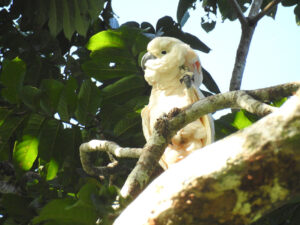
The salmon-crested cockatoo, commonly known as a Moluccan cockatoo (Cacatua moluccensis), is endemic to Seram, the largest and main island of the Maluku province in eastern Indonesia. If you have ever been around a Moluccan, you have seen their soulful dark eyes and glorious peachy crest feathers. They are also one of the loudest in the parrot world, sounding up to 135 decibels.
Moluccan cockatoos are endangered, and have been listed on Appendix I of CITIES since 1989, which means all international trade of wild caught birds is prohibited. They are also listed as endangered on the IUCN Red List. Their distribution previously covered some satellite islands of Seram, but they have since been declared extinct from the islands of Haruku, Saparua, and Nusa Laut. As with so many conservation challenges, their numbers have dwindled dramatically due to trapping and habitat loss.

Moluccans have the capacity for a long life span. In one 2012 study looking at lifespan data, the oldest known parrot was a 92-year-old salmon-crested cockatoo! However, we know how challenging it can be for them in captivity since they can be very loud and require substantial space, enrichment, and a nutritious diet. This amplifies our need to ensure this vibrant, intelligent, and majestic bird is able to survive and thrive in its native Indonesian habitat.
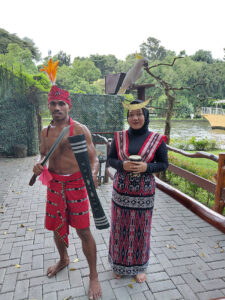
In Maluku on North Seram, the salmon-crested cockatoo (lakam is their local name) is a sacred and important species to the Huaulu tribe. Young men, between the ages of 12 and 17, are expected to carry out a ritual to prove their passage to adulthood. This involves hunting the Moluccan cockatoo for their prized salmon-colored feathers for a head-dress called a puheliam as part of a ritual ceremony called Cidaku.
The Cidaku ceremony is carried out in a very systematic way, following the birth order of the boys in a family. It cannot be performed twice in one year in one family. The pink crest feather is a vital part of the ceremony and cannot be replaced by anything else. It symbolizes the existence of a sacred life and a sense of great strength and courage like the cockatoo’s stance when its head crest is erect. The crest also symbolizes an adult male defending his holiness, self-respect, and alertness to threats.
Feather Collection Agreement

In 2019, Perkumpulan Konservasi Kakatua Indonesia (KKI), an Indonesian NGO, initiated an offer to use salmon-crested cockatoo molted feathers from its Rehabilitation Center. The Huaulu indigenous community and related stakeholders agreed. In October 2019 the agreement was signed by the Head of Huaulu village, and witnessed by several local officials, It was even acknowledged and approved by the Ministry of Forestry. This was a huge step forward towards preserving wild Moluccan cockatoos!

However, monitoring Cidaku traditional ceremonies to ensure they do not still utilize crest feathers from wild cockatoos is not an easy matter, even though an offical agreement was made seven years ago. Not all parties support the feather collection program. However, KKI continues to honor the agreement by providing crest feathers from its rehab facility. They also maintain intensive communication with the Huaulu tribe, including workshops with the community which have been well attended by tribe members.
The KKI NGO hopes to create additional conservation programs which involve active participation with the Huaulu community, to include forming a parrot patrol called the Parrot Squad. KKI is also working with the tribe to find alternative income options for the community, such as ecotours, so they will understand how important it is to preserve their native Moluccan cockatoo and improve their conservation status.
This month’s Lafeber donation goes to support KKI’s continued conservation efforts for the magnificent salmon-crested cockatoo.

Fascinating report. I did not know about this ritual. The KKI should be commended for helping save the lakam or Moluccan cockatoo. This was a great article.