



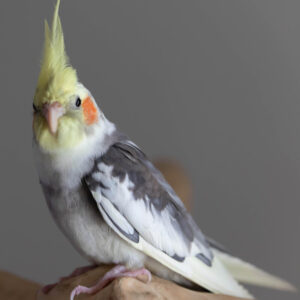
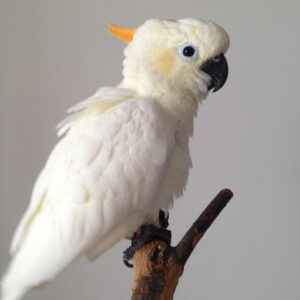
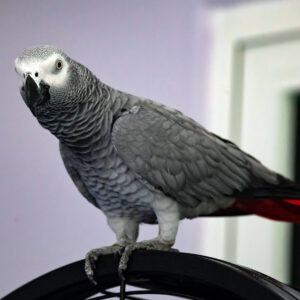
You might know what part of the world your parrot is native to, but do you know what world category your pet bird belongs to? Parrots can be categorized as Old World psittacines or New World psittacines. “Team New World” includes a familiar list of parrots that are also popular pet companions. If you share your life with a conure, Amazon parrot, or macaw, welcome to the New World! If you come home to an African grey, cockatoo, or cockatiel, you’re part of “Team Old World.”
Why Divide The World?
New World is a reference to the Western Hemisphere, namely the Americas, as well as some islands in the Atlantic and Pacific Oceans. The term “New World” is credited to Amerigo Vespucci, the 16th-century Florentine explorer, who just so happens to be the inspiration behind the name “America.” Vespucci explored the east coast of South America and discovered that South America was not part of Asia but extended much further than previously believed.
Back in those days, the world was thought of as being made up of three continents — Africa, Asia, and Europe. So this South American discovery was like discovering a new world —at least for Europeans!
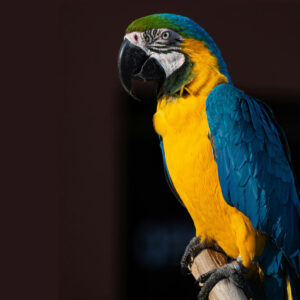
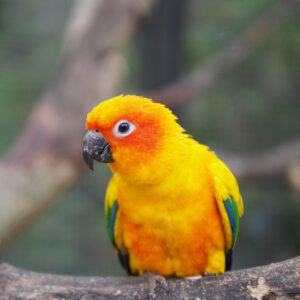
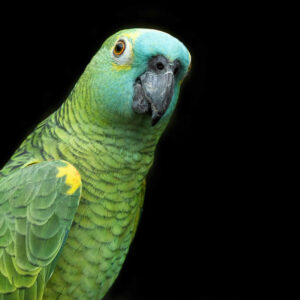
New World parrot species are native to the Western Hemisphere, specifically found across the continents of North, South, and Central America. New World parrots include Amazons, conures, caiques, parrotlets, Pionus, quaker parakeets, and macaws.
Old World parrots are native to the Eastern Hemisphere, specifically found across the continents of Africa, Asia, and Australasia. African grey parrots, lovebirds, and cockatiels are examples of Old World species. These regions encompass a diverse range of habitats, from tropical forests to savannas and grasslands, supporting a variety of parrot species. [Note, although Europe is considered part of the Old World designation, there are no parrots native to Europe, so this continent is left out of the parrot equation.]
In the simplest of terms:
New World Parrots = North + Central + South America
Old World Parrots = Africa + Asia + Australasia
A World Of Difference
New World parrots typically originate from rainforest-type habitats, which means damp and temperate weather is the norm for them. (My very unscientific take-away? If your Amazon, macaw, or conure has a hearty appetite, perhaps it’s because their wild cousins have a smorgasbord of lush rainforest foods to enjoy, and enjoy food they do!) Old World parrots, on the other hand, come from more arid habitats that are more susceptible to drought-like conditions. (My very unscientific take away: Perhaps this is why African greys and cockatoos are especially good at puzzles; their wild counterparts have to “unlock” available food sources. Of course, all parrots are natural foragers.)
A “Dustier Old World”
A notable difference between New World and Old World parrot species is that three of the more popular Old World parrots are also the dustiest. If you’ve ever shared space with an African grey, cockatoo, or cockatiel, you may be familiar with a layer of white dust left behind (which seems to be especially noticeable around any electronic device within feather shakeout fallout distance!). These three Old World species produce a ton of powder down!
Differences in Disease
Interestingly, disease might affect New World and Old World parrots differently. For example, in her article on proventricular dilatation disease (PDD), Susan Orosz, Ph.D., DVM, Dipl. ABVP (Avian), Dipl. ECZM (avian) notes that PDD affects New World and Old World parrot species in different ways. According to Orosz, the classical symptoms of PDD — depression, anorexia, loss of body condition, regurgitation, and passing undigested food in the feces are symptoms most commonly found in New World species, such as Amazons, macaws, conures, Pionus, and parrotlets.
However, with Old World species, such as African greys, cockatiels, cockatoos, and Ecelctus, a PDD-infected bird often has symptoms of ataxia, which appears as if the bird is having a seizure. Orosz suggests that a different part of the brain is affected in Old World birds with PDD as opposed to New World parrots affected with the disease.
On a similar note, Psittacine Beak & Feather Disease (PBFD) appears to be especially a concern in Old World species. The International Veterinary Information Service (IVIS) overview on circovirus, which causes PBFD, states, “The most frequently affected species are cockatoos, macaws, African grey parrots, ringneck parakeets, lories and lorikeets, eclectus parrots, pionus parrots, and lovebirds.” IVIS also notes, “The disease does not occur naturally in the wild in South America since New World species appear to have an inherent resistance to the circovirus [14]. The disease is more prevalent in Old World species; however, due to poor disease control in the shipments coming from South America and Australasia during the early pet-bird trade, the circovirus has spread rapidly across multiple species [14].”
Knowing where in the world your feathered friend is from —whether they’re New World or Old World — can offer another layer of insight to help you better understand their natural behaviors, preferences, and care needs.