



Researchers are busier than ever in trying to understand the way our feathered friends’ minds work. The reality that is often discovered is just how complicated birds are in their everyday lives. And how they behave toward many seemingly mundane tasks reveal the levels of intelligence and influence they possess. We are cautious in how we receive information and how we perform and/or appear amongst our peers. We follow trends in clothing, mannerisms, sayings, and every form of involvement that might define who we are to others. Nevertheless, we tend to watch how such trends play out before jumping in, even though we know that it will be “the popular thing” to do. A recent study reveals that birds living in cities often behave in much the same way.
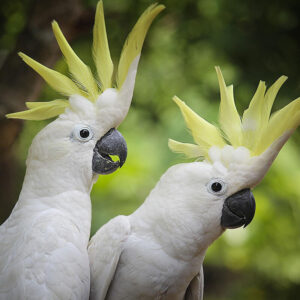
In a study published in PLOS Biology, a group of five researchers from several universities, including the University of Konstanz (Germany), The Australian National University, the University of California Davis, and The University of Sydney (Australia), set out to examine social learning in groups of wild parrots. Specifically, the researchers were interested in understanding how wild parrots develop interest in trying foods they had never eaten before.
Birds Watching Birds
What this study largely showed is that these birds watched other birds before accepting the new foods. In this study, coloration was used on almonds in the shell (blue/red), presenting varied options for the birds. After a short time, the cockatoos observing the selections by the four previously trained birds accepted those almond choices without much hesitation. In a roost further away, the birds didn’t accept the colored almonds until a bird from another roost arrived and immediately accepted the almonds. Within minutes, the other birds began to share in that same selection.
After the 20-day experiment, the previously mentioned 349 cockatoos from all five marked roosts were actively eating and enjoying the colored almonds. They learned to do so by watching and evaluating others. Interestingly, just like humans, it was the young birds that adapted to new behaviors more quickly than their older flock members. This set the tone for the younger birds, while the older birds chose to watch what their older pals would do before engaging in the same behavior. This pointed out that the younger group of birds indirectly influenced the older group of birds.
The reality of this study shows that it is ongoing societal behavioral changes of a group that can lead to a wider acceptance of like behavior by others. The closer the roost community was to another, the faster the subsequent roost communities adapted to change. Just like us.