




March 2 is National Read Across America Day (hey, why not read to your bird?!) and coincides with the birthday of children’s author and illustrator Theodor Seuss Geisel (aka Dr. Seuss), best known for his colorfully illustrated, rhyming children’s books like “Cat in the Hat” “The Grinch Who Stole Christmas” and “Green Eggs and Ham.” His books are filled with animal characters, including birds. For the most part, Dr. Seuss’s birds look familiar, but their feathers and shapes are best described as otherworldly. We’ve previously shared some real-life birds that look like they belong in a Dr. Seuss book, and here are some more fantastical Dr. Seuss-like birds to check out.
King Vulture
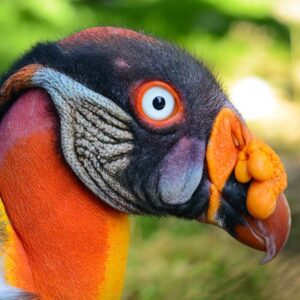
When describing birds that are breathtaking, a vulture probably doesn’t come to mind. But one look at the King Vulture (Sarcoramphus papa) and it’s hard not to take a deep breath and think “Wow!” This large bird from Central and South America has a mostly white body, but the skin on its head and neck is a kaleidoscope of colors, such as purple, orange yellow, blue and red. Some say it is so named because it shoos away other vultures when they’re found success in scavenging for a carcass. Perhaps other birds are so transfixed by the King Vulture’s appearance that they stand aside and let the King by to have first dibs.
Hawk-Headed Parrot
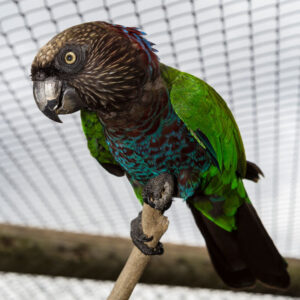
Dr. Seuss had a way of drawing a parrot-like bird but with a twist. The hawk-headed parrot (Deroptyus accipitrinus) certainly is a parrot with a visual twist.
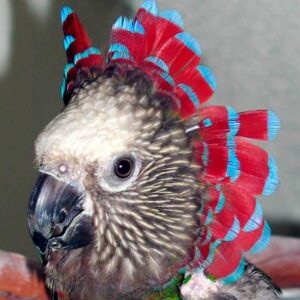
This parrot native to the Amazon Rainforest not only has a dizzying array of color — a dark brown face with white streaks, green wings, flanks and tail, and a red and blue barred breast — it has a colorful “headdress” of feathers that it raises, usually when excited.
With raised neck feathers, the hawk head’s look is transformed before your eyes. Hawk-headed parrots are kept as companion animals, although less commonly so than other companion parrot species.
The Andean Cock-Of-The-Rock
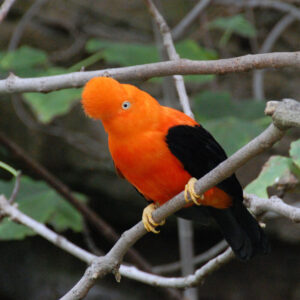
The Andean Cock-of-the-Rock (Rupicola peruvianus) has the honor of being the national bird of Peru. The male (pictured) has a large disk-like crest and bright orange plumage. The female, on the other hand, is noticeably different as she is darker and browner. The male’s courtship display is elaborate, as males are known to have confrontation displays with other males, where they face each other and bob, jump and flap while squawking and grunting and showing off their repertoire of sounds — all to impress females, a sort of bird dance-off if you will … in a Dr. Seuss world it would go something like, “The Rock goes hop, hop hop …”
Red-Crested Turaco
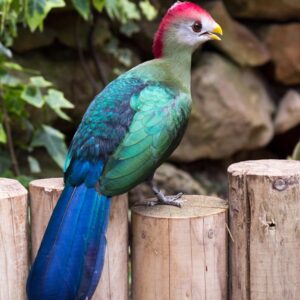
The red-crested turaco (Tauraco erythrolophus) looks like a Dr. Seuss-styled bird crossed with a dinosaur. It is the national bird of its native Angola, and its call is said to sound like that of a monkey’s.
In the wild, turacos feasts on fruit, flowers, figs, leaves, termites, and even snails. Turacos are also referred to as the “go-away” bird, as that is what its call sounds like.
_-_Weltvogelpark_Walsrode_2013-01.jpg)


