



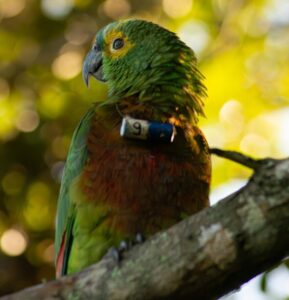
Two lovely Amazon parrot species, the vinaceous-breasted (Amazona vinacea) and the turquoise-fronted (Amazona aestiva) are native to the State of Minas Gerais in central Brazil. These highly prized parrots are usually poached as chicks, so they never learn essential survival skills like foraging, mating, nesting, or avoiding predation. For years, it was believed that a bird raised in captivity might not be able to learn these natural behaviors and once again become wild parrots. However, one special organization had some different thinking and a brave new idea!
Waita Research and Conservation Institute is a non-profit Brazilian organization created at the Belo Horizonte Wildlife Triage Center in 2010. Waita developed the “Projeto Voar (To Fly Project)” based on the hypothesis that,with very specialized rehabilitation training, necessary survival skills can be developed in wild birds subjected to captive living.
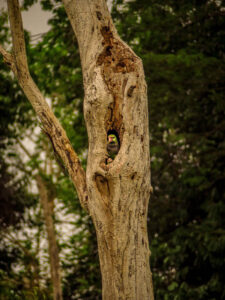
In 2012, in partnership with governmental agencies, Waita decided to rehabilitate, release, and monitor 31 turquoise-fronted Amazon parrots rescued from wildlife trafficking. After 13 months of monitoring these released parrots, over 50% were successful in returning to and surviving in the wild. The other birds disappeared (recaptured by poachers, were unmonitored, or potentially died), but this pilot project showed that, even after years in captivity, it is possible to develop a successful rehabilitation and release program.
Re-Release Training
It was not until 2021, when additional funding was secured from donors that Waita could begin to work with additional groups of parrots. These now included the vinaceous-breasted Amazon parrot. Since 2022, the To Fly Project has rehabilitated, released, and monitored five groups of parrots. This includes two groups of turquoise-fronted Amazons (53 birds) and three groups of vinaceous-breasted (50 birds) Amazon parrots.
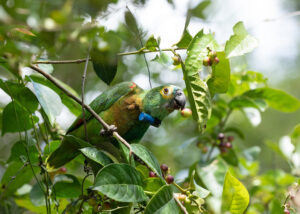
The parrots are divided into two groups. Both go through a similar protocol that includes selection screening, rehabilitation, release, and monitoring. The process is rigorous ensure the birds are fit and healthy, with the skills needed for survival back in the wild. Each bird candidate must successfully learn flight and food training. Then one of the groups goes through predation avoidance training, while the other group goes through human aversion training. These are used as control mechanisms to verify the efficiency of each training method upon release of the birds.
Once the birds are ready, there is a soft release, which means the aviary remains open. They are free to choose when to leave, and even return if they wish. Once released, the Amazons are monitored daily during the first month. After the second month, data is collected every seven days, but the team remains in the field to assist as needed. Each bird is retrofitted with transmitter collars prior to release to assist the monitoring team.
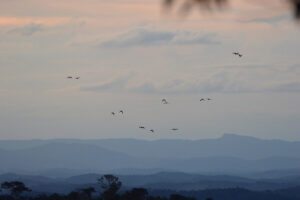
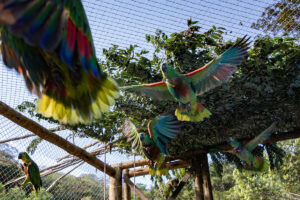
Most of the released birds showed good flying skills, even after years of captivity. If they had any difficulty, the monitoring team returned them to the rehabilitation stage. During the monitoring phase, the team noticed that there were both positive and agonistic social behaviors, sometimes with conspecific species, and at other times with other species like the scaly-headed Pionus or white-eyed conures.
Reproduction is a solid and important measure of successful reintroduction. Some of the birds had paired up during the earlier phases, and several pairs even laid eggs. However, no chicks hatched, but this indicates that it’s still possible for birds once held captive to raise offspring in the wild. What an exciting prospect, especially for two special Amazon species!
Predation remains a major challenge, for birds in general, but especially for those who have not been raised in the wild and learned these critical skills in their young lives. Over the course of the project so far, it is estimated that about 20% of the relocated birds have been predated. Anti-predation training continues to evolve, with the addition of dogs, cats, and humans as perceived predators. It is thought that some of the birds that disappeared during the project were possibly recaptured by humans.
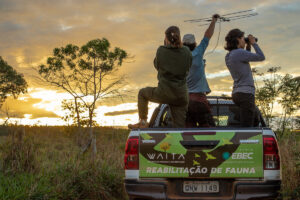
Valuable new partnerships with local authorities are being developed to educate communities about the need to preserve the birds in their wild habitats as well as return any parrots that may be found in homes. One locality, Dom Joaquim, even passed a law to establish October 22nd as Vinaceous-Breasted Amazon Parrot Day!
This month’s Lafeber donation goes to support Waita and its partners, The Brazilian Institute of Environment and Renewable Natural Resources (IBAMA) and the State Forestry Institute (IEF), in their incredible rehabilitation and reintroduction work in Brazil. To learn more about Waita projects or how you can donate, go to: https://waita.org/