




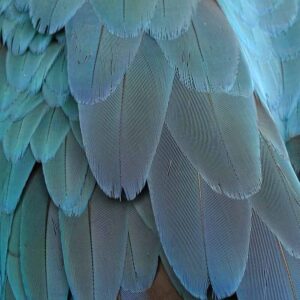
Nothing says “bird” more than their marvelous feathers! Here are some fascinating finds about feathers that might give you an extra dose of “Awe!” next time you see your bird preening their feathers, flying, or basking in natural sunlight.
A feather is anything but simple, which makes sense when you consider that feathers enable flight. Fur is a bit more straightforward; it is a uniform filament that grows from a follicle and is made of alpha-keratin, which is the same as our hair and nails. Feathers are made of super-strong beta-keratin, which makes feathers stiffer, an essential component for flying. Here are a few ways feathers showcase nature’s remarkable engineering.
Different Feathers For Different Jobs
Birds don’t just have one feather type; they have multiple types, and each serves a purpose. There are wing feathers, tail feathers, contour feathers, semiplume feathers, and down feathers. (“Flight feathers” refers to the wing feathers and tail feathers that give a bird both thrust and lift to enable flight.) Feathers, compared to hair, can do more specialized jobs. Check out this fun and immensely informative interactive webpage, “All About Feathers,” from TheCornellLab, which allows you to zoom in to see how each feather type is put together and the function it serves.
Some feathers even produce specialized sounds, such as the whistling sound of a mourning dove’s wings when it takes off, or the hum of a hummingbird. One study using 2,176 microphones and high-speed cameras proved that flapping wings, not vocal cords, produce the hummingbird’s hum!
The Feather’s Complex Engineering
Take a close look at one of your bird’s molted flight feathers, and you’ll notice the central shaft, rows of barbs, and tiny interlocking barbules that act like Velcro® to keep the feather smooth and aerodynamic. When you run your finger up against the feather’s natural direction, you’ll undo the barbs. Run your finger down the length of the feather, and the barbs zip together again. This intricate design helps feathers “keep it together” during flight. It also aids in waterproofing; run the feather under the faucet, and watch the water bead off like it does down an umbrella.
Built-In Feather Care
We use conditioner to keep our hair from becoming brittle; many parrot species use oil from their uropygial gland, also called the preen gland, to serve a similar function. They coat their beaks with this oil, and then preen with it to condition their feathers. (Check out this article about how bird use their uropygial gland for healthy feathers and waterproofing.) Parrots’ feathers also produce “powder down,” with some species (namely, Old World parrot species) producing more powder down than others. These “dustier” parrots include cockatoos, cockatiels, and African grey parrots. Powder down also helps keep feathers healthy. Birds without a uropygial gland, such as Amazon parrots and some macaw species (hyacinth, Spix, and Lear’s macaws) use the powder down from their feathers, paired with bathing and grooming/preening to keep their feathers healthy and water-resistant.
[*Please note that an earlier version of this article erroneously stated that cockatoos, cockatiels, and African grey parrots lack a uropygial gland. They all do have this preen gland.]
Feathers Shimmer
Most fur owes its color to pigments like melanin. It can be beautiful, but it doesn’t shimmer. Feathers, however, play with light in ways fur cannot. Some birds display iridescent blues and greens not from pigment but from microscopic structures that scatter light. That’s why hummingbirds and some parrots, like Pionus parrots, show metallic blue and bronze under natural sunlight. While your dog’s fur is lovely and fluffy, it won’t flash neon green in the sun. (As with most things, there are exceptions, though. Check out these iridescent mammals!)
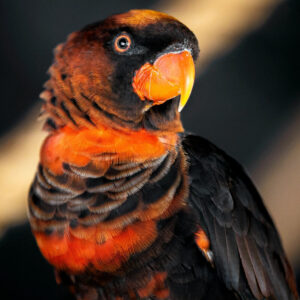
An interesting sidenote regarding parrot colors: according to this article, birds with bright yellow or red coloring, such as finches and cardinals, get their vivid reds and yellows from dietary carotenoids found in the egg yolk during development. But this isn’t the case with parrots that have yellow or red coloring. They produce their own pigments, called psittacofulvins. Studying dusky lories and rosy-faced lovebirds, scientists discovered that a single enzyme, ALDH3A2, converts red pigments to yellow, revealing how parrots fine-tune their dazzling colors.
So go ahead and tell your bird that you appreciate their feathers as the engineering masterpieces that they are! From the smallest down feather to the longest flight feather, they reveal unparalleled natural design.
II have saved feathers from my African Grey and my Blue Front Amazon for years. Does anyone put them to use?
Trudy Levesey
Excellent information! Thankyou!