



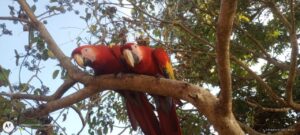
In 2018, a flash of brilliant scarlet, yellow, and blue cut through the sky above Esquipulas, a Guatemalan town near the Honduran border. It was a scarlet macaw (Ara macao) and likely a traveler from the famed reintroduction programs in Copán Ruinas, Honduras. For the family watching below, it was a moment of awe. But for the village it was a novelty, and the local residents quickly tried to capture the wild bird to keep it as a pet. Fortunately, the macaw escaped and never came back.
That single encounter sparked a realization: Conservation doesn’t care about human borders, but survival does. Today, a passionate, volunteer-led effort is underway in Guatemala to ensure that when these magnificent birds cross the border, they are met with protective communities rather than cages and slingshots.
The Copán Success Story—And the Border Risk
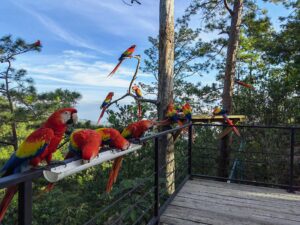
Just 15 minutes from the Guatemalan border lies Copán Ruinas, Honduras, home to Macaw Mountain and its partner NGO, PRO ALAS, an organization for the protection of birds. Together, they have run a massively successful reproduction, rehabilitation, and release program – reintroducing over 150 wild macaws to the skies.
But as the macaw population grows, more and more birds are crossing into Guatemala. However, on this side of the border they face immediate dangers. Stories are common of children throwing rocks at them or adults attempting to poach them for the illegal pet trade. To save the macaws, the success of Copán’s environmental education program needs to be replicated in Guatemala.
Apples, Coloring Books, and Local Pride
Driven by this urgency, a young Guatemalan biologist, Christian Chinchilla, has joined forces with the Parrot Conservation Corps of One Earth Conservation (OEC). Armed with specialized training from OEC’s course and a tiny spark of seed funding, a grassroots initiative has been born. Operating entirely on volunteer hours, Christian and his girlfriend have set out to change mindsets in the border village of Caparjá, Guatemala.
Before speaking to a single child, the team laid a foundation of deep community respect. Partnering with Plan Trifinio (the tri-national government development agency) and the Municipality of Camotán, they organized a critical field trip: they brought local village leaders and primary school teachers directly to Macaw Mountain so they could see the beauty and ecological importance of the macaws firsthand.
With the community’s blessing, they took the project directly to the classrooms:
- The Impact: 3 intensive environmental talks across 2 schools, directly reaching 143 children.
- The Tools: Interactive presentations answering What is a Macaw? and explaining why they are endangered.
- The Fun: Custom bird coloring books, interactive quizzes with prizes, and a healthy snack of fresh apples.
The response was electric. The children weren’t just learning abstract biology; they were learning about the very birds they had seen flying over their own roofs. They were being transformed from potential threats into future guardians of the macaws.
Reclaiming a Mayan Legacy
This conservation work is deeply tied to the cultural identity of the region. The border area is home to the indigenous Chorti Maya population, who have lived on both sides of this geographical line for generations. Just across the border at the Copán Ruins archaeological site—built by the ancestors of the Chorti—ancient stone glyphs, statues, and sculptures are covered in images of macaws. For centuries, these birds were revered symbols of the sun, sky, and spirit. By educating Chorti children in Guatemala about the macaws, this project isn’t just teaching science; it’s helping a community reconnect with a living, breathing piece of their own history.
Running on Fumes—But Hope is on the Horizon
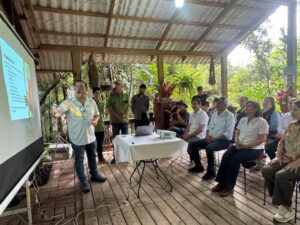
Despite the success of the initial school visits, the project hit a familiar, frustrating wall: the initial course funding ran out. Right now, the entire campaign is being kept alive purely by the sheer dedication of Christian and his girlfriend, volunteering their time to maintain community momentum. But their hard work has caught the attention of the highest levels of government.
Through the advocacy of Plan Trifinio, the Vice President of Guatemala, Dr. Karin Herrera, personally visited Macaw Mountain. Delighted by the project’s border-bridging vision, she promised government support, which the team hopes will materialize in the coming months.
How You Can Help Build the Safe Haven
While long-term government aid is on the horizon, the macaws are crossing the border today. Immediate bridge funding is urgently needed right now to restart the school visits and finish the primary education campaign across the rest of the border villages. Once the promised government funding lands, the team plans to pivot those larger institutional resources toward habitat protection, nesting monitoring, and community-led reforestation efforts alongside the villagers.
Let’s help to ensure that when a scarlet macaw crosses the sky from Honduras into Guatemala, it finds a safe haven, a welcoming community, and a generation of children ready to protect it.
Things are not perfect in Honduras either, but this month’s Lafeber donation goes to support further educational programs in Guatemala. The people there are aiming for similar conservation results achieved by the scarlet macaw project just over the border in Honduras. Thanks to One Earth Conservation for getting this project going and continuing their support.