




Social media has a major impact on the thought process. In the past, human socialization often happened in small settings. People would find groups of people who share like-mindedness, and they would inevitably learn new ways of thinking and speaking. With today’s reach of social media, the digitally connected expansion has created whole banks of thinking that merge and more effectively propagate a pathway with each other, in both good and bad ways. Why would we think that parrots are any different?
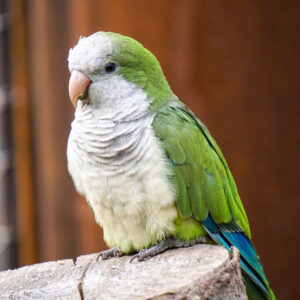
In a recently published research paper in The Royal Society Open Science journal, a team of researchers that included Simeon Q. Smeele, Lucy, M. Aplin, and Mary Brooke McElreath, all working with the Max Planck Institute of Animal Behavior (German), and Juan Carlos Senar with Museu Ciencies Naturals (Barcelona), spent two years observing the social networks of monk parakeets, also known as quaker parakeets. The hope was to determine how social networking influenced individual parrots.
Social Life Shapes Parrot Speech
Using methods of data collection, study, and intense analyses, this group paid close attention to 337 monk parakeets. They recorded the parrots’ community interactions, both socially and vocally. With 5,599 recorded vocalizations from 229 individual birds, the team discovered several amazing revelations. The team found that the larger the groupings, the more vocalizations the birds acquired compared to smaller groups. The more social the individual bird was, the greater its vocabulary of calls and screeches was. More interesting was the fact that the most social of the monk parakeets tend to be female.
This study does not say that larger groups of parakeets attracted the smarter birds, but rather the large groupings influenced a wider intake and use of newly learned “language.” With a larger vocabulary, the larger groups had more ways to communicate with one another. The more intimate the relationship, the more unique the calls are.
More than ever, we’re seeing that when we come together, no matter the setting, we develop new ways of expressing ourselves within our social circles. Similarly, the study shows that monk parakeets who became part of a close-knit group are strongly influenced by the group’s specific ways of communicating, much like how human social circles shape language and behavior.
Monk parakeets who joined a “clique” became deeply influenced by how that group communicated with each other. If a bird was more central to the group, it was certain that their vocal repertoire was larger than the others. Conversely, other studies have found that as certain species decline in numbers, the diversity of their songs and vocalizations also drops significantly.
The next step is to attempt to discover exactly what these birds’ vocalizations mean to the group and how they actively influence decision-making and outcomes. The depth of this study is far deeper and complex than the few words committed to this article. For further investigation of your own, visit this link for the published paper.
Check out Lafeber’s Quaker Parrot Species Profile Page and learn more about this fascinating parrot!
Dear Lafeber,
Thanks for your continued informative and interesting discussion about parrots.
Awesome to have your knowledge spread far and wide. I am sitting here baby sitting a 4 month old Sun Conure in UMdloti, KZN, Rep of SA. If you have some threads of advice, please share them. My 22 year old Sun Conure bred in Ft Meyers was killed by a GP Vet on the 22nd August 2024.
She ignored my warning on two occasion not to flush my birds nostrils as it terrified my beautiful companion of 22 years. I was completely devastated. What was that vet thinking of. I have a new baby as the devastation I felt after this cruel “waterboarding” and ignorance of this young female vet is unforgivable. I was privileged to be let into the private world of the Sun Conure who changed my life forever.
Kind regards and thanks again Lafeber.
Barry McQuade
South Africa