I begin this blog by reminding everyone that I am not a veterinarian and that parrots with various behavioral problem should absolutely be examined by a veterinarian to determine if any underlying biological/medical issues exist. I am writing about what we experienced with a bird that was briefly in my lab to suggest that some human diagnoses might shed light on behaviors in parrots that are a bit out of the ordinary.
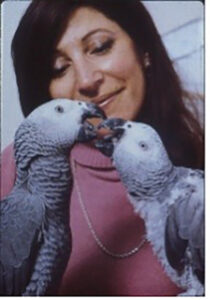
The story begins when I arrived at the University of Arizona. I would now have a laboratory big enough to add new African grey parrots to my lab to see if I could replicate the research I had been doing with Alex. Two birds, Kyaaro and Alo, were donated to our lab. The parrot I’ll be describing, Kyaaro, was only a few months old when he came to us from his breeder. He was fully fledged and weaned, and we were eager to start working with him.
Our plan was to train labels for some objects using our regular modeling technique (briefly, two trainers who, while the bird watched, asked one another to label a favored object, such that correct labeling initiated transfer of the object to the person who did the labeling) and contrast it with training labels for other objects using techniques in which elements of the modeling protocol were missing (e.g., no humans, just an audiotape of a modeling session, or just a videotape). The point was to see what aspects—if any—of our two-trainer system were necessary for label acquisition.
We did eventually obtain some data from Kyarro and the other juvenile parrot, Alo (the full two-trainer system was necessary for label acquisition; see Pepperberg, 1994), but working with Kyarro presented some unexpected problems. For example, if one of my research assistants dropped something and made a sudden noise, Alex, and Alo would startle, freeze for a moment, look around to see what was the source of possible danger, and then return to normal. Kyaaro would not only startle, but also jump off whatever perch he was on, shriek, and run for cover (his wings were trimmed to keep him from flying, but he could safely flutter to the ground). Our chasing after him probably did more harm than good.
Kyaaro would aggressively play with any toys we put in his cage, his behavior more like an attack rather than play. During a training session, he either focused super-intently or refused to focus at all; we never knew what we’d get on a given day. He was afraid of the spray bottle we used for showering our birds (even though he’d see Alex state “Want showah!” and happily proceed to get soaked), but he loved to bathe in a shallow tub. We really couldn’t figure Kyaaro out, and he was getting more and more difficult for my research assistants to handle on a daily basis (refusing to climb, etc.), until a colleague came to visit.
What Made Kyaaro Different?
She was an occupational therapist who specialized in working with children with autism and ADHD; we were going to adapt my modeling technique to see if it would help nonverbal autistic children acquire some level of communication (it did…see Pepperberg & Sherman, 2000). But she was also an owner of an African grey parrot, and when she saw Kyaaro, she remarked on how much he reminded her not of her own bird but rather of some of her very young ADHD patients. She ran several simple tests on him, similar to those she used with the children, assessing his activity and attention levels, and said that his results closely matched those of her clients with that diagnosis.
Children with ADHD were being given Ritalin (a stimulant that, conversely, seemed to calm them down), but no one at the time was trying anything like that with “difficult” parrots. Because parrots already have very fast metabolic rates and small body sizes, even a tiny amount of a drug like that can cause a life-threatening overdose. She suggested that we try giving him a very very little bit of the decaffeinated coffee-soy milk concoction that I drank daily—we knew that regular coffee would be extremely toxic, but that decaf had only tiny amounts of caffeine, and that maybe one small sip of a drink containing tiny amounts of a stimulant would work as Ritalin did for children. I did the calculations and figured that from the one sip, he would, per body weight, be getting less caffeine than I received from drinking an entire mug.
I can’t say that decaf worked miracles, but it helped a bit. Enough to keep him in the lab to finish the project on which we were working, but I realized that the situation was not sustainable for the long term. I was quite unsettled, giving him what was an unregulated treatment (and I really do NOT suggest that others try this with their birds!) He clearly wasn’t happy in our lab. For all my other birds, the research studies were and are a form of enrichment—they seem to look forward to their daily lessons and experimental trials. Not so for Kyaaro. We could see that in his particular case, being with two other male Greys who were a bit aggressive toward him and having to focus on daily sessions did not agree with his mental temperament.
We would never know if Kyaaro truly had ADHD, but he certainly acted that way. Thankfully, he had bonded with a dear friend of mine who already had two female Grey parrots. He had stayed with her for a bit at one point, and seemed very much to enjoy the absence of the male competition that he experienced with the other birds in my lab. She agreed to adopt him. Although I had grown quite fond of him, I was thrilled that he would have a wonderful, forever home. Importantly, he didn’t need any ‘meds’ once he became part of her flock and he lived for many happy years.
References
Pepperberg, I.M. (1994b). Vocal learning in African Grey parrots: effects of social interaction, reference and context.
Auk, 111:300313
Pepperberg, I.M., & Sherman, D. (2000). Proposed use of two-part interactive modeling as a means to increase
functional skills in children with a variety of disabilities. Teaching and Learning in Medicine 12(4):213-
220.