




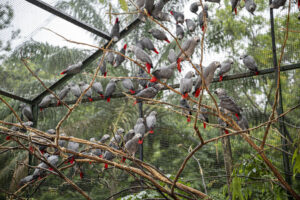
Image courtesy of Rob Ross.
Every year, hundreds of African grey parrots are rescued from the illegal wildlife trade. While getting them out of the hands of traffickers is a major win, the reality that follows is tough. Many birds arrive at rescue centers severely weakened by stress, malnutrition, injury, and disease. Sadly, some don’t make it, and without advanced medical tools, it is often impossible to know why.
To change this, the World Parrot Trust (WPT) is stepping in to build a lasting veterinary capacity on the ground where it is needed most.
Advancing Diagnostics for Seized Greys
WPT’s Mobile Veterinary Unit is partnering with Fabien Murhula Bakenga, an avian medicine Master’s student at the University of Ibadan in Nigeria. Alongside Dr. Steven Janssen and local rescue centers, Fabien is investigating recent deaths among seized parrots in Nigeria and the Democratic Republic of the Congo (DRC). Together, they are:
- Improving post-mortem procedures to accurately find the cause of death
- Upgrading sample collection so local and regional labs can successfully analyze diseases
- Evaluating practical diagnostic tools that rescue centers might be able to sustain long-term
Hands-On Training for Rescue Teams
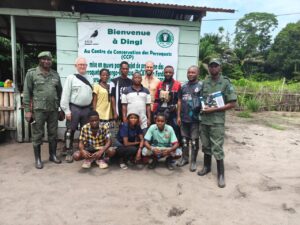
Science is only half the battle; everyday care matters just as much. WPT staff are on the ground providing hands-on mentoring to the local animal-care teams. The training focuses on:
- Biosecurity & disease recognition to stop outbreaks before they start
- Advanced animal care to give fragile, newly rescued birds the best immediate chance at survival
- Proper sample handling so the frontline staff feel confident investigating health threats independently
The Bigger Picture: Empowering Local Leaders
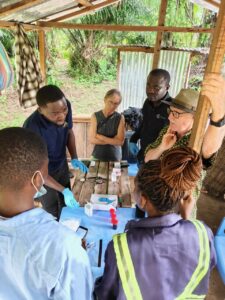
Image courtesy of Steven Janssen
This initiative isn’t a temporary patch but rather an investment in the future. By supporting scientists like Fabien, the project ensures that advanced knowledge in avian medicine stays within the region to guide future wildlife rehabilitation programs.
By better understanding the diseases targeting trafficked birds, rescue centers can lower mortality rates, respond faster to large-scale confiscations, and ensure more of these remarkable parrots get the second chance they deserve – returning to the wild forests where they belong. This important work is safeguarding the future of the African grey parrot, which continues to be under siege through poaching and illegal trafficking.
This month’s Lafeber donation goes to support the World Parrot Trust’s mission to empower and train local veterinary teams to care for those African Greys rescued from illegal poaching. The goal – to save their lives and maybe even see them return to their native habitats!
My husband bought various birds, one being an African Grey that has known no one except myself and my husband as his caretaker and provider. He’s lived in the same cage in the same house for 22 years. It is with an overwhelming sadness that due to our aging and health, we are needing to surrender him to a rescue. We hope that he will find a place at Phoenix Landing in N.C., but there is a waiting list. After spending years with this intelligent bird, who interacts continuously throughout the day with us, is engaging and entertaining much like that of a human being; this bird is like having a “little person” living with you, albeit still a bird, of course. The point is, that it became clear to me, that these beautiful creatures, domesticated tho’ still instinctually wild should not be confined to live out their long lives in a cage, in an environment that is meant to house human beings. There are animals, most being our domesticated dog companions and stock animals, that are well suited to live among people, but the plight of the birds that I have spent many years with, seems not intended for cages and confinement that their natural instincts or biological makeup gives them to freely fly across the heavens. But at this point in our world, captured birds, legal and illegitimate breeding and sales, illegal pouching and trafficking of the birds, now needs and requires the compassion and care of people who will heal their trauma and health concerns, and provide homes if release is not an option. I greatly appreciate the efforts of the people who are working to correct what has been done to the African Grey. They are very sensitive and intelligent parrots. I am not in a place to be a donor of any consequence, although I would if I could. So, all I have to give is my grateful praise to those who are invested in doing good work for our lovely creatures that bring life to the skies above us. Sincerely.