



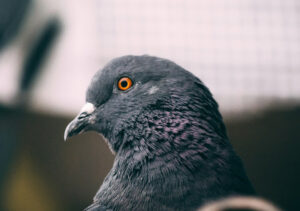
Have you ever noticed how birds shift their gaze as they scan their surroundings? They constantly assess their environment, watching for subtle movements that could signal potential threats. Birds also rely on optic flow, the visual information created by movement across the retina, to navigate their surroundings and guide many aspects of their behavior. Pigeons, for example, are well known for their ability to navigate from one location to another. Their visual system helps them process environmental cues and account for factors that may affect their journey. Because optic flow provides the brain with a tremendous amount of visual information, this complex process must be carefully managed so the brain can interpret what matters most in the moment.
The Science Behind Pigeons’ Remarkable Vision
Researchers at the University of British Columbia in Vancouver recently conducted a study examining pigeons’ eye movements during flight. The team, which included Anthony B. Lapsansky and Douglas L. Altshuler of UBC and Douglas R. Wylie of the University of Alberta, worked with 16 homing pigeons already familiar with a specific flight path. Each pigeon was fitted with a camera and hood setup equipped with a miniaturized computer that continuously recorded and tracked the bird’s eye movements.
The researchers found that pigeons use subtle, slow eye movements to scan their flight path, which allowed them to refine and improve their flight patterns. Because their eyes are positioned on the sides of their heads, pigeons have a more panoramic field of view than humans. When landing, pigeons shift their eyes inward, allowing both eyes to focus more precisely on the same area. This process, known as stereopsis, helps them perceive depth and judge distances.
For developing technologies such as drones, this study could help engineers design cameras that move in ways similar to pigeons’ eyes. Rather than remaining fixed in place, as many cameras do now, these cameras could adapt their movements to improve visual tracking in future drone designs. The ability to process more precise visual information could also help a drone’s onboard computer fine-tune its movements, improving maneuverability and reliability.
The entire study was complex and defining. The researchers were able to differentiate the eye movements of the pigeons during their flights and during their landing, both of which took in different flows of information. As we move forward with studies on how animals acquire information to evaluate their surroundings, so shall we be able to assimilate that new information into various useable technologies that can benefit humankind in many ways.
All birds have an amazing and natural set of skills that include the stabilizing of their head and their controlled eye movements for the acquired images for their brains. Our bodies and those of birds and animals are a rich conduit of an inflow of an array of informational exchanges that is difficult to realize. To learn more, check out this brief abstract on the original study on Cell.com.