




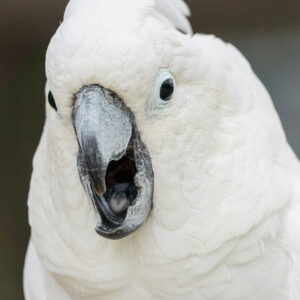
Throughout history, the art of dance has been expressed in its purest evolutionary form, driven by generational daring. One decade has a certain style, while another decade brings more abandon to the skill as presented by its youthful practitioners. Dance, of course, is not the unique enjoyment of younger age groups; it’s enjoyed by all ages. But, as we all know, humans aren’t the only species that can innovate a slick dance move, cockatoos have been known to do a few moves themselves.
In a recent peer-reviewed study published at PLOS (here), three researchers from Charles Sturt University (New South Wales, Australia), along with a researcher from Bristol University (North Somerset, UK), looked at cockatoos in captivity responding to music with dancing behavior and what may spur a cockatoo to dance as they do. The interest recognizes the reality that cockatoos in the wild can tap and bob in what are likely internalized beats. These are there for courtship purposes and are self-explanatory. The cockatoo is trying to “wow” his potential mate. However, in captivity, cockatoos often exhibit expressive dance moves without courting, and quite often in solitary situations.
These behaviors raise an intriguing question: why do cockatoos show such a strong interest in music? Known for their long lifespans and high intelligence, wild cockatoos typically form lifelong pair bonds. Captive birds, however, often lack a mate, leading researchers to ask whether dancing provides them with self-satisfaction or pleasure. A dancing cockatoo may also reflect a positive welfare state, engaging in playful behavior as a way to entertain themself. You know, the classic “Of you’re happy and you know it…” moment.
17 Fresh Cockatoo Dance Moves Discovered
The researchers analyzed over a hundred online videos of cockatoos responding to music. After applying specific criteria, 45 videos were deemed usable. Earlier studies had identified 14 standard dance moves (such as head bobbing and bouncing), but this review revealed 17 additional moves, with one bird alone inventing 17 “rare” combinations of existing dance moves. The study included five cockatoo species, supplemented by live observations of cockatoos at the Wagga Wagga Zoo in New South Wales, Australia.
The goal of the study is to determine whether music truly triggers dancing in cockatoos and, if so, whether it could be used to improve their well-being in captivity as a form of enrichment or therapy. If music is confirmed as the trigger, could it be developed into a standardized tool for positive enrichment?
Science still does not know why birds respond to music with dancing, especially if there are no potential mates around. The implications are complex, and further, more precise research is needed. But if music truly holds the power to spark dance, it could become more than entertainment, perhaps even a key to unlocking joy and well-being for birds in captivity.
I have known for some time that my pet Congo African Grey loves to listen to music. He and I do head bobs together. I often play his favorites as a form of distraction and/or entertainment. He will make obnoxious noises if he doesn’t like the selection. He prefers a strong beat but will woo-hoo some quieter selections at times if he likes them.
Both of my birds get very happy excited with music and dance. My Quaker (now deceased) used to dance and would sing certain songs. His words were not clear when singing. However, it was accurately vocalized. It was similar to a person humming their favorite song. My red lorded Amazon bobs and whistles when music is on. I agree that the psittacines enjoy music as much as we do. My Amazon was an adult when I adopted her. My Quaker was a baby. I used to leave “Sesame Street” on TV when I was at work. The theme to “Sesame Street” was one of my Quakers songs. He was accurate enough that visitors/guests would ask “is he singing “Sesame Street?”
Keep on playing their favorite tunes!
My Congo African Grey loves to dance to music he enjoys. He enjoys all types of music, but he will dance happily outside his cage to old Mexican music and 60/70’s Motown oldies. He will flap his wings wide, bob his head and moving side to side will say “Ooh” out loud. So fun. I like to dance with him!