
Introduction
The Lafeber Company Student Program hosted this distance-learning event for the University of California (UC) at Davis School of Veterinary Medicine Avian & Exotic Medicine Club in October 2024. Panelists first presented summaries on board certification through the American College of Zoological Medicine, American Board of Veterinary Practitioners, and the European College of Zoological Medicine before answering questions submitted by veterinary medical student attendees. View a recording of the live event or read the edited transcript.
Panelists
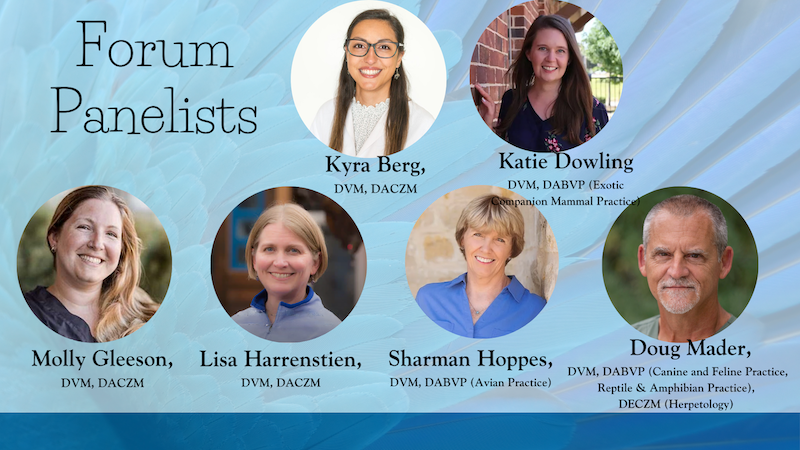
- Kyra Berg, DVM, DACZM
- Katie Dowling, DVM, DABVP (Exotic Companion Mammal Practice)
- Molly Gleeson, DVM, DACZM
- Lisa Harrenstien, DVM, DACZM
- Sharman Hoppes, DVM, DABVP (Avian Practice)
- Doug Mader, DVM, MSc, DABVP (Canine/Feline), DABVP (Reptile/Amphibian Practice), DECZM (Herpetology)
Recording
Transcript
Download a PDF of this 58-minute conversation or read the online version below.
Dr. Christal Pollock, LafeberVet (00:02:53):
…Welcome everyone to the Avian and Exotic Medicine Club’s Specialty Boards Panel Discussion. My name is Christal Pollock. I’m a veterinary consultant for Lafeber Company and I’ll be serving as the moderator for the discussion today.
Now, when our student representative, Sarah Eusebi, asked for a panel on zoological medicine board certification, I was initially pretty confused. Between your zoological medicine service, the companion exotic animal service, and more, UC Davis has an extensive list of specialists…However, Sarah clarified that she wanted to focus on specialists in private practice. And while some of your faculty members do have experience outside of academia, I understand that you do want to look beyond your admittedly amazing institution to additional perspectives outside of your “bubble”, if you will.
So, our objectives for the next hour or so…are as follows. First, we’ll have some brief remarks from our panelists, and Sarah described that a little bit.
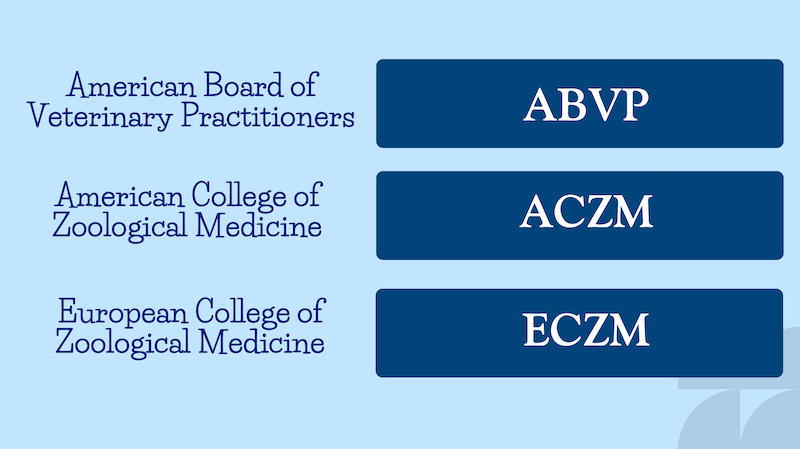
I do have these acronyms up because if we say the full name every time, we’ll be here twice as long. So, I do want you guys to become familiar with these three organizations that are all recognized by the American Veterinary Medical Association and we’re going to have our panelists talk about them. And then we’ll also briefly touch upon the relatively new and somewhat controversial American College of Exotic Pet Medicine.
We’ll then move on to the fantastic questions that your group submitted to Sarah…I have rearranged your questions into four categories.
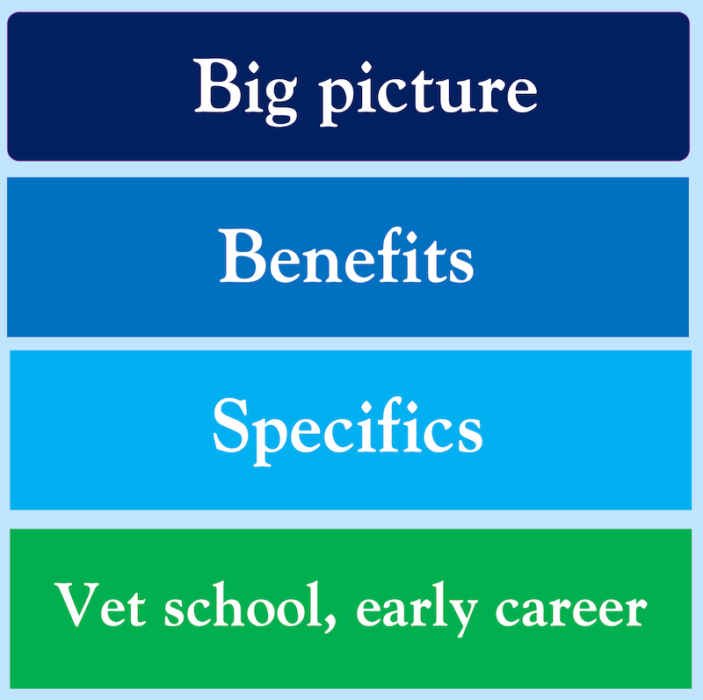
We’ll begin with some of the broad, big picture questions on board certification. Then we’ll have a few questions on the benefits or consequences of the choices you make with your career. We’ll have just a couple of questions about the specifics of board certification. Then we’ll spend more time on tips and information that you can use now or early in your career to guide your board certification choices, if that’s what you choose to do. If there’s time, we’ll open up for questions from the audience, but we have so many great questions already I don’t really think we’ll have time for that. And as Sarah mentioned, this event is being recorded. It’ll be posted to LafeberVet at a later date. That time is to be determined and I’ll let Sarah know.
Now, we have six amazing panelists that have agreed to have a conversation with you guys and I was going to go through each of their bios briefly, but that was posted on the screen beforehand and we have limited time, so I think we should go ahead and get started rather than going through their bios again because they’re all amazing and wonderful and we really appreciate them sharing their time and expertise today. We have a lot of information to cover. And so let’s go ahead and get started. The first group that we have would be the American College of Zoological Medicine. So take it away…

Kyra Berg, DVM, DACZM (00:06:03):
…So hi, my name is Dr. Berg. I’m going to be sharing with you guys just the very brief synopsis of how to become ACZM-certified, if that’s what you’re interested in…So myself, Dr. Gleeson and Dr. Harrenstien are part of the American College of Zoological Medicine or ACZM. I’ll try to be like a so that we can also clarify and distinguish ourselves from ECZM, which is Dr. Mader from European. So, Dr. Harrenstien has been a ACZM since 2005 and she was actually zoo and then transitioned more towards ZCA or Zoo Companion Animals. And then Molly and I, or Dr. Gleeson and I, have been ACZM ZCA, we’re around 3 years apart and all three of us actually did a UC Davis residency.
…So, what is zoological medicine? So it’s a discipline that integrates clinical sciences, preventative medicine, and ecology to advance the health, well-being, and conservation of free-living and managed wildlife and non-traditional companion species. And I think it’s important to acknowledge it is not restricted to the care of zoo animals or captive animals. So, that’s kind of the big thing that we like about zoological medicine is that it encompasses in our minds and in our practice as much as possible.
So, why become an ACZM diplomat? There are 316 dips in the world. It does allow for easy access to a network of very helpful and smart colleagues. So, it’s really nice to be able to have that network. Zoo med does rely on a really comparative approach to medicine and surgery. So, there’s an inherent thinking outside of the box that it allows. So even though I don’t currently practice on elephants and giraffes or tigers, there are still things that having learned all of that information, I feel like I’ve incorporated into practice. And also being one of the diplomats from either DACZM, DABVP, or DECZM, it allows the ethical use of the term “specialist” label and again for all zoological species while also giving us professional and career flexibility. So, if we wanted to do wildlife or lab animal medicine, general zoo, zoo companion, or change that career at some point, it’s really nice to have the DACZM specialty.
So how to become it: You do have to be a veterinarian, obviously. You have to have three letters of reference, one of which must be written by a dip or a diplomate. You do have to do either 3 years, so a residency route or 6 years experiential route of only zoo med work. And again, that could be aquatics, wildlife, lab animal, so it has to be non-traditional species. You do have to publish three articles in peer-reviewed journals as the primary author, and then you do have to have two mentors submit your board application and then study. So on the job experience is not enough and studying typically takes around 2 years and then the exam. So that was a very brief, quick 5-minute synopsis of 5 years of our life minimum.
Dr. Christal Pollock, LafeberVet (00:09:25):
Thank you. That was perfect. Thank you so much, Kyra. So let’s move on to ABVP, please, with Sherman and Katie…

Sharman Hoppes, DVM, DABVP (Avian Practice) (00:09:43):
So I’m Dr. Hoppes and I’m boarded through the ABVP… I’m probably a little bit unique in the fact that I’ve been in private [practice], seeing dogs and cats and exotics. I’ve worked at the university, where I’ve seen exotic pets and zoological animals. And now I’m the owner of and a clinician at a 100% exotic pet hospital in Texas…
As far as ABVP…the American Board of Veterinary Practitioners…is a board certification for practitioners. I mean it’s for people who want to be in clinical practice and most of them are going to be in a private practice setting. [ABVP] really helps you to focus on a specialty…whether it’s dogs and cats, horses and cows. We actually have two people that are boarded that work in emergency in the Dallas area that are boarded in dogs and cats. So there’s a lot of opportunity there just to kind of up your game on it. And it has a little bit, it’s a little bit easier than the zoological board certification, although it’s not at all easy.
There are two routes for ABVP: there’s a residency route and a practitioner’s route. The practitioner’s route is a little bit longer. You’re going to be basically need to have about four and a half years of practice before you can sit for the boards… The residency route is a little bit more abbreviated. You can actually do an internship, get into a 2-year residency, and within a year of finishing your residency, you could be boarded. I mean if you’re really a gunner in this. So, it’s a really fast track to getting board certified and it also allows you to really focus on a group of animals. For me, it was avian. I always loved birds and even though I didn’t really graduate from vet school thinking I was going to be avian certified, I got…directed that way.
And you can be in private practice without being boarded and you can see all these animals, but if you take that extra time to really do the study and to get certified, it really helps you personally and it also basically really speaks volumes to your clients. Clients right now are out there looking for board-certified people in private practice. They want someone boarded to see their birds, their rabbits, their reptiles. They’ll pay money for it. I mean, they are seeking specialty training in private practice. So, it’s really an excellent time to be considering board certification. And you do have to, for the residency component of it, you’re going to have to have either a year of private practice or a small animal rotating internship, or some type of private practice internship before you can enter a residency. And honestly, guys, for most ABVP residencies, you’re probably going to have to have two internships before you can get in because they’re that competitive. But it also gives you some time, most people do a dog and cat internship and then an exotic pet internship and then they go into the residency and then it gives them kind of the background to really excel in their residency. Katie, do you want to add some comments since you’ve just completed your residency?
Katie Dowling, DVM, DABVP (Exotic Companion Mammal Practice) (00:13:34):
I will second a lot of what Dr. Hoppes said. I was someone who initially thought I was going to go more of the DACZM route, but ended up finding myself more in the exotic animal private practice setting. And so that’s something that I really enjoyed and really then redirected my career path to focus more on private practice exotic species. So, I am happy to speak a little bit more about that when it comes time to answering some of your questions. But I think my general bit of advice is definitely all of these specialties offer a lot of really great opportunities for people to really advance their careers. And I think all of them have some great pros and cons, but I think the biggest thing is to also just keep your mind open because you never know where your career path is going to take you. And so don’t get too focused in on one specific thing. I think now’s the time in vet school to kind of take the opportunity to explore these different options now, so you can really figure out long term what’s best for you.
Dr. Christal Pollock, LafeberVet (00:14:42):
Thank you, Katie and Sharman. I guess we’ll move on to ECZM: the European College of Zoological Medicine.

Douglas Mader, DVM, DABVP (canine/feline practice), DABVP (reptile/amphibian practice), DECZM (00:14:48):
Good evening. It’s nice to be here with everybody. I’m talking to you from the East coast, so it’s already dark here. My name is Dr. Doug Mader. I’m double boarded in ABVP in canine/feline and reptile/amphibian. But I’m here tonight to talk about the European College of Zoological Medicine. Dr. Berg did a great job talking about the American College of Zoological Medicine. The ACZM and the ECZM both follow very similar philosophies and mission statements, so I don’t want to repeat that. One of the things that I was asked is: I am not European. I’m an American. I was actually born here in…the southern United States. I went to UC Davis and then moved back to Florida, and I’ve been here in private practice ever since.
So why am in ECZM? The main reason is I do a lot of teaching. I’ve always done a lot of teaching, a lot of writing. I teach and I write, and a lot of the work that I do is worldwide. I probably go to Europe three, four, five times every year to teach in some conference. I also have clients in Europe. I have consulting jobs that I do over there. So to me, being ECZM-certified was incredibly important to add that credibility to my name. So that when I went over there, they go, oh, he’s just a guy from America. Oh, he’s also qualified here in Europe as well. So to me that was extremely important and I take a lot of pride in it, and I think all of the diplomat and all of the specialties do the same thing. It really helps you enjoy what you do, plus it makes you a better veterinarian.
To get ECZM-certified, the path is very similar to the American college. You have to have meet some very rigid training parameters. Now, one thing, unlike America, there is no alternative pathway. I mean, there is no option other than a residency. So it’s not like you can be working in zoo animals for 10, 15 years full time, then decide, well, I’m going to be ECZM diplomate and take the test. They don’t allow that anymore. They used to, that stopped. So now, you have to meet qualifications of number of publications. You have to sit for the exam. You have to demonstrate that you do 60% of your time of a 40-hour work week in that particular subspecialty, because the ECZM does have subspecialties. They have five of them: avian, small mammal, zoo health medicine—zoo health management—reptile, and wildlife. And so you have to demonstrate that you’ve got 60% of your time of your working week in that subspecialty.
Also, with the ECZM, every 5 years you have to recredential showing that you’re staying active. And that could be done by either teaching, publishing, or you can resit for the exam every 5 years. And I like that–it’s a lot of work—but it really keeps you on top of your game. And if you’re going to be called a specialist, I think it’s important that you do stay on top of your game.
So how do you do this and how do you actually get into a residency program? It’s not simple, but it shouldn’t be simple because you’re trying to be a specialist and to be a specialist, it requires extra effort. So they all require, all five disciplines require, that out of veterinary school you spend at least 1 year in a multidisciplinary internship in surgery, medicine, pathology, you name it. Or you can have 2 years in general practice. But as Katie said, really it’s a good idea to do more than…2 years in general practice, or maybe two…internships because you really realize how much you don’t know once you start trying to learn. And I still, I’m learning every day, and I’ve been doing this for four decades.
The second set, once you get accepted into one of the residencies is to do the actual residency. And there are three options that you have. The standard residency is a 3 year, full-time residency under approved residency site, and there aren’t a lot of them. So if you’re interested, you can go to the ECZM website and you can look up the different places where they actually have them. There are a couple in the United States that offer ECZM…approved residencies. The other option is you can have what’s called an alternate route, and that’s a minimum of 3 years, but it can take up to 6 years, and that’s where you spend time at different facilities. And then they just introduce this new thing called the flexible modular pathway, which can take up to 8 years. And again, that’s where you alternate your training through multiple, multiple sites. And every site you go to has to be supervised by a diplomat. Once you do this, you have to have publications. And the publications requirement vary depending on the subdiscipline that you have. And then once you’ve completed all that you can apply for and sit for the exam.
Dr. Christal Pollock, LafeberVet (00:19:58):
Thank you. So those are the three colleges related to zoological medicine that are recognized by the AVMA…
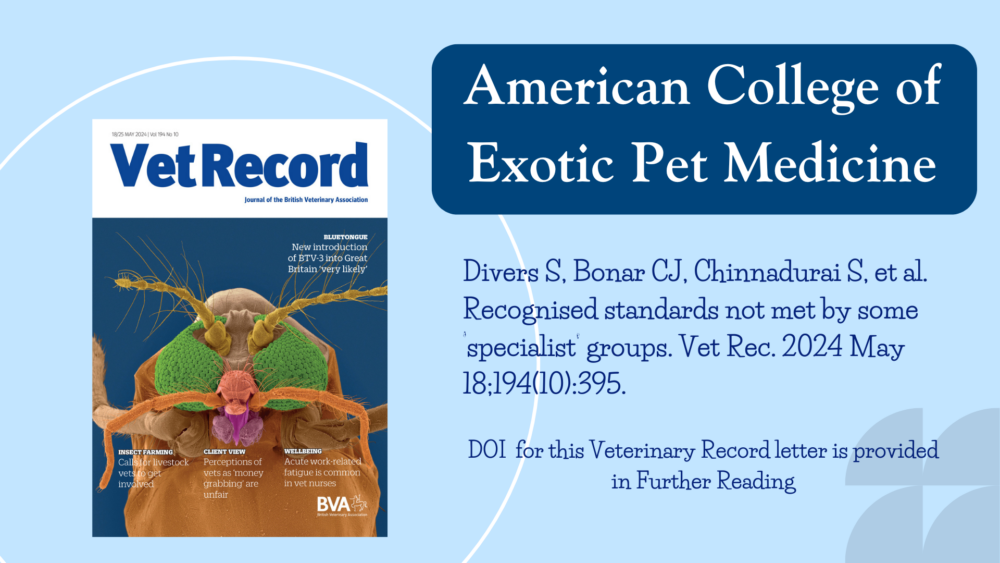
… I had shared a link to the Veterinary Record article that Dr. Berg and Dr. Herrnstein contributed to. And we don’t want to belabor this organization, but we just want you guys to be aware, sort of a “buyer beware” sort of thing, I think just so you’d know. And so if you don’t know about that article, I can resend that link to Sarah. But we’re going to move on to the questions at this point. I just want you to be aware of that organization as well.

Okay. So we had so many great [questions] and I’m going to start with some of the big picture ones. The first question I’m going to direct towards Lisa, and it’s actually two parts: So what are the key differences in the past to working with zoo animals compared to companion exotic animal species? Now I ask this because you’ve done both, but the [second] question asks: Do most veterinarians typically specialize in one area over the other?
Lisa Harrenstien, DVM, DACZM (00:26:26):
So within the ACZM, we currently call them disciplines because we don’t have other letters after the subspecialty thing. Like say for internal medicine, there’s a subspecialty of oncology or whatever. We don’t have that for ACZM. It is extremely likely that by as little as a year from now, we will, and we will have the option for somebody to have really focused on zoological companion animals, exotic pets, and have the additional letters “ZCA” after their DACZM name when they become board certified. But that’s not at the moment. By the time you students get there, it will solidly be there.
But when I went through training, well even today, I’m not sure what kinds of animals are my favorite. People ask me, I have no idea, and clinically, which kinds of animals do I enjoy the most? And it is a huge range. And so I really enjoyed the breadth of learning and everything that I had to do, to do what I picked was the discipline of general zoo. Like keep as broad as I can, don’t track, don’t limit my focus to the extent that I can in private practice doing ZCA (zoological companion animals) in private practice, there is always the possibility that someone will have a pet alligator. There’s always somebody, I mean, it’s not as likely here in Portland as it is in the middle of the Florida Keys where Doug Mader is, but they could have a pet or at least privately-owned, captive tiger—hard to say pet—but depends on their age. They could have a sloth, they could have, and it depends on the state what is considered and the culture, what’s considered typically captive-raised versus wildlife. I mean, if you’re in Malaysia, elephants have been in human care for thousands and thousands of years, so longer than we in this country have been taking care of cats, domestic cats. And is a chicken really that exotic? And is a rabbit really that exotic? I mean the lines get very blurry. So, in private practice, I would say having done both, I get to do more intense diagnostics and therapeutics on every individual animal. It does not matter what the species is. It could be an animal with a lifespan of 2 years and that owner is going to pay me rather than pay their rent. You know these people. You might be these people.
But in a zoo, the herd health kind of imperative, you have a budget, you have 3,000 animals you’re taking care of. What about that rabbit that has very malaligned teeth? Maybe that rabbit, it’s just too much for that rabbit and your department and your budget to go through over the years. So just humane euthanasia, adopt out to somebody else who wants to take it to the private practice person, who’s going to CT scan it every month of their life if you want them to. That’s the difference. The spectrum of ability to pursue care is much broader in private practice I’ve seen. And yeah, just like Dr. Hoppes said, these people are there and they want you to help them.
Dr. Christal Pollock, LafeberVet (00:30:17):
Thank you. One of the original questions that we received read: Is specialization necessary for effective practice? And based on some of the amazing clinicians that I think we probably all know without board certification, I’m not supposed to give answers, but I think the answer is no. And I want us to know if you guys would agree with that.
–All panelists give a thumbs up—

That leads me to before we move on, you do…So that leads me to a question I’m going to direct to Doug, and that is: How do you weigh the benefits and the pitfalls of board certification? And that’s very broad, but we’re starting broad and we’re going deeper.
Douglas Mader, DVM, DABVP, DECZM (00:30:55):
Well, I think it’s real important and a lot of it’s going to be individual because with me, I push myself to the limits. I expect everybody around me to push themselves too. But in order to do that, I have to push myself. So, I set really high standards for myself when I really am hard on myself if I don’t achieve those standards. So board certification was one of those goals that I wanted to make sure that I pursued. …I realized, if I did not pass the test, I was a much better veterinarian for having made the attempt, all the studying and all the discipline and being around all the mentors that I had, I learned so incredibly a huge amount.
So, as far as do you need the certification? No, I won’t give names out right now, but I can think of a half a dozen veterinarians around the country that teach at all the major conferences that are not board certified. And we look up to those people because they are experts. There’s a difference between an expert and somebody who’s board certified. And these experts, man, they know their stuff. They don’t have to be board certified to be an expert. They’ve read every journal article that we’ve read. They’ve gone to all their conferences. They’ve got 20, 30 years of experience. These people know what they’re doing. So they don’t have to be board certified. For me personally, because I do like to teach and because I do like to write, having the credentials are important. The funny thing is for the clients, I think Dr. Harrenstien pointed out that clients are looking for specialists and they are, but a lot of the clients think that if you have more initials after your name, you’re just going to charge more. And in private practice, every single one of us and every one of you here is going to hear at least once, if not a zillion times, you only care about the money. You’re not interested in anything. My only animal, that’s not true. We wouldn’t put ourselves through this specialty training if we didn’t actually care about the animal. So to me, it’s important. It’s a flag that I proudly wave. And I do think it shows that we make the effort to offer the best possible care.
Dr. Christal Pollock, LafeberVet (00:33:00):
Thank you. We’ve had a few panelists now mention the financial aspect or concerns that may be involved. And actually this goes to the next question. I’m going to ask the panelists, if you could please raise your hand if you agree with this statement I’m about to read. And then Sharman, you already touched on this a little bit, but I’d like you to expand on this topic after everybody does their hand or doesn’t do their hand. Okay. So board certification is a financially beneficial decision if you intend to work with companion exotic animal species. Would you agree with that? If you do, raise your hand
–All panelists give a thumbs up—
Okay, thank you. So Sharman, you touched on this a little bit—and Lisa, and actually Doug did too—but do you want to just expand on that at all?
Sharman Hoppes, DVM, DABVP (Avian Practice) (00:33:38):
So are they asking specifically the financial aspect for them or the financial aspect for clients?
Dr. Christal Pollock, LafeberVet (00:33:46):
I think they’re looking for ‘them’. That was just that one question, but yes, I took it as for them.
Sharman Hoppes, DVM, DABVP (Avian Practice) (00:33:54):
Vet school’s expensive and I get that. And doing internships and residencies puts off your ability to get that big paycheck and start paying off debt and I get that. And everybody…has to make their own decision about their financial ability. But I will tell you that if you decide to go the way of an internship, maybe two internships and a specialization, a residency either in zoo or ABVP, the …financial benefit, long-term will be there. You’re going to make more money in the long-term, but you’re also going to have more doors open to you. I would never, if I had not, I would be a good vet whether I’d ever gotten boarded and maybe in medicine or not. I’m a really good reptile vet. I’m a really good mammal vet. I would be a good vet no matter what I did, but I would never have gotten in academia. I would never have gotten the job at the university. I would not be the “Baylor Bear Vet” right now. I mean, there’s a lot of doors that opened for me because of my board certification. And are you going to make millions? I mean, if you want to make millions guys, you probably should have picked a different career to start with, but you’re going to make a really good living.
And the thing I will tell you. At our practice, people, they bring their animals in for CTs, endoscopy, specialty surgeries all the time. And yes, everyone’s concerned about money, but…they’re willing to pay what it takes to take care of their exotic pets. I mean, our clinic has been open now for almost 5 years. People in Dallas told us we couldn’t make it work. And it is thriving because people want that kind of care and they want people that really know how to work these animals up well and give that extra specialization care. So…it’s going to make your financial road a little harder for a little longer, but I think that the final road down there is going to be worth it. And Katie could speak for that. I mean, she did two internships and a residency with us, and she’s thriving now.
Dr. Christal Pollock, LafeberVet (00:36:30):

Thank you. Actually, this next question is also for Sharman: Can you contribute to research while working in general practice?
Sharman Hoppes, DVM, DABVP (Avian Practice) (00:36:40):
Yes, you can, but you have to work at it. It’s a little bit harder. I will tell you.
Dr. Christal Pollock, LafeberVet
Do you have time?
Sharman Hoppes, DVM, DABVP (Avian Practice)
When I was in academia, I got time off to do research. I had the Schubot Center funding most of my research, and so it was a lot easier to do. But even at our facility, we’ve done several small research projects. You just…have to pick and choose. There’s all sorts of things you can do in private practice: literature reviews, …case studies, …small research projects. It’s … very doable. And I think there’s quite a few private practices that basically have shown that it’s possible, but it isn’t quite as easy in private practice. You’ve got a full day of clients, you’ve got to find time to do the research. The last time I did private practice research, …I literally took part of my vacation time. You…have to decide what your priorities are, but it’s very possible… I think Doug can probably speak to that too
Douglas Mader, DVM, DABVP, DECZM (00:37:50):
Definitely. If you’ve got an inquisitive mind, and everybody that’s a specialist does, you just have to make the time to do it. Because unlike in academia, where they pay you to do research and give you time off, you have to pay your own bills and the way you pay your bills and private practice is by working and seeing clients. So, you have to find the time to do it on the side, which means this work-life balance stuff doesn’t always exist. So, I think back when I first got started and everybody hates that, but when I first got started, 14, 15, 16 hour days with the norm for me, but I’m enjoying it now. I’m riding the tide, so I can’t complain.
Dr. Christal Pollock, LafeberVet (00:38:29):
Thank you. This question is for Lisa, or directed first to Lisa: What other veterinary specialties work closely with zoos on a regular basis? And I think the students were wondering…
Lisa Harrenstien, DVM, DACZM (00:38:43):
Zoos or ZCA?
Dr. Christal Pollock, LafeberVet (00:38:45):
What they wrote were “zoos”, and I think what the student was wondering is they were probably looking at other specialties, but they wanted to keep their toe in exotics and zoo as much as possible.
Lisa Harrenstien, DVM, DACZM (00:38:54):
It does feel like whether you’re in ZCA private practice or ZCA at a university or zoo facility stuff, ophthalmologists are called on a lot. One, because they have more specialized equipment. You probably don’t have a slit lamp on you and they can really commit, and they’re the only people on the planet that know how to do indirect ophthalmoscopy. I mean, face it. So, they have all the right diopter lenses, they can do it, and then they can with confidence tell you that the optic disc is just 10% smaller than it should be or cupped or whatever. Anyway, so ophthalmologists, yes.
Surgeons, I would like to involve them more. We would like to involve them more. Surgeons get very busy, and it’s hard to find a mobile surgeon, depending where you live that will come to your facility. And if it’s a zoo thing, there are some instances where you would bring the zoo animal to a multi-specialty referral hospital, but if it’s the “Baylor bear”, it’s going to be more complicated and the surgeon’s going to come to you. So, you have to live in a place where you’ve developed those relationships and the people are willing to come to you.
We had a dermatologist that was sort of interested, but I feel like the level of dermatologic work that we do, there’s several basic diagnostics that you always do. And then once you get the answer from your biopsy and your scrape and your cytology and your cultures and all this stuff, then maybe it’s a phone call to these people. Like the hands-on part, I feel like for derm wasn’t as critical. But ophthalmologists, for sure.
And then in terms of consultants not really on site. I want to pick the brain of dog/cat internal medicine people all the time because the physiology of these animals isn’t really that specific to their taxon. I want to know what happens with ketosis, what is that or explain heart failure to me again, those kinds of things. And so, phone call consulting with people that’s a lot of what happens…
Dr. Christal Pollock, LafeberVet (00:41:24):
…Would you say pathology as well, or no, not so much?
Lisa Harrenstien, DVM, DACZM (00:41:30):
Oh, yeah. … Most zoos don’t have the money to have a pathologist really on site. …My postdoctoral training and stuff was with pathologists, so I’ve been schooled by them for sure. Pathologists have parts of their brain that regular humans will never have and super, super helpful. And if you’re trying to do the herd health thing where…we need to know a surveillance thing, what’s happening in this group of animals. It might be that out of a group of a hundred fish that you just received, you’re euthanizing one. So you get the full postmortem evaluation of it, and then you don’t have to anesthetize the live animals to get the samples that you probably would never be able to get given their size. So, yeah, pathologists for sure, and…some pathologists related to zoo medicine have been really influential in the regular medicine side of things. Like Dick Montali, he was the one who developed the canine distemper vaccine that was recombinant, would not kill ferrets when you gave it to them, would not kill other zoo animals when you gave it to them. So, he did that from the medical side, not the pathologist side. So, there are definitely some brilliant people that crossover.
If you’re in a zoo, if you can find an anesthesiologist to work with, those are super helpful. And depending on what you’re up with, dentists sometimes if they’re open-minded enough..
Dr. Christal Pollock, LafeberVet:
Thank you. So that gives whoever had that question, some good ideas for other specialties. Molly, if I could please direct this question to you. We were asked: What do you consider your most useful resources when you encounter a novel species or a condition or when you must perform a procedure you’ve never done before?
Molly Gleeson, DVM, DACZM (00:43:39):
Ooh, that’s a great question. I mean, I think all of us encounter that a LOT when dealing with non-traditional species, because you’re never going to know everything or know how to do everything. But one thing becoming a specialist teaches us is where to get that information. So, I have a very large library of textbooks with me both on my computer and in my office at all times. I have a very wide network of colleagues throughout all the specialists that I can speak to. And so if I am prepping for the week and I know that there’s something coming up that I’ve never dealt with, I will be reading the literature, I’ll be looking at textbooks, I’ll be drawing diagrams, I’ll be talking to colleagues about what’s gone well for them. And even if it’s something I’ve only done once and someone may have a new way of doing it, I kind of utilize all of that. I like to be extra prepared for things. I don’t like to go into anything without knowing what I’m expecting or what I’m doing, but I think you kind of have to pull a little bit from everywhere.
Dr. Christal Pollock, LafeberVet (00:44:49):
I had planned to survey the group for this question, but time is getting short, so I’m just going to start with who I thought I’d start with, which was Kyra, please. And the question was: Would you recommend entering a rotating internship immediately following graduation rather than going into general practice? And obviously it depends on your life, but…
Kyra Berg, DVM, DACZM (00:45:08):
Yeah. Yeah, that’s definitely a very personal decision. I think it depends on where you as an individual are feeling in terms of your comfort level. So, if after fourth year, do you feel comfortable turning around in two months and now being the one making recommendations for your clients? Or are you kind of like me, and you were like: You know what? I don’t think I’m really ready to be that kind of completely independent veterinarian. I still want some mentorship. I still want guidance. I know that I want to do more with my career, even if that means not getting board certified—and ultimately I was able to—but I knew I wanted to at least pursue that route, even if ultimately I couldn’t. And I knew that with an internship I’d be able to elevate the medicine that I could practice once I started being able to practice independently.
So the other thing is, to know how you are going to be going from a GP [general practice] life, where you can say, no, I’m sorry, it’s six o’clock, I’m going to go home now. Or no, I’m not going to work on the weekends. Or yes, this is my salary and I have 4 weeks of vacation and all these other things. Or do an internship, where you don’t really have weekends necessarily, and your salary is not going to be what you make in private practice and you don’t have 4 weeks of vacation. Sometimes you only have 1 week. Sometimes you don’t have time for CE [continuing education] or you only have $250 or $500 for CE, which barely covers registration. So, I think I knew that I was not going to be the kind of human that would be okay, living the good life and then going back to an internship.
So for me, every step of my career has gotten theoretically easier because I’ve gone from my rotating internship, which by the way was the foundation of my career and I strongly, strongly recommend doing because even if you’re not doing anything with exotics, cat/dog medicine is the foundation of medicine, period, end of story. And you can and will use that information and that medicine and those surgical techniques for our exotic patients, and I think it is really just super, super important to make sure that you do that. So aside from that, I had a very grueling first rotating internship, and then it got a little bit more grueling and a little bit more grueling, but it was with species that I liked. So, I think the other thing is to remember that every step of your career is headed towards the career that’s meant for you. So for me, it was easier to go straight into house officer training and then have my good life now than backwards.
Sharman Hoppes, DVM, DABVP (Avian Practice) (00:48:06):
Can I make a comment about that? Being someone who’s reviewed lots and lots of internship and residency applications, and I know basically for the zoological residencies, this is also true: If that’s really a young person’s goal is…to do a zoo residency or I want to do an ABVP residency, we all look pretty highly at small animal rotating internships because we know what they’re getting. It’s harder sometimes to know what someone’s getting in a private practice internship. And so it’s kind of a known entity, you know that they have a skill level from that small animal rotating internship. …I have taken residents that have had internships in private practice, but I do have to say I give a little bit more weight when I’m looking at applications if they’ve had a small animal rotating internship.
Dr. Christal Pollock, LafeberVet (00:49:05):
Thank you. Molly, we had a question that was also directed to postgraduate training and they said: How did you narrow down your search for residencies? Did you have any advice for them?…
Molly Gleeson, DVM, DACZM (00:49:30):
So, I did a small animal rotating and then an exotics internship, but when I was looking at residencies, I first decided what specialty I wanted to do and that kind of helped me to separate things out. I was someone who initially really wanted to do general zoo, and then the more I worked with zoologic companion animals and in the clinic and things like that, the more I knew I wanted to work with clients and be in private practice. So, that really helped to kind of narrow down, even though I wanted to do ACZM, what type of residency I wanted to do. And I mean, there’s only so many out there, and so once you start to narrow that, you get a little bit of an easier list to…tackle. I did also explore some ABVP residencies as well, just to kind of get a sense of what they were like. I did some interviews and I applied and got some interviews, but I think really figuring out where you’re headed before you actually apply is really helpful. And it helps your application as well, because when they’re looking at residency applications, you want someone who knows what they want and wants to be there, not someone who’s necessarily still trying to figure it out, who may suddenly change the specialty they want as they’re going through. And so I think making some of those choices before you even look at the list is really helpful.
Dr. Christal Pollock, LafeberVet (00:51:00):
Thank you. If you guys don’t mind, we’re going to go over just a teeny bit, but I just have one final question, but I would like to have it for the entire group, but maybe if you could try to keep your answer fairly brief, although I would like to please start with Katie. The final question for the group is reflecting on your experiences: What is one activity or skill you wished you had pursued more during veterinary school to better prepare you for your career?
Katie Dowling, DVM, DABVP (Exotic Companion Mammal Practice) (00:51:25):
That’s a really good question. I think a couple things come to mind initially. I do wish I got more involved in the research side of things as a veterinary student. It’s something I’ve had the opportunity to be a part of now as a clinician, which I’m really excited about. But I think as a veterinary student, a lot of the foundational work and kind of the teaching and learning process of how to go through the research process itself would’ve been nice to have. So that way later on, I could do it a little bit more independently. So, I think if you have any opportunities now to get involved, even just partially involved with the research, setting up the project, writing, getting that experience now would be really helpful. And it’s something that I wish I had. Something else I wish I personally had a little bit more experience with as I did an academic rotating internship, which was amazing and I would definitely do it again, but it didn’t really lend itself to giving me a lot of hands-on surgical experience my first year. And so that’s something else that I wish I had a little bit more time and a little bit more experience with prior to entering my full-time career.
Dr. Christal Pollock, LafeberVet (00:52:42):
Thank you. Does anyone else want to provide some advice?…
Sharman Hoppes, DVM, DABVP (Avian Practice) (00:52:49):
I just have a comment. …I was in vet school so long ago. I don’t know that I can actually say from myself personally, but one of the things that I tell students to do now, a lot of universities have summer research programs and they are awesome. They are absolutely awesome. Every year I had a summer research student, and I’ve even done some as a retired professor, and it’s a great experience for the students. They really learn some critical thinking…I’ve had a couple of people that have actually published papers. I’ve had some that have just done proceedings and abstracts, but it teaches them how to write, and it really gives them some tools. It’s an excellent, excellent way to get that training. If you’re interested in pursuing a residency later, I think it’s a huge, huge boost.
Molly Gleeson, DVM, DACZM (00:53:53):
…One thing I would also add is really learn your basics. I went to Davis, I tracked zoo, and I was so excited about doing exotic species that I jumped at the chance to do everything exotic-related and zoo-related, including in fourth year. I did a lot of external rotations, including with Dr. Mader, and I went through the zoo and CAPE [former name of the UC Davis clinical service] and everything, but it meant that I didn’t get to do some of the basics. Like I didn’t rotate through cardiology or neurology, and there are some of those that as much as I gained a ton of experience with exotics, I really wish I had gone back and really solidified some of those basics because I had to kind of go back and relearn and try to solidify them later on. So as exciting as it is, it is really important to get through those basics and just help yourself become the best doctor you can be before you then start branching out into your specialty.
Dr. Christal Pollock, LafeberVet (00:54:52):
That’s excellent advice. Thank you…
Douglas Mader, DVM, DABVP, DECZM (00:54:54):
I would say the same thing, except I’ll just go ahead and say all of the zoo animals and exotic animals that we work on have hearts. They all have eyes. They all have teeth. And take your time to learn your dog and cat medicine ‘cause that’s where the basics come from. You’re always going to have time to learn how to trim a wing or get blood from a guinea pig down the road. But as Dr. Gleeson just said, to learn those basics man, they’re so important.
Kyra Berg, DVM, DACZM (00:55:23):
Yeah, I will second everything that has been said in terms of cat/dog medicine. And I think research is also really important because from a residency perspective, you’re going to have to be doing a fair bit of publications and it’s hard to have to do three publications in 3 years. So, anything that you can do to kind of help yourself now, when or if you would like to go residency, is very helpful. I totally agree. I did not go through neuro and cardio, and I routinely say that cardio is one of my weakest subjects, and it’s one of my biggest regrets that I didn’t just sacrifice 2 weeks of exotics to really solidify my foundation in cardio. And the other thing I’ll say is that now that I’m in private practice, there are so many vets that I’m teaching at my specialty hospital that are very uncomfortable with emergency. And I think just having that really, really, really solid emergency foundation as well, I think it’s hard to think of, oh, why do I need to know emergency that while I’m going into private practice and exotics, because most of our animals are actually going to come in really sick. And I think being able to think on your toes and reacting quickly is very important. So, as much as we may not like emergency, it is something that we need to be very comfortable with in this field.
Dr. Christal Pollock, LafeberVet (00:56:49):
This is excellent. Anyone else want to add on? I hope you guys are all taking notes. This has been excellent advice. Anyone else? Oh, Lisa.
Lisa Harrenstien, DVM, DACZM (00:56:58):
Yeah. Two things. I guess they both involve people. One is to when you’re going through the process and trying to one, decide what your goal really is, your goal is not to get an internship. Your goal is not to get a residency. Your goal is to probably to be really good at medicine of these species and to have the lifestyle that you need, the family time that you need, the other stuff, remember, there’s other stuff in your life that you have to budget into the equation and you can be as exquisitely trained as possible and your life could just tank because you’re not paying enough attention to the other things in your life and planning for the other things in your life. So, I do like to be like Dr. Gleeson said over-prepared for procedures and stuff just because then that part of my brain is calmer for when things go sideways, because things always go sideways, whether it’s professionally or personally or whatever. And just if you’re more at ease with the predicted possibilities, then you can navigate the other stuff. And that’s sort of a zoo medicine mantra anyway, because when they go sideways, you’re a long way away from where all your supplies are.
Another thing is, as you go through your training, connect with someone who is well-known in the field you want to do and latch onto them and get them to say out loud, yelling it from the top of a mountain, that you are the best trainee they have ever met in their entire lives. Because the word of somebody who’s respected in the profession is going to get you really, really far because there’s a sea of applications that people are looking at. But if they’re like, oh, I respect this person and they say, I ought to do this, then it gives a lot of weight. So if you can connect yourself to somebody like that and be your best person you can be when you’re around them, then that will help you a lot. I think that’s how I got my residency at Davis, honestly. But that’s a whole ‘nother story.
Then the other personal side is realize that you’re all excited about this career, these taxonomic groups of animals, but what’s going to keep you in the position you are in, the culture you’re in, the clinic you’re in, the university you’re in, is the culture of the people that you are around and how you take care of each other, how you respect each other, how you communicate with each other. And so in our vintage, we didn’t really have training in that, and it’s a very personal way that you get more skilled at that. But as time goes on, you’re going to realize that’s super, super important. So whatever you can do, growing the other side of your brain—I never can’t remember if it’s right side or left side—but anyway, the other side of your brain, not the science side, that will help you and your clients and your coworkers, your staff members, your supervisors. They will all appreciate you more and you just bring more to it and hopefully you’re a happier person. So that side of it.
Dr. Christal Pollock, LafeberVet (01:00:17):
Thank you. I think that’s the perfect place to stop. Thank you all so much. I want to thank all of our panelists for sharing their time and their expertise. Thank you to AEMC and their faculty advisors. Thank you to Sarah, our Lafeber Company Student Representative for all of her hard work, and thank you all for attending this panel.
… We’re going to sign off and the students are going to stay and do a free giveaway for Dr. Mader’s book.
Sharman Hoppes, DVM, DABVP (Avian Practice) (01:00:47):
His book is very good. I read it when I was on my cruise. It was awesome.
Dr. Christal Pollock, LafeberVet (01:00:52):
…Thank you all so much. Bye now. Goodnight.
Further reading
Journal
Divers S, Bonar CJ, Chinnadurai S, et al. Recognised standards not met by some ‘specialist’ groups. Vet Rec. 2024 May 18;194(10):395. doi: 10.1002/vetr.4293. PMID: 38757818.
Websites
Become a specialist: Getting certified. American Board of Veterinary Practitioners. Available at https://abvp.com/become-a-specialist/. Accessed January 18, 2025.
Certification. American College of Zoological Medicine. Available at https://www.aczm.org/content.aspx?page_id=22&club_id=366916&module_id=49001. Accessed January 18, 2025.
Guidelines on the identification of board-certified veterinarians. American Veterinary Medical Association. Available at https://www.avma.org/resources-tools/avma-policies/avma-guidelines-identification-board-certified-veterinarians. Accessed on November 5, 2024.
Welcome to the European College of Zoological Medicine. European College of Zoological Medicine. Available at https://www.eczm.eu/. Accessed January 18, 205.
Book
Mader D. The Vet At Noah’s Ark: Stories of Survival from an Inner-City Animal Hospital. New York: Apollo Publishers; 2022.
Pollock C. Board certification panel discussion. January 18, 2025. LafeberVet website. Available at https://lafeber.com/vet/board-certification-panel-discussion/