
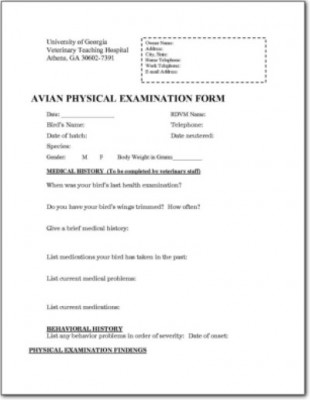
Avian Physical Examination Forms Created by LafeberVet
Provided by Dr. Tom Tully of Louisiana State University
Avian Physical Examination Forms Created by LafeberVet
Provided by Dr. Tom Tully of Louisiana State University
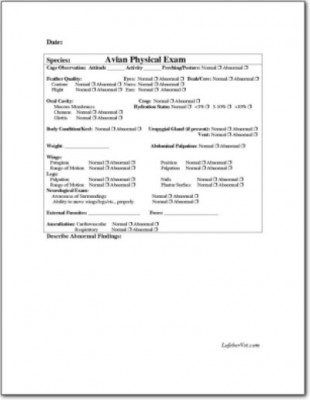
Avian Physical Examination Forms Created by LafeberVet
The first step in antimicrobial drug selection is to make sure treatment is necessary. Companion birds often display nonspecific signs of illness, and the avian clinician should be reasonably sure that an infection is present before using antibiotics. The presence of a pathogen on culture or Gram stain does not necessarily mean treatment is warranted. Small numbers of potential pathogens are frequently isolated from the choana and cloaca of healthy birds . . .
Pour les vétérinaires. Par les vétérinaires.
Le site Lafervet.com est conçu pour une utilisation par les vétérinaires. Il est ouvert aux vétérinaires diplômés, aux techniciens vétérinaires diplômés, aux animaliers et aux étudiants dans ces domaines.
Créer un compte pour accéder à des articles et des ressources du site.
L'inscription est gratuite.
Para Profesionales Veterinarios. Por Profesionales Veterinarios.
El sitio Lafervet.com es para uso de los profesionales veterinarios. Está abierto a los veterinarios licenciados, técnicos veterinarios licenciados, rehabilitadores licenciados y estudiantes en estos campos.
Cree una cuenta para acceder a los artículos y recursos del sitio.
La registro es gratis.
Please Login
The cranial nerve exam differs little from that of mammals, however there are differences in innervation. As in mammals, menace and pupillary light response (PLR) require use of cranial nerves II (optic) and III (oculomotor), however menace is difficult to interpret in birds. Also, PLR may be overridden in birds due to the presence of striated iridal muscle. Evaluate PLR early in the exam using a sudden, bright light directed toward the medial canthus. Consensual PLR is absent due to . . .
Pour les vétérinaires. Par les vétérinaires.
Le site Lafervet.com est conçu pour une utilisation par les vétérinaires. Il est ouvert aux vétérinaires diplômés, aux techniciens vétérinaires diplômés, aux animaliers et aux étudiants dans ces domaines.
Créer un compte pour accéder à des articles et des ressources du site.
L'inscription est gratuite.
Para Profesionales Veterinarios. Por Profesionales Veterinarios.
El sitio Lafervet.com es para uso de los profesionales veterinarios. Está abierto a los veterinarios licenciados, técnicos veterinarios licenciados, rehabilitadores licenciados y estudiantes en estos campos.
Cree una cuenta para acceder a los artículos y recursos del sitio.
La registro es gratis.
Please Login
In the best of captive situations, wild birds are still subject to significant stress. This is particularly true during phases of rehabilitation that require frequent capture and treatment. Experience with individual patients will dictate your approach to capture and restraint, but be aware that a slow, careful approach to capture followed by restriction of vision during restraint will generally yield best results . . .
Pour les vétérinaires. Par les vétérinaires.
Le site Lafervet.com est conçu pour une utilisation par les vétérinaires. Il est ouvert aux vétérinaires diplômés, aux techniciens vétérinaires diplômés, aux animaliers et aux étudiants dans ces domaines.
Créer un compte pour accéder à des articles et des ressources du site.
L'inscription est gratuite.
Para Profesionales Veterinarios. Por Profesionales Veterinarios.
El sitio Lafervet.com es para uso de los profesionales veterinarios. Está abierto a los veterinarios licenciados, técnicos veterinarios licenciados, rehabilitadores licenciados y estudiantes en estos campos.
Cree una cuenta para acceder a los artículos y recursos del sitio.
La registro es gratis.
Please Login
General anesthesia is generally required for placement unless the patient is extremely weak. A spinal needle or hypodermic needle may be selected . . .
Pour les vétérinaires. Par les vétérinaires.
Le site Lafervet.com est conçu pour une utilisation par les vétérinaires. Il est ouvert aux vétérinaires diplômés, aux techniciens vétérinaires diplômés, aux animaliers et aux étudiants dans ces domaines.
Créer un compte pour accéder à des articles et des ressources du site.
L'inscription est gratuite.
Para Profesionales Veterinarios. Por Profesionales Veterinarios.
El sitio Lafervet.com es para uso de los profesionales veterinarios. Está abierto a los veterinarios licenciados, técnicos veterinarios licenciados, rehabilitadores licenciados y estudiantes en estos campos.
Cree una cuenta para acceder a los artículos y recursos del sitio.
La registro es gratis.
Please Login
Arterial blood pressure measurement is an important tool in the management of the critically ill bird. Systolic blood pressure is the pressure exerted against the blood vessel wall during contraction of the heart. Although direct arterial pressure measurement is ideal, it is not commonly used because of the need for specific technical skill, invasive nature of the procedure, and cost of equipment . . .
Pour les vétérinaires. Par les vétérinaires.
Le site Lafervet.com est conçu pour une utilisation par les vétérinaires. Il est ouvert aux vétérinaires diplômés, aux techniciens vétérinaires diplômés, aux animaliers et aux étudiants dans ces domaines.
Créer un compte pour accéder à des articles et des ressources du site.
L'inscription est gratuite.
Para Profesionales Veterinarios. Por Profesionales Veterinarios.
El sitio Lafervet.com es para uso de los profesionales veterinarios. Está abierto a los veterinarios licenciados, técnicos veterinarios licenciados, rehabilitadores licenciados y estudiantes en estos campos.
Cree una cuenta para acceder a los artículos y recursos del sitio.
La registro es gratis.
Please Login
After recognizing a dyspneic bird, the clinician’s initial response should be: Hands Off!! Dyspneic birds can die soon after presentation with the additional stress of restraint and handling. Therefore minimize handling and place the bird in an oxygen-rich cage. Humidify air and provide 40 to 50% oxygen. As in mammals, oxygen therapy is potentially toxic if given for prolonged periods at high levels . . .
Pour les vétérinaires. Par les vétérinaires.
Le site Lafervet.com est conçu pour une utilisation par les vétérinaires. Il est ouvert aux vétérinaires diplômés, aux techniciens vétérinaires diplômés, aux animaliers et aux étudiants dans ces domaines.
Créer un compte pour accéder à des articles et des ressources du site.
L'inscription est gratuite.
Para Profesionales Veterinarios. Por Profesionales Veterinarios.
El sitio Lafervet.com es para uso de los profesionales veterinarios. Está abierto a los veterinarios licenciados, técnicos veterinarios licenciados, rehabilitadores licenciados y estudiantes en estos campos.
Cree una cuenta para acceder a los artículos y recursos del sitio.
La registro es gratis.
Please Login
The small, affectionate birds we call cockatiels (Nymphicus hollandicus) have undergone extensive modification through captive breeding. Color variations or mutations have increased in number over the years. The “Wild-type” or “Normal” cockatiel is the foundation of all mutations and is referred to as the “Grey” cockatiel. All other color variations, such as pearl, albino, lutino, and pied cockatiels, are mutations from this gene pool. In this client education handout, cockatiel types are described and recommendations for pet bird owners are discussed.
Client educational handout donated by Dr. Larry Nemetz.