




Contents
What We Do for Science…and for Our Birds!
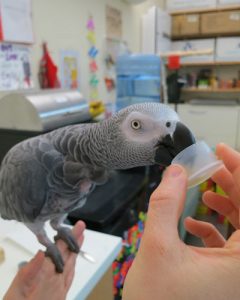
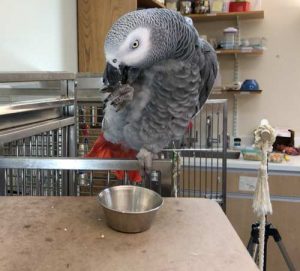
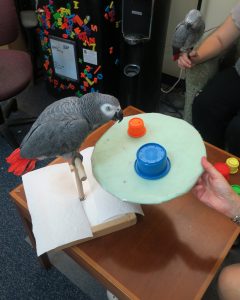
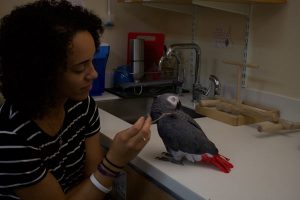
The story starts out with a paper on Piagetian liquid conservation that was just accepted for publication (more on that study in an upcoming blog). The success of the experiment relied on the ability of our parrots to choose and drink from the one container of two that held a bit more juice than the other. For example, the equivalent of a choice between about less than a fourth versus a half of a teaspoon of liquid. Given that our birds value juice as a major treat, to which we limit access (we joke that it is like “crack cocaine” for them — a concentrated sugar source they can access without any real work), it wasn’t all that surprising that they eagerly looked forward to these sessions.
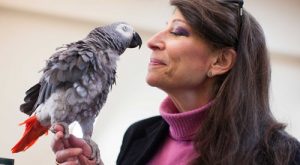
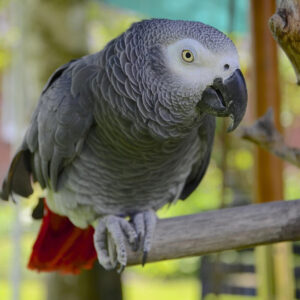
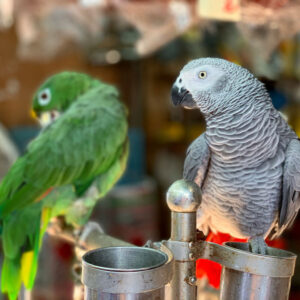
We would even switch around flavors of the organic juices that we used, so that they wouldn’t get bored by any one type. Griffin, Athena, Pepper, and Franco (two other African Greys who sometimes participate in our studies) all succeeded, comparing very favorably with young children. However, one of my colleagues, despite liking the paper as it was, suggested that we do a second, related experiment, comparing the birds with a number of different great ape species who have also been tested. It seemed like a terrific idea, and we recently began the second study.

A Parrot With an Unexpected Problem
Griffin was happy to participate; Athena, however, was another matter. In the intervening months since we had finished the first experiment, we’ve had to give her a supplement to regulate her hormones. The supplement tastes pretty awful, so we decided to give her some yummy juice after each dose both as a reward for taking her meds and to give her a more pleasant aftertaste. Unfortunately, our ploy backfired: What happened was that she started to associate juice with the nasty-flavored supplement, and began to refuse to drink any of the organic commercial juices we provided. What could we do?
A Student Finds An Unconventional Solution
Fortunately, one of my students, Francesca, noticed that Athena still likes to eat the fresh organic grapes we obtain from a local farmers’ market, and suggested that we try squeezing them for their juice. We teased Francesca about how we’d all get into trouble for starting a winery, but decided her idea was worth a try. Lo and behold, Athena slurped up that first batch! So, Francesca now spends a certain amount of time every other day, peeling and squeezing organic grapes, and filtering the resultant juice.
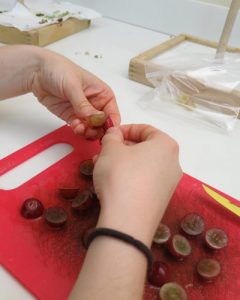
I’m sure that wasn’t what she had in mind when she applied for a fellowship to work in the lab this summer…and thankfully it really doesn’t take all that much of her time, allowing her actually to perform this and other experiments with the birds. But the experience does indeed demonstrate that, on occasion, what we have to do to get data from our birds can involve somewhat unconventional activities — and that work of this type doesn’t ever get the appropriate credit in those published papers!

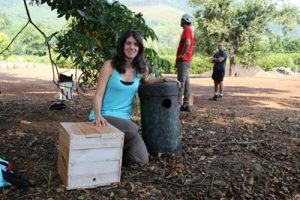 As people were gearing up for the Holidays, I had the great fortune to drive with a dear friend and client to Chicago for The Avicultural Society of Chicagoland — The TASC 2-day learning event. There were a variety of great speakers for the event and I had the good fortune of meeting one of them who was new to me, Dr. Caroline Efstathion. In this column, I would like to share her wonderful and heartwarming work.
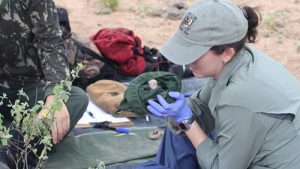 Cape Parrot
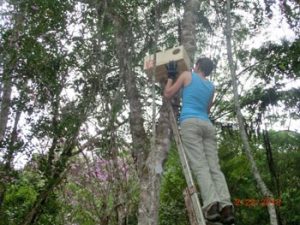 o what to do? Dr. Efstathion introduced a push-pull system to discourage bees from entering the nest while attracting them to traps nearby. A bee repellent could “push” bees away from the nest, and two bee traps with chemical “lure” would attract or “pull” bees. Trapped bees could then be removed and placed in managed hives by beekeepers, as the bees are important to pollination and to agriculture. In this way, nest site competition could be reduced between parrots and honey bees.
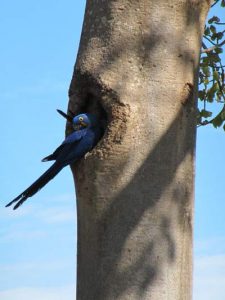 While attention is turned to the athletes competing at the Olympics in Brazil, bird people turn to ask what about birding in Brazil? When consulting the bird guides for Brazil, one learns quickly that the guides are regional. That is because a national guide would be too large for portability in the field because, frankly, there are too many species! In fact, Brazil boasts over 1,825 species with others being discovered or named continually. Brazil is considered one of the planet’s richest centers of biodiversity and represents 60% of the species found on the South American continent! With that comes the flip side — Brazil has the largest number of endemic (234) and threatened (116) species of any nation in the New World — that means it represents over one fourth of all of the species that are in trouble.
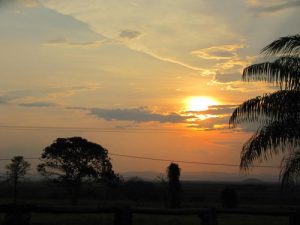 The Pantanal is a vast seasonally flooded wetland comprising about 80,000 square miles! The tropical rains begin in November and end around June. This results in the northern portion of the Pantanal flooding in January, while the southern portion receives the flood waters about two months later with flooding occurring about 2 times during the rainy season. The waters come from an even larger distinctively Brazilian tropical savanna habitat – the Cerrado. This one of the largest biomes of over 740,000 square miles. During the wet season, waters from the Cerrado pour into the large rivers of the Pantanal and there they temporarily flood the grasslands and gallery forests. This produces a large accumulation of water birds as well and contributes to the biodiversity of species. However, as the use of herbicides and fertilizers in the Cerrado increase, this produces a negative impact on the purity of the waters needed for plants and animals of the Pantanal.
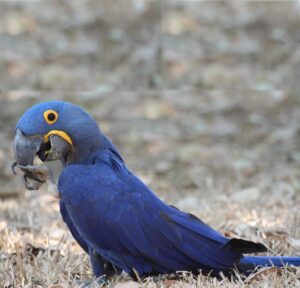
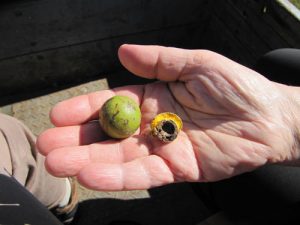 Since the 1990s, the Hyacinth Macaw project or Projeto Arara Azul headed by Neiva Guedes has helped turn the corner for this magnificent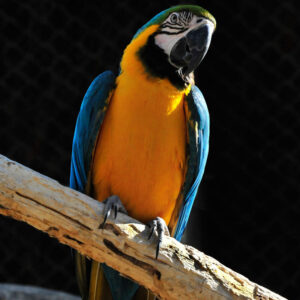


.jpg)

_-_Weltvogelpark_Walsrode_2013-01.jpg)


_male.jpg)
![[ Nimesh M]](https://commons.wikimedia.org/wiki/File:Lophocroa_leadbeateri_-Brookfield_Zoo-6.jpg)
.jpg)


