
Introduction
La’Toya Latney, DVM, DECZM (ZHM), DABVP (Reptile & Amphibian Practice), CertAqV presented this talk for the University of Minnesota College of Veterinary Medicine Zoo, Exotics, Aquatics & Wildlife Medicine Club as part of the Lafeber Company Student Program.
Abstract
Reptile nutrition is a growing field. Despite the large amount of biological data known about reptiles, there is much less known about how these species process the foods offered in captivity. This non-interactive webinar recording reviews what we know about reptile nutrition, including the nutritional strategies utilized as well as the comparative analysis of commonly fed vegetables and insects. The basic components of reptile nutrition are explored, from metabolizable energy, protein, and fat, to vitamins and minerals. Food preparation is then discussed in detail. Depending on the source, this process can be quite confusing, however, there are measures that can be taken to manipulate the nutritive profile of feeder insects.
Outline
Download a PDF of this detailed outline.
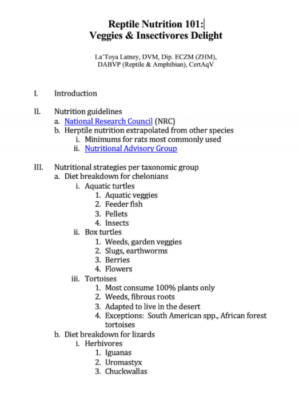
I. Introduction
II. Nutrition guidelines
-
- National Research Council (NRC)
- Herptile nutrition is extrapolated from other species
- Minimums for rats are most commonly used
- Nutritional Advisory Group
III. Nutritional strategies per taxonomic group
- Diet breakdown for chelonians
- Aquatic turtles
- Aquatic veggies
- Feeder fish
- Pellets
- Insects
- Box turtles
- Weeds, garden veggies
- Slugs, earthworms
- Berries
- Flowers
- Aquatic turtles
-
- Tortoises
- Most consume 100% plants only
- Weeds, fibrous roots
- Adapted to live in the desert
- Exceptions: South American spp., African forest tortoises
- Tortoises
- Diet breakdown for lizards
- Herbivores
- Omnivores
-
- Insectivores
- Leopard geckos
- Monitors
- Some chameleons
- Frilled dragons
- Insectivores
-
- Specialized
- Fruit/nectar feeders
- Crested geckos
- Columbian tegus
- Specialized
- Almost all snakes are carnivores
- Temperate
- Examples: corn snake, milk snakes, rat snakes, kingsnakes
- Tropical
- Examples: pythons & boas, snakes from Central & South America
- Temperate
- Specialized diets
- Insects, amphibians, feeder fish
- Examples: garter snakes, rainbow boas, ring-neck snakes, hog nose, egg-eating snake
IV. Nutritional strategies
- Herbivores
- Vegetable dinner wheel
- Dandelion greens
- Romaine lettuce
- Collard greens
- Mustard greens
- Red leaf lettuce
- Escarole
- Endive
- Swiss chard
- Bok choy
- Kale
- Spinach
- Hay science
- Alfalfa
- Botanical hay
- Oat hay
- Orchard grass
- Organic meadow
- Western timothy
- Grasses
- Vegetable dinner wheel
- Insectivore
- Insect composition
- Domestic cricket (Acheta domesticus)
- Mealworm (Tenebrio molitor)
- Mealworm-beetle life cycle
- Earthworm (Lumbricus terrestris)
- Silkworm (Bombyx mori)
- Phoenix worm larvae (Hermetia illucens)
- Madagascar hissing cockroach (Gromphadorhina portentosa)
- Turkistan or red rusty cockroach (Blatta lateralis)
- Butterworm or tebo worm (Chilecomadia moorei)
- Dubia cockroach (Blaptica dubia)
- Hornworm (Maduca quinquemaculata)
- Not readily on the market, but occasionally available
- False katydid (Microcentrum rhombifolium)
- Wood louse (Procellio scaber)
- Carnivores
- Omnivores
- Super-specialized
V. Basic components of nutrition
- Metabolizable energy (ME)
- Definition: Net energy gained from food after digestion and absorption
- Standard metabolic rates for daily energy needs at optimal temps= 32 x BW kg (0.75)
- 500-gram reptile requires 9.5-57 kcal/day at 86°F (30°C)
- Measurement
- Invertebrates: 7-2.7 kcal ME/g
- Butterworms: 977 ME/g
- Cricket: 402
- Earthworm: 708
- House fly: 918
- Mealworm karvaeL 378
- Phoenix worms: 994
- Red Turkish roach: 244
- Superworm larvae: 423
- Wax worms: 747
- Invertebrates: 7-2.7 kcal ME/g
- Factors that impact ME
- Species
- Age
- Activity
- Environmental temperature
- In reptiles, temperature is not maintained by ME
- Fewer calories needed than mammals
- Digestive efficiency is the same as mammals
- Reptiles – Metabolic rate based on metabolic body size
- Protein
- Definition: Amino acid composition and availability
- Nitrogen availability
- Measurement: g/kg or % DM
- Insect protein sources
- Exoskeletons contain amino acids
- Bioavailability may be limited
- Phoenix worms and mountain chicken frogs (Dierenfeld 2008)
- Phoenix worms and leopard geckos (Boykin 2021)
- Definition: Amino acid composition and availability
- Fat
- NRC min for rats
- 5% (50 g/kg) of diet fed (growing)
- Necessary for fat-soluble vitamins
- Lipid content in feeder inverts: 3-6X higher than rodent diets
- Is fat bad for herps?
- Species dependent: strict herbivores rely on fat more than omnivores
- Activity level
- NRC min for rats
| Invertebrates | Crude fat (g/kg) | % fat |
| Butterworms | 294 | |
| Crickets | 68 | As high as 22.8% |
| Earthworms | 16 | 12.6% |
| False katydids | 9% | |
| Fruit flies | 19 | |
| Hissing cockroach | 20.3% | |
| Mealworm larvae | 54 | As high as 31.1% |
| Phoenix worms | 140 | |
| Red rusty cockroach | 14.5% | |
| Silkworms | 14 | |
| Superworm larvae | 177 | As high as 40.1% |
| Tenebrio beetles | 17.7% | |
| Waxworms | 249 | |
| Wood louse | 11.3% | |
| Zoophobas beetles | 14.3% |
- Vitamins
- Vitamin A
- Definition: retinol, beta-carotene, retinyl esters
- Fat-soluble, light sensitive
- Measurement (IU/kg)
- Clinical relevance
- Poor levels in most insects
- Hypovitaminosis A
- A significant and common clinical problem in herptiles
- Squamous metaplasia
- Palpebral edema
- Aural abscess
- Respiratory epithelium compromise
- Lingual squamous metaplasia (“short tongue syndrome” in amphibians)
- Ulcerative chelitis
- Vision loss
- Growth deficits
- Gastrointestinal bloat
- Dermal ulcerations
- Septicemia
- Acute death
- Supplementation with beta carotene is not as effective, must use retinol or retinyl esters
- NRC min retinol for rats: 2300 IU/kg
- Do we know minimum requirements for herps?
- Box turtles: 3-6 IU/g diet DM
- Aquatic turtles: 2-8 IU/g diet DM
- Chameleons: 5-9 IU/ cricket DM
- Foam nesting frogs: 230,000 IU vitamin A/kg of supplement
- Vitamin A
| Invertebrates | IU/kg | ug/kg |
| Butterworms | <300 | |
| Crickets | <1000 | |
| Earthworms | <1000 | |
| False katydids | 2953 | |
| Hissing cockroach | 182 | |
| House flies | <300 | |
| Mealworm larvae | <1000 | |
| Phoenix worms | <300 | |
| Red rusty cockroach | 120 | |
| Silkworms | 1580 | |
| Superworm larvae | <1000 | |
| Tenebrio beetles | 12 | |
| Waxworms | <1000 | |
| Wood louse | 170 | |
| Zoophobas beetles | 41 |
- Vitamin E
- Definition: antioxidant vitamins, alpha-tocopherol
- Measurement
- mg/kg
- % fat in diet
- Clinical relevancy
- Invertebrates have adequate levels, ranging from 5-166 mg/kg
- Steatitis in deficient patients
- NRC rat min 18 mg/kg
- Vitamin D3
- Definition
- 25-hydroxycholecalciferol or calcidiol
- Activated by photosynthetic mechanisms (UVB driven) in diurnal and crepuscular herps and people
- Sun >
- UVB radiation >
- Vitamin D precursor in the skin >
- 25-hydroxycholecalciferol
- 1, 25- hydroxycholecalciferol
- Absorbed via intestine
- Calcium absorption and homeostasis
- Serum levels are dependent on musculoskeletal, renal, integumentary, and GI health
- Measurement: ug/kg or IU/kg
- Production and calcium homeostasis
- Clinical relevance
- Calcium deficiencies across many orders of herptile spp.
- Well studied in diurnal herbivores
- Insectivore supplementation?
- Diurnal or crepuscular
- House gecko (Carmen 2000)
- Jamaican anole (Ferguson 2005)
- Nocturnal
- Leopard geckos (Mitchell, ARAV 2013)
- Homemade vs oral supplements
- UVB first
- Level comparable to natural history
- Even nocturnal spp. can use UVB
- Supplementation
- Caution: Inadvertent toxicity can occur
- Insects “groom” powders off exoskeleton
- If utilized, do so for 1 week or less
- UVB first
- Diurnal or crepuscular
- Definition
- Minerals
- Calcium & phosphorus
- NRC min for calcium in rats: 5-5 g/kg
- NRC min for phosphorus in rats: 3 g/kg
- Insects
- Ca: 089-9.3 g/kg
- P: 5-3.7 g/kg
- Phoenix worms
- 9.3 g/kg
- Wood louse
- 14% calcium DM
- 11.79 Ca:P ratio
- Digestibility?
- Calcium & phosphorus
VI. Food prep
- Commercial diets
- Canned/dried prey items
- Pellets
- Powder/gel food
- Advantages
- Shelf life of products
- Don’t have to handle or care for live prey
- Consistent nutrition profile
- Challenges
- Acceptance by reptiles
- Variable quality/nutritional content
- Care and feeding of prey
- General concepts
- Do not feed directly from pet store of post-shipment
- Need appropriate planning
- Housing examples
- Containers and containment
- Stocking density/surface area
- Substrate/hides
- Crickets
- The development and evaluation of a gut-loading diet for feeder crickets formulated to provide a balanced nutrient source for insectivorous amphibians and reptiles (Attard 2013)
- Ingredients
- Soybean flour
- Sweet potato flour
- Red lentil flour
- Spirulina
- Crushed rabbit alfalfa pellets
- Gut load x 24h
- Ingredients
- The development and evaluation of a gut-loading diet for feeder crickets formulated to provide a balanced nutrient source for insectivorous amphibians and reptiles (Attard 2013)
- Beetle larvae
- Similar setups for mealworms and superworms
- Hydration is important
- Breeding is easy
- Can be gut loaded
- Roaches
- Popular
- Death head
- Lobster
- Dubias
- Dubia blaptica
- Cannot climb glass
- Adults live 1-2 years
- Breed constantly
- Quiet, no odor
- Dubia blaptica
- Turkish
- Hissing
- Madagascar hissing roaches (Gromphadorhina portentosa)
- Large, easy to care for
- Tropical
- Can climb glass
- Adults: 2-3 years
- Juveniles take 3 months to mature
- Madagascar hissing roaches (Gromphadorhina portentosa)
- Popular
- Butterworms or trevoworms (Chilecomadia moorei)
- Chilean carpenter moth – invasive species
- Irradiated prior to import to prevent molting
- Store in fridge for weeks
- Gut load 24 hours prior?
- General concepts
-
-
- Reptiworms, calciworms, and Phoenix worms
- Phoenix worms are the larvae of the black solder fly (Hermetia illucens)
- Well studied, used in aquaculture, poultry, vermiculite
- Stored in cups at room temp
- Phoenix worms are the larvae of the black solder fly (Hermetia illucens)
- Hornworms
- Grow rapidly and eat non-stop
- Feed to insectivores within 7-10 days depending on desired size
- Large specimens
- May require cuticle laceration
- Silkworms
- Picky eaters: mulberry leaves (vitamin A)
- Most vendors sell with a food substrate
- Store at room temperature and feed them within 7-10 days
- Moisture of feed can promote fungal growth
- Earthworms
- Dirt substrate
- Feed composting scraps
- Can gut load 24h prior
- Moth and fly larvae
- Drosophila melanogaster
- Reptiworms, calciworms, and Phoenix worms
-
-
- Prey health is important for insectivore health
- Well hydrated
- Well nourished, high-quality diets
- Infectious disease
- Prey health is important for insectivore health
-
- Augmenting nutrition profile (vitamin/mineral)
- Dusting
- Shake invert in small particle dust prior to feeding
- Imprecise way to guarantee supplementation
- Insects can groom off dust or dust falls off
- Gut loading
- Short-term feeding nutrient dense diet to prey
- Many studies confirm this method works for calcium
- Do both!
- Dusting
- Augmenting nutrition profile (vitamin/mineral)
VII. “Happy Meal”® menu
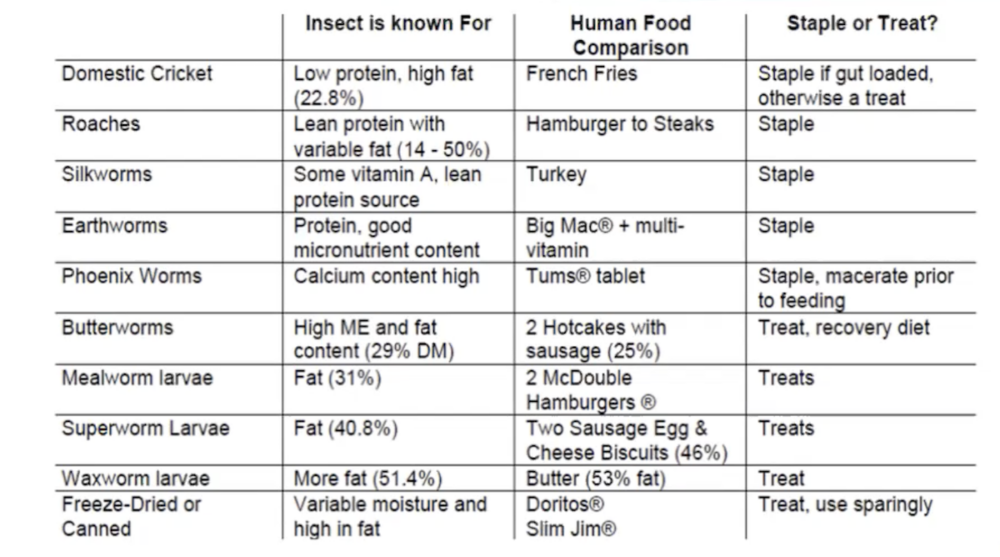
- Larval insects
- High in fat
- Deficient in vitamins and minerals
- Variable protein bioavailability
- Adult beetles, earthworms, roaches
- Lower fat
- Good protein levels (especially earthworms)
- Most insects have poor calcium levels
- Increase dietary calcium with supplementation
- Exception: Phoenix worms have high calcium content
- Macerate to increase bioavailability
- Insect care
- Well hydrated
- Well nourished
- Feed calcium-rich diet at least 24h prior (not >9% total calcium)
- Can be kept or bred at home
Recording
Client education
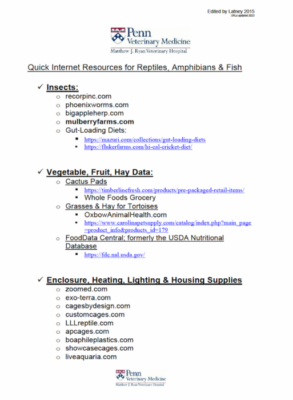
Download this list of husbandry resources that Dr. Latney shares with her herptile and piscine clients.
Garden resources
Explore these resources shared by Dr. Latney for building economical, effective gardens for tortoises.
- Starting a Back to Eden Garden From Scratch
- The Best DIY Cinder Block Raised Garden Bed – The Owner-Builder Network
- How to Build a Cinder Block Raised Garden Bed
RACE approval
This program was reviewed and approved by the American Association of Veterinary State Boards (AAVSB) Registry of Approved Continuing Education (RACE) program for 1 hour of continuing education credit for veterinarians and veterinary technicians in jurisdictions that recognize AAVSB RACE approval.
References
References
Attard L. The development and evaluation of a gut-loading diet for feeder crickets formulated to provide a balanced nutrient source for insectivorous amphibians and reptiles. University of Guelph Thesis. May 9, 2013. Available at http://hdl.handle.net/10214/6653.
Boykin K, Bitter AK, Mitchell MA. Using a commercial gut-loading diet to create a positive calcium to phosphorus ratio in mealworms (Tenebrio molitor). Journal of Herpetological Medicine and Surgery. 2021; 31(4):302-306. doi: 10.5818/JHMS-D-21-00027.
Carmen EN, Ferguson GW, Gehrmann WH, Chen TC, Holick MF. Photobiosynthetic opportunity and ability for UV-B generated vitamin D synthesis in free-living house geckos (Hemidactylus turcicus) and Texas spiny lizards (Sceloporus olivaceous). Copeia. 2000; 2000(1):245-250. Available at https://www.jstor.org/stable/1448257. Accessed March 4, 2024.
Dierenfeld ES, King J. Digestibility and mineral availability of Phoenix worms, Hermetia illucens, ingested by mountain chicken frogs, Leptodactylus fallax. Journal of Herpetological Medicine and Surgery. 2008; 18 (3/4):100-105. doi: 10.5818/1529-9651.18.3-4.100.
Donoghue S. Nutrition. In: Mader DR (ed). Reptile Medicine and Surgery, 2nd edition. Saunders Elsevier; St. Louis: 2006. Pp. 251-298.
Ferguson GW, Gehrmann WH, Karsten KB, et al. Ultraviolet exposure and vitamin D synthesis in a sun-dwelling and a shade-dwelling species of Anolis: are there adaptations for lower ultraviolet B and dietary vitamin D3 availability in the shade? Physiol Biochem Zool 2005; 78:193–200.
Finke MD. Complete nutrient content of four species of feeder insects. Zoo Biology. 2012; 32, 27-36. doi: 10.1002/zoo.21012.
Finke MD. Complete nutrient composition of commercially raised invertebrates used as food for insectivores. Zoo Biology. 2002; 21(3):269-285. doi: 10.1002/zoo.10031.
Fleming RH. Nutritional factors affecting poultry bone health. Proc Nutr Soc. 2008 May;67(2):177-83. doi: 10.1017/S0029665108007015. PMID: 18412991.
Oonincx DGAB, Dierenfeld ES. An investigation into the chemical composition of alternative invertebrate prey. Zoo Biol. 2012; 31: 40-54.
Latney L. Reptile nutrition 101: Veggies and insectivores delight. March 10, 2023. LafeberVet web site. Avaialble at https://lafeber.com/vet/reptile-nutrition-101-veggie-insectivores-delight/