




 The Work Ethic
You have a choice between toiling hard for your living or receiving everything you need for free. Sounds like a no-brainer, right? Who wouldn’t want life to be as easy as possible? Why spend resources (such as energy) if one doesn’t have to do so? Well, that’s actually not what researchers find for almost every subject tested when the choice involves food — except, interestingly, domestic cats!
Work For Food?
The technical term for choosing to work for a reward rather than getting it for free is called “contra-freeloading.” The first study of this behavior was in in rats, by Glen Jensen (1963). He found that rats would work for about 50% of their daily ration even if they could receive 100% for free. Initially, the scientific community believed that the finding was specific to rats: That, because of their feeding strategies in nature, they might figure that the food for which they had to work was an ephemeral source that they had to exploit for as long as possible and that the free food would be around as backup. Whether this explanation is valid or not, subsequent studies, on creatures from pigeons (Neuringer, 1969) to grizzly bears (McGowan et al., 2010) and apes (Menzel, 1991) showed that the phenomenon was widespread. It’s even been shown in humans (Tarte, 1981).
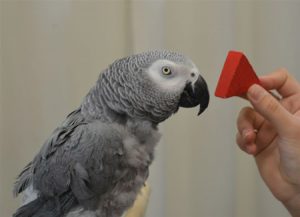
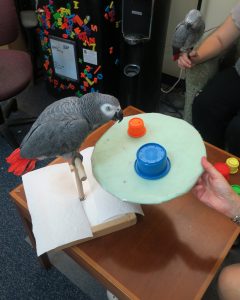
As someone who studies parrot cognition, most interesting to me was a study recently presented at the International Ethological Congress in Portugal. The experiment involved an exchange paradigm, in which parrots could choose either a token they could trade for a particular food or some food itself. If the token represented a lesser-quality food than the food choice, the birds chose the food item; if the token represented a higher quality food, the birds chose the token and traded up. The critical trials were where the token represented the same quality food as the food item presented, as that would actually test for contra-freeloading.
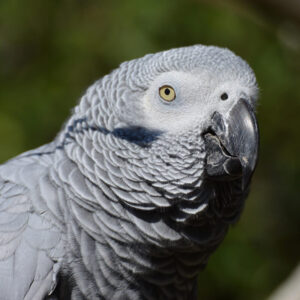
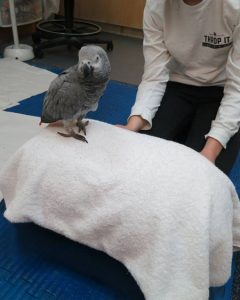
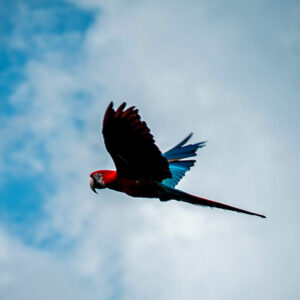
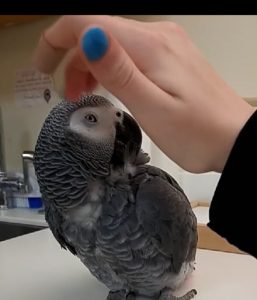
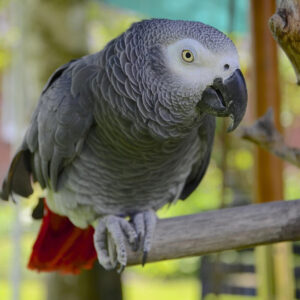
The researcher tested four species: great green macaws, blue-throated macaws, blue-headed macaws, and Grey parrots. Although the great green macaws seemed to prefer the food, the other three macaw species and grey parrots all chose the token. So, where am I going with this?
Foraging Caters To A Parrot’s Wild Instincts
Although I can’t figure out why the one species of macaw would act more like domestic cats than any of the other species, it was clear that the other parrots really wanted to play the game. And that finding suggests the real importance of providing foraging opportunities for our parrots. In the wild, most parrot species (including those great green macaws) travel long distances every day and have to work fairly hard to get their nourishment. For example, African greys crack nuts, eviscerate fruits, and juice bark (May, 2004). Such behavior is part and parcel of their lives. They are not made to be “perch-potatoes,” simply sitting around and eating out of a dish.
In captivity, having the chance to figure out a new foraging toy is probably one of the most interesting parts of their day. They really seem to enjoy the challenge of learning about the affordances of such toys. And as I wrote in last month’s blog, one of our Greys, Athena, was most annoyed when we failed to fill her foraging toy, even when she could eat the same food from her bowl. Sometimes, too, I think my birds like to ask for specific treats not because they really want the foods, but because they want the social interactions with the students who are providing the items!
In sum, when owners provide foraging toys — particularly if several are provided at once — our birds aren’t merely being provided with a distraction. They are being given a choice as to how they wish to spend their time, and also some control over how they choose to live their lives. And they are telling us, very clearly, that at least some of the time, they would rather work than not!
Jensen, G.D. (1963) Preference for bar pressing over freeloading as a function of number of rewarded presses. Journal of Experimental Psychology, 65, 451–454.
May, D.L. (2004). The vocal repertoire of Grey Parrots (Psittacus erithacus) living in the Congo Basin (Central African Republic, Cameroon). PhD Thesis, University of Arizona, Tucson.
Menzel EW (1991) Chimpanzees (Pan troglodytes)—problem seeking versus the bird-in-hand, least-effort strategy. Primates, 32, 497–508.
McGowan, R.T.S., Robbins, C.T., Alldredge, J.R., Newberry, R.C. (2010) Contrafreeloading in grizzly bears: implications for captive foraging enrichment. Zoo Biology, 29, 484–502.
Neuringer, A.J. (1969). Animals respond for food in the presence of free food. Science, 166, 399-401.
Tarte, R. (1981). Contrafreeloading in humans. Psychological Reports, 49, 859-866.
 Lafeber Company was honored the last two weeks to be part of something huge: A collection of parrot rescues and third parties sending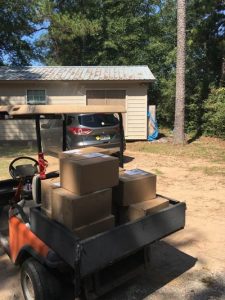
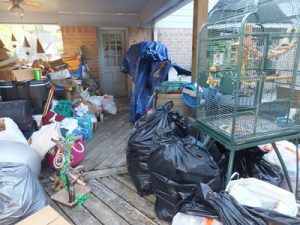 One of our Customer Service associates, Diane, lives in the middle of Houston and her home took on quite a bit of water, just as others did. If you are a regular caller to Lafeber Company, you have more than likely spoken to Diane. She’s the one with the Carolinas accent mixed with that Texas drawl, and she can tell you anything you need to know about birds, and especially baby birds! Diane sent her birds to Magnolia for safekeeping while she and her husband try to rebuild enough to make it safe for the birds and themselves. They are lucky enough that they are able to live in the upstairs still, while so many were not as fortunate.
 “We did flood and, while not as bad as some people in Houston, it was enough to cover our whole downstairs with water, and the damage is more than I could have imagined. This section of our subdivision is one of the high points in Houston, and while it usually gets stranded like an island with a creek at one end and a creek at the other, we have never flooded in 37 years (so why would we have flood insurance?) and we do not have flood insurance. I couldn’t believe it when I saw water coming down the street; I yelled to my husband to move the car and made a mad dash into the garage to grab carriers for the birds and started getting them out of their cages and upstairs, and before I could finish I was already splashing through water it came up that fast! Nothing but our pets & their food was saved but at least I got that.”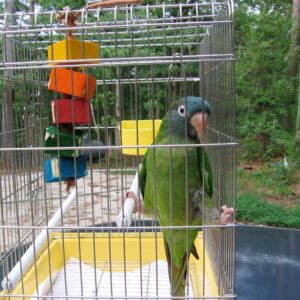


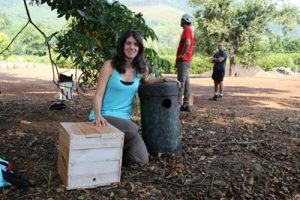 As people were gearing up for the Holidays, I had the great fortune to drive with a dear friend and client to Chicago for The Avicultural Society of Chicagoland — The TASC 2-day learning event. There were a variety of great speakers for the event and I had the good fortune of meeting one of them who was new to me, Dr. Caroline Efstathion. In this column, I would like to share her wonderful and heartwarming work.
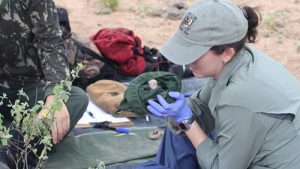 Cape Parrot
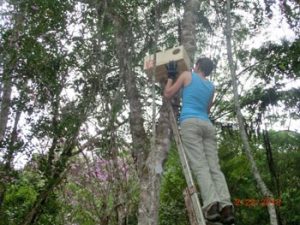 o what to do? Dr. Efstathion introduced a push-pull system to discourage bees from entering the nest while attracting them to traps nearby. A bee repellent could “push” bees away from the nest, and two bee traps with chemical “lure” would attract or “pull” bees. Trapped bees could then be removed and placed in managed hives by beekeepers, as the bees are important to pollination and to agriculture. In this way, nest site competition could be reduced between parrots and honey bees.

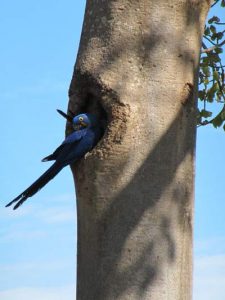 While attention is turned to the athletes competing at the Olympics in Brazil, bird people turn to ask what about birding in Brazil? When consulting the bird guides for Brazil, one learns quickly that the guides are regional. That is because a national guide would be too large for portability in the field because, frankly, there are too many species! In fact, Brazil boasts over 1,825 species with others being discovered or named continually. Brazil is considered one of the planet’s richest centers of biodiversity and represents 60% of the species found on the South American continent! With that comes the flip side — Brazil has the largest number of endemic (234) and threatened (116) species of any nation in the New World — that means it represents over one fourth of all of the species that are in trouble.
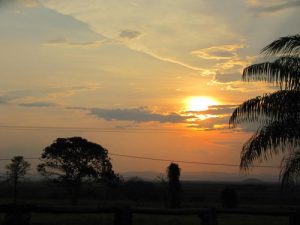 The Pantanal is a vast seasonally flooded wetland comprising about 80,000 square miles! The tropical rains begin in November and end around June. This results in the northern portion of the Pantanal flooding in January, while the southern portion receives the flood waters about two months later with flooding occurring about 2 times during the rainy season. The waters come from an even larger distinctively Brazilian tropical savanna habitat – the Cerrado. This one of the largest biomes of over 740,000 square miles. During the wet season, waters from the Cerrado pour into the large rivers of the Pantanal and there they temporarily flood the grasslands and gallery forests. This produces a large accumulation of water birds as well and contributes to the biodiversity of species. However, as the use of herbicides and fertilizers in the Cerrado increase, this produces a negative impact on the purity of the waters needed for plants and animals of the Pantanal.
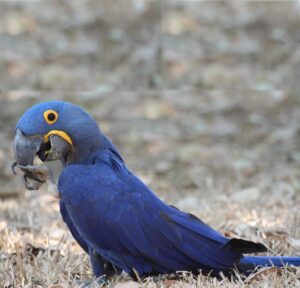
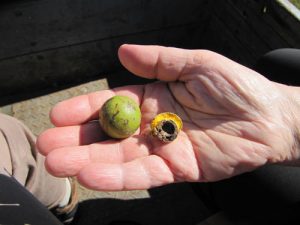 Since the 1990s, the Hyacinth Macaw project or Projeto Arara Azul headed by Neiva Guedes has helped turn the corner for this magnificent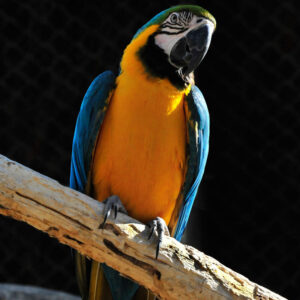




.jpg)

_-_Weltvogelpark_Walsrode_2013-01.jpg)


_male.jpg)
![[ Nimesh M]](https://commons.wikimedia.org/wiki/File:Lophocroa_leadbeateri_-Brookfield_Zoo-6.jpg)
.jpg)
