




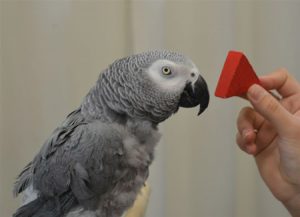
One of the many questions I’m often asked is how we choose topics to study. Specifically, where do we get our inspiration? Our choice of studies is actually influenced by several different issues, and I’ll discuss a few of them in some detail.
Will Others Like It?
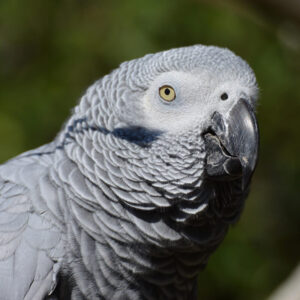
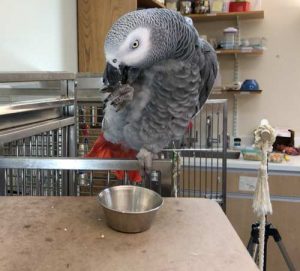
The first issue is, not surprisingly, whether the topic would be of interest to my colleagues. If no one would want to read the eventually published paper, we have very little incentive to perform the study. Thankfully, both colleagues and owners of companion birds do seem to want to know how a bird with a brain the size of a shelled walnut stacks up against species as disparate as, for example, children, adult humans, apes, cetaceans, and monkeys.
We therefore often compare the abilities of our birds to those of other species, replicating existing research to provide a comparative approach. So, after attending a seminar or a conference and learning about studies in different laboratories, we often choose to examine how African grey parrots fare on various cognitive tasks. We may or may not have to adapt other labs’ procedures based on our parrots’ abilities. If, for example, a study involves young children’s vocal responses, and our parrots have similar labels in their repertoire, we generally use almost identical procedures.
Interestingly, however, we often have to perform additional controls that researchers studying children will ignore — for example, making sure that there are no olfactory cues, or that the students are not cuing the birds with body/head/eye gestures. Thus our protocol is often more exacting than those used for humans! If the human or nonhuman primate study involves pointing, we have to adapt the protocol so that our African greys can indicate the correct response by tapping with their beaks. We therefore spend a lot of time reading about research on many different species.
Student Inspiration
Another source of inspiration comes from my students. The final exam in every course I teach is always the assignment to design an experiment on animal cognition. If students design a really cool study, I’ll ask them if they want to become a research assistant in my lab to try out their idea on our parrots. Of course, an undergraduate usually doesn’t present a project that is completely ready to administer to the birds, but we work together to design the appropriate controls and refine the methodology. A paper based on one such exam paper (looking at probabilistic reasoning) has just been accepted for publication, and I’ll describe the results in detail in a forthcoming blog.
The bases for the experiments described above often originate with classic studies on children, like those designed by Jean Piaget (1936), or on chimpanzees, like those designed by David Premack (1983). Examples of the former involve our studies on object permanence (knowing that an object still exists even after it is hidden, e.g., Pepperberg, Willner & Gravitz, 1997) and liquid conservation (knowing that changes in shape do not affect changes in volume; Pepperberg et al., 2017); examples of the latter involve our studies on concepts of same/different (knowing not just that two objects are either identical or totally different, but that they can share some attributes and differ on others, Pepperberg, 1987).
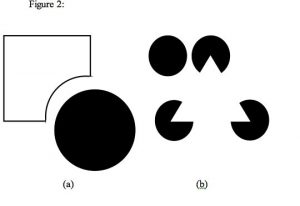
Sometimes the experiments involve examining phenomena such as how our birds respond to classic optical illusions, often because another avian species does not process the illusion as do humans, and we want to see if African greys are more like humans or pigeons (more like humans: Pepperberg & Nakayama, 2016; Pepperberg, Vicinay, & Cavanagh, 2008).
Collaboration
Occasionally, however, colleagues design novel experiments to test a previously unstudied or understudied concept in another species and we decide to collaborate — either adapting their proposed protocols for our birds or designing protocols that are identical for the birds and humans. That has been the case with an ongoing study on visual working memory manipulation — determining if Griffin can process as much, more, or less information than adult humans or children. (Hint: He’s pretty good!)
It would be fun to figure out a task that no one has ever given any other subject, to see how our birds perform, and then have everyone else replicate our work … but right now, so many studies already exist that are just waiting for a comparative perspective; we have our work cut out for us for many years!
Piaget, J. (1936). La naissance de l’intelligence (The origins of intelligence). Neuchatel, Switzerland: Delachaux et Niestle.
Pepperberg, I.M. (1987b). Acquisition of the same/different concept by an African Grey parrot (Psittacus erithacus): Learning with respect to categories of color, shape, and material. Animal Learning & Behavior, 15, 423 432.
Pepperberg, I.M., Gray, S., Lesser, J.S., & Hartsfield, L.A. (2017). Piagetian liquid conservation in Grey parrots (Psittacus erithacus). Journal of Comparative Psychology. 10.1037/com0000085
Pepperberg, I.M., & Nakayama, K. (2016). Robust representation of shape by a Grey parrot (Psittacus erithacus). Cognition, 153, 146-160.
Pepperberg, I.M., Vicinay, J., Cavanagh, P. (2008) The Müller-Lyer illusion is processed by a Grey Parrot (Psittacus erithacus). Perception, 37, 765-781.
Pepperberg, I.M., Willner, M.R., & Gravitz, L.B. (1997). Development of Piagetian object permanence in a Grey parrot (Psittacus erithacus). Journal of Comparative Psychology, 111, 63-75.
Premack, D. (1983). The codes of man and beast. Behavioral & Brain Sciences, 6, 125–167.
 The Work Ethic
 Lafeber Company was honored the last two weeks to be part of something huge: A collection of parrot rescues and third parties sending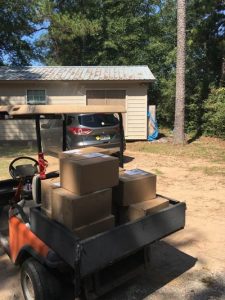
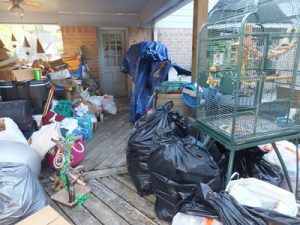 One of our Customer Service associates, Diane, lives in the middle of Houston and her home took on quite a bit of water, just as others did. If you are a regular caller to Lafeber Company, you have more than likely spoken to Diane. She’s the one with the Carolinas accent mixed with that Texas drawl, and she can tell you anything you need to know about birds, and especially baby birds! Diane sent her birds to Magnolia for safekeeping while she and her husband try to rebuild enough to make it safe for the birds and themselves. They are lucky enough that they are able to live in the upstairs still, while so many were not as fortunate.
 “We did flood and, while not as bad as some people in Houston, it was enough to cover our whole downstairs with water, and the damage is more than I could have imagined. This section of our subdivision is one of the high points in Houston, and while it usually gets stranded like an island with a creek at one end and a creek at the other, we have never flooded in 37 years (so why would we have flood insurance?) and we do not have flood insurance. I couldn’t believe it when I saw water coming down the street; I yelled to my husband to move the car and made a mad dash into the garage to grab carriers for the birds and started getting them out of their cages and upstairs, and before I could finish I was already splashing through water it came up that fast! Nothing but our pets & their food was saved but at least I got that.”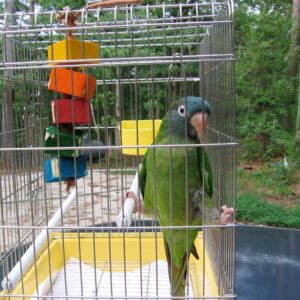


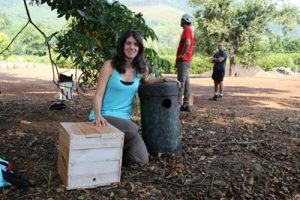 As people were gearing up for the Holidays, I had the great fortune to drive with a dear friend and client to Chicago for The Avicultural Society of Chicagoland — The TASC 2-day learning event. There were a variety of great speakers for the event and I had the good fortune of meeting one of them who was new to me, Dr. Caroline Efstathion. In this column, I would like to share her wonderful and heartwarming work.
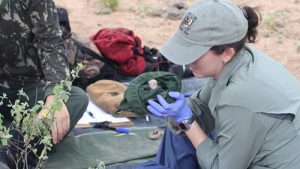 Cape Parrot
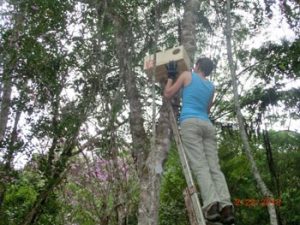 o what to do? Dr. Efstathion introduced a push-pull system to discourage bees from entering the nest while attracting them to traps nearby. A bee repellent could “push” bees away from the nest, and two bee traps with chemical “lure” would attract or “pull” bees. Trapped bees could then be removed and placed in managed hives by beekeepers, as the bees are important to pollination and to agriculture. In this way, nest site competition could be reduced between parrots and honey bees.

 While attention is turned to the athletes competing at the Olympics in Brazil, bird people turn to ask what about birding in Brazil? When consulting the bird guides for Brazil, one learns quickly that the guides are regional. That is because a national guide would be too large for portability in the field because, frankly, there are too many species! In fact, Brazil boasts over 1,825 species with others being discovered or named continually. Brazil is considered one of the planet’s richest centers of biodiversity and represents 60% of the species found on the South American continent! With that comes the flip side — Brazil has the largest number of endemic (234) and threatened (116) species of any nation in the New World — that means it represents over one fourth of all of the species that are in trouble.
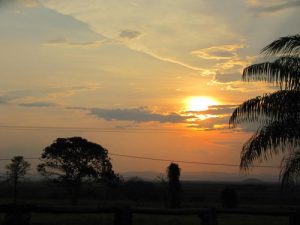 The Pantanal is a vast seasonally flooded wetland comprising about 80,000 square miles! The tropical rains begin in November and end around June. This results in the northern portion of the Pantanal flooding in January, while the southern portion receives the flood waters about two months later with flooding occurring about 2 times during the rainy season. The waters come from an even larger distinctively Brazilian tropical savanna habitat – the Cerrado. This one of the largest biomes of over 740,000 square miles. During the wet season, waters from the Cerrado pour into the large rivers of the Pantanal and there they temporarily flood the grasslands and gallery forests. This produces a large accumulation of water birds as well and contributes to the biodiversity of species. However, as the use of herbicides and fertilizers in the Cerrado increase, this produces a negative impact on the purity of the waters needed for plants and animals of the Pantanal.
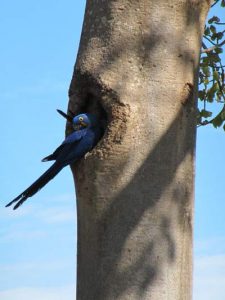
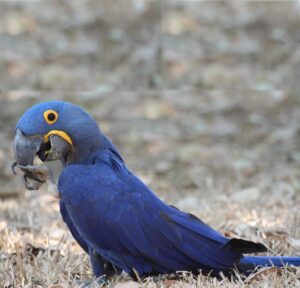
 Since the 1990s, the Hyacinth Macaw project or Projeto Arara Azul headed by Neiva Guedes has helped turn the corner for this magnificent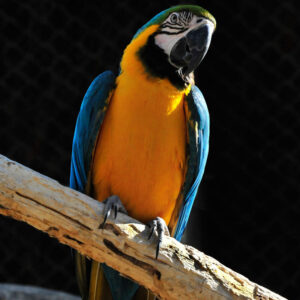




.jpg)

_-_Weltvogelpark_Walsrode_2013-01.jpg)


_male.jpg)
![[ Nimesh M]](https://commons.wikimedia.org/wiki/File:Lophocroa_leadbeateri_-Brookfield_Zoo-6.jpg)
.jpg)
