

Avian Expert Articles

Posts

“Penelope The Powerful Parrot” Aims To Help Families Cope With The COVID-19 Pandemic

Since the beginning of understanding, humankind has written — in many ways — about the complexities of life within their sphere. Whether those were etchings and paintings on cave walls, interpreted poems and stories that speak of hardships, movies with messages, books with concerns, and even music of blues, rock, jazz, or folk, life, and its hardships were being written about. In all those options, there are some excellent stories that tell a tale in order to convey a message of hope to the reader. Often, the installment of hope within a person is best achieved if instilled when a mind is young. A young mind can more easily germinate the seed of a positive message and grow it for practical and invaluable use when things are stressful and in need of hope.

Powerful Positive Book

“Penelope The Powerful Parrot” is a story written by Brett Peppe, a licensed professional counselor (LPC), who holds a Master’s degree. He is also licensed as a clinical alcohol and drug counselor (LCADC), as well as a board certified telemental health provider (BC-TMH). With those credentials, Peppe has clinical insight into the things that can be detrimental to a healthy perspective. In his book, “Penelope The Powerful Parrot,” the writer hopes to make a strong and lasting positive impact on readers — and listeners — that can help children and their families deal with the traumas of COVID-19 in their lives. The book is designed to teach the audience to adopt influential skills in order to feel better about themselves and to give power to families to openly discuss the results of the pandemic. With death, isolation, and fear as terrible components of the virus, this important book is written to help children feel “heard and seen by a caring, trusted adult by practicing coping strategies.”

“Penelope The Powerful Parrot” tells the story of a parrot that is disrupted by the arrival of a predator snake. This dangerous event is coupled with the familiar “pandemic” term in order to merge the threats into a singularly identifiable and modifiable issue that can be used to blend discussion points. As the pandemic worsens, Penelope finds herself isolated and becoming increasingly saddened by her inability to gather with her usual friends.

As the story unfolds, Penelope discovers and unearths various methods of coping with the issues that were caused by the arrival of “the threat.” She discovers the power these methods provide her with by dealing with her feelings and becoming stronger as a result. The goal of “Penelope The Powerful Parrot” as a therapeutic tool is to unveil power to families to bring the damaging impact of the COVID-19 pandemic to interactive therapy. With death, isolation, and fear brought to the forefront by the virus, family lives are disrupted. “Penelope The Powerful Parrot” is a lifeline for them. There are three songs in the book that are used interactively with children to give them a sense of power for themselves.

For the story, the author found a strong connection to the Eastern Rosella, a parrot native to Australia. Peppe found the Rosella’s various colorful feathers to be a natural lead-in to talking about different feelings and loss, a range of emotions that can be felt throughout this pandemic period. Peppe also discovered that the bacterium that covers the beautiful feathers, protecting them from damage, could be further used as a healthy discussion point.

Parrot Character To Help Kids Cope

The story is presented not only as a book that can be purchased but also as an interactive read-along video with song and movement. The book was released in November of 2020. The read-along experience with song and movement of “Penelope The Powerful Parrot” is currently being ZOOM-distributed via the New Jersey Hope and Healing program, funded by FEMA/SAMHSA grants to provide assistive crisis counseling in New Jersey. It is a beautiful program of help to children that should be expanded throughout the US, and even the entire world to help families in crisis caused by the pandemic.
Cities Building Bird-Friendly Communities

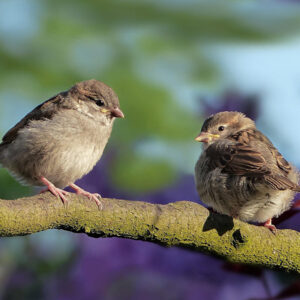
two sparrows perched on a branch outside
Photo by Oldiefan/Pixabay

Birds are everywhere. You find them in your backyard, in the trees, and flying within your field of vision while driving or walking. You hear them sing their songs and make their otherwise friendly bird sounds as they go from one place to another. There’s really little you can do to expel the bird from your daily life. And why would you want to? With many species bringing so many variations of appearance, size, and color, you’re likely to see and hear at least 10 different species in a single day. As beautiful and seemingly plentiful as these birds appear, they face a daily threat of predators, habitat disruption, and disappearing food sources. That’s why enlightened cities and towns are beginning to view themselves as a “bird-friendly community.”

Lights Out

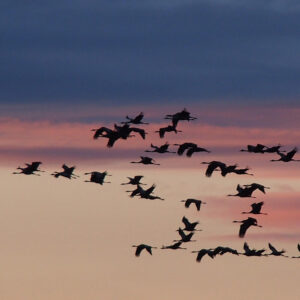
cranes in flight at sunset
Cranes flying at sunset. Photo by Katharina2013/Pixabay

So, what’s a bird-friendly community? It’s when a city or town takes it upon itself to legislate safeguards within the community to protect birds from a series of potentially dangerous things. In 2020, Lafeber posted an article about the dangers of building collisions in large cities with tall buildings during migration. These collisions were escalated due to the nighttime lighting of buildings. Birds are vastly dependent upon their natural instincts for travel in the airspace. As they migrate, strongly lit buildings within a metropolis have wreaked havoc on their navigational system and have killed many thousands of birds as they collide into buildings.

Birds are drawn to light. They use it to properly navigate. But when artificial lighting appears in their migratory travel, they are also drawn to it. As a result, some of the biggest cities in migratory pathways have decided to reduce their night lighting significantly by way of suggestion. Chicago, Dallas. Fort Worth, and Houston have responded with “lights-out” pacts that cater to the well-being of our birds.

In Texas, an initiative known as Lights Out Texas sought to partner with building owners to shut lights off. With nearly two billion birds passing through Texas annually from their southern stayovers, this initiative is essential to the many birds flying. (I live in Fort Worth. Living in close view of the city’s skyline, I can verify that the city is extremely dark at night from their light reductions.) Chicago has been involved in this practice since 1995 with their Lights Out Chicago initiative. Audubon Societies within the cities as well as the Cornell Lab of Ornithology have worked closely to produce favorable results.

Building Bird-Friendly Habitats

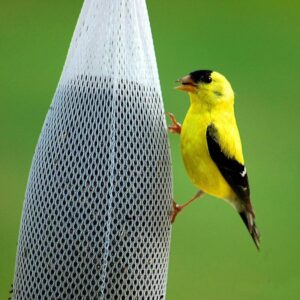
golden finch perched on the side of a bird feeder bag
Photo by paulbr75/Pixabay

But lighting is a protective measure designed to assist migrating birds. What about birds that are part of the ecological structure of a city or township? Many locations have gone to great lengths to install favorable habitats so birds of the area can find nesting homes and more safety. Within such parks and artificial habitats, significant efforts have been undertaken to install proper trees, plants, and flowers that naturally attract birds. These movements have rapidly spread throughout locations and contribute not only to the attraction and eventual well-being of the birds, but also to the people that emotionally enjoy birds being nearby.  New York City’s famed Central Park is one of the country’s greatest effort at combining nature with an urbanized metropolis. There are many enthusiasts that haunt this park for bird sightings of all kinds, including unusual stopovers.

Back yards become favored locations as property owners can naturalize their yards to create unique hot spots for visitation. Specific plants and trees coupled with clean and sanitized bird feeders and baths have contributed to extraordinary displays of bird gatherings. These bird-friendly spots allow for the photo capture of birds and might even allow for the rare picture of a mutated bird that shows up occasionally.

As cities, towns, and property owners begin to contribute to the well-being of nature’s birds, it can only lead to good things for all of us. Not only are our birds increasingly protected from the glare and intrusion of our technologies, but they are also the lucky recipients of naturalized spots to allow for them to live stress-free. If you’re interested in creating a bird-friendly spot, the internet is a vast resource of information that gives suggestions for every species. But it also delivers sound and proven solutions to problems that you yourself can help to correct…like turning your artificial lights off for the evening hours.

Lafeber’s Global Parrot Conservation Spotlight: Africa — Nigeria And The Democratic Republic Of Congo

African grey parrots
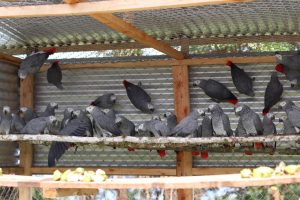
African grey parrots released back into the wild, photo courtesy World Parrot Trust

Africa is the native land to several old-world parrot species. This month we will look at the ongoing work to protect the Congo African grey in Nigeria and the Democratic Republic of Congo (DRC). These parrots are quite beloved and famed in captivity, but their very existence in Africa is in serious jeopardy. While the population has been rapidly collapsing, the current yet risky efforts to preserve this species are having some moderate success. However, more needs to be done, and soon! In 2016, Congo African greys were listed as “endangered” on the IUCN (International Union for Conservation of Nature) Red List of Threatened Species, and placed on Appendix I of CITIES (the Convention on International Trade in Endangered Species of Wild Species of Fauna and Flora).

Greys In Peril

By some official counts, over 1.2 million wild African greys have entered international trade over the last 40 years. That marks a huge dent in the population, and of course many do not survive the trip to their final commercial destination. Like many challenged species, their habitats are also now fragmented, which has implications for genetic diversity, food sources, and overall population growth. Unfortunately, it’s now very rare to find large roosting groups.

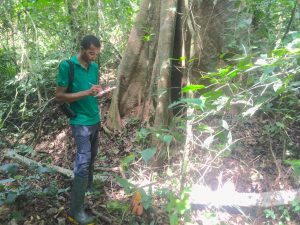
surveyor in Nigeria Okomu National Park, photo courtesy World Parrot Trust

Here are some of the projects underway in an attempt to make a future difference.

Surveying Greys In Nigeria

In Nigeria, surveys have been conducted at 28 sites throughout the country’s forests by the World Parrot Trust and local partners since 2018. These surveys have found a steep decline in the African grey population due to continued trapping, while in other areas without trapping the population is more resilient. That’s hopeful! These surveys also help to engage local communities, building the foundation for community-based conservation at key sites, which is absolutely essential to the success of any conservation effort. Nigeria has been a leader in securing protections for the greys. However, that message has not found its way to enough traders and consumers in some regions, and enacted laws are not yet well enforced. It is a hard work in progress, and COVID has added to that challenge.

African grey parrots
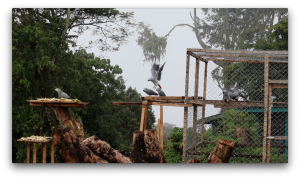
African greys pre-release; photo courtesy World Parrot Trust

Saving Greys In the Democratic Republic Of Congo

In the DRC, while efforts to dismantle illegal trafficking networks are beginning to take effect with multiple groups of parrots seized from traders, several hundred greys are still being trapped each month. The World Parrot Trust works with local authorities and rescue centers to provide emergency veterinary care for the birds that can be saved, and to improve rehabilitation and release programs. The good news—within the last year, three Congolese veterinarians have been trained to help with seizure cases to decrease the mortality rates, and an additional rehabilitation aviary was built to receive birds from three major seizures. In November 2020, the first group was released from the rehab facility, marking a major step forward towards sustaining the African grey population in the DRC.

African grey parrot
photo courtest World Parrot Trust

The key to success in both of these countries is a commitment from the local population to protect these birds as part of their heritage, preserve the forest lands needed, and find sustainable sources of income. Last fall, the DRC began making regular announcements on local radio stations to raise awareness about the plight of grey parrots, a hopeful step in the right direction.

Nigeria Okomu National Park, photo courtesy World Parrot Trust

Lafeber’s $500 GLOBAL PARROT conservation grant this month goes to a new community-based initiative to monitor and protect nests at an essential breeding area in Nigeria using newly trained and employed former parrot trappers. These sites were recently identified during surveys in coastal Nigeria. You can also help this new and important initiative. For more information or to make a tax-deductible donation, go to the World Parrot Trust website. Earmark your donation specifically for Congo African greys.


Inside Dr. Pepperberg’s Lab: African Greys Griffin And Athena Celebrate Their Hatchdates

A Very Merry (Un-)Hatchday in CovidLand….

African grey parrots
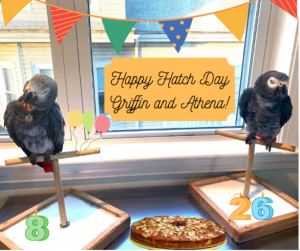
A little photoshop magic shows what we would have LIKED our party to look like. Courtesy of Dr. Irene Pepperberg

I felt that the title was appropriate, given that (a) everyone I know feels as though they have dropped down a “rabbit hole” this year, into a place as confusing as Alice’s Wonderland, and (b) for the second year in a row we will not be having a traditional celebration for our parrots’ hatchdays. Now, I realize that marking such dates has much more to do with human behavioral practices than parrot behavior, but that doesn’t mean that our birds haven’t enjoyed the events!

African grey parrots
Courtesy of Dr. Irene Pepperberg

Cake And Friends

Pre-COVID, we always did something special on a bird’s hatchday. Alex loved carrot cake, so we always made sure that we brought one into lab — he and the other birds would get one sliver each (sans the cream cheese frosting!) and the rest of us would heartily enjoy the remainder. Griffin’s love of apples —“banerry”— and almonds —“corknuts”— led to my lab manager finding a recipe for an incredible masterpiece made mostly of apples and almond flour. Given how much healthier her banerry-corknut cake is compared to commercial carrot cake, the birds could even have more than a sliver. And, given that Athena’s April hatchday is only three days after Griffin’s, we started having a joint celebration. Students who did not have shifts on the birds’ hatchdays would stop by the lab, which meant that many who never overlapped during the semester finally had a chance to socialize. And if we came upon some of the members of our department who were special friends of the parrots, we would invite them in, too, during the day. Given that the birds always have whatever toys they like in their cages, we never made a big deal about things like physical presents, but the way the parrots acted, it really seemed as though having a lot of the “flock” together all at the same time seemed to be a special treat of its own.

A More Intimate Gathering

The last two years, however, have been rather different. Last year, we absolutely could not have more than one person in our space at any one time. So…although we found some nice organic fruit-based bread that the birds could eat, it could be only in the presence of one person, and thanks to COVID, we also could not leave anything around for any of the humans to share. Last year was Griffin’s 25th, and we had really been looking forward to a slightly bigger celebration than usual, but such clearly was not the case.

African grey parrots
Courtesy of Dr. Irene Pepperberg

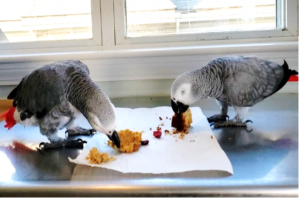
For this year, we thought about some kind of ZOOM event, but everyone is so totally ZOOMed-out, it seemed like it would be more of a chore than an event one would look forward to attending. However, now that about half of our skeleton crew has been fully vaccinated, we can begin to loosen up some of our restrictions, at least a wee bit. So, the birds DID get a home-baked (small!) cake that they and at least one of their human companions shared, with leftovers in the fridge. And we did take a picture and also photoshopped what we would have LIKED our party to look like, posting both the real and imagined “parties” on social media. Not ideal, but…

We are, of course, thankful that everyone in the lab — parrots and people — so far have been healthy and safe, and that there is another hatchday to celebrate. Moreover, we very much look forward to 2022, when we hope that the world will return to normal and when we can have a more traditional — and fun — time for everyone. In the meantime…stay safe!

A Rare Bird — The All-Black Chicken

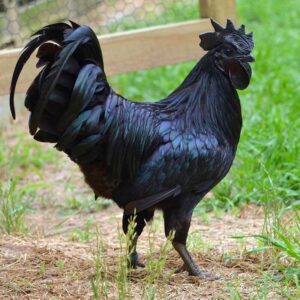
black chicken (Ayam cemani) standing in grass
Photo by Legendofgao, CC BY-SA 4.0, via Wikimedia Commons

Nature! You’re something else. Not only are you gifted with a wide array of tools for creation, but you’re also plenty handy with colors and imagination. It doesn’t take too long to glance around us and see just how diverse the world is with its many forms of life. Shapes, functions, kind, various orientations that span the spectrum from night living to essential day creatures; from the foods eaten to the locations lived in, and colors.

Did we say colors again? Why yes, I suppose we did. Since we’re mentioning colors, let’s look at an unusual and certainly uncommon creature that differs drastically from their normal kind, and even more so from the mutation that delivers albinism in so many things. Say hello to the Ayam Cemani — or to put it more easily, the black chicken.

A Different Kind Of Chicken

The assigned designation –Ayam Cemani– divides simply into a sensible description. Ayam means “chicken” in Indonesian, while Cemani translates to “thoroughly black.” The Ayam Cemani origin is found to be in Indonesia where they have been revered for more than a few centuries. In fact, the chicken is believed to have been used for religious ceremonies–and likely other types of ceremonies as well as early as the 12th century. What makes the Ayam Cemani chicken even more interesting is that not only are their outer appearance black, their internal organs, bones, and muscles are black as well. The only thing not black in or on an Ayam Cemani is the blood, which is found to be a normal color.

The coloration of the entire creature is a result of a genetic disorder called fibromelanosis or more simply, hyperpigmentation. The tissues of the bird are infused with excess pigmentation that impacts the entirety of the creature right through to the bones and muscles. The internal organs, tongue, beak, and well…everything else become black. This is a rare instance and because it is, these creatures are typically out of the hands of the average person. In the past, it was the rich and the powerful that kept these chickens to add more differentiation to themselves from the common people. Their rare existence contributed to a rise in cost. As always, creatures with strange but desirable abnormalities interest people, people who are willing to spend a lot to acquire a rarity in the animal kingdom.

Today, the acquisition of an Ayam Cemani is still a near impossibility, unless, of course, you have expendable cash. It is reported that a single adult Ayam Cemani is worth around $2,500 US Dollars. A chick can run around $200 each in some markets but you’re saddled with the hope they grow into the adult you want. They are equally rare because they only lay an estimated 80-100 eggs on an annual basis. Even then, there are no guarantees hens will hatch chicks because they are said to be unreliable as caring setters. The eggs they lay are cream-colored and unusually large. The males can get to 7 pounds and a female up to 5 pounds. There are breeders within the United States and other European countries who have worked to make these unique chickens more available. The Ayam Cemani is considered the rarest chicken in the world.

The Ayam Cemani creature is quite assuredly a beautiful one to look at. Way to go, nature!

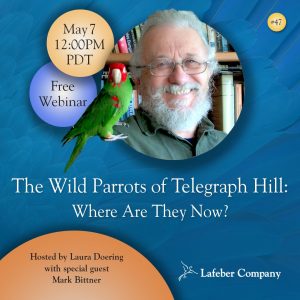
Webinar: The Wild Parrots Of Telegraph Hill: Where Are They Now?

Webinar: The Wild Parrots of Telegraph Hill: Where Are They Now?

Date: Friday, May 7, 2021

Time: 12:00 pm PDT (double-check your local time with this time zone converter)
Parrot lovers were captivated by the wild, feathered cast of the 2003 documentary by Judy Irving, as well as by their co-star, Mark Bittner. Join us for a Free, live, interactive webinar with our very special guest, Mark Bittner. Mark will talk about the film and the birds, including updates on both! This is a webinar you don’t want to miss! For those who haven’t seen the movie or want to watch it again, it is still available on DVD or for viewing online through several services.

About Mark

In 1973, at the age of 21, Mark Bittner left his home in Seattle for San Francisco with two aims: he hoped to make a career in music and to unravel the mysteries of consciousness. The only unraveling that took place was his hope to have a career in music, and he ended up on the street. But he never quit his pursuit of the mysteries of consciousness. Surprisingly, a lot of the loose ends of his many-years-long study came together in 1996 when he began to feed and observe a flock of wild parrots in San Francisco. Out of that experience came a book and a documentary film, both entitled “The Wild Parrots of Telegraph Hill.” Mark is currently working on a book and a complementary set of music recordings about the events that led up to his time as a homeless seeker. The book is called “Street Song” and the recordings are called “Street Songs.”

Missed our webinar? No problem! You can access the webinar in its entirety here:


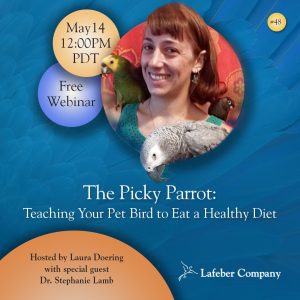
Webinar: The Picky Parrot: Teach Your Pet Bird To Eat A Healthy Diet

Webinar: The Picky Parrot: Teach Your Pet Bird to Eat a Healthy Diet

Date: Friday, May 14, 2021

Time: 12:00 pm PDT (double-check your local time with this time zone converter)
Help! My bird refuses to eat anything healthy! My bird isn’t going to touch that food! My parrot only wants to eat junk food! If any of this sounds familiar, you don’t want to miss this free interactive webinar hosted by Laura Doering, former editor of Bird Talk magazine and Birds USA magazine with special guest Stephanie Lamb, DVM, DABVP (Avian Practice). Dr. Lamb will discuss healthy foods your bird can eat, and most importantly, how to convince your bird to try new foods. Her tips and tricks will guarantee that even the pickiest parrot will be trying new foods in no time!

Missed our webinar? No problem! You can access the webinar in its entirety here:


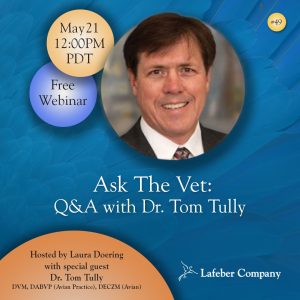
Webinar: Ask The Vet: Q&A With Tom Tully, DVM, DABVP (Avian Practice), DECZM (Avian)

Webinar: Ask The Vet: Q&A with Tom Tully, DVM, DABVP (Avian Practice), DECZM (Avian)

Date: Friday, May 21, 2021

Time: 12:00 pm PDT (double-check your local time with this time zone converter)

Webinar with Dr. TullyJoin us for a live, interactive webinar hosted by Laura Doering, former editor of Bird Talk magazine and Birds USA magazine. Our special guest Tom Tully, DVM, DABVP (Avian Practice), DECZM (Avian), will answer your questions about pet bird health, nutrition, care, and behavior problems. Is your bird’s problem health-related or behavioral? Are you offering the right foods to your pet bird? Ask the Vet!
Missed our webinar? No problem! You can access the webinar in its entirety here:


World’s Oldest Wild Bird Raising Chicks At Age 70!

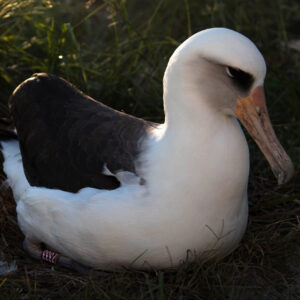
Laysan albatross named Wisdom sitting on nest
Photo “Wisdom sits on her nest, November 2020. Credit: Jon Brack/Friends of Midway Atoll NWR” by USFWS – Pacific Region, CC BY-NC 2.0

If you were to ask yourself—or a wider range of people—what is the one thing you’d like in your life, it’s probably a long and healthy life. You’d probably add to that a strong and positive outlook going forward. No one would disagree with you. (If they did, it’s probably time to sit down and have an honest and clarifying talk with them, right?) As for birds, they already have the potential for long life. Meet Wisdom the Albatross, who, at 70, has several distinctions to her peers in the wild. The first is that she is the oldest bird in the wild. On top of that, she’s also the oldest banded bird in the wild.

Wisdom is a Laysan Albatross who was estimated at being hatched in 1951. Captured in 1956, she was banded by Chandler Robbins, a scientist with the US Geological Survey. (Wisdom has outlived Mr. Robbins, who died in 2017.) It’s actually possible that Wisdom could be even older, as the scientists who captured her simply estimated her age as being 5 years of age then. But 70 works well for all purposes. In her tracking, scientists have logged a full 3,000,000 miles having been flown by Wisdom since her banding.

Laying Eggs At 70!

What makes Wisdom an interesting bird these days is the fact that she has recently laid and hatched an egg, her possible 36th in a line of successful hatchings at the old age of 70. In fact, it is stated that Wisdom has hatched an egg every year since 2006. This is unusual activity since most albatross birds take a year off between eggs. But not Wisdom. In her aging, she has likely felt the need to leave behind a legacy of family. Her latest egg was laid in late November of 2020 and hatched in February of 2021. Her mate is known as Akeakamai, who has been with Wisdom since 2012. Laysan albatrosses stay in monogamous relationships until the death of a mate force them to attach to another mate.

Wisdom has made the Midway Atoll National Wildlife Refuge her forever home. This refuge is located at the Midway Islands, which is a part of the Hawaiian collection of islands. The Midway Atoll Refuge is part of the larger Papahānaumokuākea Marine National Monument. Wisdom may lift off and fly long treks, but she always comes back to the refuge. In 2011, a 9.0 earthquake and subsequent tsunami impacted the Atoll killing an estimated 2,000 Laysan and black-footed albatrosses. Along with the adults, an unassessed but larger amount of chick hatchlings were also destroyed in the tsunami, which swept six miles inland at a speed nearing 500 mph. Wisdom survived that onslaught of nature.

A Look At Albatrosses

The Laysan Albatross is a small bird much like a seagull in size and appearance. They are largely found in the Hawaiian Islands. They are currently classified as NT (Near Threatened) on the IUCN conservation status list. They are vulnerable to extinction due to a variety of reasons. Chief among them is lead poisoning caused by ingesting lead-based paint chips. These chips are from buildings that the birds nest near. Plans are now underway to strip those buildings and to remove the toxic paint that led to the poisoning of the young.

Wisdom is quite the enduring bird. At 70, she has proven to be resilient in many ways. For that, we can only stand in awe and cheer Wisdom for her accomplishments.

Webinar: The Grey Way: Adoption – A New Start With Lisa Bono, CPBC

Webinar: The Grey Way: Adoption – A New Start with Lisa Bono, CPBC

Date: Friday, April 9, 2021

Time: 12:00 pm PDT (double-check your local time with this time zone converter)

Lisa Bono Webinar Join us for a free, live interactive webinar! Lisa Bono, CPBC, owner and operator of The Platinum Parrot and a certified parrot behavior consultant specializing in African grey parrots, presents Episode 3 of The Grey Way, a Lafeber Pet Birds Webinar Series focusing on Congo & Timneh African grey parrots as pets. Are you thinking of adoption? Concerned about the myth of a second-hand bird? Lisa will discuss how understanding the process will ensure a smooth transition and will help a bird in need get a new lease on life. Helping one bird won’t change the world, but it will change the world for that one bird.

Missed our webinar? No problem! You can access the webinar in its entirety here:


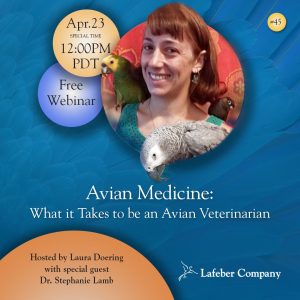
Webinar: Avian Medicine: What It Takes To Be An Avian Veterinarian

Webinar: Avian Medicine: What it Takes to be an Avian Veterinarian

Date: Friday, April 23, 2021

Time: 12:00 pm PDT (double-check your local time with this time zone converter)

We have all seen the terms Board Certified or Avian Specialist or noticed extra credentials behind the DVM after a Veterinarian’s name. What do these mean and how do they earn these? Dr. Stephanie Lamb discusses what it takes to become an Avian Vet and the specialized equipment needed in order to examine, diagnose and treat birds. What does a Vet learn about exotics in Vet School? Why won’t my dog /cat Vet treat my birds, too? Why does my bird need to be seen by an Avian Vet? Learn the answers to these questions and more during this FREE, live interactive webinar.

Missed our webinar? No problem! You can access the webinar in its entirety here:


Webinar: Heart To Heart: Pet Bird Behavior Q&A With Chris Davis

Webinar: Heart to Heart: Pet Bird Behavior Q&A with Chris Davis

Date: Friday, April 16, 2021

Time: 12:00 p.m. PST (double-check your local time with this time zone converter)

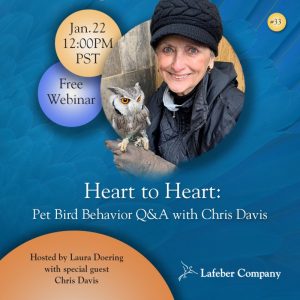
Join us for a free interactive webinar: Heart to Heart: Pet Bird Behavior Q&A with Chris Davis. This live event marks the return of the popular monthly Bird Talk Magazine feature, as a webinar. Chris will share a behavior case or problem and then field viewer’s behavior-related questions. Chris is a pioneer in avian behavior who has helped many bird stewards open the lines of communication and grow their bond with their feathered friends.

Missed our webinar? No problem! You can access the webinar in its entirety here:


Webinar: Ask The Vet: Q&A With Tom Tully, DVM, DABVP (Avian Practice), DECZM (Avian)

Webinar: Ask The Vet: Q&A with Tom Tully, DVM, DABVP (Avian Practice), DECZM (Avian)

Date: Friday, April 30, 2021

Time: 12:00 pm PDT (double-check your local time with this time zone converter)

Join us for a live, interactive webinar hosted by Laura Doering, former editor of Bird Talk magazine and Birds USA magazine. Our special guest Tom Tully, DVM, DABVP (Avian Practice), DECZM (Avian), will answer your questions about pet bird health, nutrition, care, and behavior problems. Is your bird’s problem health-related or behavioral? Are you offering the right foods to your pet bird? Ask the Vet!

Missed our webinar? No problem! You can access the webinar in its entirety here:


Inside Dr. Pepperberg’s Lab: More On Individual Differences In Parrots

African grey parrots
Griffin eyes his breakfast somewhat suspiciously while Athena looks on. Courtesy of Dr. Irene Pepperberg

I’ve discussed personality differences in parrots to some extent in previous entries but think that it is an important enough topic to revisit in some depth. To be perfectly clear, each bird has his or her specific personality. Like humans, some birds share certain traits and differ in others, but the combinations of all these traits are unique to an individual.

For example, all my birds have had somewhat different food preferences. Grapes are a constant favorite, but Alex would eat only purple ones…to the extent that he would throw a green one at a trainer and state, “Want grape—purple!” The other birds will eat both. For Griffin, bananas are acceptable only at a particular stage of ripeness. Griffin hates carrots in any shape or form, and (probably having learned from Alex) will throw the offending vegetable at any student hapless enough to put it in his bowl. He never much liked yam until he watched Athena gobble it down, and then warm yam became a favorite…but forget it when it gets cold.

Observational learning goes just so far, however. Athena adores Swiss chard and we bring it in whenever it is available. Griffin watches her enjoy eating this healthy green and consistently asks for it…but each time he takes a bite, he spits it out and shakes his head in what looks like disgust! We actually keep lists so as not to waste food—no sense in putting something in a bowl that will just be ignored or tossed.

Our birds also have serious differences when it comes to toys. Alex would chew on pretty much anything, as does Athena—but for Griffin, the only material that is worth shredding is paper. Griffin ignores just about any toy we put in his cage, as did Alex—but not Athena. She particularly loves her foraging toy and will preferentially forage for the same pasta that is available in a food bowl. That behavior actually inspired a student’s MA thesis—I’ll write about it once the paper is published.

African grey parrot
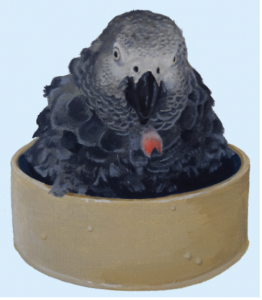
Athena squeezes in her water bowl to take a bath. Courtesy of Dr. Irene Pepperberg

Some of my birds have loved being showered—Alex would keep saying “Want shower!” until he was completely soaking wet. Athena and Griffin tolerate being showered; they both much prefer to try to take baths in their (quite large, but not quite adequate) water bowls—and both will totally ignore the presence of a more suitable container. Another bird, Kyaaro (who was in the lab only briefly, as he had ADHD and wasn’t really a suitable research subject) would bathe only if we gave him a partially water-filled plastic box (the size normally used for cat litter).

From Stranger Danger To Like At First Sight

As I mentioned in an earlier entry, they all react differently to strangers. Alex, for some reason, adored tall blond men. One theory is that he was hand-fed by someone who looked like that before I purchased him; whatever the reason, it was a clear preference. I’d hire a tall blond male student at the same time as a shorter dark-haired female (someone who even looked a bit like me), and the guy would have Alex climbing and trying to regurgitate in minutes, whereas the female would take days to earn his trust.

Griffin is wary of all strangers but does respond fairly quickly to my colleagues who have lots of experience working with nonhumans (folks who know not to stare at him immediately, to spend time talking with me first so that he sees my reaction to them as ‘safe’, and who can judge by his actions when he is ready to interact). Athena in contrast, hasn’t yet met a human whom she doesn’t like—although that doesn’t mean she won’t ignore or nip a trainer who wants her to do something SHE doesn’t find appealing at the moment.

Different Approaches For Different Birds

These personality differences also mean that we must approach training and testing somewhat differently for the different birds. Moreover, it also means that we often get different results for the different birds—and find that such individual differences might be really important when analyzing our data. My colleagues often have the same experience: Sometimes they will not see an overall effect, but then find that a subset of their birds can perform brilliantly while another subset seem to have little ability—or at least little interest—with respect to the task in question. For that reason, we all often claim that if one bird succeeds, the task is within the purview of the species. The argument is much like that for humans—not everyone is an Einstein, a Beethoven, or a Michelangelo—but we claim that humans are capable of brilliance in science, music, and art because of the masterworks of those individuals.

I don’t think that these differences in parrot personality can be attributed to male versus female behavior, given that Athena sometimes matches what Alex would do or like, and at other times matches Griffin. For the same reason, although observational learning likely plays a role in some similarities and differences, it cannot be the entire basis for their behavior patterns. The reasons for personality differences in parrots are likely a combination of the same reasons that exist in humans—an interacting mix of genetics and experiences. The main point is that we need to appreciate these individual differences, accept them, accommodate them, and not assume a ‘one size fits all’ response to the actions of our avian companions!

Lafeber’s Global Parrot Conservation Spotlight: Indonesia

Moluccan cockatoo
A Moluccan cockatoo pair perch together in their native Indonesia. Photo courtesy of the Indonesian Parrot Project

Wild parrots need our attention and help, not just to thrive but often simply to survive. Many worthy research and conservation organizations are working hard to protect a wide diversity of parrot species. Lafeber is committed to helping. We hope you will be inspired as well. This month takes us to Indonesia.

Originally known as Project Bird Watch, The Indonesian Parrot Project (IPP) was established in 2001 by Dr. Stewart Metz and Barbara Bailey. They first visited Indonesia in 2001, and were captivated by the people, birds, and exquisite islands. That trip changed their lives and inspired them to create IPP, whose mission over the last 20 years has grown to include conservation support for several parrot species: Moluccan cockatoos, Eclectus, various other cockatoos, great-billed parrots, and lorikeets.

cockatoo
A salmon-crested cockatoo in Indonesia. Photo courtesy of the Indonesian Parrot Project

Dr. Metz also shared his life with China, a wild-caught Moluccan, so he was deeply inspired to shepherd conservation of this endangered species. Stewart was a personal friend and mentor, and in 2003 he told me “these marvelous creatures are my passion. They grab at one’s heartstrings and then become almost a reason for being.” If you live with a Moluccan cockatoo, also referred to as a Salmon-crested or Seram cockatoo, you know what he means!

A Complicated Landscape

cockatoo
Photo courtesy of the Indonesian Parrot Project

Indonesia is a vast archipelago of over 17,500 islands and has a complicated geography. If a parrot is confiscated from a smuggler, it is not always clear which island that bird originated from or if it can be safely released. In addition, Indonesia is part of the Ring of Fire, and constantly subject to earthquakes, volcanic eruptions, floods, and other major weather events, often making travel and communication a challenge. The work of IPP and its Indonesian counterpart, Konservasi Kakatua Indonesia (KKI), is ambitious, enterprising, and often exhausting!

cockatoos in Indonesia
Photo courtesy of the Indonesian Parrot Project

We still have so much to learn about the lives of wild parrots, especially the most endangered and vulnerable ones. IPP is supporting several scientific efforts such as genetic, census, breeding, and ecologic studies. If you live with a cockatoo or Eclectus, don’t you want to know more about how they breed, build nests, and communicate with each other; as well as what they eat and what their flock dynamics are like? For those most endangered species, like Indonesian cockatoos, it is extremely important that we ask these questions and support those organizations that can help us find those answers before it is too late.

The Indonesian Parrot Project (IPP) was established in 2001 by Dr. Stewart Metz and Barbara Bailey.

Stewart Metz, who we sadly lost in 2017, knew that the only way to staunch the tide of poaching and trapping, was to help local populations find other sources of income and work. Habitats where parrots live are also places of great poverty, so it essential to create sustainable income for the local community. Therefore, IPP helps support the forest wardens who find and track active nests. It also supports local women’s cooperatives for arts and crafts, as well as organic farming.

The love Stewart Metz had for the Moluccan cockatoos and the people of Indonesia was palpable in everything thing he said and did. He remains an inspiration to this day, and his remarkable conservation work now continues in the good hands of Executive Director Bonnie Zimmerman and the Indonesian community at large. Check out the IPP documentary.

Community pride in Indonesia
The Indonesian community shows its parrot pride. Photo courtesy of the Indonesian Parrot Project

Lafeber’s $500 GLOBAL PARROT conservation grant this month goes to the Indonesian Parrot Project.  You can help too. For more information or to make a tax-deductible donation, go to: https://indonesian-parrot-project.org/ As they say in Bahasa Indonesia, “Sempai jumpa!”  (Cheers!)

Prosthetic Beak Saves Injured Wild Parrot

looking up at a white-eyed conure perched on a cord
This shows what a healthy, uninjured white-eyed conure looks like. Photo from Evelimlamaiara, CC BY-SA 4.0, via Wikimedia Commons

For many years, the technological ability to help repair damages to nature has been on the uptick. One of the most satisfying trends has been 3D printing of damaged and essential parts of creatures in our animal kingdom and their appendages. Some years back, a maliciously abused toucan by a teen gang in South America had its beak snapped off. It was replaced by the miracle of 3D printing. Since that event, other miracles have occurred that have enabled birds and other creatures to carry on with their lives. But as science improves so do its methods.

Parrot In Need Of A Helping Hand

Recently a white-eyed conure with a severely damaged beak was discovered in the wild and brought to a Brazil-based animal center. With the damage assessed, it was realized that the bird would have little chance of survival in the wild given the state of its beak. The beak was so severely damaged it was almost non-existent. Enter the visionaries of Renascer Acn in both the founder of the agency, Paulo Roberto Martins, and a veterinarian, Dr. Maria Ângela Panelli Marchió.

After the arrival of the parrot, the two professionals spent some time to figure what would improve the unfortunate accident to the parrot’s decimated beak. The solution was a resin creation of a beak that was affixed to the bird. The veterinarian had experience in critical situations and was essential to the restoration process. After a bit of rehabilitation, it was determined that the bird could never go back into the wild due to the possibility of the resin beak failing. The parrot was lucky once in being found and saved. It might not be so lucky a second time should the beak fail.

New Beak Offers A New Lease On Life

The parrot will reside in the home of Paulo’s Renascer ACN’s home-base with the newly assigned name of Maritaca. Currently, the facility houses around 150 birds. The facility was started back in 2017 after the rescue of a macaw parrot, who had hit a wire and was damaged. Rather than see the bird euthanized, Paulo decided to take care of the bird especially since it was known that the bird had eggs to care for. It was then that he decided to start the agency by which he now cares for many birds, including the parrot with the repaired prosthetic beak.

On average, the facility rescues about four animals a week. The facility is operated on donations, a stipend from the local government, and personal funds from the founder. As with many facilities, donations are welcomed and help to make the lives of creatures and birds better. One can easily imagine the possibility that the plight of the parrot with the damaged beak might have been unresolved if Renascer Acn were not available to provide the help it so desperately needed.

If interested, you can go to the Facebook page of Renascer Acn and watch their work unfold.

Spotting A Rare Beauty: Pied Mutation Rainbow Lorikeet

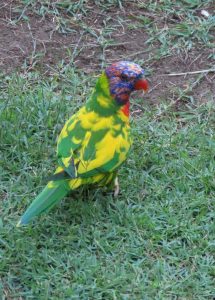
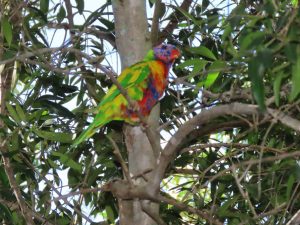
rainbow lorikeet (pied mutation)
photo courtesy Jayde Parrey

Nature has a funny way of evolving sometimes. One of its quirks is the mutation. Mutations can come in the way of color changes, and it can also slam up against the wall with a dual-sided male/female combination. We’ve seen this dual oddity in several birds, including the Northern Cardinal. Other mutations can be found producing excessive feather growth like in the Silkie Chicken or the Feather Duster Parakeet. And while many of these kinds of genetic mutations are rare, they show up more often than we would think they could. One such mutation is a coloration abnormality referred to as a “pied mutation.”

A pied mutation is when expected color displays in areas on a bird are replaced by patches of other colors that are not expected, as well as some unusual body markings. The mutated colorations in a bird fall under three types of pied mutation – dominant, recessive, and clearflight. Of course, there are multiple types of other kinds of mutations affecting birds, but for this article, we’ll stick with the pied mutation as the subject of this writing is a recently seen beautiful abnormality. The bird is a Rainbow Lorikeet that was recently spotted in North Rothbury, a small village located in the state of New South Wales in Australia. Although the Rainbow Lorikeet is a common bird in Australia, this one was anything but common.

photo courtesy of Jayde Parrey

Spotting a Rare Beauty

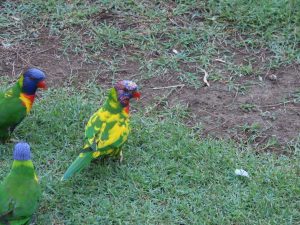
New South Wales resident, Jayde Parrey, discovered this unusually colored Rainbow Lorikeet in her yard along with around 20 other normal Lorikeets. According to Jayde, the mutated bird seemed to get along nicely with the flock it was spotted with. It fed with them and did all the things a bird normally does without displayed prejudice from the other birds. Jayde has lovingly named this bird Kalyn after a rugby fullback by the name of Kayln Ponga. The headgear worn by the footballer is as colorful as the head of the bird making it an easy choice to pair the names. Jayde has managed to get several excellent photographs of Kalyn, some of which Jayde has graciously provided to us as exclusive photos.

rainbow lorikeet
photo courtesy Jayde Parrey

A normal Rainbow Lorikeet has a solid green back with the front of the bird a palette of colors that led to the naming of the bird. Typically, that means an orange/yellow chest, a solid, blue-colored head, a greenish collar, and a beautiful solid blue belly. The spotted mutation (AKA Kalyn), perhaps the first of its kind spotted anywhere, has patches of different colors replacing the normal colors. The head is primarily blue but is a firework display of a mix of colors that include red and yellow. The expected collar is missing replaced by a continuation of the primarily green back. The back is patched with yellow displayed in a random patterning. The front of the lorikeet is heavily splotched with a non-patterned collection of orange, yellow, and blue. The coloration of the beak has determined Kalyn to be an adult Rainbow Lorikeet. Kalyn is nonetheless striking and is as beautiful as the normal “mates” it hangs with. Regardless, its difference to the others is striking making it an easily recognized oddity.

We like Kalyn.

Inside Dr. Pepperberg’s Lab: Parrots And Vocal Learning

close up on head and shoulders of African grey parrot
Photo by rbojanssen/Pixabay

Parrots are special not only because they are vocal learners, but also because they are open-ended vocal learners, able to learn new utterances their entire lives. Of the approximately 10,000 species of birds that have been identified, a bit fewer than half, less than 5,000, learn their vocalizations. Most of these are the 4,000 songbirds—called oscines—but only a small number of these, like European starlings (Sturnus vulgaris) and canaries (Serinus canaria), can learn new songs throughout their lives. Hummingbirds also learn their songs but not beyond their youth.

However, of the 350 species of parrots, all that have so far been studied do so. But not all parrots can learn the vocalizations of other species, such as human speech. Vocal learning itself is quite special, found only in humans, birds, bats, marine mammals, elephants, and possibly naked-mole rats (Barker et al., 2021). What exactly does vocal learning entail, and what is responsible for this special ability?

A Look At Vocal Learning

In general, vocal learning is not simply the ability to produce sounds. Many species do so, and do so in specific instances, such as a dog’s greeting bark versus its aggressive growl. Such species, however, do not learn their vocalizations. These utterances are innately specified and will develop in the absence of any input. The vocalizer, like the vervet monkey that uses different alarm calls in various contexts (Price et al., 2015), does need to learn the appropriate contexts for specific utterances, but not the utterance itself.

Vocal learners, in contrast, need both to hear input and hear it in the appropriate context to acquire the appropriate utterances and their appropriate uses. If raised in auditory isolation, vocal learners fail to acquire any real communicative behavior (e.g., Thorpe, 1958). If we compare species that do and do not exhibit vocal learning, we find differences in their vocal tracts (the parts of an individual’s anatomy used to produce sounds) and in a number of brain areas. It is these differences that enable the individual to learn the appropriate sounds from out of everything it hears—and learning what to ignore is just as important as learning what to acquire!—what they mean, when and how to use them, and how to produce them.

Birds’ “Song Systems”

I’m not a neurobiologist and therefore cannot discuss all the details of the changes in the avian brain that allowed the oscines and parrots to learn their utterances (for anyone who is interested, several papers by Michael Farries are referenced below), but a very simplified take-home message is that the areas responsible for such behavior evolved through the reorganization of existing areas plus the development of additional pathways in areas responsible for existing behavior; the anatomical structures controlled by these pathways could then be used in multiple ways (e.g., areas and pathways that are used to control the beak and tongue for singing evolved from those used to control the beak and tongue for eating so that these structures could be used for both activities; other areas evolved for acquisition of sound patterns, etc.).

The point is that once these areas for learning existed—known as the “song system”—such vocal learning allowed birds’ vocalizations to develop in amazing ways. For example, birds of the same species were able to adjust their repertoires into dialects so as to be heard more easily in specific ecological areas, some could expand the size of their repertoires, males and females could develop different singing styles—without going into all the possible variations, vocal learning allowed for innovation and adaptation, characteristics that release communication from rigid, innately specified responses to stimuli. And, with respect to parrots, new data (Chakraborty et al., 2015) provides evidence that (a) parrot brains uniquely contain a second song system (a shell) in addition to the core song system that they share with other avian vocal learners, (b) relative size differences occur in the core and shell regions among parrot species, and (c) parrots with a greater shell/core ratio (e.g., Greys) are those that can learn other species’ vocalizations compared to others (e.g., keas) with smaller ratios that do not.

No one really knows why certain birds like parrots are open-ended learners, but some theories about parrots involve their long lives—for example, parrots engage in specific vocal duets with their mates with whom they pair for life; however, over a long life, a bird is likely to lose a mate and then must be able to develop a new duet with a new partner. Another idea is that over their long lives, birds of various flocks might need to merge—or split—and thus acquire new dialects appropriate to the area.

Why Birds Learn To “Parrot”

Mynah bird with beak open sitting on perch
Some mynah bird species have become well known for their imitative skills. Photo by PublicDomainPictures/Pixabay

Why parrots might need to be able to learn other species vocalizations is also unknown. One suggestion arises from a study of Indian Hill mynah birds (Tenaza, 1976). In India, humans set out foods in shrines that are often scavenged by monkeys; mynahs learned to reproduce the alarm calls of monkeys and used the calls to scatter monkey troops just long enough to swoop down and steal some of the food. Munn (1986) documented non-parrots that used alarm calls of other avian species to dupe them just long enough to swoop in to grab their insect prey.

Perhaps the same is true of parrots who want to grab bites of ripe fruit or nuts from other species? In the wild, African grey parrots have been documented as producing the sounds of nine different bird species and a bat (Cruickshank et al., 1992), but the authors did not suggest any reason for this behavior. Might another possibility be that a larger repertoire would make a bird a more interesting mate, because its duet would be more distinctive from those of other pairs? Or maybe it relates to the need to communicate in mixed-species flocks? Chapman et al. (1989) describe such flocks in Costa Rica but do not report any vocal behavior. In captivity, parrots generally learn human speech as a means of integrating themselves into their human “flock,” or acquire other sounds that they have observed attract the attention of their human owners.

Only further research will answer all our questions!

References

Barker, A.J., Veviurko, G., Bennett, N.C., Hart, D.W., Mograby, L., & Lewin, G.R. (2021). Cultural transmission of vocal dialect in the naked mole-rat. Science, 371, 503-507.

Chakraborty, M., Walløe, S., Nedergaard, S., Fridel, E. E., Dabelsteen, T., Pakkenberg, B., … & Jarvis, E. D. (2015). Core and shell song systems unique to the parrot brain. PLoS One, 10(6), p.e0118496.

Chapman, C.A., Chapman, L.J., & Lefebvre, L. (1989). Variability in parrot flock size: Possible functions of communal roosts. Condor, 91, 842-847.

Cruickshank, A.J., Gautier, J-P., & Chappuis, C. (1992). Vocal mimicry in wild African Grey Parrots Psittacus erithacus. Ibis, 135, 293-299.

Farries, M.A. (2001). The oscine song system considered in the context of the avian brain: lessons learned from comparative neurobiology. Brain, Behavior and Evolution, 58, 80-100/

Farries, M.A. (2004). The avian song system in comparative perspective. Annals of the New York Academy of Sciences, 1016, 61-76.

Munn, C.A. (1986). Parrots that ‘cry wolf”. Nature, 319, 143-145.

Price, T., Wadewitz, P., Cheney, D., Seyfarth, R., Hammerschmidt, K., and Fischer, J. (2015). Vervets revisited: A quantitative analysis of alarm call structure and context specificity. Scientific Report,5, 13220. doi: 10.1038/srep13220.

Tenaza, R.R. (1976). Wild mynahs mimic wild primates. Nature, 259, 561.

Thorpe, WH. (1958). The learning of song patterns by birds, with special reference to the song of the chaffinch, Fringilla coelebs. Ibis, 100, 535–570.

Webinar: Ask The Vet: Q&A With Tom Tully, DVM, DABVP (Avian Practice), DECZM (Avian)

Webinar: Ask The Vet: Q&A with Tom Tully, DVM, DABVP (Avian Practice), DECZM (Avian)

Date: Friday, March 26, 2021

Time: 12:00 pm PDT (double-check your local time with this time zone converter)

Join us for a live, interactive webinar hosted by Laura Doering, former editor of Bird Talk magazine and Birds USA magazine. Our special guest Tom Tully, DVM, DABVP (Avian Practice), DECZM (Avian), will answer your questions about pet bird health, nutrition, care and behavior problems. Is your bird’s problem health related or behavioral? Are you offering the right foods to your pet bird? Ask the Vet!
Missed our webinar? No problem! You can access the webinar in its entirety here:


Webinar: Grey Parrot Anatomy Project: An Update And Relevance To All Parrot Species

Webinar: Grey Parrot Anatomy Project: An Update & Relevance to all Parrot Species

Date: Friday, March 19, 2021

Time: 12:00 p.m. PDT (double-check your local time with this time zone converter)

Scott Echols, DVM, DABVP(Avian Practice) is the founder of the Grey Parrot Anatomy Project and will give updates on the comprehensive study. The information gained goes beyond simply identifying anatomy and has been used to better diagnose and treat a multitude of diseases that affect pet birds. New imaging technology and future directions will be presented.

Missed our webinar? No problem! You can access the webinar in its entirety here:


Webinar: Where Do Baby Parrots Come From? A Veterinary View Of Avian Reproduction

Webinar: Where do Baby Parrots Come From? A Veterinary View of Avian Reproduction

Date: Friday, March 12, 2021

Time: 11:30 a.m. PST (double-check your local time with this time zone converter)

Whether you breed birds or have pet birds, it’s important to understand how a bird’s reproductive system works and to be aware of possible health concerns. In this webinar, Dr. Stephanie Lamb will discuss avian reproductive anatomy and physiology, as well as possible treatment strategies for related issues.

Missed our webinar? No problem! You can access the webinar in its entirety here:


Webinar: Heart To Heart: Pet Bird Behavior Q&A With Chris Davis

Webinar: Heart to Heart: Pet Bird Behavior Q&A with Chris Davis

Date: Friday, March 5, 2021

Time: 12:00 p.m. PST (double-check your local time with this time zone converter)

Show your feathered friend how much you love them by tuning in to this free webinar focused on bird behavior and the human-bird bond. Inspired by her former Bird Talk Magazine column, Heart to Heart: Pet Bird Behavior Q&A, Chris will share a behavior case or problem and then field viewer’s behavior-related questions. Chris is a pioneer in avian behavior who has helped many bird stewards open the lines of communication and grow their bond with their feathered friends.

Missed our webinar? No problem! You can access the webinar in its entirety here:


Lafeber’s Global Parrot Conservation Spotlight: Bolivia

blue-and-gold macaws
Blue-and-gold macaws
photo by CLB/ José Antonio Díaz Luque

Wild parrots need our attention and help, not only to thrive but often simply to survive. Many worthy research and conservation organizations are working hard to protect a wide diversity of parrot species. Lafeber is committed to helping. We hope you will be inspired as well.

This month takes us to Bolivia, South America. The Conservación del Loro Boliviano Foundation, or CLB, (www.fclbolivia.org), is a relatively new organization. Formed in 2011, it describes itself as young, but full of life. Based in the city of Santa Cruz de la Sierra, CLB is comprised of people with a deep conviction to the preservation of biodiversity and habitats. The Conservation Director is José Antonio Díaz Luque, who is also a conservation programs facilitator for the World Parrot Trust.

Bolivia is home to more than 2,900 animal species, including over 1,400 birds (about 14% of birds known in the world, and the sixth most diverse country in terms of bird species).. There are 54 Psittacine species, ranging from the critically endangered red-fronted and blue-throated macaws, to a diverse number of other macaws, Amazons, conures, and Pionus species. 

Bolivia has gained global attention for its “Law of the Rights of Mother Earth,” which accords nature the same rights as humans. Passed in 2010, it defines Mother Earth as “…the dynamic living system formed by the indivisible community of all life systems and living beings whom are interrelated, interdependent, and complementary, which share a common destiny.” This law recognizes the need for equilibrium, restoration, clean air and water, and, most importantly, the diversity of life. This is good news for parrots.

On the other hand, one third of the country is in the Andean mountain range and home to 20% of the world’s glaciers. This means Bolivia is particularly sensitive to climate change. We know that a change to any part of a habitat may greatly affect another, and all the ecosystems associated with it. This may leave parrots more vulnerable.

Bolivia is also home to a lush Amazon basin, as well as dry, rugged scrub filled with cacti. Parrots are indigenous to all these areas. Protecting wild parrots requires action on many fronts, and it is especially complicated given the wide diversity of habitat and life in Bolivia.

Here are some of the important things the CLB Foundation has done recently.

Rescue & Rehabilitation

blue-and-gold macaw
Blue-and-gold macaws are released in the wild.
photo by CLB/ José Antonio Díaz Luque

Birds confiscated by trappers often require medical care and rehabilitation. CLB participated in a 20 month rehabilitation effort for a group of blue-and-gold macaws, yellow-chevron parakeets, and white-eyed conures. They were successfully released back into the wild in December 2019, the first parrot release ever authorized in Bolivia. Upon observation of the birds one month later, the results were very positive!

CLB is also working with the Endangered Species Research Center (CIESA) to develop critical facilities for parrot rescue and rehabilitation. This will be the first facility on its kind Bolivia, a country where the illegal parrot trade is still a massive problem, so there is an overwhelming need for proper rehabilitation and release. 

Community Outreach

Critical to conservation is an interested and committed local community. Without this support, trappers have few constraints, and habitat is destroyed. CLB knows that, and this is why it is laser focused on supporting local organizations that are leaders in conservation in their regions.

These communities promote fairs and events that not only promote conservation but also generate economic activity for the local population.

For example, CLB supported the development of the first festival for the conservation of the blue-throated macaw in the Gran Mojos Municipal Protected Area, and 50 people from the local community participated in activities such as drawing, painting, talks and a field activity to learn about the blue-throated macaw in the wild. For the red-fronted macaw, CLB supported the Jardin Cactaceas Municipal Protected Area in the development of its first fair for the endangered red-fronted macaw, where more than 60 participants were able to purchase products derived from mango fruits, liqueurs, and jams from eight producers of the communities of Anamal and Las Juntas, an important breeding region.

Involving children is especially important! The goal is to increase and maintain community pride and participation for years to come, as well as ensure new activities are created to support community development. CLB is committed to this huge effort.

Research & Publications

The Conservation Director of CLB, José Antonio Díaz Luque, was one of 11 contributing authors to the October 2019 study about the ecological reasons that parrots waste food. This study involved 103 parrot species, including 26 from Bolivia. What wild parrots eat is also an important area of research, and helps us better understand our parrots in captivity. In April 2020, he was also an active participant in a published scientific study on the critical role of blue macaws (including the hyacinth macaw) in seed dispersal in their natural environments, which shows the importance of the species in the ecosystem and the need to preserve them.

Habitat & Environmental Protection

green-wing macaw
green-wing macaw
photo by CLB/ José Antonio Díaz Luque

Protecting existing nests is essential. Equally important is expanding potential habitat areas. This often means working with private land owners to minimize habitat loss. CLB is building relationships with local ranchers to locate nests and preserve those areas on private property, as well as continuing support the protected areas team where those endangered species survive.

Lafeber’s $500 GLOBAL PARROT conservation grant this month goes to the CLB Foundation for its continued good works. There are several ways you can also help the parrots of Bolivia.  Visit the CLB campaign page or make a tax-deductible donation through the World Parrot Trust (parrots.org) specifically noting it is for CLB.


Webinar: The Grey Way—African Grey Behavior

Webinar: The Grey Way—African Grey Behavior

Date: Friday, February 19, 2021

Time: 12:00 pm PST (double-check your local time with this time zone converter)


Lisa Bono, CPBC, owner and operator of The Platinum Parrot and a certified parrot behavior consultant specializing in African grey parrots, presents Episode 2 of The Grey Way, a Lafeber Pet Birds Webinar Series focusing on Congo & Timneh African grey parrots as pets. This episode tackles on common behaviors and quirks exhibited by pet greys. Is this a normal behavior or a problem behavior? Learn how to recognize the difference and what to do during this free, interactive webinar.

Missed our webinar? No problem! You can access the webinar in its entirety here:

Additional References:

https://www.facebook.com/LisaABonoParrotBehaviorConsultant/videos/743529335737790

https://www.facebook.com/LisaABonoParrotBehaviorConsultant/videos/4646222597189/


Webinar: Ask The Vet: Q&A With Tom Tully, DVM, DABVP (Avian Practice), DECZM (Avian)

Webinar: Ask The Vet: Q&A with Tom Tully, DVM, DABVP (Avian Practice), DECZM (Avian)

Date: Friday, February 26, 2021

Time: 12:00 pm PST (double-check your local time with this time zone converter)

Join us for a live, interactive webinar hosted by Laura Doering, former editor of Bird Talk magazine and Birds USA magazine. Our special guest Tom Tully, DVM, DABVP (Avian Practice), DECZM (Avian), will answer your questions about pet bird health, nutrition, care and behavior problems. Is your bird’s problem health related or behavioral? Are you offering the right foods to your pet bird? Ask the Vet!
Missed our webinar? No problem! You can access the webinar in its entirety here:


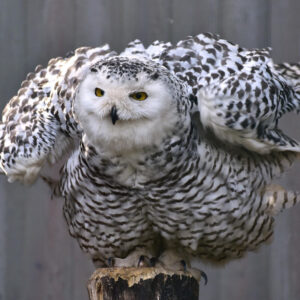
Rare Snowy Owl Lands In Central Park NYC

snowy owl with wings spread standing on post
Photo by sipa/Pixabay

One hundred years is a lot of change for Earth. From technological advances, environmental changes, prevalent thought, and evolutionary movement, a hundred years can be defining in its historical containment. As the stress of Covid isolation rages on, the interests of birdwatchers, especially those who look for rare appearances, have concentrated on the arrival of a snowy owl. Ok. No big deal, right? Well, this one is, as it’s the first documented sighting of the snowy owl in New York’s City’s famed Central Park since 1890. That’s well over 100 years of history and change for the park and the city between sightings.

Spotting A Rarity

The snowy owl arrived in the park on January 27, 2021. The popular twitter account, @birdcentralpark, run by noted birder, David Barrett (with a verified follower base of 4,200 birders), alerted readers to the arrival of the raptor at around 10:30 am. In little time, the park had more than 100 onlookers catching sight of a probable ‘once in a lifetime’ viewing of the majestic bird. The party of viewers were respectful but were policed by the New York City Urban Park Rangers. Dogs were leashed and not allowed to disturb the bird as it stayed behind a fenced location of baseball fields at the Park’s Northern Meadow field. During the stay, the owl contended with a few crows, and a hawk, all displeased with its arrival. By 6:30 pm the snowy owl had lifted wings and flown away. The extended stay charmed the masses and gave plenty of opportunity for rare photos, a chance to educate themselves, and a lucky spot to watching an owl out of the ordinary for the spot.

A Snow Bird

The snowy owl is a bird of the Arctic region where it spends its summers. It is migratory, which leads it to other locations primarily found in Canada and the upper regions of the US. There are some that find their way to Siberia. But with the changes in the weathering of the environment, these magnificent birds have changed their patterns as noticed by the unusual arrival of the snowy owl in Central Park.

The snowy owl is a large creature with a wingspan that can reach over 5 feet in the male and a maximum of 6 feet for the female. The male can be measured as large as 25 inches in length while the female can be slightly larger, measuring 28 inches in length. Make no mistake, these raptors are quite sizeable and can be intimidating. They are nocturnal hunters of prey and are carnivorous, often eating their catch whole.

They are listed as Vulnerable, which is the first stage in the Threatened category of the IUCN (International Union for Conservation of Nature). There are approximately 28,000 mature Snowy Owls in existence (not counting juveniles) with a decreasing trend attributed to global warming. The lifespan of a Snowy Owl is approximately 8 years in length. You can review pertinent conservation data of the Snowy Owl at the IUCN site (here).

The snowy owl that graced the stage for the NYC Central Park birdwatchers is considered to be a juvenile. It is suggested that the dark bars on the wings indicate its youthful status. Regardless, this sighting will be a warm memory for the few that were able to see the grand creature.
The @birdcentralpark Twitter account posted this video of the snowy owl.

Posted in New

Webinar: Heart To Heart: Pet Bird Behavior Q&A With Chris Davis

Webinar: Heart to Heart: Pet Bird Behavior Q&A with Chris Davis

Date: Friday, February 12, 2021

Time: 12:00 p.m. PST (double-check your local time with this time zone converter)

Join us for a free interactive webinar: Heart to Heart: Pet Bird Behavior Q&A with Chris Davis. This live event marks the return of the popular monthly Bird Talk Magazine feature, as a webinar. Chris will share a behavior case or problem and then field viewer’s behavior-related questions. Chris is a pioneer in avian behavior who has helped many bird stewards open the lines of communication and grow their bond with their feathered friends.

Missed our webinar? No problem! You can access the webinar in its entirety here:


“Twitching” Is Bird Watching At Its Extreme

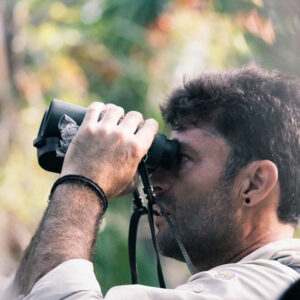
close up on man holding binoculars up to eyes
Photo by Forest Simon/Unsplash

Let’s face it. We love our birds. We love them in the wild where we can watch them being completely themselves uninterrupted by anything other than being aware of preying species. And we certainly wouldn’t be here if we didn’t love exotic birds in our care. Every color, every revelation of intelligence, and every sighting makes our pulse quicken in ways that other seemingly mundane world views do not. (Do you get excited over a traffic jam, messy roadways, and other unsightly or unwanted visual stimuli? I thought not.) Birds are in our everyday life in so many ways. If you’re one of the lucky ones who care for a winged friend, then this is even more accentuated.

There are a group of extraordinary people that take birding (watching them in the wild as a hobby) to an even greater extreme. They count the ability as a tremendous gift made freely available to them. Some go to great lengths to catch sight of a bird that is rare to the human eye. There is a developed term for these birdwatchers. It’s called “twitching.” Yeah, I know. Me, too! I was pleasantly surprised to discover such a term and behavior, but it exists. And it is a noun used to describe an obsessive compulsion to travel great distances to find otherwise rare birds, birds that would not normally be seen in a natural setting.

What’s With The Twitch?

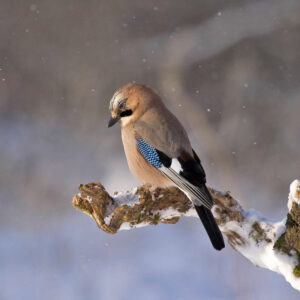
jay perched on snow-covered branch outdoors
Photo by TomaszProszek/Unsplash

Twitching is a revered application of an assigned phrase to describe those who are extreme birdwatchers. As the story goes, the term derives from a story of two British bird fans from the ’50s who used motor bikes to travel from location to location just to catch sight of a bird they have not seen. Cold weather did not deter these two UK fans in preventing them from an immersive experience.

As the weather grew even colder, the two would shiver on their bikes – or “twitch.” The term stuck and is now used worldwide to describe those who stop at nothing to catch sight of a rare bird found in a discovered location. If you were to look on the internet for the origin of twitching, you’re more likely to discover that the term is attached to Howard Medhurst, an avid British birdwatcher. He exhibited a twitchy motion as part of his normal behavior pattern. He would travel great distances to catch sight of a bird, all at the drop of a hat. That makes twitching a more revered and honorary designation for a person who is super-indulging in an acquired and compulsive habit of birdwatching.

Extreme Birding

Today, to “twitch” means to stop at nothing to catch sight of any bird. No expense is spared, no location too far, and no means are too difficult if it will present a wonderful view of a bird that few are lucky to see in the wild. Recently, a surge of twitchers flocked (sorry) to a location in Maryland at the Chesapeake & Ohio Canal National Park to catch sight of an unusual appearance of a Painted Bunting. The bird is explained to be too far north for its normal movement, but this one out of place bird captured the fancy of every avid birder–or twitcher worldwide to catch sight of this beautiful bird away from its normal range. This sighting caused entry snarls to the park and was the place to be for lovers of birds. Armed with cameras–some quite expensive–twitchers from all over shivered in the cold weather simply to snap a lasting photo.

Twitchers go the extra mile for everything simply to tick a rare bird sighting off a meticulously compiled list. Simply put, a twitcher is the most avid, the most enthusiastic of all birdwatchers…or more likely, bird-chasers.

Do you twitch?

Webinar: Love Is In The Air: Am I Sending My Parrot The Wrong Signals?

Webinar: Love is in the Air: Am I Sending My Parrot the Wrong Signals?

Date: Friday, February 5, 2021

Time: 11:30 am PST (double-check your local time with this time zone converter)

Dr. Lamb February 5 webinar

Dr. Stephanie Lamb will discuss the signals we send to our birds that can actually be hormonal triggers. This can include body language, physical contact or even how we house them or the environment we provide. Can foods be a trigger? Are any of the toys or enrichment items a trigger? What is the possible harm to my bird or how can triggering my bird’s hormones affect his or her behavior? Learn the answers to these questions and more during this free, interactive webinar.

Missed our webinar? No problem! You can access the webinar in its entirety here:


Inside Dr. Pepperberg’s Lab: Some Parrots Dislike Uncertainty And Novelty

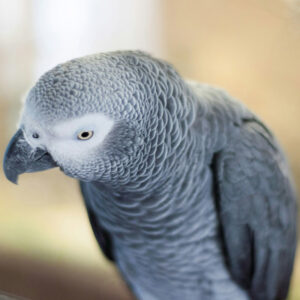
African grey parrot sitting and looking downward with head tilted to side
Photo by Hannah Dickens/Unsplash

Nonhumans run the gamut in terms of where they land on a scale of neophobia (dislike of novelty) and neophilia (attraction to novelty), and birds are no exceptions. Some birds that one might expect to be very “bold” because of their size and overall behavior patterns, like ravens, are actually quite neophobic. My colleagues who work with ravens say that it may take several months before a raven will explore a new apparatus placed in their enclosure (Bugnyar, pers. comm.), and when I’ve visited their large aviaries in Austria, just my appearance sends the ravens to their furthermost perches. Urban crows, in contrast, although still skittish, are much more exploratory (Greggor et al., 2016).

Parrots: Curious or Skittish?

Different parrot species also respond differently. As soon as I entered the kea aviary, a short walk from that of the ravens, half a dozen parrots landed on or near me, and I was glad that I had removed all my jewelry and covered the buttons on my shirt with a zippered hoodie; I had to chase them from my hair clips, which they viewed as a new toy. Goffin’s cockatoos responded similarly; in fact, one was quicker than the keas and made off with a hair clip! In contrast, African greys and most Amazon parrots, although not nearly as neophobic as ravens, often take a while to accept novelty of any sort.

Goffin's cockatoo sitting on branch
Goffin’s cockatoos are more inclined to exhibit neophilia (attraction to novelty). Photo by RoyBuri/Pixabay

Not surprisingly, parrot neophilia/neophobia has been the subject of several research studies. Mettke-Hoffman and colleagues  (2002) argue that neophobia and exploratory tendencies in parrots are related to the costs (e.g., predation risk, risk of eating noxious food) and benefits (e.g., finding unexploited foraging sites, nest sites, or mates) of engaging in exploration, and that species that must deal with highly variable environments in nature tend to be less neophobic. Fox and Millam (2007) also found, at least for orange-winged Amazon parrots, that early exposure to various toys and other objects decreased—though did not eliminate—the neophobia that normally develops with age. The bottom line for our feathered companions seems to be that we need to start early when introducing novelty and, in later life, give them plenty of time to adapt to new items.

From my experience in Austria, I learned that neophobia involves people as well as objects. I’ve often been told that greys are “one-person” parrots—but all my birds, from the time they entered my lab (from 7.5 weeks to ~1 yr) were exposed to multiple people on a daily basis, including students who rotated in and out each year. I think that is why all of my students have always been able to handle all of my birds. That doesn’t mean that birds and students don’t have favorites (they do; Griffin will always be a momma’s boy), but it does mean that, with very few exceptions, my parrots work with everyone in the lab.

It may take a student several weeks to gain the trust of a particular bird, and my birds definitely recognize someone with experience in handling animals (Griffin, who is wary of strangers, immediately climbed up for Frans de Waal, a famous primatologist, and for Thomas Bugnyar, the raven researcher mentioned above), but in 40-plus years I’ve had to let go only one student who couldn’t handle the parrots.

Sticklers To Schedules

Interestingly, I’ve found that more than anything else my greys dislike changes in their daily schedule. They seem to have an internal clock that tells them when it is time for lunch and dinner, and object to any alterations. If I lose track of time (when writing this blog, for example!), and it gets close to dinner time, both Griffin and Athena start squawking. Alex would specifically call out “Want GRAIN!”

They also really get cranky when we have to change the trainers’ schedules every semester (because of class schedule changes) and between semesters, when several students usually take vacation time. Even when the birds normally get along really well with a student, if she covers for another trainer during a particular shift, both birds will often refuse to comply with her requests. And, because my birds seem to understand numbers, and I tell them how many days I’ll be gone when I have to go to a conference, they seem very upset if my flight is cancelled and I am not back when promised! I’m often greeted with pile of chewed-off feathers on my return, to let me know in no uncertain terms how inappropriate my behavior has been. I believe that some of this behavior goes back to the subject of the previous blog, trust. Because captive parrots depend on humans for basics, they have to be able to trust that we will always be present for them….thus, if they think we are letting them down…

Furthermore, being suspicious of change is one way to ensure that their environment is benign (hey, that misplaced rock could be evidence that a predator is near!); when living in our homes, they also have to trust that we will keep their surroundings safe. Therefore change must be introduced gradually. Interestingly, I’ve learned that if my students and I play with a toy, show the bird how it works, even act as though it is our toy and something the parrot shouldn’t have…well, that will likely spark a lot of curiosity!

African grey parrot
Athena happily playing with a toy that would scare Griffin. Courtesy of Dr. Irene Pepperberg

It is also obvious to me that each parrot has his or her own personality, and broad generalizations don’t always apply. Griffin and Athena couldn’t be more different. At 7 years old, Athena acts like a chick. She adores new people and if a new toy has any similarity to an old one, I can barely hang it in her cage before she investigates. None of my other African greys were quite so inquisitive after reaching maturity, and Griffin is particularly wary of strangers.

In sum, as I’ve said before, we must really be attuned to our feathered friends. Each bird, just like each of our human friends, has a different personality, with different interests, needs, wants, and preferences. They may each have different favored foods, toys, perches, etc. Being aware of these differences, particularly their tolerance for change, will improve everyone’s lives!

References

Fox, R.A, & Millam, J.R. (2007). Novelty and individual differences influence neophobia in orange-winged Amazon parrots (Amazona amazonica). Applied Animal Behaviour Science, 104, 107-115

Greggor, A., Clayton, N., Fulford, A., & Thorton, A. (2016).  Street smart: faster approach toward litter in urban areas by highly neophobic corvids and less fearful birds.  Animal Behaviour, 117, 123-133.

Mettke-Hofman, C, Winkler H., & Leisler, B. (2002). The significance of ecological factors in exploration and neophobia in parrots. Ethology, 108, 249-72.


Webinar: Ask The Vet: Q&A With Tom Tully, DVM, DABVP (Avian Practice), DECZM (Avian)

Webinar: Ask The Vet: Q&A with Tom Tully, DVM, DABVP (Avian Practice), DECZM (Avian)

Date: Friday, January 29, 2021

Time: 12:00 pm PST (double-check your local time with this time zone converter)

Thomas Tully, DVMJoin us for a live, interactive webinar hosted by Laura Doering, former editor of Bird Talk magazine and Birds USA magazine. Our special guest Tom Tully, DVM, DABVP (Avian Practice), DECZM (Avian), will answer your questions about pet bird health, nutrition, care and behavior problems. Is your bird’s problem health related or behavioral? Are you offering the right foods to your pet bird? Ask the Vet!
Missed our webinar? No problem! You can access the webinar in its entirety here:


Starling Murmurations: A Sight To Behold

Starling Murmuration
Airwolfhound, CC BY-SA 2.0, via Wikimedia Commons

The visual beauty of nature always seems to capture our imagination in unexpected ways. Whether that might be the stunning colors and natural attributes of a bird in your backyard (cardinals, jays, hummingbirds, and buntings to name a few), the displays of affection by creatures, or even the beautiful flight of exotic birds in exotic locales, nature never ceases to draw a gasp when it runs into your field of vision.

One of the more amazing displays of nature and physics are the murmuration clouds of starlings. If you’ve seen one, then you already understand the awe of the display as hundreds of birds navigate with precision to fly in concert with each other.

Recently, a massive gathering of starlings delighted crowds in San Rafael, CA. It is said that thousands upon thousands of the European Starlings have gathered in locations and have commenced to provide artistic displays of their murmuration phenomenon. It is reported that the birds begin their show like clockwork at around 4:30 pm – 5:00 pm. They mesmerize gathering crowds as they arrive to take in the sight. The birds have done this for several weeks. Watchers have been incredibly touched and say that the “show” appears to be undertaken by “a million” birds.

Murmurations Explained

murmuration of birds over a wood dock in ocean
Photo by Hamish Duncan/Unsplash

What are murmurations? It is thought that the starlings undertake this procedure as means to keep warm in colder climes. It is also thought that it is a defensive maneuver that is evolutionarily designed to thwart the precision of predators making it nearly impossible to zero in on any one bird in the swarm. There are amazing physics involved in this procedure. (If you have seen this particular display in San Rafael, please leave a comment, or better, a photo.) Dusk in San Rafael will never look the same for the onlookers who took time to watch this new display of their current Starling residents once the birds move on, as they usually do.

The Art Of Murmurations

Photographer Søren Solkær, who who hails from Denmark, is known for his photography of the famous and popular. He has changed his focus to the capture of starling murmurations. And his photos are incredible. His newfound interest over the last few years have led him to capture some of the most important views of murmurations in an artistic manner. He states, “starlings move as one unified organism…”, which poetically describes the visual treat the birds supply.

Solkær began a project of photographing starling murmurations back in 2017, calling his project Black Sun. With a group of photographs, many of them ethereal and inspiring in their viewing, he has created beautiful and unforgettable scenes of unique murmurations. He has referred to these individual scenes as “…an ink drawing or a calligraphic brush stroke…” A look at the many photographs in his growing collection for Black Sun will underscore just what he means by his assessment of the natural display. You can look at the photographs of his developing Black Sun project here. We have hope that the photographs for Black Sun will eventually make their way into a published book.

Hopefully you have already witnessed the grace of a murmuration, which means a close collection of starlings in one place. If not, I sincerely hope you are able to in your lifetime. They are as wonderful to behold as the clear night sky, and a colorful display of auroras.

Webinar: Heart To Heart: Pet Bird Behavior Q&A With Chris Davis

Webinar: Heart to Heart: Pet Bird Behavior Q&A with Chris Davis

Date: Friday, January 22, 2021

Time: 12:00 p.m. PST (double-check your local time with this time zone converter)

Join us for a free interactive webinar: Heart to Heart: Pet Bird Behavior Q&A with Chris Davis. This live event marks the return of the popular monthly Bird Talk Magazine feature, as a webinar. Chris will share a behavior case or problem and then field viewer’s behavior-related questions. Chris is a pioneer in avian behavior who has helped many bird stewards open the lines of communication and grow their bond with their feathered friends.

Our “Heart to Heart: Pet Bird Behavior Q&A with Chris Davis” webinar is starting soon! Click below to join at 12:00pm PT


Join Webinar


Inside Dr. Pepperberg’s Lab: Parrots And People—Relationships Built On Trust

African grey
Being prey animals, companion parrots are hardwired to be on the lookout for outdoor predators. Courtesy of Dr. Irene Pepperberg

Parrots are prey animals—in the wild, they must always be on guard against numerous predators. Obviously, each species has its own specific vulnerabilities, depending on where it lives, but whether the predator is a hawk, an owl, or a carnivorous cat, sentinel behavior is a way of life, and something that seems to be innate. Alex, for example, was domestically bred, had never been in the wild, and yet was so completely spooked when he noticed a tiny screech owl on the porch of my house—constantly repeating “Wanna go back,” even after it was hidden from view—that we had to abruptly end one of his few sojourns from the lab (Pepperberg, 2008). He was frightened but, thankfully, trusted me to get him to what he perceived would be safety.

Birds living in captivity are completely dependent upon their humans, and unless they can fully trust their human caretakers, they will not form a solid bond with them. These birds must trust that their humans will provide an appropriate diet and fresh clean water on a daily basis, because they cannot forage on their own. If they find themselves hungry or thirsty, as far as they are concerned, that trust has been broken.

They are dependent on their humans to provide activities and companionship; in the wild they spend their days foraging, bathing, and always interacting with other birds (in both friendly and aggressive ways), birds with whom they trade watch-periods, sharing the chore of acting as sentinels against predators. If they are left alone for long periods, they then must themselves constantly be on alert to keep safe from predators, and will likely have less trust that their human companions will “have their back.”

With An Eye to the Outside

Although most birds I know enjoy ‘sunning’ themselves in front of a window, they also are very aware of outdoor predators (see a previous blog on hawks); they thus must trust their humans not to place their cages directly against a window. And if the cages are positioned that way for enrichment or because no other options exist, it is important that they can trust their humans to draw shades or cover their cages at night to provide security so that they can rest peacefully. Some parrots are happiest if a towel covers a small portion of the cage at all times to give them a sanctuary area.

I find it interesting that Griffin—and Alex before him—seems to wait to do much of his preening until I or certain students come into lab; I think it is because he recognizes whom he can trust to keep watch so he can concentrate on his feathers. I think that is also why I’ve found that students must spend many weeks caring for the birds, doing mundane chores, before the birds will do any experimental trials for them: While involved in a task, the birds can’t take their attention away from the experiment to watch out for their own safety, and have to trust that the students will keep them protected; that trust is built while the students learn to care for the parrots’ needs.

And although my birds can talk to me in English and express many of their desires, it also appears that they—and likely many pet birds—understand more than they can express vocally. One of my students noticed that, in situations in which Griffin didn’t want to climb or was being aggressive because he thought something he didn’t like was going to happen (e.g., she was trying to get him to climb off his cage near to the time when he usually got a shower or his medications, etc.), if she specifically told him she was not going to do shower/meds/etc…he  would pause, tilt his head, and then lift up his foot and deign to climb.

The same student had a similar experience with Athena, who loves to crack open almonds but sometimes ends up with a beak-resistant nut: The student would offer to retrieve and open those nuts for Athena, but it took several tries before Athena understood that the student wasn’t trying to steal the nut, but rather was trying to be of assistance… Eventually, if Athena was struggling and the student held out her hand and said “Can I help?” Athena would drop the nut onto the human palm and wait patiently to get it back.

Trust Goes Both Ways

And, of course, the need for trust works both ways. For example, if Griffin really doesn’t want to climb, he gives me a gentle nip (something Athena is slowly learning)—his way of saying “No”—and I have to trust that he has a good reason for his behavior. It often turns out that it is something like his needing to finish eating or getting a drink before being willing to engage in some other activity.

It is very clear that humans must take the time to understand the basic reasons for the behavior patterns of our avian companions. If we do so, we can be rewarded with a very special bond.

Reference

Pepperberg, I.M. (2008). Alex & Me. New York: Harper-Collins

Webinar: Avian Emergency: First Aid For Your Pet Bird, Part 2

Webinar: Avian Emergency: First Aid for Your Pet Bird, Part 2

Date: Friday, January 15, 2021

Time: 11:30 am PST (double-check your local time with this time zone converter)

Dr. Lamb Webinar January 15, 2021

Join us for a free interactive, webinar, Avian Emergency Part 2: First Aid for your Pet Bird, with Stephanie Lamb, DVM, DABVP (Avian Practice). No matter how careful we are, accidents can and do happen to our feathered family members. Dr. Lamb will discuss the questions that viewers had from the first Avian Emergency Webinar, covering basic first-aid skills we should all know, how to stabilize your bird until you can get it to the vet, and how to make your own first-aid kit for your birds. This talk will go into more detail on the points that pet bird owners had the most questions about.

Missed our webinar? No problem! You can access the webinar in its entirety here:


New Study Shows Birds Bring Happiness

robin perched on branch outdoors
Photo by DavidReed/Pixabay

As we look around us in the biosphere we call home, we are inundated with a wealth of lifeforms. Many of them are creatures we do not often think about. Giraffes, lions, tigers, and bears (oh, my), and much more than these, help to make up the world of life that we know all too well. But there are other creatures that extend our awareness beyond the textbook and the television. Pets like dogs, cats, and our beloved exotic birds create more immediate awareness and therefore stimulate our brains and emotions to a bit higher level than most other animals in the wild. And then, there are the wild everyday birds that we might take for granted. But they’re there regardless, and they deliver far more than you think.

Happier With Birds

Early in December, a study was published that surprisingly (or not to some) recognized that a greater biodiversity of wild birds in their busy and active displays to humans made humans happier. That was in addition to comforts of satisfying income. Basically, the more visible birds became within your view contributed heavily toward a greater personal satisfaction. The study covered Europeans and found that when even just a 10% increase in birds surrounding us, we became happier.

This study was undertaken by the Senckenberg Gesellschaft für Naturforschung, a museum of notable worth, and the University of Kiel, a 355-year old institute of learning located in Germany. It was their combined interest to determine human well-being as it relates to our surrounding biodiverse landscape of creatures. This newfound interest derived from a 2012 survey that sought to determine happiness among humans. One of the standouts was the fact that birds contributed heavily to the understood happiness among the European population. The new study sought to look deeper and to cement those findings.

Birds are everywhere. Their song is heard most often, more than any other life form in the wild. Their movement captures attention as they fly, often in some amazing ways (murmurations, concerted flock movement for gatherings on wires, and many kinds of random flight patterns that bring birds into a field of view). In short, it’s difficult, even impossible, to not be immersed in bird sightings and the song they happily sing when you are moving about.

Interacting With Birds Around Us

three sparrows at bird feeder
Photo by GeorgeB2/Pixabay

To help make the happiness levels among many people even higher, some people engage in interactive experiences like bird sighting adventures, setting up feeding locations to attract birds to a yard or locale, and sometimes even elaborately planned-out yard setups that require specific shrubs, trees, and plants to attract more birds than normal. An environment filled with the daily movement and song of wild birds simply makes us much happier. And for that, we can realize that a world without the landscape of birds can be a bleak and sobering event. There is obviously a sense of ease that birds give us just by being there.

On a serious and somber note, our birds throughout the world are undergoing serious and frightening levels of decline that bode poorly for our feathered creatures. For decades we have recognized the need to slow-down the expansion of human activity into the realm of the birds. Our inability to cease or change our modes of living have done much to drive birds away from some locations to more undisturbed places. As a result, the effects could be as disturbingly catastrophic to humans and their levels of happiness as they would be to the bird themselves.

New Year, New Resolutions For You And Your Bird!

A new year is upon us, and with that comes new motivations for the 12 months ahead. We can use this time to think of ways we can make our lives and the lives of our feathered friends more enriched, less stressful, and healthier.

Create A Menu

collared lory bending to eat fruit from a bowl
Photo by TootSweetCarole/Pixabay

Knowing what’s for dinner can make mealtime healthier and more adventurous. Not thinking about what to eat until you are feeling hunger pains increases the likelihood that processed, quick-to-make-foods sneak their way onto your plate at the expense of more nutrient-dense selections. For people, when you factor in the USDA’s recommendation of consuming 5 to 13 servings of fruits and vegetables per day, depending on age, gender, and level of physical activity, some degree of forethought is needed.

As far as feathered family members are concerned, the start of a new year can be a good time to assess how much variety your bird is being served. If your bird is a feathered foodie, they might appreciate a rotation of nutritious vegetables, healthy fruits, and other healthy selections to supplement their main diet.

If your bird is a picky eater, you might find the fix to be in offering a different vegetable each day until you find the ones they take a liking to. It could even be a matter of the way you serve it. Your bird’s menu, for example, could offer fresh carrot wedged through the cage bars one day, and mushed steamed carrot another day. Planning out your bird’s daily selection can help you zero in on their likes and dislikes, and ensures that your bird has the opportunity to try new healthy treats.

Make Your Interactions Count

budgie sitting on knee being pet with a finger
Photo by ed5/Pixabay

For many people, the end of one year and the beginning of the next is a time for reflection, and it can also be a good time for us to count our blessings. Let’s not forget to include our bird companions in the mix. How often do you take the time to tell your bird how wonderful they are? Even birds that aren’t hands-on companions enjoy being talked to, and paying compliments is a surefire way to ensure your tone of voice is warm and inviting.

Use the year ahead to take those baby steps to earn your bird’s trust if your feathered friend is skittish or shy, or to teach your bird a new trick. January makes for a good point of reference to track your progress over the ensuing months.

Imagine where you’d want to be a year from now, whether that is your bird being receptive to you gently petting their head feathers or sitting on your hand, teaching your bird the step-up cue, or noticing that your once skittish bird is more relaxed in their environment because you respected their boundaries and did not force interactions that might destroy trust.

Make Your Bird’s Environment Shiny & New

side view of cockatiel on perch in cage
Photo by Vikino/Pixabay

It’s tempting to put off cage cleaning until the end of the week (or the end of the month!); after all, parrots tend to render their cages messy again soon after mealtime or playtime is over. But cleaning the cage at the end of the day not only lessens the amount of debris from being launched out of the cage in the event of wing-flapping, it can give insight into how often your bird is pooping (you’ll have an idea of what is normal for your bird, too); it can give you an idea as to what foods your bird is actually consuming and which they are ignoring; and you’re sooner to notice if a new toy should be rotated in because the current one was destroyed.

Conversely, if the same toy is ignored day after day, you’re quicker to note that the toy is not one your bird likes. Essentially, a daily cleaning (cleaning food and water dishes, changing the cage liner, checking for wear and tear of perches and toys, etc.) helps you pay closer attention to what’s going on in your bird’s environment.

Embrace The Bird Community

Sharing your home with a feathered friend is different than what cat or dog households might experience. Your cat-loving or dog-loving friends and family might not understand why you drive an hour or so away for your bird’s vet, or why your spare room is the birds’ room, and they might not understand why your bird doesn’t want to interact with them. You can’t ask them if your bird’s behavior is something they’ve experienced before, or compare your birds’ food or enrichment preferences. Make connections with other bird people. Consider joining a bird club or attending a bird conference. Take advantage of Lafeber’s free interactive webinars with avian veterinarians, behaviorists, and similar avian experts, where you’ll have the opportunity to learn, ask questions, and chat online with other pet bird enthusiasts.

Make That Well-Bird Check-Up

Make no mistake, your avian veterinarian wants to see your bird in the new year. That can be at the start of the year, the middle of the year, or near year’s end—whatever it takes for your bird to get their annual physical. Don’t forget to set this important appointment and keep it. It’s always better to be proactive when it comes to your bird’s health than to take chances on a scenario where a treatable condition turns into a health concern.

What’s on your New Year’s resolution list? Do share in the comment section.

Inside Dr. Pepperberg’s Lab: Giving Thanks To The Caretakers

As we think about 2020 during this holiday season, many of us simply can’t wait for what we hope will be a new beginning in 2021. I won’t try to convince anyone that this has been anything other than an incredibly difficult year, even for those of us who have plenty for which to give thanks (for example, those of us who have remained healthy, whose friends and family have remained healthy, who still have jobs and homes)—all of us still most likely have had to deal with some form of adversity. But we really can find many other things for which to be grateful and for which we should give thanks, and I want to devote this blog to giving thanks to animal caretakers, who have rarely been acknowledged when we think about those individuals who have devoted themselves to their work in this time of crises.

Caretakers Always On-Call

close up on white and blue parakeet (aka) budgie in a cage
Photo by Chiara Guercio/Unsplash

I’m thinking about all the veterinarians and their assistants, who quickly figured out—sometimes faster than doctors dealing with humans—how to manage the care of their clients. Just because our companion animals (mostly) didn’t get sick from COVID, didn’t mean that they didn’t get sick at all. If your bird or other animal needed care, your veterinarian was there to do everything possible.

I’m thinking about all the zookeepers across the world. Dealing with shutdowns that threatened severe funding cuts, they didn’t stop caring for the denizens for whom they were responsible. They managed as best they could, making sure that enclosures and cages were cleaned, and meals appeared on time. The public complained that one of their favorite pastimes was no longer available, but how many sent donations to help out? While the public could stay safe during lockdowns, many zookeepers had to take public transit to get to their jobs, taking risks that others could avoid.

I’m thinking about all the animal care technicians at laboratories. Some were even forced to euthanize animals for whom they had cared for months, if not years. The emotional toll was horrific. Many worked long shifts to ensure the health and welfare of their charges so that euthanasia could be avoided. Like zookeepers, they too often had to deal with the vagaries of public transportation.

I’m thinking of all the workers at shelters. They faced many of the same issues as zookeepers. Granted, many people decided lockdown was the perfect time to adopt that cute puppy or kitten, but fewer people were eager to adopt the older pets orphaned by COVID, or relinquished by owners now too sick to manage, or owners rendered homeless by wildfire and hurricane seasons that never seem to end. And, of course, COVID kept home many volunteers who normally would have been helping out.

African greys Athena and Griffin
Courtesy of Dr. Irene Pepperberg

Obviously, I could go on, but I’ll finish with a plea to support all types of animal caretakers and a very big thank you to my own staff—a small cadre that has worked hard, covered for one another, and kept Griffin and Athena healthy and happy….Here’s to a MUCH BETTER 2021!


Webinar: Ask The Vet: Q&A With Tom Tully, DVM, DABVP (Avian Practice), DECZM (Avian)

Webinar: Ask The Vet: Q&A with Tom Tully, DVM, DABVP (Avian Practice), DECZM (Avian)

Thomas Tully, DVMDate: Friday, December 18, 2020

Time: 12:00 pm PST (double-check your local time with this time zone converter)

Join us for a live, interactive webinar hosted by Laura Doering, former editor of Bird Talk magazine and Birds USA magazine. Our special guest Tom Tully, DVM, DABVP (Avian Practice), DECZM (Avian), will answer your questions about pet bird health, nutrition, care and behavior problems. Is your bird’s problem health related or behavioral? Are you offering the right foods to your pet bird? Ask the Vet!
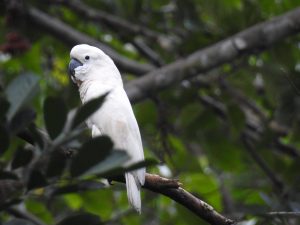
Missed our webinar? No problem! You can access the webinar in its entirety here:


Parrots Help Bring Stories To Life

We all have a special memory of book readings and stories being told in a classroom or library group sessions when we were young. There may be those of you who still attend a book reading at a neighboring bookstore or library, especially if you have young children. It goes without saying that a reading host can add exponentially to a reading session if they’re vibrant readers and storytellers. Add in props, as many do, and the stories take on a life of their own. Foundations are built for memorable experiences that will never be forgotten. One such storyteller is Andrea Garcia.

Parrot Storytellers

Andrea Garcia is a library aide in the Los Angeles area working at Delevan Drive and Aragon Avenue elementary schools. It is there that she leads story sessions and uses her parrots and others of her exotic birds to assist in the adventures. During this Covid-19 era, she sets up her sessions via Zoom for a virtual impact. Andrea hosts some 32 sessions a week. In her sessions, she brings a bird to the forefront to draw in the listening children. At the beginning of the reading, she introduces her selected bird and usually the parrot will sit on her shoulder for the duration of the session.

Andrea Garcia is a unique individual who, along with her husband, has acquired exotic birds since 2000. She currently has around 100 birds ranging from cockatoos, Amazon parrots, lovebirds, parakeets, finches, and cockatiels. Both Andrea and her husband were influenced by the parrots that were in their own young lives.

The idea for the Zoom sessions, which are ongoing, came from before the pandemic interrupted the natural flow of life. Andrea and her husband would host bird programs at schools and the nearby public library to the delight of the audiences. The show would consist of tricks and would segue into the importance of proper care for the exotic pets. But as the pandemic raged with no rapid end in sight, Andrea suggested introducing her parrots into a Zoom session for story-time. Needless to say, the experiment has become a resounding success for all involved.

Of her birds, Andrea’s favorites are Wocky, a blue-fronted Amazon parrot, a yellow-naped Amazon by the name of Harold Greene, and Lorie, a Goffin’s cockatoo, who is quite shy and will only say her name. When she’s at the forefront, the other parrots charmingly chant, “Go, Lorie,” with Lorie breaking into a dance. Harold Greene is her most talkative bird and is the one that interacts with the children the best during the sessions. At times, Harold will even slip in sound effects to enhance the story being told. Andrea dresses for the part of the story to make the sessions more fun.

The pandemic-influenced approach of stories via Zoom has earned Andrea some deserving attention in the news. Her approach is a gracious one that entertains children with adventures and with the reactive displays of exotic birds. Combining their uniquely individual personalities into a show is quite simply just what the doctor ordered.

Our collective hats are off to Andrea, her wonderful birds, and the brilliant offerings of stories for children.

Webinar: From Head To Tail – Visual Clues To Pet Bird Health

Webinar: From Head to Tail – Visual Clues to Pet Bird Health

Date: Friday, December 11, 2020

Time: 11:30 am PST (double-check your local time with this time zone converter)
Join us for a free interactive webinar with Stephanie Lamb, DVM, DABVP (Avian Practice). Dr. Lamb will show us how to perform a home physical on our pet birds. She will also help us identify signs that can be an indication of illness or other internal problem such as nutritional deficiencies.

Our “From Head to Tail – Visual Clues to Pet Bird Health” webinar is starting soon! Click below to join at 11:30am PST


Join Webinar


Rocky The “Rockefeller Center Christmas Tree Owl” Goes Home


saw-whet owl sitting on branch
Rocky is a saw-whet owl, much like this one. Photo by Peter K Burian, CC BY-SA 4.0, via Wikimedia Commons

As Christmas draws near, all manner of preparation and displays arrive to herald in the expected holidays. With 2020 being the year that the world ground to a near standstill due to COVID-19, it is a refreshing change to turn our wearied attention to Thanksgiving, Christmas, and other holidays. And with that, the hopeful promise of a New Year for 2021.

The big-ticket annual event for New York City is the placement and decorating of the Christmas tree at Rockefeller Center. This annual event has been a part of the New York City culture since its beginning in 1931. For the residents of NYC, the tree and its lighting ceremony represents “…a gathering place and reflection of what was happening in the world around it.” The Rockefeller Center refers to the usually enormous tree (the tallest – a Norway Spruce – topped out at 100 feet in 1999) placed within its boundaries as “…a holiday beacon for New Yorkers and visitors alike.” For 2020, that is a welcome tradition for all. But what does this tree have to do with birds?

Owl’s Unplanned Trip To Rockefeller Center

In mid-November, a new tree was being transported from Oneonta, NY. The Norway Spruce’s magnificent height was assessed at 75 feet.  What differentiates this tree from previous years’ trees was that it had a passenger for the trip to New York City, a saw-whet owl. The owl is considered one of the smallest within the owl family. A worker helping set up the tree discovered the baby owl within the branches. He removed the owl and arranged for the bird to be taken to a neighboring small non-profit wildlife center known as Ravensbeard. It was figured that the bird had not eaten in the three-day period from transport to setup.

The owl was originally thought to be a male and was named Rockefeller because of its current location. The name stuck and was shortened to “Rocky.” Rocky was given to the care of the wildlife center where it was fed, properly watered, and expertly cared for. It was soon determined to be a female owl. After a clean bill of health and clear X-rays for Rocky by the Center’s veterinarian, it was the right thing to do for the baby owl to release her back into the environment she obviously originated from.

On November 24, the Ravensbeard Wildlife Center transported Rocky back to her origination point in Oneonta. After finding a nice cluster of conifers to provide for a reasonable amount of cover for Rocky, the crew released her at sunset (to give her enough time to find safety before nighttime). She was officially back in the wild where she belongs. A beautiful video of the release was made and posted on the Center’s Facebook page. The Ravensbeard Wildlife Center has received a strong flow of financial support via donations because of their flawless Rocky episode.

This story with a feel-good ending is a perfect segue into a new holiday season, one that deserves a nice human touch after all 2020 has given in a long year of negatives.

Godspeed, Rocky.  May you grow to provide nature with many generations of your family.

Webinar: Heart To Heart: Pet Bird Behavior Q&A With Chris Davis

Webinar: Heart to Heart: Pet Bird Behavior Q&A with Chris Davis

Date: Friday, December 4, 2020

Time: 12 pm PST (double-check your local time with this time zone converter)
Chris Davis
Chris Davis with an owl friend.

Join us for a free interactive webinar: Heart to Heart: Pet Bird Behavior Q&A with Chris Davis. This live event marks the return of the popular monthly Bird Talk Magazine feature, as a webinar. Chris will share a behavior case or problem and then field viewers’ behavior-related questions. Chris is a pioneer in avian behavior who has helped many bird stewards open the lines of communication and grow their bond with their feathered friends.

Missed our webinar? No problem! You can access the webinar in its entirety here:


Artist Leila Jeffreys Captivates With Stunning Bird Portraits

In the world of visual art, one of the methods of representation is the capture of a model in a perfect setting. With humans, the art of the figure, face, or stance becomes a unique display of perceived beauty. Of course, there are other uses — such as sales, metaphorical discussion points, and other needs — where a model display is often used. But we can also look to other things to model beauty and points. We have inanimate objects like mountains, abstract suggestions like the effect of wind through a tree to evoke awe, and sad moments in time that can move us to positive and necessary action.

And birds! Birds also make incredible models for photos and paintings. What’s needed to move such captures to a higher place is the application of unique art. That takes a skilled artist to consistently present the world at large with such beauty.

Leila Jeffreys is an artist from Australia who uses the tools of photography to create incredible portraitures of birds of all kinds. The prints are large and reveal immaculate details of the bird. More amazing is the end product, which turns a bird into a persona that highlights the introspective reality of the bird itself. This is achieved by photographing a bird, eliminating all distraction to present a sharp, human-like photo that helps to bring forward personality, individual beauty, and a look into the eyes of the bird itself. In all cases, this has produced a moment of clarity known to momentarily take away the breath of the viewer.  This is the art of Leila Jeffreys.

Starting With Budgies

Jeffreys began her work in 2010 with portraits of budgerigars with human-sized heads. This allowed the photo to capture the intricate areas of the beak, the feathers, and the eyes. With this human-like viewpoint, the essence of the birds was revealed and became the focal point. As time progressed and her fame grew, Jeffreys turned to other exotic and wild birds to achieve the same goal. By 2019, she began to create other stunning works of art that showed a grouping of parakeets. These soon encouraged her to work in video in a successful attempt to recreate her unique view but in movement. These works are as amazing as her photographs are. She has also published three best-selling books featuring her works

Exhibition after exhibition has brought many admirers and well-known collectors to Jeffreys’ singular-styled work. They have sought to purchase her works and display them with pride within their homes and places of public display. As of this writing, a print sells for approximately $4,500 each. She is the subject of the Australian Broadcasting Corporation 2019 documentary, “Bird Nerd: The Art of Leila Jeffreys.” She has also been profiled in many magazines and newspapers worldwide for her vibrant approach to the beauty and humanization of a bird.

To be fully immersed in the beauty of Jeffreys’ art, it’s essential to see the works. The first place to start is in the space of her website. There, you can be awed by a sampling of the photographs and her fascinating videos.

Posted in New

Webinar: Avian Emergency: First Aid For Your Pet Bird

webinarWebinar: Avian Emergency: First Aid for Your Pet Bird

Date: Friday, November 20, 2020

Time: 12 pm PST (double-check your local time with this time zone converter)
Join us for a free interactive webinar with Stephanie Lamb, DVM, DABVP (Avian Practice). No matter how careful we are, accidents can and do happen to our feathered family members. Dr. Lamb will walk us through basic first-aid skills we should all know, as well as how to stabilize your bird until you can get it to the vet, and how to make your own first-aid kit for your birds.
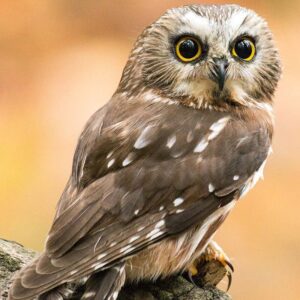
Missed our webinar? No problem! You can access the webinar in its entirety here:


Arizona Aims To Bring Back Its Native Thick-Billed Parrot


two thick-billed parrots standing on branch perch in zoo
Photo by JavAlvarezS, CC BY-SA 4.0, via Wikimedia Commons

The thick-billed parrot is a beautiful bright green and red-crowned parrot weighing in at approximately a pound. It is also a bird that is on the IUCN list as “threatened.” To date, there are only about 1,700 in the wild. Currently, the bird is found in the northern regions of Mexico. It is one of a few exotic birds once native to the U.S. For the record, the last official sighting of the thick-billed parrot in the U.S., before it moved on, was in 1938 in the Chiricahua Mountains, which is in southeastern Arizona, close to the border of New Mexico. The mountain range sits largely within the Chiricahua Wilderness, reaching a height of 9,759 feet at its highest point. But since then, the parrots have settled in Mexico.

Parrots That Thrive In Elevation

These birds like high elevations, making the mountain range one of comfort for them. There, they existed on a foraged diet of pinecone seeds. In the mountain range, there are rich sources of food for the parrot. However, illegal hunting was largely at fault for the disappearance, or local extinction, of the parrot. For nearly a 100 years, the skies of Arizona has been void of their loud vocalizing.

Presently, a devoted and dedicated collective of savvy scientists, and ornithologists are working diligently to help restore many parrots to their once natural habitats. The same is true of researchers and scientists attempting to reintroduce the thick-billed parrot back into its original mountain habitat of Arizona. The hope of restoration is two-fold. The first–and always is–conservation. What was once a dangerous locale for the birds is now under protection. It is hoped that new protections can help stem the frightening extinction rates seen in the world of our precious creatures who have fallen prey to man’s development of essential habitat spaces.

Another Try In Arizona

In the ’80s and ’90s, the reintroduction of the thick-billed parrot into the wilderness of the Arizona landmass with its mountain proved unsuccessful. Captive-bred, the birds easily fell prey to natural predators and, therefore, reduced the released birds back to local extinction. But the time is once again here for another attempt to reintroduce the parrot back into Arizona.

Since 2005, the Arizona Game and Fish department has worked with counterparts in Mexico to help restore the birds back to the mountain range. One of the problems for the remaining birds in Mexico is that warmer temperatures are reducing the snow-lines. This wreaks havoc on the pinecone seed diet the birds depend on to survive. With the Arizona mountain still rich with the necessary temperatures, and seed availability it only makes sense to continue to work hard to make the U.S .home again to the birds.

With proper maintenance and continued learning, the Game and Fish department might finally succeed in restoring a suitable and safe habitat for a parrot that desperately needs it. Let us hope that this time is the time it works and works well for the beautiful parrot who once called the U.S. home.

Webinar: Ask The Vet: Q&A With Tom Tully, DVM, DABVP (Avian Practice), DECZM (Avian)

Thomas Tully, DVMWebinar: Ask The Vet: Q&A with Tom Tully, DVM, DABVP (Avian Practice), DECZM (Avian)

Date: Friday, November 13, 2020

Time: 12 pm PST (double-check your local time with this time zone converter)

Our “Ask the Vet with Tom Tully, DVM, DABVP (Avian Practice), DECZM (Avian)” webinar is back this Friday, November 13! Dr. Tully will answer your questions about pet bird health, nutrition, care and behavior problems. Is your bird’s problem health related or behavioral? Are you offering the right foods to your pet bird? Ask the Vet!

Missed our webinar? No problem! You can access the webinar in its entirety here:


Inside Pepperberg’s Lab: Research Under COVID-Optimal Conditions

Pepperberg, Alex Foundation
African Grey Griffin. Image by the Alex Foundation (www.alexfoundation.org)

I’ve been asked if we are able to continue our work since we left Harvard, and the answer is yes—although not quite the way we would like, particularly when it comes to training. As readers of this blog and my research papers know, any study in our laboratory that requires training involves our model/rival technique—use of two humans who demonstrate to the parrots exactly what we would like them to learn. Unfortunately, with the social distancing requirements of COVID, we can’t have more than one person working with the birds at any one time.

So, how do we cope? We’ve tried a few different things. At first, we tried Skyping with a former student—that didn’t work very well, because the birds didn’t view her as a real entity. Next, because we had begun to have some success using Alex as a model for Griffin just before Alex passed away, we thought maybe we could get Griffin to model for Athena. That initially didn’t work too well, either, because Griffin was totally bored with identifying toys that he no longer cared about receiving. We have, however, had a bit more success with having Griffin model color labels, which Athena was learning just before the shutdown—but with some interesting twists!

I quickly learned that Griffin wouldn’t simply model color labels of the various objects in the lab for the same reason that he wouldn’t model their object labels…boredom. I also learned that he wouldn’t work with me on a task involving the concept of relative size—beginning by learning to label the color of the bigger or smaller plastic cup—something he was also starting to do with some level of accuracy before the shutdown, something on which Alex had succeeded (Pepperberg & Brezinsky, 1991) and an important concept that we used for subsequent studies (e.g., Pepperberg et al., 2008).

Griffin As Athena’s Role Model

However, when cleaning out the lab at Harvard, I found some index cards with thick lines of different colors and lengths drawn across them—stimuli we had used for training Alex many years before. I wondered if a change in stimuli might intrigue Griffin and whether Athena might learn something by watching—or at least be entertained enough so that she wouldn’t shriek at the top of her lungs, her basic response when she noticed that Griffin was getting attention and she wasn’t. So, I set the birds up on their T-stands close to my chair, as they had been placed for previous unsuccessful modeling attempts, and asked Griffin to look at a card and tell me the color of the longer line.

Pepperberg; African grey
African grey parrots Griffin and Athena are tasked with answering the question “What color smaller?” with a nut treat at stake. Courtesy of Dr. Irene Pepperberg

I knew from experience that if he wasn’t sure what to say but knew he had to produce a color label, he would choose “yellow” by default; I therefore rigged the questions so that “yellow” would be the first correct answer, figuring if he got it right and could ask for a reward, he might pay some attention to the subsequent questions. That part at least worked, and Athena thankfully quietly paid attention—particularly to the transfer of the nut!

Competing For Nuts

The next query was “What color smaller?” and the answer was “Blue.” I showed Griffin the card, asked him the question, and before he could say anything, Athena hollered “ooooo”—it wasn’t “blue,” but it was pretty close to her label at the time (the /b/ sound is not easy to produce for a creature that lacks lips, and she still hasn’t figured out how to use her esophagus to “burp” her /b/ and /p/). I quickly told her she was a good girl and gave her a nut. Griffin was not pleased! After all, he knew the game and knew that he was supposed to be modeling for her, and getting all the nuts.

For the third question, again “What color smaller?”, the answer was “Orange,” and Griffin quickly croaked out “rose”—given that parrots see in the UV, and that I really had no idea what the computer-generated color looked like for Griffin, I told him he was close and to try again. From previous work in the lab, he knew from my response that whatever color it was that he actually saw on the red/orange spectrum, he was to label this particular shade “orange,” and so he did. At this point, I was pretty excited. Possibly this version of the model/rival procedure would actually work with the two birds.

Well, by this time maybe they were bored or had had enough of each other, because neither would respond to my next question, for which the answer was “Green,” but I haven’t given up hope…I’ll keep trying! Once Griffin understands the concept of bigger/smaller, and to say, “None” when nothing is bigger or smaller, there are a number of optical illusions we can study in order to understand just how he sees our world; thus getting him to succeed on this task is really important. And, of course, we are working on a few other studies for which the birds already have the necessary training, and for which testing can be done with one person as long as every trial is videotaped and examined by an independent observer. So, while I have to say that it is not fun trying to adapt our studies to a COVID environment, and that we—as well as everyone else, of course—are looking forward to a return to pre-COVID normalcy, for now, adaptation is key!

References Pepperberg, I.M & Brezinsky, M.V. (1991). Relational learning by an African Grey parrot (Psittacus erithacus): Discriminations based on relative size. Journal of Comparative Psychology 105:286 294. Pepperberg, I.M., Vicinay, J., Cavanagh, P. (2008)

Webinar: Let’s Talk Birds: A Bird Talk Magazine Reunion!

Webinar: Let’s Talk Birds: A Bird Talk Magazine Reunion!

Date: Friday, November 6, 2020

Time: 12 pm PST (double-check your local time with this time zone converter)

Bird Talk magazine was one of many pet-themed magazines published by BowTie Inc. (formerly Fancy Publications), which also included Cat Fancy and Dog Fancy magazines. Sadly, BowTie Inc. ceased publication of Bird Talk in 2012.

Join us for a free, interactive webinar with the former editors of Bird Talk Magazine! Here’s your chance to go behind-the-scenes of the iconic magazine dedicated to the better care of pet birds. Our special guest Melissa Kauffman and host Laura Doering will talk about how Bird Talk’s monthly issues came together and the tears shed when it ceased publication. For three decades, Bird Talk magazine served the pet bird community with exclusive expert-written articles, gave the low-down on the latest bird products and it offered an outlet for bird lovers to bond with other avian enthusiasts. Melissa Kauffman was a big part of staying true to the magazine’s motto of Dedicated To Better Care For Pet Birds. She was also mentor to webinar host Laura Doering, who had big shoes to fill when she took over as editor.

Missed our webinar? No problem! You can access the webinar in its entirety here:


Webinar: Ask The Vet: Q&A With Tom Tully, DVM, DABVP (Avian Practice), DECZM (Avian)

Thomas Tully, DVMWebinar: Ask The Vet: Q&A with Tom Tully, DVM, DABVP (Avian Practice), DECZM (Avian)

Date: Friday, October 30, 2020

Time: 12 pm PST (double-check your local time with this time zone converter)

Our “Ask the Vet with Tom Tully, DVM, DABVP (Avian Practice), DECZM (Avian)” webinar is back Friday, October 30! Dr. Tully will answer your questions about pet bird health, nutrition, care and behavior problems. Is your bird’s problem health related or behavioral? Are you offering the right foods to your pet bird? Ask the Vet!

Missed our webinar? No problem! You can access the webinar in its entirety here:


Birds In The News: Parrot Feather Color Research Reveals Fascinating Finds And More

Add “birds” to your Google News alert topics–or simply search the word “bird” or “parrot” in Google to see what’s going on in the world of birds. Here are some recent “birds in the news” stories worth checking out.

Feather Color May Be Linked To Body Size & Climate

You’ll want to read this fascinating study that explores how parrots’ feather color is influenced by body size and  climate. For one, researchers found that smaller, shorter-lived parrot species are more likely to show visual differences (sexual dimorphism) between male and female plumage colors or patterns than larger parrot species. Study results also suggest that environment plays a role in parrots’ appearance, as sexual dimorphism was discovered to be more pronounced in parrots living in closed or forested habitats. Another reason  to read on? See why parrots native to warmer and wetter environments are darker, while parrots from hotter climates show more blue coloring.

Yes, You’re Hearing Four Times More Wild Birds Than Usual!

wild bird, perhaps a sparrow, standing on wall outdoors with beak open
Photo by Linh Pham/Unsplash

Have you noticed a pleasant chatter of wild birds since COVID-related shutdowns? You’re not alone. Many people have recently become more aware of the birds in their area. Researchers studying wild birds in San Francisco found that birds have responded to the diminished city noise by producing softer songs, with a wider range of notes. Apparently, not having to compete with urban noise pollution has given birds the ability to hone-in on their vocal skills.

You Can Help Keep Birds Safe During Fall Migration

swallow flying against blue sky
Photo by TheOtherKev/Pixabay

Some birds migrate a mind-boggling distance — up to thousands of miles — to reach warmer climates during winter months. And then they fly back again in spring. Sadly, millions of birds die annually after flying into windows during their migration. In this article, Missouri Department of Conservation (MDC) Ornithologist Sarah Kendrick encourages people to make small changes at their home or office to prevent window strikes. Kendrick notes that when a bird strikes a window at a home or office, the window is reflecting either sky or vegetation and the bird believes it is a pass-through. Breaking up that reflection can help the bird know that the window is an obstacle. Learn what steps you can take to help migrating birds safely navigate around your home.

“Unicorn” Bird Discovered

The recent discovery of a genetic anomaly in a rose-breasted grosbeak (Pheucticus ludovicianus) has scientists and bird enthusiasts in awe by its rarity. This two-sexed bird was discovered in a Pennsylvania reserve. What makes this bird so unique is that it displays an even split down the middle of its body of both male and female feather coloring. Its right side shows red plumage, which is a male trait, and its left shows golden yellow feathers, which is a female trait. Learn just how rare this is and if it affects the bird’s health.

Webinar: Bird Seeds Versus Pellets: What’s The Difference?

Webinar: Bird Seeds Versus Pellets: What’s the Difference?

Date: Friday, October 23, 2020

Time: 12 pm PST (double-check your local time with this time zone converter)

blue Indian ring-necked parakeet eating
Photo by AlkeMade/Pixabay

Join us for a free interactive webinar with Stephanie Lamb, DVM, DABVP (Avian Practice). Dr. Lamb will help clear up the confusion over seeds. Are they really bad for your bird? Can a nutritionally balanced diet contain seeds? Dr. Lamb will address the myths and help you determine the best way to offer your bird a nutritious diet that provides variety as well as encourages natural foraging exercise.
Missed our webinar? No problem! You can access the webinar in its entirety below. Also, check out our pellet conversion resources.


Inside Dr. Pepperberg’s Lab: Virtual Interactions With Our Parrots

African grey parrot
Griffin Skyping with another former student, Gabriella. Courtesy of Dr. Irene Pepperberg

Given that almost everyone is now interacting with friends and family over platforms like ZOOM, Skype, FaceTime, etc., I’m often asked about how parrots might deal with virtual interactions. As with most questions about parrots, the answers are complicated.

The primary issues involve their visual system, which differs significantly from ours. I’m not just talking about the obvious differences, like the placement of their eyes that decreases what is called “binocular overlap” compared to humans or the neuroanatomical differences—but issues like seeing in the UV or having a very different flicker-fusion rate (FFR, the frequency at which an intermittent stimulus appears to be completely steady to the average observer), which play a big role in their ability to process information presented virtually.

For example, the FFR quite likely was one reason that our attempts to train our parrots with video failed (Pepperberg et al., 1998), even though Alex, for instance, would recognize similarity and difference in objects presented via video (Routledge & Pepperberg, 1988). These early studies used monitors with cathode ray tubes (CRT), which rely on human FFR to produce “normal-looking” action. Because parrots’ FFR is about twice that of humans’ FFR, CRT output, rather than being viewed as an integrated whole, may be seen as an interrupted collection of flashing images that might distract the bird’s attention, thus making it difficult to observe the physical objects to be labeled, or even disrupting formation of a connection between audio and visual input—and thus providing one reason why video tutoring failed.

Parrots See What We Don’t

For both the old CRTs and the newer liquid crystal displays (LCD), colors are optimized for the human, 3-cone, visual system, called “tricromatic.” Birds, however, are at least tetracromatic—that is they also see in the UV, and the world looks very different to them. For a description of what we know about their UV vision, read a recent paper by Stoddard et al. (2020). Thus, what they see on a computer screen probably looks extremely different to them from what they see when they look at something that is physically present. That is not to say that they can’t recognize things at all…quite likely they may think “Well, this has the shape of a human and it sounds like a human, so even though it looks very oddly colored, it probably is some kind of human.” Ditto for other items. That may be why some parrots do seem to like watching TV with their owners.

At one point, we re-tried the video tutoring study using LCD screens (Pepperberg & Wilkes, 2004), which do not have flicker fusion issues, and played videotapes to our parrots. Even then, they failed to learn from the tapes. It could still have been color issues, or it could have been the lack of social interaction—the birds just watched pre-recorded tapes, so obviously the humans on the tapes didn’t adjust their behavior to what the bird was doing at the time. African greys are social animals; they probably learn not only vocalizations but also other critical behavior patterns from watching one another and interacting with one another in real time (Todt, 1975). Although they can learn vocalizations (at least) equally well from humans as from other parrots, the interactions likely must also be in real time.

Recently, given the impossibility of using our live, social modeling technique during the need for social distancing during COVID, one of my former students and I tried to model for Athena over ZOOM. We figured that we could be totally interactive, that Athena would recognize her voice and features, that flicker-fusion would not be a problem, and maybe the color weirdness might be acceptable. No such luck. Athena did seem to recognize Francesca—at least she tried to peck Francesca’s nose on the screen the way she would in real-life—but Athena would not attend to the screen while we modeled. It is also possible that Athena noticed a reflection of a grey parrot in the computer screen and was tapping on that, rather than actually recognizing Francesca.

That’s Entertainment

Nevertheless, both Griffin and Athena seem to enjoy whatever it is that they do see on the screens. When with my friend and colleague Leigh Ann and I set up a ZOOM meeting, she brings her two African greys over to the computer, and all four birds make various noises and tap the screen. It’s not clear that they recognize each other visually, but they do make lots of noise. And when I Skyped with Leor, a student who had been gone for a year, both birds initially gave her the “cold wing” to make it clear that her departure had been unacceptable…as in real-life, only after a while were they willing to interact a bit. Again, it was not clear to me as to what was the focus of their responding—her voice or her image—but at least they didn’t find it aversive.

So, in sum…if your birds seem to like to watch TV or interact with computer screens, by all means keep doing that…just don’t believe that what they experience is exactly the same thing that you experience—they may be responding to what they hear, to reflections in the screen, or maybe they simply accept that sometimes things come in very weird colors!

References

Pepperberg, I.M., Naughton, J. R., & Banta, P. A. (1998). Allospecific vocal learning by Grey parrots (Psittacus erithacus): A failure of videotaped instruction under certain conditions. Behavioural Processes, 42, 139–158.

Pepperbergm I.M., & Wilkes, S.R. (2004), Lack of referential vocal learning from LCD video by Grey parrots (Psittacus erithacus). Interaction Studies 5, 75–97.

Rutledge, D., & Pepperberg, I.M. (1988). [Video studies of same/different.] Unpublished raw data.

Stoddard, M.C., Eyster, H.N., Hogan, B.G., Morris, D.H., Soucy, E.R., & Inouye, D.W. (2020). Wild hummingbirds discriminate nonspectral colors. Proceedinds of the National Academy of Sciences, /doi.10.1073/pnas.1919377117

Todt, D. (1975). Social learning of vocal patterns and modes of their applications in Grey Parrots. Zeitschrift für Tierpsychologie, 39, 178–188.

Webinar: What Should I Feed? Nutritionally Balanced Diets Are For The Birds!

Webinar: What Should I Feed? Nutritionally Balanced Diets are For the Birds!

Date: Friday, October 16, 2020

Time: 12 pm PST (double-check your local time with this time zone converter)

close up on head of blue-and-gold macaw looking over their wing
Photo by Cloud11/Pixabay

Join us for a free interactive webinar on October 16 – What Should I Feed? Nutritionally Balanced Diets are For the Birds! Our guest is Kara M. Burns, MS, MEd, LVT, VTS (Nutrition), VTS-H (Internal Medicine, Dentistry). Kara will discuss the importance of balanced nutrition for pet birds. She will cover how nutrition affects your bird inside and out, and why it can take time for a bird to exhibit signs of poor nutrition, as well as the signs of improvement when you start feeding them a balanced diet.

Missed our webinar? No problem! You can access the webinar in its entirety here:


Webinar: It’s Not All Talk: 6 Steps To Loving Communication With Your Bird And Other Animals

Webinar: It’s Not All Talk: 6 Steps to Loving Communication with Your Bird & other Animals

Date: Friday, October 9, 2020

Time: 12 pm PST (double-check your local time with this time zone converter)

October 9 – It’s Not All Talk: 6 Steps to Loving Communication with Your Bird & other Animals

Dr. Ted Lafeber
Dr. Ted Lafeber says hello to a hyacinth macaw.
Chris Davis
Chris Davis befriends a cute owl.

Join us for a free interactive webinar hosted by Laura Doering, former editor of Bird Talk magazine and Birds USA magazine. Our specials Guests will be Christine Davis, CPBC, and Dr. Ted Lafeber. They will share their step-by-step method of forming a stronger relationship with pet birds and all animals through loving communication. This can serve as a stand-alone  method or as a foundation to compliment any style of positive reinforcement training. Don’t miss this opportunity to build or strengthen your animal communications – tune in Friday, October 9.

Missed our webinar? No problem! You can access the webinar in its entirety here:


Webinar: Tropical Surprise: Hint – It’s For The Birds!

Webinar: Tropical Surprise: Hint — It’s For the Birds!

Date: Thursday, October 1, 2020

Time: 12 pm PST (double-check your local time with this time zone converter)

close up on face of macaw with toe in beak
Photo by Kaitlin Dowis/Unsplash

Join us for a free interactive webinar hosted by Laura Doering, former editor of Bird Talk magazine and Birds USA magazine. Laura will welcome a surprise guest to talk about our favorite subject — Birds, Birds, Birds! Sponsored by Lafeber Company, this special webinar will also include a big announcement! We will  take viewer questions throughout the webinar, because it’s just that special. One very lucky viewer will be randomly selected to win a prize, but you must be viewing live to win. This webinar is so special, we are holding it a day early — Thursday, October 1. We just can’t wait any longer to share the fun!

Missed our webinar? No problem! You can access the webinar in its entirety here:


Bird Seeds Versus Pellets: What’s The Difference?

cockatiel perched on cage
Do you know the nutrients in your feathered friend’s food? Photo by giovannistrapazzon/Pixabay

When pet bird owners go to their veterinarian or bird-savvy pet store, they are often informed that pellets or Nutri-Berries are better than seeds as the major portion of the diet. But what is the difference really?

Pellets, and other formulated diets like Nutri-Berries, are created to have a balanced ratio of nutrients packed into a single unit. These formulations are based off research done in granivorous birds, including chickens, budgerigars, and cockatiels. We still need to learn a lot about pet parrot nutritional requirements, but pellets provide a much better balance of nutrients than seeds.

Seed mixes that are typically found in pet bird diets are unbalanced in various nutrients. Both deficiencies and excesses occur when a bird is fed these as the main part or only component of their diet. Seeds can and do lead to many health problems if they are fed in inappropriate quantities and ratios in the diet.

When comparing pellets and seeds on a nutrient level, researchers and avian veterinarians have identified several key differences. Following is a list of the unbalanced nutrients that occur in seed-based diets, how these nutrients are important for life, and the effects for a bird not having these nutrients adequately provided.

Deficiencies Of A Seed-Only Diet

Calcium & Phosphorus

Amazon parrot eating Nutri-Berrie
Nutri-Berries, pellets, and other formulated diets are created with the goal of offering balanced nutrition in every bite.

Seeds are insufficient in calcium and often have an imbalance in their calcium to phosphorus ratio. Calcium is one of the most commonly discussed minerals in birds, particularly because of its vital role in reproduction and egg laying. Calcium is required to form the shell of an egg; however, it is also required in the body for normal bone health, nervous system functioning, and muscle health. Deficiencies can result in egg binding, impaired bone development, thin eggshells, poor uterine contractions and neurologic signs like seizures.

Phosphorus is a mineral that functions closely with calcium. The ratio of calcium to phosphorus is important and should be about 2 parts calcium to 1 part phosphorus. Seeds are often unbalanced with this ratio and have calcium in lower amounts and phosphorus in higher amounts. Deficiencies in phosphorus or imbalances in the calcium-to-phosphorus ratio can result in weakness, rickets, and thin-shelled eggs. Excessive amounts of phosphorus can interfere with the absorption of calcium from the intestinal tract and induce a condition known as nutritional secondary hyperparathyroidism. Although any pet bird can experience imbalances in these nutrients when fed a seed-based diet, African Grey parrots are well-known for deficiencies in calcium , which can cause seizure activity and poor bone development in young individuals.

Sodium

Sodium is an important element for cell signaling and electrical conductance. Seeds do not supply ample amounts of this, which can result in deficiencies that cause poor egg production and poor growth.

Zinc

Zinc functions as a cofactor for many different enzymes and is important for growth, reproduction, and tissue healing. Low levels of zinc found in seeds can result in poor growth, thicker and shorter long bones, scaling of the feet and skin, and poor feathering.

Iron

Iron’s importance lies in the fact that it is involved in cellular respiration. It is complexed with the protein known as heme, and it helps transport oxygen around the body to tissues. Diets that are exclusively seeds are low in this element, and deficiencies can lead to anemia.

Lysine/Methionine

Indian Ring-Necked Parakeet on hand full of seed
Birds might enjoy eating seeds, but a seed-only diet can cause health problems. Renan Brun/Unsplash

These are both proteins and are just two of the approximately 20 amino acids that are necessary for life. Proteins have a wide variety of functions within the body. They act as enzymes to catalyze reactions. Both lysine and methionine have structural properties and make up portions of muscles and collagen. They act as transports of compounds both within and outside of cells. Both function in the bloodstream, both to help with the immune system and with clotting blood. Their list of functions can go on and on. Deficiencies in lysine and methionine are common with seed-based diets and have been associated with liver disease in birds.

Vitamin A

Vitamin A is a fat-soluble vitamin that is important in vision, immune system health, and in cells that line the skin, respiratory tract, reproductive tract, kidneys, and glandular tissues. Deficiencies in this nutrient are very common for seed diets and can result in a change in the superficial epithelial cells of the previously mentioned tissue. This can then result in various problems, such as sinus infections, kidney disorders, and reduced fertility and hatchability of eggs.

Vitamin B

There are several B vitamins, but there are just a few that seeds are often lacking.

  • Vitamin B2 is also known as riboflavin. It is also important for carbohydrate metabolism. In cockatiels that are growing, a deficiency in this vitamin will cause achromatosis, which is a loss of normal pigmentation to the feathers. It can also cause a reduction of eggs in a clutch and reduced hatching of eggs.
  • Vitamin B9 is folic acid. This works as a cofactor in the synthesis of purines, which is a component of DNA. Low levels will result in slow growth, poor feathering, anemia, reduced egg production and hatchability, and boney abnormalities in embryos and growing birds.
  • Vitamin B12 is cobalamin. It functions as a coenzyme and is involved in fat and protein metabolism and the synthesis of DNA. Deficiencies will result in anemia. They can also result in a fatty liver, heart, and kidneys.
  • Choline is often grouped with B vitamins due to similarities that they have. It is important for normal nervous system and liver health. Birds with deficiencies in this nutrient have been found to suffer from fatty liver disease.

Notable Excesses Of A Seed-Only Diet

Fats

Seeds are undoubtedly high in fat. Take, for example, the sunflower seed. For this delicious food item that many pet birds relish, 74% of the dry matter is fat! That is a very high volume. With sunflower seeds being a common item found in seed mixes, you can see how it could easily become an excessive amount of fat if the bird were to consume it frequently. Too much fat in the diet can lead to various problems, including liver disorders, heart problems, reproductive disorders, and obesity.

Be In The Know

Exploring and understanding the difference between the nutrients in seeds and pellets helps you see just how important it is that birds receive more balanced nutrition. If birds continue to eat seeds for the greater part of their meals, nutritional imbalances can eventually catch up and cause major health concerns. However, providing pellets or Nutri-Berries as a portion of the diet ensures a more adequate nutrient profile. This goes a long way to prevent certain disorders and allow for a much healthier life.

Be sure to check out our pellet conversion resources!

More Parrot Nutrition Info:

1. Toft CA, Wright TF. (2015) The thriving parrot: The foods and beaks of parrots. In: Parrots of the wild: A natural history of the world’s most captivating birds. Eds Toft CA, Wright TF. University of California Press, Oakland. pp 39-80
2. Koutsos E, Gelis S, Echols MS. (2016) Advancements in nutrition and nutritional therapy. In: Current therapy in avian medicine and surgery. Ed Speer BL. Elsevier, St. Louis. pp 142-176
3. Harper J, Skinner ND. (1998) Clinical nutrition of small psittacines and passerines. Semi Exot Pet Med 7: 116-127
4. Brightsmith DJ. (2012) Nutritional levels of diets fed to captive Amazon parrots: Does mixing seed, produce and pellets provide a health diet? J Avian Med Surg 26:149-160
5. Harrison GJ. (1998) 43 Years of progress in pet bird nutrition. AVMA vol 212, No 8, April 15 1998 p1226-1230
6. Nijboer J. (2015) Nutrition in Psittacines. Online Merck Manual Veterinary Manual
7. Koutsos EA, Matson KD, Klasing KC. (2001) Nutrition of birds in the order psittaciformes: a review. J.  Avian Med Surgery 15(4):257–275
8. Butcher GD, Miles RD. (1993) Understanding Pet Bird Nutrition. CIR1082, Veterinary Medicine-Large Animal Clinical Sciences Department, UF/IFAS Extension

Webinar: Ask The Vet: Q&A With Tom Tully, DVM, DABVP (Avian Practice), DECZM (Avian)

Thomas Tully, DVMWebinar: Ask The Vet: Q&A with Tom Tully, DVM, DABVP (Avian Practice), DECZM (Avian)

Date: Friday, September 25, 2020

Time: 12 pm PST (double-check your local time with this time zone converter)

Our “Ask the Vet with Tom Tully, DVM, DABVP (Avian Practice), DECZM (Avian)” webinar is back Friday, September 25! Dr. Tully will answer your questions about pet bird health, nutrition, care and behavior problems. Is your bird’s problem health related or behavioral? Are you offering the right foods to your pet bird? Ask the Vet!


Missed our webinar? No problem! You can access the webinar in its entirety here:


Why Are Pellets Better Than Seeds For Pet Birds?

The adage “you are what you eat” applies to birds, too. Mario Mendez/Unsplash

When people first started to keep pet birds in their homes, they made lots of guesses on what to feed them. Originally, people fed seeds because that is what they observed birds eat in the wild. Unfortunately, seeds were not enough and many nutritional problems ensued. This led people to start including fruits and vegetables to the diet, which helped with certain disorders. However, many pet birds were selective and picked out the food items that they enjoyed and ignored all the rest. This just further kept diets unbalanced and problematic for pet birds. Finally, pellets came on the market to solve these issues.

The Pellet Advantage

macaw eating Avi-Cake
Foods like Avi-Cakes (shown) and Nutri-Berries provide superior nutrition along with the enrichment of foraging.

One of the great benefits of pellets is that they take away a bird’s ability to selectively eat only their favorite items out of mix. Pellets are created by taking various ingredients and mixing them together at specific amounts to form a single, combined, more-balanced food item. They can come as a pelleted cube, a crumble (Nutri-Berries), a cake (Avi-Cakes), or even a mash diet.

As pellets have become more popular among bird owners, birds are living longer and having fewer nutritional problems arise. But what is it that really makes pellets better than seeds as a dietary option? Any avian veterinarian will tell you that they see many birds come into their hospital for care because of illnesses related to poorly balanced, seed-based, diets. Let’s explore a few of these.

Bird Illnesses Caused By Nutritional Imbalance

Liver Disease

One of the most common problems veterinarians manage in pet birds is liver disease. Liver disorders arise from various causes, but one of the most common syndromes is hepatic lipidosis (fatty liver disease). Too much fat within the liver leads to inappropriate liver function. Birds who have this as a problem can show a reduction in appetite, quiet behavior, and regurgitation. The white part to their droppings can take on a greenish color. Some birds will have their beak grow quickly and be flaky when they develop a liver disorder.

Various nutritional imbalances can lead to fatty liver disease, including too high of fat in the diet, inadequate levels of protein, or a choline deficiency. All of these nutritional imbalances can be brought on by eating a seed-only diet. Eating a pellet-based diet can prevent and even be a part of the treatment plan for a bird with hepatic lipidosis.

Reproductive Disorders

cockatiel head looking to the side
Poor nutrition affects many body functions, including liver, reproduction, breathing, heart, and more. Ursula Gamez/Unsplash

Many different types of reproductive disease can ensue from a diet high in seeds. The first nutrient to consider that can cause reproductive tract disorders that seeds are deficient in is calcium. Calcium is required not only to form the shell of the egg, but it is also required for normal uterine contractions to allow for appropriate egg laying. Without adequate levels of calcium in the diet, problems like thin-shelled eggs and egg binding can occur. Also, birds pull calcium from their bones during egg laying. If they haven’t had enough calcium in the diet, then they may extract too much calcium, making their bones brittle and prone to fractures.

Another nutrient that is important for normal reproductive processes but is minimal in seed-based diets is vitamin A. A lack of vitamin A can lead to changes to the oviduct and the glandular tissues in this organ, leading to difficulties during the egg-laying process.

Additionally, seed-based diets are a very energy-dense diet due to their high fat content. Birds that have their energy demands met and anticipate an abundance of foods might be stimulated to become hormonal. Generally, unless someone is planning to breed their birds, most veterinarians recommend against encouraging hormonal drive at home. Various behavioral and health problems can occur when birds are hormonal.

Pellets provide a more balanced ratio of calcium to phosphorus and appropriate levels of vitamin A for a healthy reproductive tract. However, they are lower in their calorie content, which helps to not be as stimulating as seeds to hormonal drive.

Respiratory Problems

Respiratory disorders are another common reason birds come to a veterinary hospital. When a doctor does their physical examination on a pet bird, they may discover some changes to the respiratory system that could be linked to an underlying nutritional problem.

As previously mentioned, seeds are deficient in vitamin A. Vitamin A is important for the health of cells that line the respiratory tract. If birds are not receiving adequate levels of this nutrient, it can make the cells unhealthy. This could lead to a poor production of respiratory secretions, cellular debris accumulation, and create an environment that allows for infectious agents like bacteria or fungal organism to overgrow. This means that a bird could come in with a respiratory infection, but the underlying cause is a deficiency of vitamin A.

Ultimately, the bird not only needs to be treated for the infection it has, but it also needs its low level of vitamin A corrected.

Neurologic Disorders

Some challenging problems that veterinary practitioners encounter that can be nutritional in origin are disorders of the nervous system. Birds may present to the hospital with weakness, muscle tremors, and even seizures. Nutritional imbalances that have been linked to these problems include deficiencies in calcium and magnesium or imbalances in the calcium to phosphorus ratio. Seed-based diets are notorious for being low in calcium as we have already mentioned. They can also be high in phosphorus and result in an inappropriate calcium to phosphorus ratio. When these nutrients are out of balance it can result in neurologic problems.

Pellets are more balanced with these minerals and deficiencies in these nutrients are not common when birds are fed a pellet-based diet.

Cardiovascular Disease

An area of growing concern for avian veterinarians is cardiovascular health. A disease known as atherosclerosis is becoming more and more commonly diagnosed in pet birds. In this disease, blood vessels develop plaques of fatty and inflammatory debris, leading to a narrowing of the size of the blood vessel internally. This can result in poor blood flow to various organs and numerous signs may occur. Weakness, exercise intolerance, neurologic disorders such as wobbly walking, and difficulty breathing are all signs owners may encounter. Sadly, some birds don’t even show signs of illness and are found dead.

Although there is still a lot that veterinarians need to learn about how this disease develops, one of the current theories is that high-fat diets, such as seed-based diets, could be a contributing factor to the development of this disease.

Skin Problems

Some potentially less serious but still problematic issues that can develop from birds eating seed-based diets are skin problems. Dry, scaly skin and the development of bumblefoot has been associated with low levels of vitamin A. As previously mentioned, a deficiency in this nutrient is common with seed-only diets. Lipomas are fatty masses, typically in the skin, that have been associated with high fat in the diet.

Again, the high fat in seeds can be a contributing factor to this type of problem. Because pellets are appropriate with their vitamin A content and lower in fat, these issues are less frequently encountered in birds that eat pellets.

Doing The Best For Your Feathered Friend

Taking all these points into consideration, one can see why most veterinarians would recommend a pellet-based diet over a seed-based diet. Less nutritional imbalances and greater health are provided to birds when they consume more pellets in their diets. One of the greatest tools an owner has at home to keep their birds healthy is to feed them a proper diet; therefore, a pellet-based diet is advantageous to a seed-based diet for pet birds.

Be sure to check out our pellet conversion resources!

Celebrate National Pet Bird Day!

sun conure on perch in front of green background
Sun conure. Photo by jggrz/Pixabay

Dogs get their day, cats do too. Now it’s our feathered companions turn—September 17 is National Pet Bird Day! Let’s celebrate everything that our pets do for us. If you share your home with a bird pal, companionship can be filled with vocal duets, conversations that loop back over and over (e.g., you find yourself answering, “How are you?” over and over), and adventures in buying the right toy or creating the perfect item for your bird to destroy. Your bird might be your shower buddy, fellow foodie, dance partner or cuddle bug, and leave you in awe by their beauty and their cleverness. Take time today to do something extra special for your bird.

blue budgie perched on top of open laptop
Photo by Mullerelles/Pixabay

Here are some ideas to get you started:

  • Buy or build your bird a new toy. This can be as complex as a challenging puzzle toy or as simple as some fun-to-destroy wood, cardboard or paper. Let your bird make a mess!
  • Take some silly pictures of your pet (or with your pet) and share with friends and family, or update your phone or computer screen. Don’t let dogs and cats steal the spotlight—share photos of your bird on social media with the hashtag #NationalPetBirdDay
  • Make it a play date! Spread out a sheet to mark your birdie playground, and add fun food and bird-safe toys/items for your bird to explore while you sit with them. Don’t be a passive observer. Pick up the items and talk about them (“I love the color blue, don’t you?!”) or pretend like you’re keeping the Nutri-Berrie for yourself—some birds find extra satisfaction from stealing what they think is yours!
  • Join a bird club or Facebook group dedicated to pet birds. Bird people can learn from one another and share in the joy of life with feathered companion when we flock together.
  • Help someone in need buy pet food or other essentials for their pet bird(s).

How do celebrate your feathered friend? Do share in our comment section.

Subscribe to our newsletter

Click here to subscribe to our newsletter

×

Join our Lafeber Flock

Enjoy our Pet Birds' weekly newsletter, featuring captivating stories, care tips, and more.
Opt for Small Mammals' monthly edition for delightful facts about rabbits, guinea pigs, and more.
Choose our monthly Backyard Chickens newsletter for insightful information to keep your flock happy.
*