Inside Pepperberg’s Lab: Getting Parrots To Exercise
Exercise is particularly important for our parrots, as most conditions in captivity are extremely different from the lives they live in the wild.





Exercise is particularly important for our parrots, as most conditions in captivity are extremely different from the lives they live in the wild.
Early on in her behavioral research with Alex the African grey, Dr. Irene Pepperberg began incorporating what she refers to as the model/rival (M/R) system to teach a parrot how to speak and how to use speech appropriately, which also allows the bird to verbally communicate requests.

With cognitive abilities matching that of a 5-6 year old, African grey parrots can likewise come up with some creative distractions to delay bedtime. This month, Dr. Pepperberg gives us a look back at the bedtime antics of Alex the African grey, as well as how current greys Griffin and Athena attempt to throw a wrench in attempts at a good night routine.
Research with parrots leads to some unexpected results. Some pleasant, like learning words that weren’t trained, and some unpleasant, like acting out.

Curious to know what an average day is like in Dr. Irene Pepperberg’s research lab on the Harvard campus? Here’s a behind-the-scenes look at a day in the life of African greys Griffin and Athena!
Parrots often solicit humans by putting their heads down and rubbing against their humans’ fingers; some will even learn to request “Tickle,” “Scritch,” or “Scratch.” Despite being subjects of scientific study, the birds in my lab are no exception, and they have influenced their trainers’ behavior in some striking ways.
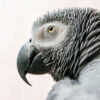
Dr. Irene Pepperberg, who famously worked with Alex the African grey parrot on documenting parrot intelligence, recently released new research focused on results of her work with African grey parrot Griffin.
It appears that the part of the brain that corresponds to the forebrain, the pallium in birds, has a much higher concentration of neurons or the brain cells packed in the same amount of space than many primates.

If your bird startles at the sound of a slammed door, car alarm or other loud, unexpected noise, the Fourth of July might not be the easiest holiday for your feathered friend to handle. Here are some preemptive steps to take to help your bird remain stress-free around Independence Day.
Parrots in the wild spend good part of the day on foot looking for items to munch. And so it stands to reason that the parrots in our homes might also enjoy walking on their own two feet to see what they can find. Here are some tips for creating a bottom play and foraging area for your pet bird.
Find out how some birds evolved to be more intelligent than we humans initially thought.
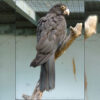
Research on Vasa parrots from the University of York and University of St. Andrews that point to the first documentation of nonhuman use of tools for grinding, and one of only a few reports of nonhuman animals sharing tools directly. See the Vasa parrots’ tool of choice to grind calcium powder from shells.
Behavior offers clues on your bird’s mental state. Lack of appetite, feather picking, and changing habits might indicate an emotional struggle.
From budgerigars to African Greys to macaws, nine parrot species in a university study reveal why certain bird species are better at imitating sounds than other birds. Hint: It’s got a lot to do with the structure of the brain.
If you don’t understand the instincts, needs, and anatomy of your parrot friend, problems can quickly arise. Interrupting your bird’s snooze time or switching food abruptly are just two ways you can ruin your bird’s day. Learn what not to do so both you and your bird live harmoniously.
Life with a feathered companion calls for doing things a bit differently, which non-bird people might find baffling. Here are 10 Things Bird Owners Do That Others Will Never Understand.
Every bird has a play personality — from explorer to destroyer, and many more. Knowing your bird’s style of play can help you zero in on the types of toys and interactions your bird enjoys most.
Check out this scientific look at the mind of parrots, and learn a whole new meaning for “birdbrain.”
Bigger birds aren’t the only ones talking. In fact, some of the smaller parrots are capable of mimicking human speech and can even amass impressive vocabularies. Here’s a look at some of the tiny talkers of the pet bird world.
Knowing what in-home conditions can inadvertently mimic breeding season in the wild can help us lessen or deter hormonal behavior inside the home. Find out how cage placement and the food you offer can affect your bird’s behavior.
Cockatiels can be every bit a parrot as their larger counterparts — friendly and outgoing to snugly and gentle — no wonder these little feathered companions are America’s Top Bird. But ever stop to think if your cockatiel is normal?
Halloween is just around the corner. We are scared of zombies and ghosts, and perhaps even the thought of a whole community of children eating sugar. But what’s scary to your small companion bird?
Small birds like the friendly and outgoing cockatiel can be taught to do behaviors on cue — and it’s easier than you think. Our small companion birds have many natural behaviors that lend themselves nicely to trick training.
Our small birds love their time out of the cage. How do we know this? We know because sometimes it’s soooo difficult to get them back in the cage. Plan for this by training your pet bird. Here are some tips to try for when you need to get your small bird back in the cage, now.
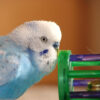
There are many behaviors that a budgie will do naturally. With some practice, you can give a cue for the natural behavior, and then have a nice behavior your budgie can perform upon request.
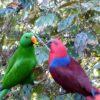
Female birds tend to fly under the radar, so to speak, when compared to their flashier male counterparts. In many bird species, including parrots, the males have the more eye-catching colors. It’s time, however, to give our feathered girls time in the spotlight.
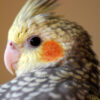
Most of the qualities you’d really like in a parrot are found in the gentle, amenable cockatiel. Read on to find out what makes cockatiels such a wonderful pet.
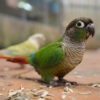
No wonder conures are a popular pet bird companion. They are smart, active, cuddly, and social. There are many species of conure, and each group has its own unique set of traits. See the similarities and differences between the fiery-colored Sun conure of the Aratinga genus to the diminutive green-cheeked conure of the Pyrrhura genus.
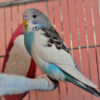
Parakeets as pets are a manageable size, entertaining, social, and talkative. Small enough to fit in your apartment and travel with you, parakeets can make great pets. Check out these 8 perks of sharing your life with a parakeet.
Sharing seems to be less common in our nonhuman primate relatives, and appears to occur only under some fairly specific conditions. But what about creatures that are not primates? Our recent studies suggest that African grey parrots also can engage in sharing behavior.
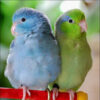
At a glance, parrotlets and lovebirds look a lot alike. What do these short-tailed, compact birds from entirely different continents have in common, and what makes them different?
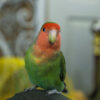
No other companion pet has a name quite as endearing as a lovebird. The lovebird’s genus, Agapornis, is the words “love” and “bird” joined together — agape is Greek for “love” and ornis is Greek for “bird.”
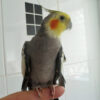
Don’t let the small size of your small parrot – your budgie, cockatiel or lovebird – deter you from teaching him or her some behaviors on cue. Some commands are really helpful in managing your pet bird. Here are three things to teach your small pet bird.
Does covering the cage or running toward your bird to tell him/her to quiet down … or screaming back … sound familiar? If you find yourself in need of a little quiet time and your parrot is simply not getting it, here are tips and tricks to stop the screech.
Fall is the time of change – particularly along the northern tier in the United States. While we often think about how autumn affects us, a change of seasons also brings out changes in our pet birds.
You may be a pet person. You’ve had a dog or a cat for a pet, and maybe several of each. But now you’re a bird owner. Wow! Here are some of the things that make companion birds interesting, and things that make them different from dogs and cats.
Parrots are social creatures. They are flock animals, traveling and feeding together as a group. The majority of the activities in which they engage are done as a group.
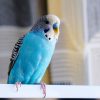
Budgies (parakeets) chatter a lot, as budgie owners will have noticed. What does all that chatter mean? Here are some common budgie sounds and what they might mean.
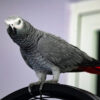
To put it bluntly, keeping companion parrots is similar to trying to pound a square peg into a round hole. The fact that they do as well as they do is testimony more to their adaptability than it is to our husbandry efforts.
Parrots are wonderful if you have a low tolerance for boredom like I do. Despite living and working with them for over three decades, I still find their complexities stimulating and the study of their behaviors both fascinating and absorbing.
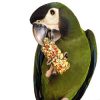
Food plays an essential role in the survival of every living creature. It can also be a source of great pleasure. Animal trainers, behaviorists, pet owners, and, yes, parents of small children, use food in a number of creative ways. Most people love giving their animals friends food treats.
Providing projects that occupy busy beaks and stimulate avian Einsteins is one of the never-ending challenges of parrot ownership. The quest for that perfect bird toy takes us trekking to innumerable pet shops and bird marts, and pouring through countless catalogs.
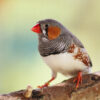
If you’re considering adding a finch or a canary to your family, you might be surprised to find that a canary is a finch. Zebra finches, society finches, also called Bengalese finches, and canaries actually have a lot in common.
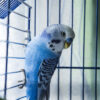
For years, budgies, also called parakeets, were the most numerous companion birds, and only recently were overtaken by cockatiels. If you’re looking at getting one or the other, how do they compare?
Give your budgie (aka “parakeet”) some toys! You will be wildly entertained as your budgie plays, and your budgie will stay active and engaged without getting into any mischief from boredom.
Chirps, warbles, whistles, squawks, cheeps, and more are noises and sounds pet cockatiels make. Find out what your cockatiel is trying to say.

I remember the first thing that Liz wanted all parrot owners to do when they first got their bird and especially if they were having a problem: she wanted them to take it to their avian vet!
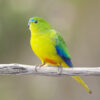
Almost all parrots are non-migratory birds, that is, they do not fly to a different climate during specific times of the year. There are two parrot species, however, that do migrate in the truest sense of the word — the swift parrot (Lathamus discolor) and the orange-bellied parrot (Neophema chrysogaster).

I had the pleasure of working with many avian experts throughout my years as editor of Bird Talk magazine, but none was quite like avian behavioral consultant Liz Wilson.

The bird community lost a special member when long-time parrot advocate and well-respected author Liz Wilson, CVT, passed away on April 13, 2013. Liz was the voice behind the popular parrot behavior column “Parrot Psychology,” which ran in Bird Talk magazine for many years and, up until her passing, was a monthly feature on LafeberCares.com.
There is no such thing as a parrot biting for no reason. No such thing. It is, however, common for a parrot to bite for no reason that humans understand. BIG difference.
Changing a parrot’s behavior usually means the humans have to change their behavior first — not always so easy. So we look for ways around the problem behavior, ways to change what leads up to the problem behavior.
Find out why you might want to rethink your pet bird’s cage setup, how long you leave the lights on, the type of foods you feed, and even the way you pet and interact with your bird.
A fundamental rule of behavior is that no animal, human or otherwise, continues a behavior if it isn’t reinforced. These rewards are crucial to identify and understand because they are the reason that our birds continue to present behaviors that we do not like.
Check out part two of Liz’s Parrot Psychology column “Do’s & Don’ts For Living With Parrots: Part II, The Do’s.” This LafeberCares exclusive will help you and your pet bird get on the right track in the year ahead and beyond.
Life with parrots can be complicated, but it gets simpler if you avoid these 18 things. If you haven’t avoided them all, keep trying!

Five years after Alex’s passing, he is still sorely missed; by me and, I believe, by Griffin and Arthur, the other African grey parrots in my lab. Days still exist, particularly when I return after a long absence, during which I walk into the laboratory, glance at the cage in the far corner of the room, and expect to be greeted by Alex’s familiar, imperious “Come here!”
Parrots can be extremely vocal critters, and you can find out a lot about your pet parrot’s mood by the sounds it makes. What’s behind that laugh, the gibberish talk, or why the ear-piercing shriek?
Politeness means accepting that our parrots should not be expected to wait around in the hopes that we will choose to interact with them. They have their own lives, after all, and they have a right to choose not to interact with us whenever we might wish it. It means not expecting them to be at our beck and call.
Since it behooves us to periodically examine our relationships with our parrots, we should consider these different parenting approaches in terms of our pet birds.