



I recently gave a talk that reviewed Alex’s numerical abilities and realized that I had never discussed this issue in a blog. The material is far from new, but worth reviewing because Alex’s number studies were unique in several ways.
Not only was he the only nonhuman who used vocal labels (rather than, for example, a point to a specific group or Arabic numeral), but he was also trained in a very unusual manner. And he outperformed some of the other nonhumans on certain tasks as well. I’m not going to discuss all of Alex’s numerical abilities here. That would make this blog as long as a book chapter! But I’ll start the process this month; as the saying goes,“to be continued!”
Alex’s ability to vocally produce his number labels gave us certain advantages. First, we didn’t have to control for inadvertent cuing, such as somehow indicating which numeral he should choose from amongst a physical set (the ape studies were extremely careful, but they did have to include these controls). Second, because he could say anything he wanted — even non-number labels, for example. We could find out a bit more about exactly how he was processing information. This is something I’ll discuss briefly below and more in subsequent blogs.
How We Learn Numbers
When children learn their numbers, they start with the label “1.” Usually, they are about 2 years old before they begin to understand the concept of “1” versus “many.” It takes about another nine months before they understand “1” versus “2” versus “many,” and another five months to add “3” (see Carey, 2009). Around that time, they also begin to repeat a number line in order (e.g., can list their numerals, often well beyond “3”). At first, they don’t generally say them in the correct order.
However, even when they get the order correct, they understand the line about as well as they understand their ABCs at that point. They think LMNOP is one letter. They learned what is essentially a rote phrase. A few months later, about the time they add “4,” they gain a critical insight: They recognize the connection between their number line and the numeral labels they have learned to associate with quantity. They realize that each successive numeral in the number list is exactly one more than its predecessor (Carey, 2009). They then quickly understand what the next numbers in the list mean, and no longer have to be taught each number in turn.
Alex, however, did not learn his numbers this way!
Alex’s Unique Approach To Numbers
We started training Alex on “3” and “4,” because he already knew something about those labels. He already knew to identify a triangle as “3-corner” and a square as “4-corner.” Thus, he could already pronounce those labels. He probably understood something about their relationship to the quantities of corners (if nothing else, that the square had more “corners” than the triangle).
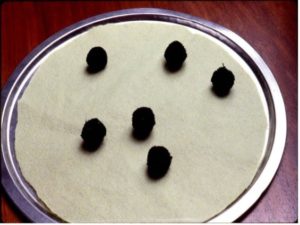
It took him a few months of Model/Rival training to transfer use of these labels to a few sets of objects. We then had to test him on novel sets, so that he couldn’t be responding based on things like mass, density, or contour. In order to claim he was answering with respect to number, he had to be able to identify three big pieces of wood as well as three small pieces of paper, and do the same even for objects for which he had no labels! The labels “3” and “4” had to mean the same thing for every possible set of items.
Adding To Alex’s Numerical Abilities
We then taught him “2” and “5”— one more and one less than the numbers he knew. It took him two months to learn “2” and six months to learn “5.” The “f” and “v” sounds are difficult for parrots, because they don’t have lips. At first, his attempts sounded too much like “hide.” (BTW: Griffin refuses to learn “5,” probably for the same reason!)
We then introduced “1” and “6.” It took another two months for him to learn “6.” Interestingly, it took over a year for him to learn “1.” It seemed that he didn’t understand why it was necessary. He had always been able to obtain a single object by just saying its label. Insisting that he now add a number label appeared to confuse him — even though the question was “How many?” instead of “What’s here?” He had previously, occasionally made what we called “generic” errors on other numbers when he gave us only the label of the object in response to “How many?” For “1,” the problem at first was not occasional! It took quite a bit of training to get him to attend to what we wanted.
We didn’t start training him on “7” and “8” for many years, because we were doing many other studies. He learned “8” almost immediately, because he knew how to say the label “grate.” The label “7” took about a year. He kept saying “sss-one,” again omitting that difficult “v” sound. I’ll come back to “7” and “8” next time. Those numbers were part of a very important, separate study (Pepperberg & Carey, 2012).
Exploring Nonhuman, Numerical Abilities
We had really good data early on that Alex had acquired an exact understanding of his number labels “1” through “6” (Pepperberg, 1987). He responded just like two apes, Sheba (Boysen & Berntson, 1989) and Ai (Matsuzawa, 1985), who had also learned the meaning of these Arabic numerals. Thus these three nonhumans had done something far beyond what other nonhumans had achieved. Most nonhumans (and children before they actually learn their number labels) have a limited understanding of quantity; they engage in something called the “approximate number system” or ANS (see Halberta & Feigenson, 2008).
Specifically, almost every nonhuman studied can demonstrate exact numerical understanding of “1,” “2,” and “3,” but then get fuzzy at the larger numbers. When asked to identify “4,” for example, they confuse the quantity with “3” and “5.” And as the numbers get larger, they make more mistakes and the range of errors widens, too. If asked to identify “8,” they not only often confuse it with “7” and “9” but also with “6” and “10.” Thus, they understand only “approximately 8.” When Alex and the two apes erred, their errors were usually random, caused by lack of attention, rather than produced as an approximation.
Proving Alex Understood
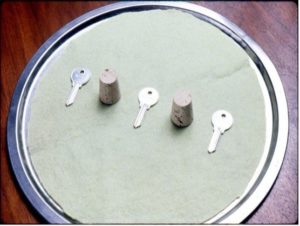
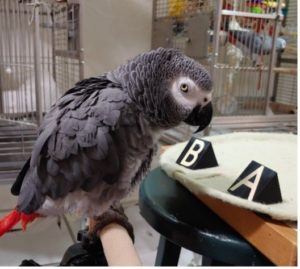
Of course, to be certain that Alex really did understand his numbers, we had to eliminate other confounds in addition to mass, density, and contour. We thus made sure he could identify objects in random arrays (see Figure 1), so that he wasn’t recognizing a pattern (think of dominoes or dice, or triangles and squares). And we also needed to show that he could identify subsets (e.g., “How many cork?” versus “How many key?” Figure 2): Young children who don’t quite understand their numbers cannot separate out subsets (Greeno et al., 1984; Siegel, 1982). We also had to ensure that, unlike some nonhumans who understood large numbers only approximately, Alex wasn’t doing something like clumping small groups he could recognize with the ANS (e.g., learn that two groups of 3 were “6” without actually understanding “6″). We, therefore, gave him a complex task given to humans (see Figure 3, Trick & Pylyshyn, 1989).
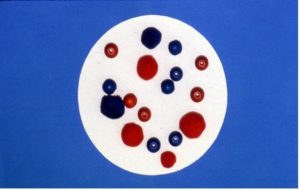
The researchers performing the study determined that humans couldn’t use a clumping mechanism and the ANS when asked to identify the number of a subset of objects defined by multiple attributes in a very complicated array (e.g., “How many blue wood?” versus “How many blue wool?” versus “How many red wood?” versus “How many red wool?”, Figure 3), but always had to perform an exact quantification for every set.
If Alex were, like the humans, unable to clump in order to use the ANS, he would have made more errors on the larger numbers and his errors would always have been labels that were close to the correct response — but that wasn’t the case! He was just as accurate on the large as the small numbers, and his errors were random (Pepperberg, 1994). So, we had clear evidence that Alex could produce the correct number label in the presence of a corresponding set of objects. That was a big step in learning about his number sense.
However, you’ll notice that throughout this article, I never use the word “count” or “counting.” The reason is that counting is a very special ability, much more complicated than just being able to label sets of objects — something that I’ll discuss next time.
References
Boysen, S. T. and Berntson, G. G. (1989). Numerical competence in a chimpanzee (Pan troglodytes). Journal of Comparative Psychology, 103, 23–31.
Carey, S. (2009). The Origin of Concepts. New York: Oxford University Press.
Greeno, J. G., Riley, M. S. & Gelman, R. (1984). Conceptual competence and children’s counting. Cognitive Psychology, 16, 94–143.
Halberda, J., & Feigenson, L. (2008). Developmental change in the acuity of the ‘‘number sense’’: The approximate number system in 3-, 4-, 5-, and 6-year-olds and adults. Developmental Psychology, 44, 1457–1465.
Matsuzawa, T. (1985). Use of numbers by a chimpanzee. Nature, 315, 57–59.
Pepperberg, I. M. (1987). Evidence for conceptual quantitative abilities in the African Grey parrot: labeling of cardinal sets. Ethology, 75, 37–61.
Pepperberg, I. M. (1994). Evidence for numerical competence in an African Grey parrot (Psittacus erithacus). Journal of Comparative Psychology, 108, 36–44.
Pepperberg, I. M. & Carey, S. (2012). Grey parrot number acquisition: the inference of cardinal value from ordinal position on the numeral list. Cognition, 125, 219–232.
Siegel, L. S. (1982). The development of quantity concepts: perceptual and linguistic factors. In Children’s Logical and Mathematical Cognition, ed. C. J. Brainerd. Berlin, Heidelberg, New York: Springer-Verlag, pp. 123–155.
Trick, L. & Pylyshyn, Z. (1989). Subitizing and the FNST spatial index model. University of Ontario, Ontario, Canada, COGMEM #44.
 Join us for a FREE, live, interactive webinar hosted by Laura Doering, former editor of Bird Talk magazine and Birds USA magazine.
 Join us for a FREE, live, interactive webinar hosted by Laura Doering, former editor of Bird Talk magazine and Birds USA magazine.
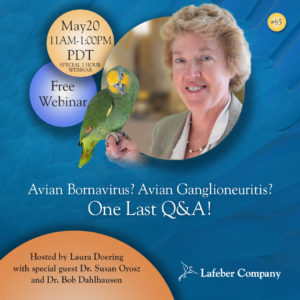 Join us for this very important FREE, live webinar hosted by Laura Doering, former editor of Bird Talk magazine and Birds USA magazine.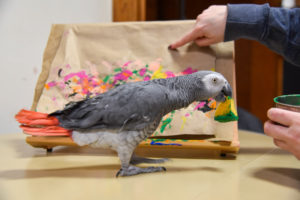

 Join us for a FREE, live, interactive webinar hosted by Laura Doering, former editor of Bird Talk magazine and Birds USA magazine.
 Join us for a FREE, live, interactive webinar hosted by Laura Doering, former editor of Bird Talk magazine and Birds USA magazine.
 Join us for a FREE, live, interactive webinar hosted by Laura Doering, former editor of Bird Talk magazine and Birds USA magazine.
 Join us for a live, interactive webinar hosted by Laura Doering, former editor of Bird Talk magazine and Birds USA magazine.

 Join us for a FREE, live, interactive webinar hosted by Laura Doering, former editor of Bird Talk magazine and Birds USA magazine.
 Join us for this very important FREE, live webinar hosted by Laura Doering, former editor of Bird Talk magazine and Birds USA magazine.
 Join us for a FREE, live, interactive webinar hosted by Laura Doering, former editor of Bird Talk magazine and Birds USA magazine.
 Join us for a live, interactive webinar hosted by Laura Doering, former editor of Bird Talk magazine and Birds USA magazine.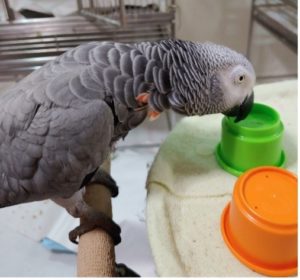


 Join us for a FREE, live, interactive webinar hosted by Laura Doering, former editor of Bird Talk magazine and Birds USA magazine.
 Join us for a FREE, live, interactive webinar hosted by Laura Doering, former editor of Bird Talk magazine and Birds USA magazine.
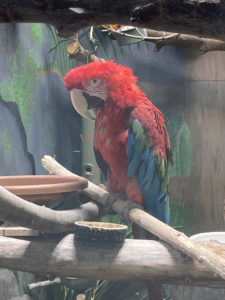
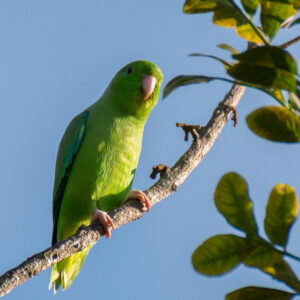
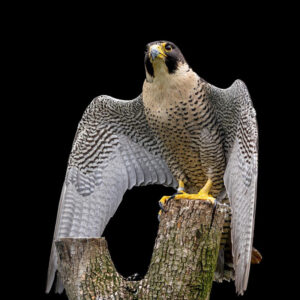
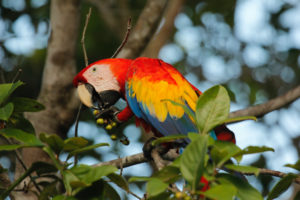
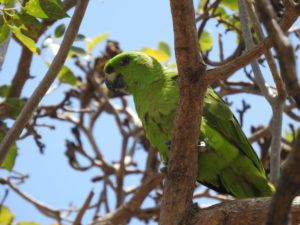
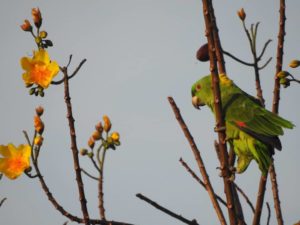

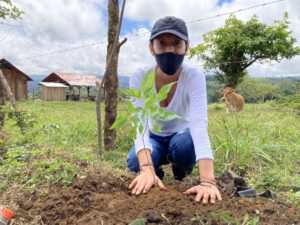
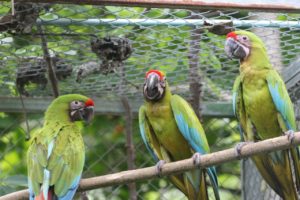
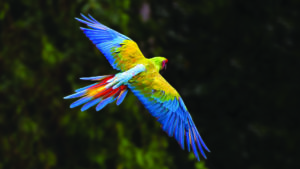
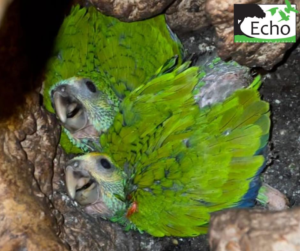
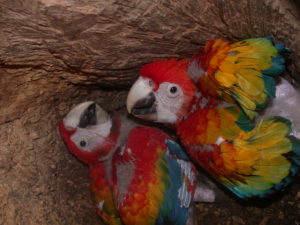
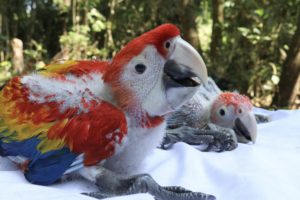 The Maya Biosphere Reserve (MBR) in Guatemala was created in 1990 to protect the tropical forest in Mesoamerica. After the Amazon, Mesoamerica’s Maya Forest is the largest remaining tropical rainforest in the Americas. The MBR is divided into zones with different status levels. The most protected “core zone” covers about 36% of the MBR and is intended to preclude human settlement, logging, or extraction of resources. There are several ancient Mayan cities within this area, and it is part of a tri-national system of contiguous protected areas spanning Guatemala, Belize, and Mexico. It is also home to scarlet macaws. However, this area is facing increased threats due to illegal human settlements, intentional forest fires, oil exploration, and cattle ranching.
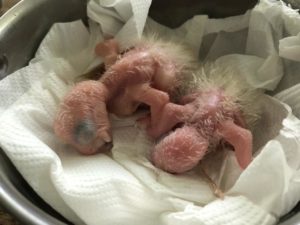
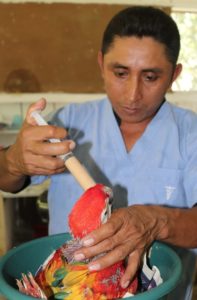 To accelerate recovery of the scarlets in this area, WCS is pulling the low-weight chicks from nests, raising them in a field laboratory, and placing them in foster nests when possible. They are also enlarging possible tree cavities, installing falcon-proof nests, and combatting Africanized bee infestations.
 WCS has top-notch scientists working on conservation programs around the world and they produce many important research studies each year. Their mission is to work with indigenous people in order to build sustainable communities for both people and animals.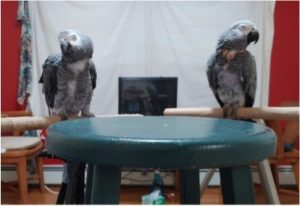
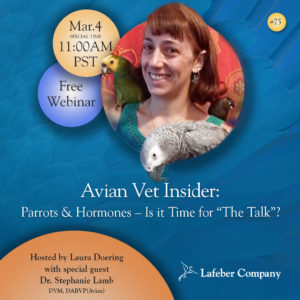
 Join us for a FREE, live, interactive webinar hosted by Laura Doering, former editor of Bird Talk magazine and Birds USA magazine. Our special guest, Dr. Stephanie Lamb, DVM, DABVP (Avian Practice), will talk about the top 5 bird species she treats most often, and the top 5 rarest bird species she has treated. Your Avian Vet will see many of the same species every week. The familiarity with these species can be helpful, even though each case is unique in its own way. On the other end of things, your Avian Vet sometimes sees an uncommon and even very rare avian species as a patient. Cases like this can bring their own set of challenges, especially if this is the first time the Vet has encountered a particular species. Find out what species are treated day-to-day, and how treating a rare species might be different, in this insider’s view of the daily happenings at your Avian Vet’s clinic.
 Join us for a FREE, live, interactive webinar hosted by Laura Doering, former editor of Bird Talk magazine and Birds USA magazine. Our special guest, Lisa Bono, CPBC, owner and operator of The Platinum Parrot and a certified parrot behavior consultant specializing in African grey parrots, presents Episode 6 of The Grey Way, a Lafeber Pet Birds Webinar Series focusing on Congo & Timneh African grey parrots as pets. In this episode, Lisa will talk about keeping your bird safe amidst holiday revelry. The holidays can bring family gatherings, festive decorations, decadent foods, seasonal spirits and all of the additional sounds and loud noises that go with festivities. All of the things that can make the holidays a celebration for people also bring anxiety and dangers for our pets. Greys can be especially sensitive to all of these sudden changes. Lisa will discuss how to prepare and protect our pet birds during the holidays. She will help us know how to still have a good time with family and friends while keeping the stress to a minimum for our birds. While Lisa’s advice will address Grey-centric concerns, the information in this webinar can help all pet birds. Let’s get ready for safe & happy holidays!
 Join us for a live, interactive webinar hosted by Laura Doering, former editor of Bird Talk magazine and Birds USA magazine. Our special guest
 Join us for a live, interactive webinar hosted by Laura Doering, former editor of Bird Talk magazine and Birds USA magazine. Our special guest
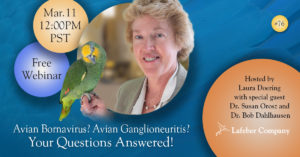
 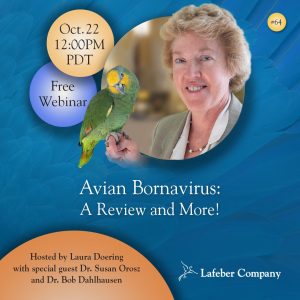 Join us for this very important FREE, live webinar hosted by Laura Doering, former editor of Bird Talk magazine and Birds USA magazine. Our special guests, Susan Orosz PhD, DVM, DABVP (Avian), DECZM (Avian) & Bob Dahlhausen, DVM, will provide a brief review on Avian Bornavirus(ABV) and how it can affect our various parrot species. The doctors will then expand on the information from the first ABV webinar, including more about diagnostic testing & treatments. They will also address questions that were pre-submitted by viewers. In order to provide as much information as possible, we will not be taking live questions.
 Join us for a FREE, live, interactive webinar hosted by Laura Doering, former editor of Bird Talk magazine and Birds USA magazine. Our special guest Stephanie Lamb, DVM, DABVP (Avian Practice), will talk about her experiences at the most recent ExoticsCon – an annual Veterinary conference that brings Vets & Technicians from all aspects of Exotics Medicine together to share new findings and interesting cases. From Scientific Sessions to Hands-On Labs, the specialized Vets & Techs are learning the latest in Exotics Medicine in order to provide the most advanced care for your Exotic Pets. When not in classes, these professionals are networking or visiting the exhibit hall where they can find out about new equipment, food, supplements and more to help their Exotic patients. What is a Hands-On Lab or a Poster Competition? Learn these answers as well as the importance and significance of Veterinary meetings and how they benefit you & your pets, during this insider’s view of ExoticsCon.
 Join us for a FREE, live, interactive webinar hosted by Laura Doering, former editor of Bird Talk magazine and Birds USA magazine. Our special guest
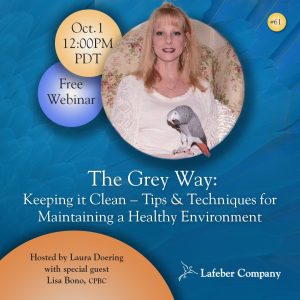 Join us for a FREE, live, interactive webinar hosted by Laura Doering, former editor of Bird Talk magazine and Birds USA magazine. Our special guest, Lisa Bono, CPBC, owner and operator of The Platinum Parrot and a certified parrot behavior consultant specializing in African grey parrots, presents Episode 5 of The Grey Way, a Lafeber Pet Birds Webinar Series focusing on Congo & Timneh African grey parrots as pets. In this episode, Lisa will talk about how to keep your cages & play stands clean to provide a healthy indoor environment for your pet birds. Whether you have one bird or a multi-bird household, cleaning doesn’t have to be a difficult chore if you establish a routine and good husbandry practices. From safe cleaners to keeping the indoor air healthy, Lisa will share tips to help you save time, making your life easier and giving you more quality time with your birds. She will explain why too much cleaning can be a health concern and where to draw the line between too clean and “call the cleaning police!” While Lisa will address grey-centric concerns, her cleaning lessons can help any pet bird owner.