




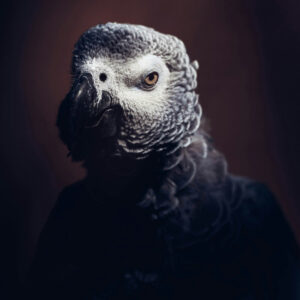
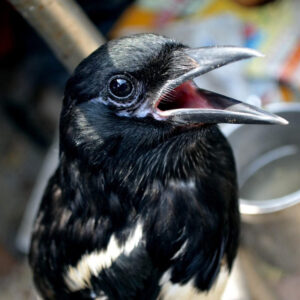
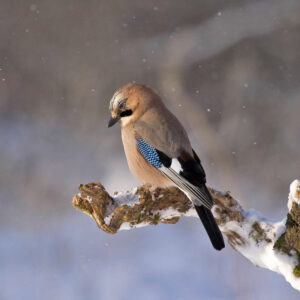
A journal article, published this August (Schnell et al., 2021), showed that a species of European jay demonstrates clear distress when their expectations of finding a treat are violated. The experimenters showed the birds that a very desirable food was being hidden under one of two cups, and then, without the birds knowing, the experimenters swapped it for something the birds didn’t like nearly as much. Not all birds reacted strongly, but those that did check under other cups, or squawked and flew away, and usually ignored the less-desired food they had found.
Parrots Dislike Trickery Too!
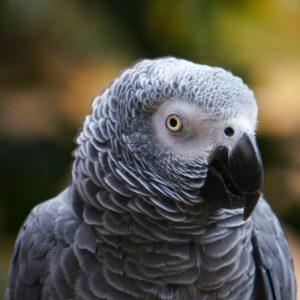
I wasn’t at all surprised by their results, having observed the same behavior in my parrots (Pepperberg et al., 1997) decades ago! We performed the study as part of an experiment on object permanence—the notion that an object does not cease to exist (is ‘permanent’) even if it is out of sight. The very first studies of this type were performed by a Swiss psychologist, Jean Piaget, who was interested in studying the development of various types of intelligence in children. He started testing babies when they were only a few months old and kept presenting more and more complicated types of tasks as the children got older (Piaget, 1936/1952).
The easiest task just checked to see if the baby could track the object as it was moved around; then the tasks got harder: The object was partially hidden under something like a blanket, then fully hidden; next came tracking when two possible hiding places existed, then three, and so forth. Other researchers (e.g., Uzgaris & Hunt, 1975) looked at even more complicated tasks—actions like hiding the treat in the experimenter’s hand and then moving the hand among several cups before hiding the treat under one cup and showing an empty hand.
When we did the study in question, Alex had already passed all the Uzgiris and Hunt tasks (Pepperberg & Kozak, 1986); here we wanted to track Griffin from a very early age to see if his development paralleled that of children (it did, but he progressed more quickly)—plus, our concern was that our parrots might be smart enough to track something of interest, but not necessarily remember what it was that they were tracking.
One way to check this possibility was to do the ‘treat substitution’ trick. Other researchers (e.g., Tinklepaugh, 1928, 1932) had examined how nonhuman primates reacted to being tricked with “reat substitution,” so we thought that would be an interesting task for our birds. And they reacted similarly—Griffin turned over the cup under which he thought he would find a nut, didn’t find the expected cashew, then turned over all the other cups and, when that didn’t work, ran over to the experimenters!
Alex reacted similarly, but also stared at the experimenters with slitted eyes—an aggressive stance—and added some emphatic banging of his beak on the table, which for him was a signal of displeasure and frustration. At the time we did these experiments, we couldn’t videotape each trial with a tiny camera or a mobile phone as we do now (the experiment was actually done in 1996!), so we don’t have a cinematic record—just our notes (thus no pretty pictures this month).
Of course, this behavior makes a lot of sense when one thinks about the lives of nonhumans that are usually preyed upon in the wild—they form expectations of where food should be over time, and if it is not there, they will have wasted a lot of precious foraging time and effort and possibly exposed themselves to predators for naught. And, of course, if they take the time to break open a particular type of nutshell, they definitely expect to find that type of nut! In general, novelty in the wild is more likely to indicate some form of danger (e.g., an unexpected shadow could be a hawk looking for a meal) rather than something fun, which is why most parrots are somewhat neophobic (i.e., shy away from new objects or situations, and dislike surprises).
Thus, although these findings in parrots and jays may not have violated our expectations, as scientists we are always interested in testing our hypotheses. And we are always excited when we find data to show that those hypotheses were correct!
References
Pepperberg, I.M. & Kozak, F.A. (1986). Object permanence in the African Grey parrot (Psittacus erithacus). Anim. Learn. Behav. 14:322‑330.
Pepperberg, I.M., Willner, M.R., & Gravitz, L.B. (1997). Development of Piagetian object permanence in a Grey parrot (Psittacus erithacus). J. Comp. Psychol. 111:63–75.
Piaget, J. (1952). The origins of intelligence in children (M. Cook, Trans.). New York: International Universities Press. (Original work published 1936)
Schnell, A.K., Maria Loconsole, M., Garcia-Pelegrin, E., Clive Wilkins, C., & Nicola S. Clayton, N.S. (2021). Jays are sensitive to cognitive illusions. R. Soc. Open Sci. 8: 202358. https://doi.org/10.1098/rsos.202358
Tinklepaugh, O. T. (1928). An experimental study of representative factors in monkeys. J. Comp. Psychol. 8:197-236.
Tinklepaugh, O. T. (1932). Multiple delayed reaction with chimpanzees and monkeys. J. Comp. Psychol. 13:207-243.
Uzgiris, I. C., & Hunt, J. (1975). Assessment in infancy: Ordinal scales of psychological development. Champaign: University of Illinois Press.

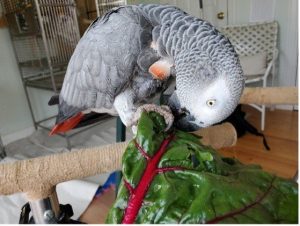
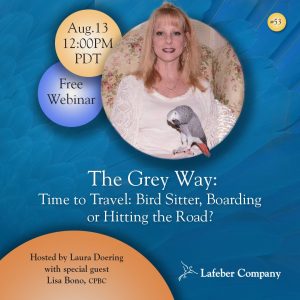 Join us for a FREE, live interactive webinar! Lisa Bono, CPBC, owner and operator of The Platinum Parrot and a certified parrot behavior consultant specializing in African grey parrots, presents Episode 4 of The Grey Way, a Lafeber Pet Birds Webinar Series focusing on Congo & Timneh African grey parrots as pets. In this episode, Lisa discusses your options when planning a trip. How to choose a qualified bird sitter or boarding facility? Is taking your Grey with you an option? Preparing your Grey for a road trip or air travel? There are many factors to consider, and Lisa’s webinar will help you make an informed decision.
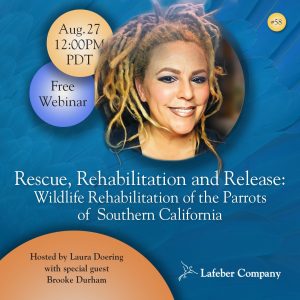 Join us for a FREE, live, interactive webinar hosted by Laura Doering, former editor of Bird Talk magazine and Birds USA magazine. Our special guest, Brooke Durham, will talk about SoCal Parrot, a licensed wildlife rehabilitation facility near San Diego, California. This unique facility is the only psittacine wildlife rehabilitation organization in the world that works solely with wild urban parrots. Brooke will discuss the species they work with, as well as research and conservation efforts the organization is involved with. The work they do goes beyond parrot rescue and rehabilitation. Learn all about the important work this organization does by tuning in to this unique webinar!


 Join us for this very important FREE, live
  Join us for a live, interactive
  Join us for a FREE, live, interactive

 Join us for a free interactive webinar: Heart to Heart: Pet Bird Behavior Q&A with
  Join us for a FREE, live, interactive webinar hosted by Laura Doering, former editor of Bird Talk magazine and Birds USA magazine. Our special guest,
  Join us for a live, interactive webinar hosted by Laura Doering, former editor of Bird Talk magazine and Birds USA magazine. Our special guest
  This webinar has been cancelled/postponed due to a medical crisis with one of Lisa’s Greys.
 Time: 12:00 pm PDT (double-check your local time with this
  Time: 12:00 pm PDT (double-check your local time with this
  Join us for a live, interactive webinar hosted by Laura Doering, former editor of Bird Talk magazine and Birds USA magazine. Our special guest
 Join us for a free, live interactive webinar!
  Time: 12:00 pm PDT (double-check your local time with this
  Date: Friday, April 16, 2021
 Join us for a live, interactive webinar hosted by Laura Doering, former editor of Bird Talk magazine and Birds USA magazine. Our special guest

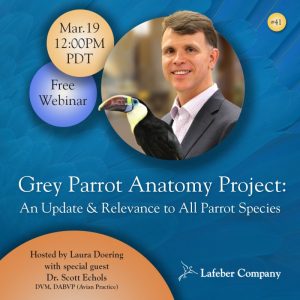
 Time: 12:00 pm PDT (double-check your local time with this
  Time: 12:00 p.m. PDT (double-check your local time with this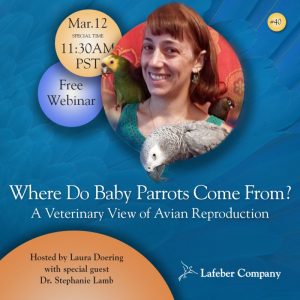
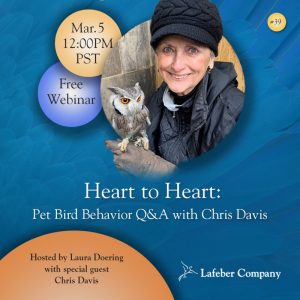 Show your feathered friend how much you love them by tuning in to this free webinar focused on bird behavior and the human-bird bond. Inspired by her former Bird Talk Magazine column, Heart to Heart: Pet Bird Behavior Q&A, Chris will share a behavior case or problem and then field viewer’s behavior-related questions. Chris is a pioneer in avian behavior who has helped many bird stewards open the lines of communication and grow their bond with their feathered friends.
 Lisa Bono, CPBC, owner and operator of The Platinum Parrot and a certified parrot behavior consultant specializing in African grey parrots, presents Episode 2 of The Grey Way, a Lafeber Pet Birds Webinar Series focusing on Congo & Timneh African grey parrots as pets. This episode tackles on common behaviors and quirks exhibited by pet greys. Is this a normal behavior or a problem behavior? Learn how to recognize the difference and what to do during this free, interactive webinar.
 Join us for a live, interactive webinar hosted by Laura Doering, former editor of Bird Talk magazine and Birds USA magazine. Our special guest
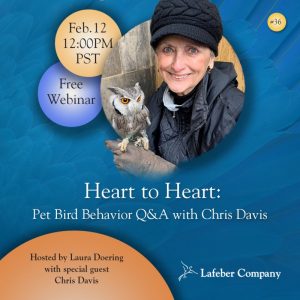 Date: Friday, February 12, 2021
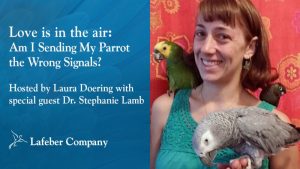
 Join us for a live, interactive webinar hosted by Laura Doering, former editor of Bird Talk magazine and Birds USA magazine. Our special guest



.jpg)