



Contents
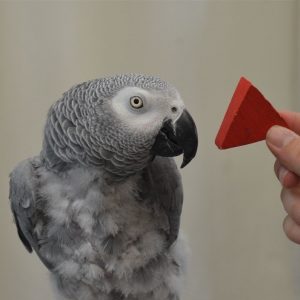
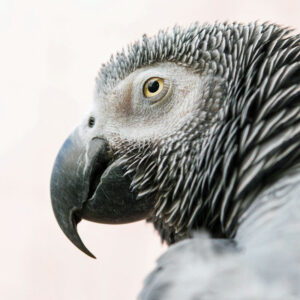
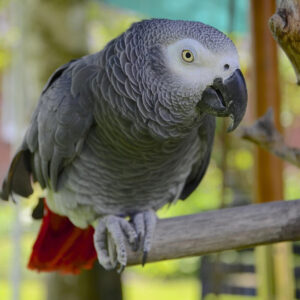
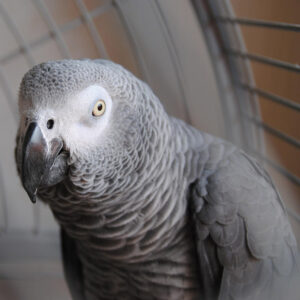
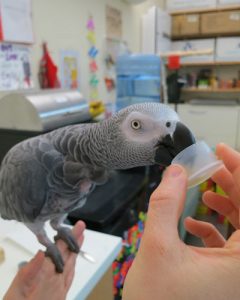
In previous blogs I’ve talked about the importance of using “inference by exclusion” (inferring where something can be found after being given information about where it is absent) for examining nonhuman cognition. Many species succeed at the task at some level, but only a few exhibit a very special case of this behavior involving symbolic communication — something called mutual exclusivity (ME). Interestingly, African grey Griffin demonstrated something very much like ME when initially learning his labels.
Some History On Mutual Exclusivity
The term was first coined by Markman (Markman & Wachtel, 1988), but was previously studied by Carey (1978) under the term fast mapping, in experiments to determine how children acquired their early labels. The task is something like the following: A child is shown two toys that s/he can label (e.g., a ball and a block) along with one novel object (e.g., a cherry pitter). The child is asked to give the experimenter the “dax.” Now, the child knows that neither the ball nor the block is ever called a “dax,” so, by exclusion, s/he picks up the novel item, and thereby maps the novel label to the novel object. Shusterman (Shusterman & Krieger, 1984) used a similar strategy to teach sea lions new labels for new objects.
Of course, the extent of mapping is dependent upon context — if a subject is given several of these trials at once, with several new labels (e.g., “dax,”, “glif,” “nep”), and then given all of the novel objects at once and then asked to choose the “dax,” the mapping often isn’t as good as if the original trial is repeated several times; that is, with only one novel object-novel label connection. However, learning with exclusion is often faster than simple pairing of label and object, and is therefore thought to help children expand their vocabulary.
More About How Mutual Exclusivity Works
ME also seems to help children eventually learn category labels and labels for attributes of objects — but not in their early stages of acquisition. Interestingly, children often have a very difficult time learning that a specific object can have two labels — here, they initially take ME too far, believing not only that every object has a name, but also only one name. So, for example, they happily label the family pet as a “doggie,” but will vehemently state “No animal…doggie!”, excluding the second novel label. Obviously, at some point, they override this aspect of ME, because all normal children learn lots of labels for each of their objects. And, at that point, ME will then help them learn new attribute labels — e.g., novel colors.
So, when given a yellow block, a blue block, and a vibrant pink block, and asked to give the experimenter the “fuschia” one, few of them hesitate in their choice…not only do they know that all the objects are blocks; they also know the referents for yellow and blue, and thus use ME to infer that the novel vocalization had to refer to the color label for the novel attribute. Furthermore, if later asked if “fuschia” is a color, shape or a material, they say it is a color.
Label Training In Parrots
So, how does Griffin fit into all this? Well, his label training differed a bit from that of Alex the African grey. When I started working with Alex in 1977, I didn’t know anything about ME (it was just beginning to be studied in children), but I figured that if I wanted him to learn object labels, I’d best start with items that had very few other attributes, such as color and shape. So, for example, “paper” referred to pieces of a white index card, “wood” to uncolored tongue depressors, and “hide” to amorphously shaped pieces of rawhide. He had no problem learning these labels (Pepperberg, 1981).
When it came time to teach color labels, I dyed several objects with one shade of food color, and then we modeled “What color?” with responses of “green paper,” “green wood,” so that the attribute — the color green — was an additional label rather than a second, separate label, and that two items with different object labels had only that one particular novel attribute in common. Again, Alex had no trouble learning color labels and, in the same way, shape labels (Pepperberg, 1981, 1983). By the time Griffin came on the scene, however, all the various objects in the lab came in all sorts of colors and shapes, and we decided to see if that made any difference when teaching him his labels.
Griffin Tackles ME
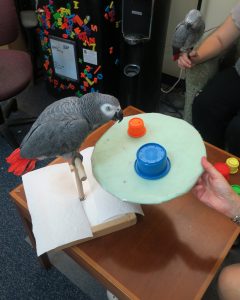
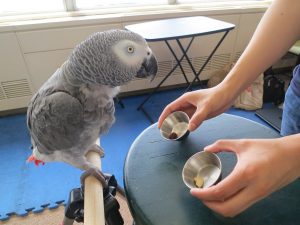
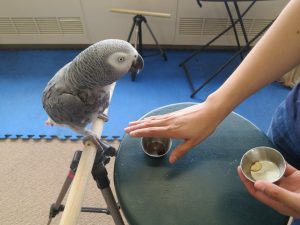
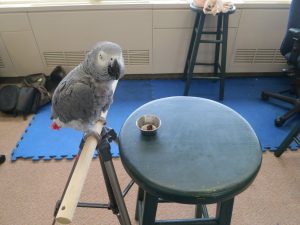
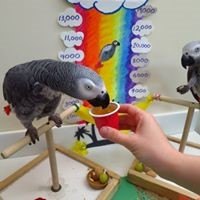
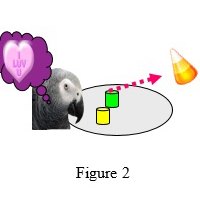
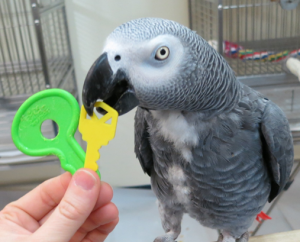
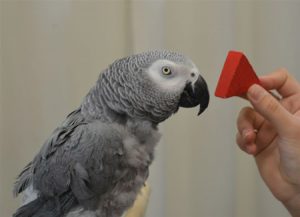
Therefore, Griffin learned labels for objects by seeing several differently colored versions of the same item — e.g., green, blue, yellow wooden sticks or pompons — and humans responding to the questions “What matter?” appropriately. He was able to infer that, because the various groups of wood or wool had different color, but common material, attributes — those materials were called “wood” or “wool.” And when we taught him color labels for a group of variously colored but otherwise identical cups, he also learned to respond to “What color?” with those color labels. So far, no problem. But what would happen when we tried to get him to learn attribute labels not as additional, but as alternate labels, for the various items he could already label? Specifically, what would happen if we showed him a woolen pompon and asked, “What color?” instead of the usual “What matter?”
ME then came into play: Indeed, when asked “What color?” for an item for which he already had a label (“wool”), he at first ignored the query, rejected the color label, and responded “wool” (Pepperberg & Wilcox, 2001) even though he knew the appropriate color label! And he simply wouldn’t learn the label “cup!” Just like the young children who initially used ME to exclude “animal” for a dog, it took months of training to get Griffin to understand that an object could be both “green” and “wool,” or “blue” and “wood”— and likewise with shape and novel object labels.
Eventually, of course, Griffin, again like children, fully understood how objects could be categorized with respect to various different attributes, and now is as competent as was Alex with respect to labeling all these attributes (Pepperberg & Nakayama, 2016), and better than even 5-year-old children on physical tasks of inference by exclusion (Pepperberg et al., 2018). However, it was quite exciting to find that the path of label acquisition, including ME, could be so similar for species that are so evolutionarily distant!
References
Carey, S. The child as word learner. In M. Halle, G. Miller, and J. Bresnan (Eds), Linguistic Theory and Psychological Reality. Cambridge: MIT Press.
Markman, E.M., & Wachtel, G.F. (1988). Children’s use of mutual exclusivity to constrain the meanings of words. Cognitive Psychology, 20, 121-157.
Pepperberg, I.M. (1981). Functional vocalizations by an African Grey Parrot (Psittacus erithacus). Zeitschrift fiir Tierpsychologie, 55, 139-160.
Pepperberg, I.M. (1983). Cognition in the African Grey parrot: Preliminary evidence for auditory/vocal comprehension of the class concept. Animal Learning & Behavior, 11, 179-185.
Pepperberg, I.M., Gray, S.L., Cornero, F.M., Mody, S., & Carey, S. (2018). Logical reasoning by a Grey parrot (Psittacus erithacus)? A case study of the disjunctive syllogism. Behaviour DOI:10.1163/1568539X-00003528.
Pepperberg, I. M., & Nakayama, K. (2016). Robust representation of shape in a Grey parrot (Psittacus erithacus). Cognition, 153, 146–160.
Pepperberg, I. M., & Wilcox, S. E. (2000). Evidence for a form of mutual exclusivity during label acquisition by Grey parrots (Psittacus erithacus)? Journal of Comparative Psychology, 114, 219–231.
Schusterman, R.J., & Krieger, K. (1984). California sea lions are capable of semantic comprehension. Psychological Record, 34, 3-24.
 Snuggle with your feathered friend, pop some popcorn for you, break open a bag of

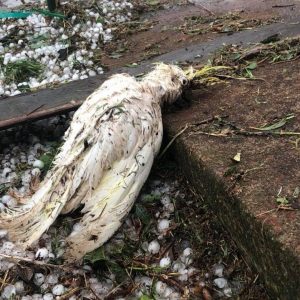 Throughout history, there has been no lack of extraordinary tales of extreme determination against overwhelming odds. Some of them are history book worthy. And while there are many more stories of bravery that fill the all the pages of life’s book, none of them are less memorable than the other. This particularly heartwarming tale involves the tale of the aptly named Lazarus the Cockatoo.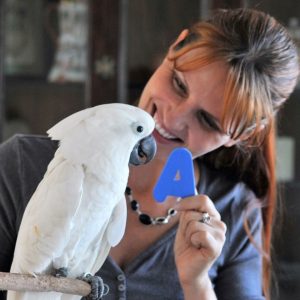


 The Work Ethic
 Lafeber Company was honored the last two weeks to be part of something huge: A collection of parrot rescues and third parties sending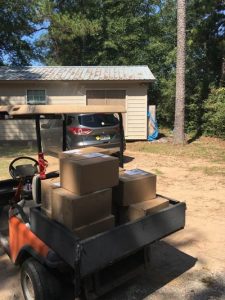
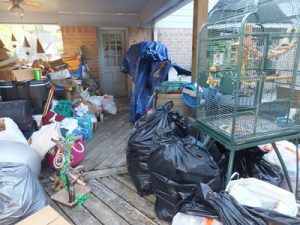 One of our Customer Service associates, Diane, lives in the middle of Houston and her home took on quite a bit of water, just as others did. If you are a regular caller to Lafeber Company, you have more than likely spoken to Diane. She’s the one with the Carolinas accent mixed with that Texas drawl, and she can tell you anything you need to know about birds, and especially baby birds! Diane sent her birds to Magnolia for safekeeping while she and her husband try to rebuild enough to make it safe for the birds and themselves. They are lucky enough that they are able to live in the upstairs still, while so many were not as fortunate.
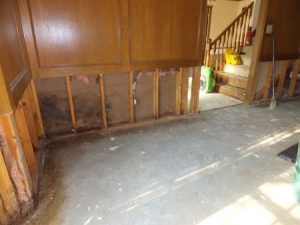 “We did flood and, while not as bad as some people in Houston, it was enough to cover our whole downstairs with water, and the damage is more than I could have imagined. This section of our subdivision is one of the high points in Houston, and while it usually gets stranded like an island with a creek at one end and a creek at the other, we have never flooded in 37 years (so why would we have flood insurance?) and we do not have flood insurance. I couldn’t believe it when I saw water coming down the street; I yelled to my husband to move the car and made a mad dash into the garage to grab carriers for the birds and started getting them out of their cages and upstairs, and before I could finish I was already splashing through water it came up that fast! Nothing but our pets & their food was saved but at least I got that.”