

Avian Expert Articles

Posts

A Firsthand Look At A Seabird Rescue

By Rebecca Duerr. DVM. MPVM. Ph.D.
International Bird Rescue
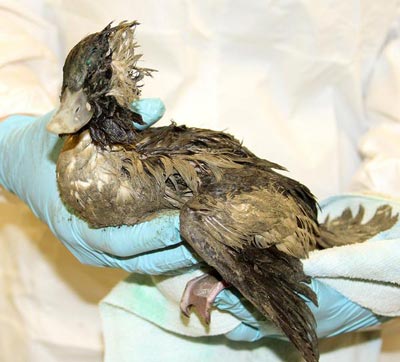
A bufflehead covered in a mysterious substance. (Photo courtesy International Bird Rescue)

On the afternoon of Friday, January 16, 2015, we received word that there were about 50 Surf Scoters sitting on the beach at East Bay Regional Shoreline on San Francisco Bay. As a diving duck that largely lives entirely on the water except during breeding season, we knew sitting on the beach was extremely unusual behavior for scoters and it was likely the birds were contaminated with something that was affecting their feathers’ waterproofing. Aquatic birds like scoters rely on their normally waterproof plumage to provide buoyancy and insulation against cold water. When the feathers become contaminated, they quickly become cold and exhausted from struggling to swim, and are driven to get out of the water to dry off and rest. Seabirds become emaciated very fast when cold and unable to forage; time is of the essence to rescue them before they starve to death.
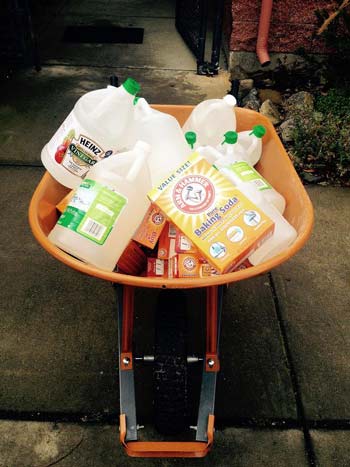
Wheelbarrow of cleaning products used in the rescue effort. (Photo courtesy International Bird Rescue)
Bird being washed. (Photo courtesy International Bird Rescue)

East Bay Regional Parks personnel captured the birds and delivered them to our center for care that Friday evening. When we examined the birds, we found cold, wet birds with a range of feather contamination. Some had a few areas where feathers were stuck together; some had blobs of sticky material that caused the feathers to mat together in a thick mess. Some were stuck to the towels or paper lining from the transport containers.
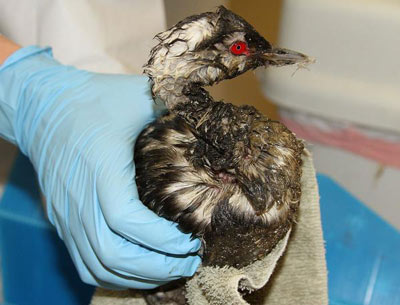
A grebe getting cleaned. (Photo courtesy International Bird Rescue)

We knew it wasn’t petroleum oil, but it was definitely an environmental contaminant of some kind. It had the texture of a hardened epoxy, slightly tacky to the touch but did not come off on gloves. Thick sections of it showed a translucent gray color. Since we didn’t know what the material was, we weren’t sure we would be able to wash it off the birds. We also didn’t know how hazardous the material was; hence, we erred on the side of caution and required all staff and volunteers working with the contaminated birds to wear the same personal protective gear they would wear during an oil spill.
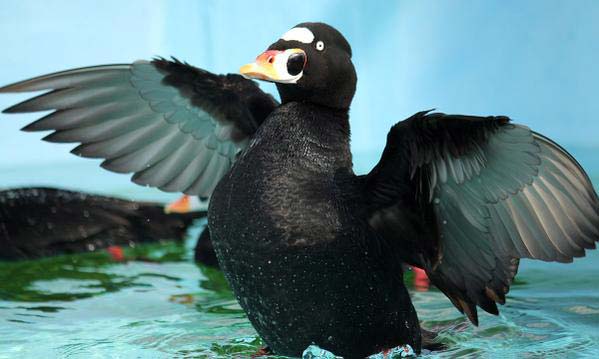


Surf scoter seabird
A cleaned-up surf scoter ready to fly. (Photo courtesy International Bird Rescue)

A Rescue Plan Is Hatched

International Bird Rescue’s most experienced bird washers went to work in the wash room Friday night to figure out how to remove the substance, as simple detergent did not cut it. If they were not able to figure this crucial step out, we may have been faced with having to euthanize all the affected birds. It is not possible to pluck feathers and keep species such as scoters out of water for the months needed to regrow a complete set of new feathers, so that was not an option. Thankfully, by late Friday night our staff had worked out a procedure that seemed to do the trick, and they planned to try it on a few birds Saturday morning. The birds were stabilized with warmth, fluids, and food overnight.
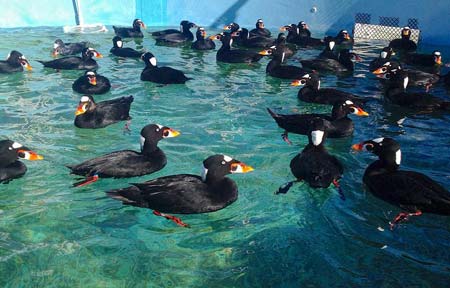
surf scoters
Surf scoters in recovery pool. (Photo courtesy International Bird Rescue)

On Saturday morning, a dozen birds were washed and progressed through our post-wash waterproofing procedure. Although the birds were more difficult to clean and harder to waterproof after washing than oiled birds usually are, the wash protocol appeared to be working. Each bird took about twice as long to wash as an oiled bird, and several needed to be washed again. Meanwhile, more birds were being found on the beaches. Our wash teams got to work intensively washing birds as fast as possible. By day eight, 313 live birds had been collected and brought to us for care, and one of our wildlife center managers made her goal of 50 birds washed on her 50th birthday.

Photo courtesy International Bird Rescue

Although I later shifted to medical and surgical management of the numerous injuries of these birds, my role as IBR’s veterinarian at the beginning of this event was to lead the team caring for birds prior to wash. We were very busy examining birds for medical problems and injuries, and providing birds with warmth, fluids and nutrition to strengthen them for the stressful wash process. Surf Scoters are primarily molluskivores, which means they mostly eat mollusks such as clams, mussels, and snails, but may consume any aquatic small prey animals such as worms, crustaceans, or fish roe. In captivity, Surf Scoters readily eat fish and do very well. We typically feed them small fish such as night smelt when they are eating on their own, or tube feed blended fish slurry when they are not. Many of the birds in care were not eating reliably, so were tube fed up to six times a day.

By the third day of the event, I noticed that the most malnourished and emaciated birds were having problems digesting their blended fish. Several birds had begun regurgitating their nutritional tubings and a few had died; it appeared that the food was just sitting in their stomachs decomposing instead of being digested. At that point I decided these birds’ best chance was to feed them Lafeber’s Emeraid Piscivore. Emeraid Piscivore, which is part of Lafeber’s veterinarian-prescribed, species-specific specialty diets,  is formulated to have its protein content essentially pre-digested as free amino acids and small peptides, so the animal doesn’t have to put much metabolic work into digestion—it can just directly absorb the nutrients without having to break them down first. This diet is also designed to allow variability in how much fat is added. I contacted Dr. Lafeber, and we arranged for a large shipment of the diet. We had a few days’ supply on hand, so began feeding it to the most emaciated birds right away. We fed it at 11% fat, which was the percent fat I identified as optimal for Common Murres in my Ph.D. work. Once transitioned onto Emeraid Piscivore, the birds stopped regurgitating and began doing much better.

Because we had several hundred birds that needed tube feeding many times a day, we had problems keeping up with making enough blended fish for all the birds. We decided to use the Emeraid Piscivore to round out our food supplies for all birds on tube feedings, not just the most critical cases. Emeraid Piscivore is very easy to make on demand in whatever volume is needed. It has a very fine texture and passes through feeding tubes easily. Of the approximately 6,500 tube feedings these birds received in the first week of care prior to becoming reliable self-feeders, about half the total diet fed was Emeraid Piscivore.
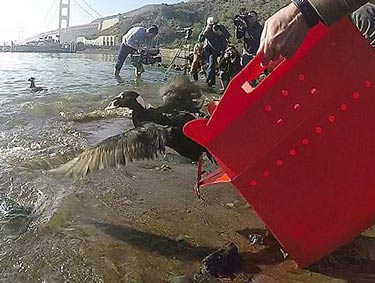
A healthy and clean bird being released back into the San Francisco Bay. (Photo courtesy International Bird Rescue)

All-in-all, Emeraid Piscivore served us very well in providing an easily-digested diet for the most critically emaciated birds, and helped us through a food supply crisis when we were having problems making less-expensive diet fast enough to feed hundreds of birds simultaneously. It was a great help in managing the care of the several hundred birds affected by this event.

See What Sets Bird Hospitals Apart

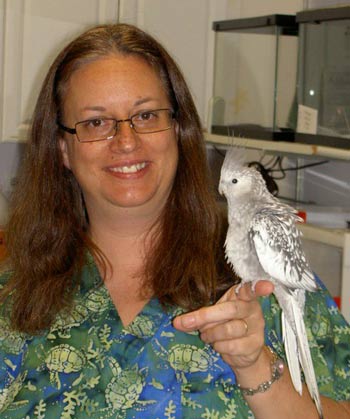
DrSueHortonWithCockatiel-(1)Veterinarian Susan Horton recently opened the Chicago Exotics Hospital, which is devoted to birds, rabbits, reptiles and other exotic pets, in Skokie, Illinois. See how her dream clinic became a reality and what sets an exotics-only clinic apart.

  1. How long have you been working with birds? 

As a veterinarian, I have been working with birds for 20 years now. As an enthusiast, I have been working with and keeping birds for 45 years. It started with my love of wild birds, and led to breeding parakeets and doves as a teen and into my twenties. I went to school and eventually veterinary school specifically because I wanted to be an exotic veterinarian with a heavy interest in avian medicine. I have been seeing avian patients since day one of graduation!

  1. What is your favorite part about working with birds? 

ChicagoAnimalHospitalJune-2015I really enjoy the way their minds work. There is so much going on in there. I love my patients who recognize me and give me a good snuggle! They are so intelligent and amazing! They surprise me all the time. Of course I love the beauty of their feathers and the wonderful ability to fly as well.

  1. What is the most challenging part of working with birds? 

Being ready for any kind of avian patient can be difficult. Sometimes a quick trip to the store is necessary to provide the right food items. Making sure the client has all the information they need for their bird is challenging. We provide in-house handouts, as well as a webpage with plenty of information and links to our favorite sites. Having a well-trained support staff helps as well! Being prepared for all of their potential medical emergencies can be daunting. We maintain a good relationship with our neighbor emergency hospital (where we resided for the last 15 years) for overnight and weekend care when necessary. Providing everything they need in-hospital is a must for a clinic like ours.

  1. What made you decide to open a new clinic?

ChicagoExoticsHosptialIt has always been my goal. I have been leasing space for the last 15 years. Building my own building with specific exotic and avian patients in mind seemed like just a dream. But I found an excellent construction company that was willing to create what I wanted, and it has turned out to be amazing! Also, it is nice to have not one, but two signs of our own after 15 years!

  1. What was the most challenging part of opening a new clinic?
A look at the Chicago Exotics Animal Hospital when it was under construction.

Finding the right location with enough space and a parking lot turned out to be the most difficult part. Luckily, with a lot of learning experiences and a lot of patience, a beautiful space opened up four doors down from where we had been for the last 15 years. It wasn’t beautiful at the time of purchase, but it is now. It is a building that housed a Chinese restaurant and a convenience store. The restaurant stayed as our tenant. The rest of the space was open and ready for us to create the perfect hospital. Zoning was a trip, too! They have an appearance committee that dictates everything about the outside of your building down to the specific trees and flowers.

  1. What are your favorite features of the new clinic, and how is an exotics-focused clinic different from “dog & cat” clinics?

ChicagoExoticsHospitalPeople come in looking for kennels right off the bat. We don’t see any animals that require kennels, so there are none! We have more oxygen cages and hook ups than a normal animal hospital would have. Our rabbit dental station is very unique. I am so happy to have an area dedicated to bird grooming as well as the avian ICU. Sound proofing helps the patients remain calm and not be disturbed by noise. The avian ICU provides private, heated incubators that have optional oxygen available. No predators near these guys! Every kind of perch imaginable can be found somewhere in the hospital. The pharmacy area is extensive and probably bigger then we need but it gives a nice buffer between the flow through exam rooms and the treatment area. Our reptile patients also have every imaginable need met. From lighting to heating to feeding; we have it all! I don’t mean to leave out our fuzzy friends housing and needs, we have that, too. Rabbits, guinea pigs, ferrets, and other small fuzzies all have their space. As well as a heated rack of dedicated hedgehog incubators!

We do see fish and have quite a bit of equipment dedicated to that. I wasn’t able to build my fish room, yet. Some day, when we expand into the restaurant space, maybe I will get my fish room then! We have several devices for fish anesthesia and maintenance for surgery. This is a very unique aspect of exotic animal medicine.

We have very high detailed radiology as well as an endoscopy station, too. This allows us to provide the best diagnostics for our special patients. We have more spotlights and magnification than most hospitals. Many of our patients are very small. Our surgery room was created with the avian patient in mind. Species-specific intubation, monitoring devices, heat supplementation and surgical tools all contribute to the best and safest possible situation for our patients.

I love my avian and exotic library! Students love it too. I have quite an amazing collection from periodicals to textbooks. Everything you might want to know, and more about avian and exotic animal identification, husbandry, medicine and surgery. We have an extensive protocol portfolio as well.

We have more of a home feel to our waiting room and exam rooms, less of a hospital vibe. I think this keeps the patients and the clients calm and relaxed. Comfort is very important to me. From the beautiful tile floor in the waiting room to the intricately carved wood furniture from Hong Kong (heirloom to my associate), to the overall décor; this hospital was made to make everyone entering the front door feel special. Our exam rooms all have personal touches from the staff. The floors are a lovely laminate that looks like wood. The colors are all very earthy and match our website layout. I hope it all conveys the special love and dedication I feel towards this specialty to every creature walking through that door! This is my dream hospital and I love it!

5 Ways You Freak Your Pet Bird Out

Believe it or not, things that you do every day might be freaking out your bird. Do any of the following sound familiar?

1. You go to pick your bird up while holding something in your hand.

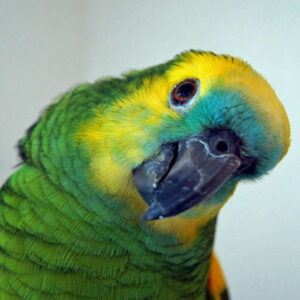
close up on head of blue-fronted Amazon that is tilting head to the side
Photo by DennisBuntrock/Pixabay

It’s easy for us to recognize everyday items such as pencils, papers, phones, utensils etc. as the innocuous items they are. We must remind ourselves, however, that our feathered friends come from a prey animal background, meaning that they are hard-wired to view unfamiliar or unexpected things as potential threats. Some pet bird stewards have been caught off guard when their bird refuses to step up onto their hand or strikes a defensive posture, not realizing that the pencil or phone they are holding either in their offered Step-up hand or even the opposite hand is freaking their bird out. Approach your bird with clean and item-free hands.

2. You switch the light on in your bird’s room during his/her sleep hours.

Similarly, you enter the bird’s room in the dark without turning a light on. Pet birds generally don’t like surprises, especially at night when they might feel especially vulnerable. Bumps in the night can and do send some pet birds into an episode of night fright, where they thrash about the cage. Avoid entering your bird’s room during its sleep time or at the very least keep interruptions to a minimum.

3. You place an unfamiliar item in his/her cage.

Some birds love the challenge of a new toy or the comfort of a new perch. Some need a little time to warm up to the new item. If your bird tends to be a bit timid with new items, place the new toys or cage accessory outside the cage but within view for a few days so he/she can get used to its presence.

4. You don’t respond to your bird’s contact call, especially if it’s a urgent call.

Our feathered friends are flock-focused and your bird more likely than not considers you to be part of the flock. Your bird might be the type that likes to know where you are in the home when you leave the room. The quickest way to put your bird at ease is with a contact call, which could be a quick whistle or word from you while you’re in another room. And one call you must answer in order to avoid freaking your bird out is a distress call. A distress call means “I need you now.” Your bird is trying to get your attention. I’m glad I answered my cockatiel‘s recent flurry of chirps when I returned home after being gone all day. I had filled his water bowl but inadvertently left it on the stand outside his cage. He was thirsty and let me know it!

5. You try a “cold turkey approach” to changing your bird’s diet.

When new bird owners learn that a seed-only diet is bad for pet birds, they might believe they are doing the right thing by swapping the old diet out with a new one pronto; essentially having the bird quit the bad diet “cold turkey.” The concern with this approach is that the bird might not recognize the new offerings as its new diet. Imagine how you’d freak out if the only diet you knew was suddenly swapped out with a diet completely foreign to you. The freak out-free approach is to gradually wean the bird off of the old diet and onto the new, healthier one.

Vaccines And Pet Birds

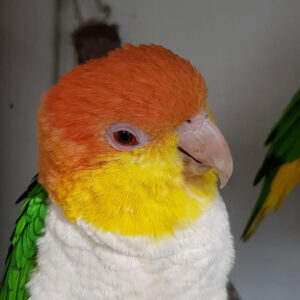
looking down on a white-bellied caique who is looking to the side
Caique. Photo by sebastiaansuk/Pixabay

We are often asked about vaccinating our parrots. And the answer is, well, maybe.

We have limited vaccines and some have come and gone from the market — mostly gone. The only vaccine available is the polyomavirus vaccine.

So what should we do?

Vaccinations For Parrots?

Polyomavirus at one time was killing our parrots — mostly hand-reared chicks and sometimes adults, and often in large numbers. In budgies, the disease would affect the nestlings from 10-25 days of age, causing death acutely. Larger parrots are also susceptible to avian polyomavirus (APV) infection but usually do not have signs of disease. Some species are highly susceptible to disease, especially caiques, while others rarely if ever develop signs of disease.

APV-disease occurs at different ages in different species. In conures, death typically occurs in birds less than 6 weeks of age. Death in macaws and Eclectus parrots occur at about (8 weeks) weeks or younger. Most, possibly all, of the nestlings lost are being hand-fed when this happens. Infected chicks that are being hand-fed appear healthy, show very few premonitory signs, and then die suddenly. Chicks kept in the nest box, being fed by the parents, rarely develop disease; this fortunate outcome is due to the transfer of secretory antibody.

When signs do occur, they precede death by up to 24 hours. Observant owners may notice delayed crop emptying, weakness, a generalized pallor, or bruising under the skin in the preceding hours before death. Yellow discoloration of the urates is another rare observation. Necropsy findings typically include generalized pallor with subcutaneous and subserosal hemorrhages and enlargement of the spleen and liver. Less commonly, ascites of abdominal fluid and/or pericardial effusion around the heart may be present.
Infection Vs. Disease

It has become evident that infection and disease are not synonymous, particularly with this virus. Many birds can be infected with the virus but rarely do adult birds develop disease. They develop sensitized B and T lymphocytes, as well as antibodies and an immune response that prevents disease from occurring and eliminates the viral infection. Those that do show disease often are immunosuppressed. The exception is caique species, where adult birds can develop disease.

Whether disease will develop is dependent on the species of bird infected, the age of the bird infected, and whether that bird is immune-suppressed. Birds that are infected and do not develop disease still have virus replication within their bodies and shed virus in their droppings for a period of time. The length of time that virus shedding occurs, again, depends on the age of the bird at the time of infection and its species. Some hand-fed birds that are partially immune-competent will develop and recover from transient disease. These birds often retain the viral infection for prolonged periods of time and serve to transmit the infection to naïve individuals.

Birds that are infected but do not develop signs of disease will become viremic and may begin shedding virus through the cloaca and possibly oral mucosa. Rarely, viremia lasts for months. Fecal shedding lasts for up to 16 weeks, but again is much shorter in adult birds and nestlings that are infected at an older age.

Polyomavirus Vaccine

A commercial vaccine is available for polyomavirus. Some avian veterinarians recommend vaccination starting at 21 days of age and repeat the vaccine in two weeks. They then follow the recommendation that the parrot should receive the vaccine yearly. Some birds immunized with this vaccine will develop persistent swellings at the immunization site, which is usually the subcutaneous tissue over the caudal pectoral muscles. These lesions will take several weeks to a few months to regress completely. There are other times that these injection sites can lead to dermal tumors.

The other problem with the vaccine is that, scientifically, administration of the vaccine in one study did not result in titers when given to young parrots that had not been previously exposed to the virus. Multiple blood samples were collected including two weeks after the second booster. None of the naïve individuals produced detectable antibody titers. Antibody was detected in a 1-year-old sun conure that survived a polyomavirus outbreak. This bird had detectable titers prior to vaccination that did not change throughout the study. Because none of the naive parrots produced any antibody titers, it was unknown if the vaccine could protect them if they were exposed to the virus.

For these reasons, other avian veterinarians have chosen not to vaccinate parrots for polyomavirus. While there are other infectious diseases out there that affect our feathered companions and can cause serious harm, effective vaccines have not been produced to date to keep them from getting diseases these organisms cause.

Importance Of Annual Vet-Checks

But that does not mean that because we don’t have reliable vaccines for our parrots we should not take them to our avian veterinarians for yearly exams. All companion birds, just like our dogs and cats, need to get checked out with a yearly examination. Many companion birds can have low-grade infections, and if the immune system becomes depressed, can develop serious signs of illness quickly. For this reason, many avian veterinarians will perform Gram stains of the choanal slit in the oral cavity of the patient along with a fecal Gram stain. This will help them to determine if there are infections in the bird, which attempts to mask signs of disease.

Depending on the age and the health status of a particular avian patient, we might also take X-rays, measure their blood pressure, do cardiac ultrasounds, and/or take blood for various tests. All of these processes, along with reviewing the husbandry of the avian patient, is designed to keep them as healthy as possible. We want them to all lead long and healthy, enjoyable lives!

10 Things Bird Owners Do That Others Find Baffling

10 Things Bird Owners Do That Others Will Never Understand

1. Shower with their birds.

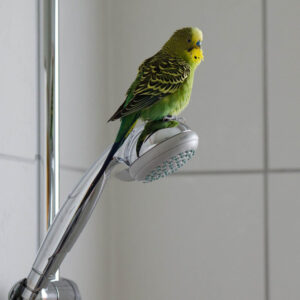
budgie perched on showerhead in shower
Photo from Pixabay

There’s a reason why shower perches exist — many parrots, like people, love to get soaked in a shower. Taking your parrot into the shower with you saves time and saves water. (Well, on second thought, showering with your parrot might cause you to take a longer shower if your bird opens up his/her wings and does a “water dance” to catch each droplet). Some pet bird people perch their birds on the shower rod or nearby so their birds’ feathers can benefit from the steam. If your bird likes to sing or whistle while in the shower, you might want to give non-bird overnight houseguests a heads up, or they might assume that’s you!

Dogs are typically bathed all by themselves in the bathtub, outdoors under a garden hose or at the groomer, and cats are rarely bathed — so your cat and dog loving friends might not understand that showering with you is a favorite part of your bird’s day.

2. Be OK with bird poop on their clothing.

Experienced bird people tend not to freak out if and when their bird poops on them. We just deal with it by blotting it off with a wipe or napkin and continue our conversation. When you think about it, bird poop is much less offensive, at least size wise and smell-wise, than that of cats and dogs.

3. Sing to their birds in a “Sesame-Street” kind of way.

Compared to other pets, parrots tend to be a little more interactive — as in you sing, they sing; you whistle, they whistle; you talk, they talk back. Combine this with the fact that most parrots respond better to words or phrases said or sung in a silly way — a habit you quickly develop — and you might be amusing your houseguests without even knowing it.

4. Save the good veggies and fruit for their birds.

If you have a houseguest with fridge privileges, they might be taken aback by your intervening if they open the crisp bin, the one dedicated solely for your flock. You know your birds won’t forgive you if they see some silly human eating their daily blueberry or freshly misted romaine leaf.

5. Dedicate a quiet room for their bird.

Bird people know how much their birds cherish a good night’s sleep. Birds don’t want to be startled off of their perch and they don’t want to have to keep one eye open in a room with activity going on. Some birds even insist on going to bed at the same time each night and will start to vocalize their disapproval of being left in the “mix of things” when the clock strikes that certain hour. The solution is designating a separate sleep room. Your evening guests might be equally startled if they accidentally venture into your bird’s quiet room and are met with a squawk or the sound of a bird flapping his/her wings as he/she tries to stay steady on the perch.

6. Hide in the closet, pantry or bathroom when they’re on the phone so their bird can’t interrupt them.

A lot of bird people have an in-home “phone booth,” which can be a closet, pantry or bathroom — a place where they can hide so their bird won’t know they are on the phone. “Why” a layperson may ask? Because many parrots seem compelled to compete with their people during a phone call. This can be through mimicking their person’s intonations, laugh or in, extreme cases, full-on screaming for the duration of the call. The bird will most always win, so the easiest solution is to slip out of sight/sound while you make or answer a call.

7. Spend $25 on a toy their bird will completely destroy within the week, and then buy more.

It’s fun to go bird toy shopping because toys for birds are often colorful, kid-like, and there is an endless variety. A torn and chewed up toy is the ultimate form of flattery when it comes to parrots and their playthings. Bird people know that parrots need safe items to chew up and thoroughly destroy and won’t flinch at spending what would be considered a good amount of money in cat and dog terms on a toy that won’t last more than a week or two.

8. Save their birds’ molted feathers.

Bird people are fortunate in that their pets “gift them” with a whole lot of feathers a couple of times a year, when their birds molt. A lot of parrot people save some of their birds’ colorful feathers as keepsakes. (My personal favorite is my cockatiel‘s top crest feather, which resembles a little plume.)

9. Whistle/contact call to their bird whenever they leave the room.

You might be so used to whistling to your bird from another room, that you won’t notice the curious expression on your visitor’s face, who probably doesn’t know the intricacies of your bird needing to know that you are nearby and safe.

10. Drive two or more hours to their favorite vet or bird store.

Bird people are a dedicated bunch. This might mean driving a couple hours to a bird-experienced veterinarian or to an avian-retail store. In a dog and cat-centered pet world, a lot of bird people go out of their way to find top-quality avian services.


Avian Medicine Gets The Spotlight In Paris

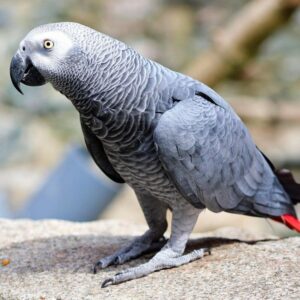
African grey parrot standing on cement or similar surface outside
Photo by ManfredRichter/Pixabay

In April 2015, Paris was the city that many exotic animal veterinarians flocked to for the second ICARE conference, which is short for International Conference for Avian, Herpetological and Exotic mammal medicine. This conference brought together a number of exotic animal veterinary associations, including the European Association of Avian Veterinarians, Association of Small Mammal Veterinarians, Association of Reptile Veterinarians and the European College of Zoological Medicine. There were four days of conferences and two days of pre-conference activities — one day of masterclasses and another of laboratories.

The meeting was sponsored, in part by the National Veterinary School of Alfort, France ( École nationale vétérinaire d’Alfort or ENVA), which is one of the oldest veterinary colleges in the world. It was very humbling to sit in the same halls that many veterinary students had used starting in 1766 listening to the latest information on the care of animals! Yes 1766 — 10 years before the American Revolutionary war! And one of the most interesting aspects to the School for me was the Fragonard museum, where there are many birds and other animals that were dissected and preserved way before — like 200 years before! — the development techniques used by Gunther von Hagens in the Bodies exhibition. It was frankly astonishing to see these preserved dissections to better understand how the body works! After the first two days, the remainder of the conference, where scientific talks were presented, was at the Conference Center of the Parc de la Villette in the heart of Paris.

There were many talks on many subjects, and I will highlight some of these talks and masterclasses from the conference over the next year. Many of you who bring your beloved bird to your veterinarian benefit from the research that was presented at this and other conferences. However, this is probably the biggest and the most important venue for presenting of research of birds and exotic mammals. As research dollars dwindle, the area that is hurt the most is that of our birds and other exotic pets. This lack of funding makes it difficult to do some rather simple things — like figure out if we can use certain drugs and how they are used in birds.

Specific Tests & Studies

For example, Dr. Marina Krautwald-Junghan from Leipzig Germany did a masterclass on the use of ultrasound in birds. Much of her work has involved understanding if and how we can ultrasound the heart of birds. She demonstrated the proper technique along with the type of ultrasound instrumentation that is necessary to see the fast beating heart of birds. Many ultrasound machines cannot capture or image that fast moving avian heart. Additionally she showed us normal hearts including the normal sizes of the atria and ventricles and the 2 views. From there, we were to figure out some common abnormalities from the images. As our companion birds’ age, heart disease is becoming more common. We learned how to diagnose a number of these conditions with the use of the ultrasound.

Additionally, Dr. Krautwald’s research group determined the pharmacokinetics of an ACE inhibitor that is used for dogs in heart failure- enalapril. In her study, they used racing pigeons to determine the dose of enalapril. From that information, we as veterinarians have to adapt that to other species of birds, realizing that it may be different. But that is all what we have — not like doses for dogs and breeds of dogs vs. cats, for example. In addition to the masterclass, one of her veterinarians gave a paper on the use of the spectral Doppler for diagnosing atherosclerosis in the great vessels of the heart. This is a real problem that we are confronted with now almost weekly in our avian practices. The technique presented allows us to view the aorta and to determine if the outflow is impeded by cholesterol plaque. For this particular study, they used African greys and Amazon parrots. They followed birds with this problem after starting them on enalapril and changes in their diet and found that these changes improved their heart performance, and hence their quality of life.
Another area of scientific interest was that of PDD or proventricular dilatation disease and the role of avian bornavirus. Previous studies by the group directed by Dr. Michael Liertz in Giessen Germany looked at possible routes of infection of the virus to cause disease. They tried to infect birds using the traditional routes of infection — fecal, oral and nasal — but birds did not develop signs of disease. Other studies presented by Dr. Monica Rinder from Munich showed that putting the virus into the brain did not produce symptoms in canaries. These canaries were found to shed the virus and had lymphoplasmacytic inclusions in the brain — they just did not produce the lesions more commonly seen in the GI tract of canaries. Canaries that had the natural signs of disease with changes in the GI tract also had large numbers of viral particles in the brain. However, those strains of canary bornavirus were used in this study but failed to cause the natural signs of disease.

The understanding of the relationship of avian bornavirus to the pathogenesis of the disease is not clear. For example, we know that avian bornaviruses are known to produce the symptoms of the disease — the proventicular dilatation — but not all birds with this condition test positive for this virus. Studies in humans have demonstrated that an infection with the intestinal pathogen Campylobacter jejuni may lead to Guillain-Barre Syndrome, a ganglioneuritis very similar to PDD. Antibodies against ganglioside 1 have been demonstrated in humans with Guillain-Barre syndrome, which suggests that this is caused from infection with Campylobacter. Blood samples from parrots in Dr. Rossi’s study from Camerino, Italy, showed that there was a 93% cross reactivity between these parrot samples and that of a lipopolysaccharide from Campylobacter. This suggests that the release of these large molecules may be involved in causing an autoimmune reaction that causes the symptoms of PDD. While avian bornavirus can cause symptoms by causing these lipoproteins to be released in the nervous tissues, other infectious agents, and in this case, Camplyobacter may also do the same.

Adventure Awaits: Bird-Watching Tours

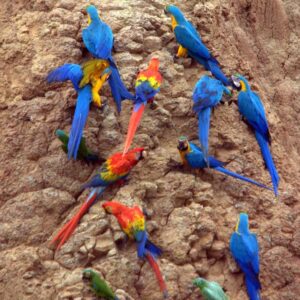
Blue-and-gold macaws, scarlet macaws, chestnut-fronted Macaw and a mealy parrot at the Tambopata clay lick
Macaws and Amazon parrots share a clay lick at the Tambopata National Reserve, Peru. Photo from “DSC_8774.NEF” by Brian Ralphs, CC BY 2.0

All bird lovers typically enjoy several recourses to their affinities. Those are most often satisfied by actually owning an exotic bird as a pet, backyard viewing of domestic birds, and marveling at extraordinary and daring photographs of their favorite breeds.

But did you know that there are many available bird-watching tours, sites, and lodges that cater to a chosen area’s unique display of birds in the wild? Surprisingly, there are many such enchantments all over the world.

Choose Your Favorite Birds And Location

If it is your thrill to view the birds you’re most accustomed to (parrots, toucans, macaws, etc.), then there are plenty of South American locations such as Cock Of The Rock Lodge in The Cloud Forests of The Manu Mountains in Peru. There, you can spend scheduled days in the Manu Wildlife Center engaging in breathtaking views of hundreds of parrots and macaws in their natural settings. You’ll watch them behind “blinds”, which allow you to quietly enjoy their many activities. You will also see them as you travel from various points in the tour.

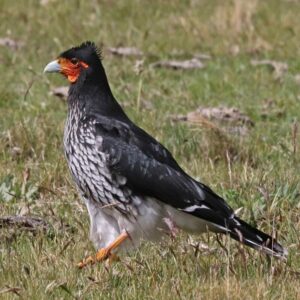
carunculated caracara walking along grassy ground
Carunculated Caracara (Phalcoboenus carunculatus) belongs to a small genus of birds of prey in the Falconidae family, and is found in barren, open habitats in the Andes, Patagonia and the Falkland Islands. Photo by Joseph C Boone, CC BY-SA 4.0, via Wikimedia Commons

In addition to the birds and other wildlife, you will be immersed in the beauty of nature as it’s meant to be appreciated. This tour can be set up with a specialist company, Wildside Nature Tours. However, there are several other tours that involve train rides to Machu-Picchu, with equally spectacular views of native Condors, a wide variety of other bird species, and, as you travel through the Amazon rainforest, many species of monkeys in their many ways of life. Of course, there are plenty of Inca — and pre-Inca — ruins to photograph as well. There are just so many incredible experiences to be had with such tours. Other available tours in other parts of the world include the world famous Galapagos Islands, with its several birding and wildlife tours. Those provide close-up views of islands native iguanas, turtles, the brightly colored crabs, and the islands’ variety of birds that include Cormorants, Penguins, Albatrosses, and Finches.

There are tours that originate in Africa, Indonesia, China, Armenia, Central America, really just about anywhere that there are unique spreads of nature with an incredible collection of wildlife that inhabit these aforementioned places.

By Lodge, By Boat, By Blind, By Cruise…

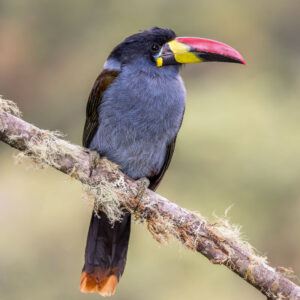
grey-breasted mountain toucan perched on a branch outdoors
Grey-breasted mountain toucan. Photo by Charles J. Sharp, CC BY-SA 4.0, via Wikimedia Commons

Tours can be enjoyed in several ways. We explored in detail the lodges and boat courses, and the many non-invasive “blinds” by which to visually take in the beauty of birds. But there are also cruises that design their itineraries around the indigenous wildlife that can be enjoyed. There are series of Bird Festivals that can be attended whereby you not only see birds, but also enjoy instructive workshops on those birds. Even more exciting are the various photography tours that encourage the use of your cameras, and get you as close as possible to the wildlife so that you can capture your own timeless photos to display and to enjoy your entire lifetime.

If exotic birds and the various manner of wildlife that accompany them are beautiful to you, perhaps the planning of one of these many individual tours might be an unforgettable journey for you. To get you started, here is an invaluable link to a site that will provide almost every step needed to involve yourself in the time of your life.

Blast From The Past Pet Bird Products

conure sitting on perch in cage
Photo by Irfan Syahmi/Unsplash

After spending well over a decade as an editor on a pet bird publication (RIP Bird Talk!), I witnessed bird products come and go via the ads run in the magazine. When I first started, at the bottom of the editorial masthead as an assistant editor, it was a time when the magazine had its most robust assortment of advertisements. The bigger, full-page ads were usually cage manufactures and food companies, and then came the half-page, quarter-page ads and so on for perches and playgyms, toys and then various cage accessories. Part of my job as assistant editor was to proofread the classified ads, which were the smaller ads in the back of the magazine. This is where one was most likely to come across an advertisement that was a bit more “unique,” and a couple of ads still stand out in my mind in terms of “uniqueness.”

50/50?

First up, was an ad to help you determine the sex of your pet bird. But it wasn’t a DNA test kit — no feather or drop of blood from your bird that you sent off to a lab for testing. This ad was for a pendulum that you hung over your bird and waited to see which way it swung to determine whether your bird was male or female. I did some Googling and found a post that captured the ad’s wording, which was: DETERMINE THE SEX OF YOUR BIRD IN SECONDS…with a simple pendulum device. Weighs less than an ounce. Small enough to fit in your shirt pocket. Never touches the bird. 100% money-back guarantee. For your sex indicator and instruction pamphlet, send $15 to …” I believe it was a similar novelty item that is marketed for expectant parents — if the pendulum swings in a strong circular motion, it’s a “she”; if it moves back and forth, it’s a “he.” I never got to try one of these out on my birds, but I’m pretty sure I wouldn’t have been able to get a reading anyway, as my birds generally dislike anything moving overhead.

A Wild Wild-Bird Feeder

There was also an advertisement for a wild-bird feeder that was like none other, and it always caused me to smile when it appeared in the magazine. It was a small ad but it had a product photo included, which made it especially standout. This product trained wild birds to eat straight from your hand. To make that happen, you started with the life-size cardboard cutout photo of a guy — he had a name like “Chuck” or “Bob” — and he wore a real hat and shirt (if I remember correctly, both hat and shirt were red and black checkered flannel). The dummy guy’s flat cardboard hands were propped up so you could place some birdseed in them. If memory serves, he was built for sitting and so the idea was to leave this dummy man in a chair in your yard or garden and, in a few days or so, the wild birds would feel safe sitting on his hands to feast. After the birds were used to eating from the dummy man’s hands, you would then switch places with the dummy by putting on his hat and shirt and sitting in his spot. Every now and then companies would send us product samples to test out (unsolicited) and whenever the magazine received a large-sized parcel, I hoped that it might contain our very own cardboard guy bird feeder to test out. I yearned to see dummy feeder dude sitting outside the editorial office, wild birds feasting on his steady, flat cardboard hands, so that I could then put on the flannel hat and shirt and announce to my boss, “Heading out to feed the wild birds.” Unfortunately, that day never came.

In all seriousness, over the years, I’ve had the pleasure of meeting quite a few of the people behind the companies that make the products we and our birds enjoy and, for most, a lot of blood, sweat and tears go into making them. Likewise, I’ve had the opportunity to visit a large sampling of avian specialty stores. Ask the owner or manager of your favorite bird store why they do what they do, and here’s what you’re likely to hear, “I didn’t get into this for the money, I do it for the birds!” Take a close look at your bird’s favorite food, toy, perch, playgym, etc., there’s a good chance that a lot of hard work and craftsmanship — powered by a true love of birds — went into making it.

Healthy Gut, Healthier Bird

The Gut Microbiome: It’s Role In Health

closeup on head of yellow-crowned Amazon with head cocked to side
Photo from Pixabay

In the mid-2000s, Dr. Sokol, a gastroenterologist for humans at St. Antoine hospital in Paris, did a comparative DNA analysis for patients with chronic inflammatory bowel disease. He found that in the diseased section of bowel, there was a relative depletion of a common bacterium, Faecali bacterium. Instead of thinking that this disease was a consequence of bad microbes, he suggested that maybe it represented the loss of good microbes. He, like others, has since found that these good bacteria stimulate receptors along the gut lining to enhance the immune system.

It appears that there are a select group of microbes that are important for gut health and hence a balanced immune system. These microbes belong to a group of what are termed clostridial clusters. While they are distantly related to Clostrium difficile, they appear to be responsible for keeping the gut lining healthy and the barriers of the GI tract tight. Clostridum difficile, on the other hand, causes inflammation of the gut wall and can result in bleeding and loss of fluids to the point of death.

But good microbes appear to occupy a particular ecological niche in the gut lining. They are thought to interact with the immune system, keep bad microbes in check, provide nutrients for cells of the gut, and digest or ferment fiber to help to keep the mucus layer functioning correctly.

The Role Of Antibiotics

 One of the interesting talks at the meeting focused on the use of antibiotics. In the study presented, the microbiome of healthy dogs was compared with dogs that had inflammatory bowel disease; as you might guess, they were dramatically different. What was most striking was that the standard antibiotic therapy that was used caused further changes in the microbiome. The microbiome only slowly got closer to normal over time, and even then with the use of a microbiome product designed to shift the organisms to the “good” microbes and to healthy immune function in the gut. Studies suggest that the proper mix of microbes contributes to health and reduces inflammation, while the relative absence of good bacteria or an overrepresentation of bad bacteria work against health. The ecology of the gut appears to influence obesity, overall immune response, and even mood.

Gut Check: Companion Birds Vs. Wild Birds

So what about our companion birds? We know very little about the microbiomes compared with humans and small mammals. We know that the microbiome of a particular species tends to be different from another species. Gram staining of fecal samples over the past 30 years has shown that the bacteria of our parrots when they are normal consists of large numbers of gram-positive rods and cocci with limited to no gram-negative or anaerobic bacteria. However, parrots are not very far removed from their wild relatives, so the question is, do wild parrots have similar microbiota as those in our homes?

The studies from Dr. Jan Suchodolski’s lab at Texas A&M showed that there was less biodiversity of the microbiome of the wild parrots compared with the companion parrots. For this study, researchers used cloacal samples, not fresh feces. In mammal studies, they have used fresh feces for their microbiome studies so the results may be different. In this study, they used four mealy parrots (Amazona farinosa), three blue-and-yellow macaws (Ara ararauna), and one red-and-green macaw (Ara chloropterus) with one group from a breeding facility in Texas or the Schubot Center at Texas A&M and the other from the wild near the Tambopata clay lick in Peru. Interestingly, in the wild bird group, sequences belonging to three phyla were identified: Firmicutes (84.5%), Proteobacteria (5.5%), and Actinobateria (10.0%); these same species of bacteria were found in different proportions along with Bacteroides (0.2%) in the companion group. While Lactobacillus organisms were common in the companion bird group, they were not found in the wild parrots. While Staphylococcus species were found in the wild birds, they were not found in the companion parrot group. Enterobacteriaceae, which are gram-negative bacteria, however, were found in the companion bird group, but none were found in the wild parrots. There were also some trends as to the microbiome of the species and to the place of housing with the companion birds. These data help us to better understand which species of the microbiome are normal for our birds. It also gives us some clues for future work on enhancing their immune system.

Probiotic Help?

In an ongoing study with researchers in Italy, they have tried the use of a special probiotic called Sivoy on growing chickens and then on young, hand-raised parrots. The Sivoy is a blend of eight different species of bacteria at high levels that are designed to support the immune system. In groups that had the Sivoy, their body weights and body condition were improved compared with the age-matched controls as they grew to weaning. Researchers are looking at components of the immune system to further understand how this product works in birds. Additionally they are finishing the studies on how the microbiome of these groups were affected over time. These data may help with understanding how to treat various disease conditions on our pet birds. By understanding the microbiome and how it is affected with growth and diseases that are difficult to treat, we may improve responses with new ways of looking at these conditions.

Capturing The Beauty Of Birds

You don’t have to be told that birds are one of the more exquisite creatures on our big beautiful planet. With a rich array of colors, a widely varying display of plumage, and an unmatched ability to compose a symphony of songs, birds of all species easily capture our collective attentions. One of the many ways that we appreciate our birds of nature is by photography of them in the wild. With the arrival of increasing technological advances, cameras and lenses have given patient photographers the ability to capture photos that can become works of art … certainly photos that awe!

Since 2010, The National Audubon Society has held an annual Photography Awards, inviting aspiring photographers to participate, namely those who are willing to wait for that once in a lifetime shot. Like most photography contests and exhibits, there are several categories of judging and presentation. For the Audubon Photography Awards, those are Amateur, Professional, Fine Art, and Youth (in an effort to encourage future greats in this worthy effort). To weed out the obvious abundance of photos offered by everyone with a camera, there are stringent criteria applied to find the extraordinary photo shots of birds of all kinds in various modes of activity. Such criteria include technical quality, originality, and artistic merit. In the organizations past contests have produced some jaw-dropping selections.

The 2015 Audubon Photography Awards have recently closed with an impressive collection of photography. With over 2,300 participants, and almost 9,000 submitted images, the five judges assigned to the task of selection have had their work cut out for them. Along with winners from the five categories and the Grand Prize Winner, there are three honorable mentions for shots that were too good to not be acknowldged.

The Grand Prize winner of this year’s contest is Melissa Groo, who photographed a stunning portrait shot of a Great Egret as it arrived for the night in a rookery in Florida. The other winners include Chris Gug, who won in the Professional category with an artistic underwater shot of a school of fish circling a cormorant; Constance Mier, with a win in the Fine Art category with a shimmery shot of cormorants astride posts in the water; Donald Wuori for the Amateur category with a shot of a male warbler feeding a female warbler in her nest; and, for the Youth category, Zachary Webster won for his shot of a Painted Bunting frolicking in the water.

The three honorable mentions went to Tim Timmons, who gained the Amateur category mention with a gorgeous symmetrical shot of Black Skimmers; Steve Russell with a mention in the Amateur category for a portrait shot of a pair of flamingos; and to Jason Savage for the mention in the Professional category of his photo of aggressive interaction between two Sandhill Cranes.

Lafeber congratulates the winners of the 2015 Audubon Photography Awards, and the honorable mentions. You can view the photos of the winners here. In addition, Audubon has allowed for the display of the Top 100 photo entries in a stunning slideshow that can be viewed here.

Spring Cleaning Tips For Bird Owners

Ah … there’s nothing quite like the satisfaction of resting your feet after a thorough spring clean. If only for a fleeting week or so, you can enjoy your home’s righteous return to its pristine condition — one that is free from bird-generated dust and dander. Check out these easy “Spring Clean” tips and tricks every pet bird enthusiast should try.

1. Window Coverings

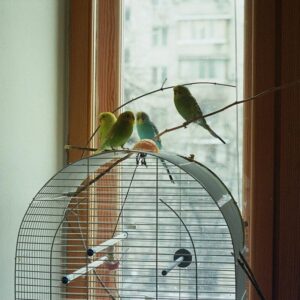
four parakeets (aka budgies) perched atop a cage by window
Photo by Julia Rekamie/Unsplash

The problem: Many pet birds prefer a room with a view and appreciate being housed near a window. This can offer your bird visual enrichment, but you might not notice the slow buildup of birdie-dust on your window screen. If you share your home with a cockatiel, cockatoo, or African grey parrot, all three of which are high-dust generating parrots, your window screen might be especially in need of a deep cleaning.

The fix: Take the window screen off the window, and bring it outside to hose it down. For stubborn debris, dip a soft-bristled brush in dishwashing liquid and scrub both sides of the screen, then rinse with the hose. Leave the screen out to air dry, which will give you time to grab a hand-vac or extended vacuum hose to suck up seed hulls, flung food crumbs and feather dander from the window’s nooks and crannies. Before you re-hang the screen, inspect it for wear and tear, as a gap or hole in the screen can potentially lead to a lost bird.

The problem: Blinds, whether opened or closed, can be dust catchers, especially those within the vicinity of cage fallout.

The fix: Mix equal parts vinegar with water in a bowl, put an old sock on your hand, dip it into the bowl, and then slide your wetted “sock puppet” hand across each slat of the blind. If the blind slats are really dirty, you might have to rinse out the sock a few times or have a backup sock (good thing they come in pairs!), and change out the water in the bowl so you aren’t just smearing dirty water across the blinds.

2. Curtains

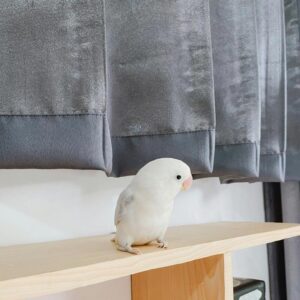
white and gray parrot sitting on shelf by silver curtains
Photo by Dian Pradita Putri/Pexels

The problem: The upside of curtains is that they can give your bird some visual respite from things outside that might startle him/her (like the neighbor’s cat lingering outside). The downside to curtains is that they are real dust magnets. In addition to dust, dander, fine molted feathers and seed hulls, curtains can also trap pollen and dust mites. Home experts recommend cleaning curtains at least once a year, if not quarterly, which means a trip to the dry cleaner or a drop in the washing machine if you know for certain that your curtains are machine washable. [Note: Bird enthusiasts especially might want to opt for a “green” or “organic” dry cleaner, one who uses water and nontoxic detergents in specialized machines instead of perchloroethylene (PERC), which has been linked to health problems. Remove dry-cleaned curtains, and any other dry-cleaned garments, from the plastic bag and hang outdoors or in the garage to air-dry air before re-hanging them.]

3. Carpet

The problem: The go-to item for anyone who shares their home with the feathered kind is a broom for tile and wood floors, or a good vacuum for carpet. Carpet usually gets frequent vacuuming, but what about washing it? Home experts suggest that homes with pets should have carpets cleaned at least once a year. Yet, just like some household cleaners can be irritants to pet birds, so can some carpet cleaners.

The fix: The safest way to go is to clean carpet with a steam cleaner that uses hot water only, as in totally chemical-free. And for good caution, locate your bird to another area of the home while the carpet dries.

4. Shelves And Bookcases

The problem: Unless you are a true minimalist, a place to store things is must-have for most homes. But while shelves and bookcases accumulate your stuff, they also accumulate dust. Add to this the fact that many of us store our birds’ food and accessories on shelves near their cages, and we have a layer of cage fallout to boot.

The fix: Spring cleaning is a time to roll up the sleeves and take everything off the shelf, bookcase or mantle, and clean from the top down. While you’re at it, wipe down the items you remove. Once everything is sparkly and back in its place, vacuum or sweep the floor.

5. Electronics

African grey parrot perched atop cage
Pet bird owners can protect their computer towers, display screens, printers, keyboards and other electronics by purchasing dust covers designed to do just that! Photo by TheOtherKev/Pixabay

The problem: Wondering why your hi-def TV is so cloudy? If you can write on the screen using your finger, chances are your bird’s cage is in the vicinity, especially if you have one of the dusty three — African grey, cockatoo or cockatiel. Your TV or computer screen doesn’t have to wait until spring for a clean though; you can typically complete this task in 5 minutes.

The fix: First, turn off the TV or computer, as a dark screen makes dust and dirt more visible. Most gadget geeks recommend using a soft cloth like a microfiber cloth (one tech guru even says a dry eraser will do the job). If the dirt/smudge is still there, wet the cloth with distilled water or use some of that vinegar you used to clean the blinds to create an equal ratio of distilled water to vinegar. While it’s tempting to just use a paper towel, napkin or the edge of your shirt, these materials can potentially scratch the screen. And using an ammonia-based product like Windex can react with the screen’s coating and then you’re left with a cloudy screen — that simply won’t fly with your movie-loving parrot.

A Unique Feather Color Mutation

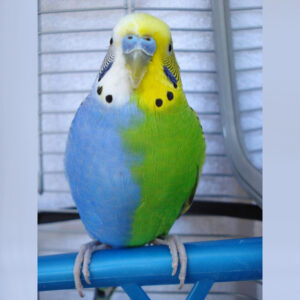
half-sider budgie (aka parakeet) that is half blue and half green standing on perch in cage
Photo “half-sider-budgie” by Susan Dennis, Public Domain Mark

Nature is full of surprises. With the wide palette of beautiful colors, brilliant birds that sport them, and every other animal on the face of this earth that share a unique pattern to their existence, nature has yet to disappoint us with its art. One of the more dazzling displays of colors is found on birds. And while we appreciate this well-known attribute of birds, you may be shocked to find that sometimes a mistake is made resulting in a bird so different that it makes us fill with awe at the results.

Half-Sider Birds

There is a rare accident of nature that produces what is known as a “Half-Sider” bird. In essence, the “half-sider” is a bird split down the middle in color as if it were, in fact, two birds fused into one, a sort of freak experiment, if you will. And in reality, that’s what they are. Only it happens at the fertilization period.

These “half-sider” birds are technically two individual fraternal twins that were fused during their very early development. In this fusing, they become one distinct embryo that eventually is hatched as these unique and fascinating hybrids of male and female, or male/male, female/female. Often, females and males, as in the cardinals, have separate appearances in color. When this “half-sider” event occurs, the red male, and greenish-brown female sides are easily determined.

There is a complex scientific explanation to this phenomenon that can be found on the internet. Here is a link that details this amazing process that produces such a stunning visual effect. In the avian world, this can happen to any bird. Sadly, birds of these kinds are not well-received by their own in the wild, or in a caged setting. But despite the strangeness of the occurrence, these birds in captivity are extraordinarily beautiful.

The “half-sider” effect has been mostly noted in parakeets and other parrots, as well as chickens, cardinals and finches. This chimera effect is so striking that it is impossible to not be amazed and awe-struck by the colorful division of sides.

Yes, nature is full of beautiful surprises. And a half-sider bird is one of them.

Types Of Parrot Play

What’s Your Bird’s Play Personality?

In the best-selling book, “Play: How it Shapes the Brain, Opens the Imagination, and Invigorates the Soul,” (2009) author Stuart Brown, M.D. validates the importance of play in the lives of both people and animals —  “Play lets animals learn about their environment and the rules of engagement with friend and foe.” Brown also makes the argument that play is so essential to development and survival that “the impulse to play has become a biological drive.” The book defines eight distinct play types (listed below in bold), which we can see in our feathered companions. Knowing your bird’s play type can be useful in helping you better cater to your bird’s style of play, be it with the right toy types or interaction. Here’s a playful look at the eight play personalities as they might pertain to our feathered friends:

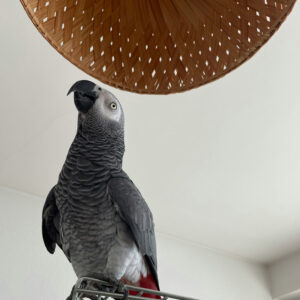
African grey atop cage reaching for woven lampshade above
Photo by Johanna Moraz/Unsplash

1. The Joker — makes people laugh, plays practical jokes. Of course, our pet birds can certainly make us laugh out loud from time to time, whether they mean to or not. Some parrots species seem to especially fit the joker role more so than others. Take, for example, African greys, cockatoos and macaws. African greys might be the “straight-faced” joker, as in mimicking the doorbell and perching stoically as you go to answer it. And I once met a cockatoo that liked to surprise people who passed through a doorway by hanging upside down on the top of the door frame and swinging overhead, giggling with delight. I’ve also heard of macaws that like to play a “Boo!” game with people, where they fake lunge to get a reaction. Some people are certain that their cockatiel (or budgie) gets a kick a out of flittering to the top of the curtain rod just as they are about to be put back in the cage in a “Gotcha!” type moment.

Jokers do what they do for the reaction. So if it’s a behavior you don’t mind reinforcing — like getting up to answer the door whenever your bird “rings” the doorbell, then by all means, humor your little feathered friend. If it’s something you’d rather not live with on a frequent bases, channel your best stone-cold face and leave it as that.

black-headed caique standing on branch with head turned to side
Photo by hbeiser/Pixabay

2. The Kinesthete — loves to move, dance, swim, play sports. (Well, if we sub-out “swim” for “bathe,” we keep this play type a little more focused on birds.) A lot birds take a liking to dancing and rhythmic movements — cockatoos, for sure; conures, too. Lories and caiques are prone to highly energetic play sessions and seem to especially love chasing and tossing foot toys around. Budgies seem to make sport of their drop/push toys, like the standard weeble-wobble penguin toy. Throw in a love for water play, and there are a lot more birds to add to this play type, from parrotlets all the way up to the big macaws.

If you have a “Kinesthete” bird, toys to try include: exercise toys like swings, boings, climbing walls and ladders; and noise toys like bird-safe bells and rattles. If your bird loves to dance, be his/her personal DJ or crooner to help him/her get a groove on. And some birds love a dancing partner … well more of a swayer or head banger — opt for movements your bird can follow! For water-loving birds, try mixing up their water play for a little variety … one day could be a gentle spray bath; another could be shower time with you, or place a shallow bowl of water on a table top or cage floor and see if your bird cares to take a dip.

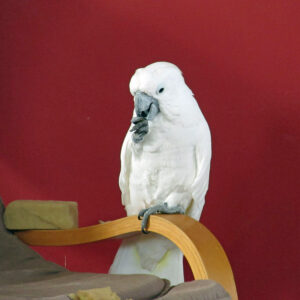
cockatoo perched on wood arm of chair
Photo by Jack Irving/Unsplash

3. The Explorer — goes to new places, meets new people, seeks out new experiences (physically or mentally). A lot of parrots love to go exploring, (albeit, sometimes without the knowledge or consent of their people). Cockatoos, Amazons and cockatiels are just some of the species that seem to love a good walk-about in their home environment. Be beware that some birds might be on a seek-and-destroy mission; which doesn’t bode well for home furnishings. If you have an explorer play type in your home, a solid system of supervision is in order whenever your bird is out of the cage. In the simplest of ways, you can help feed your bird’s inner explorer by sitting with him/her on the floor and allowing him/her to investigate the room (and intervene if your bird goes “out-of-bounds” or gets into something that is off limits). You can make exploring more exciting and emotionally rewarding by creating foraging opportunities. One way is to allow your bird to “find” things as he/she explores. For example, wrap a Nutri-Berrie in a piece of paper and place a few about the floor of a room for your bird to unwrap and devour. Or take the toy that has sat untouched in the cage and put it on the floor — for some birds, a toy’s appeal lies in the presentation. Or sprinkle some pieces of millet around the cage bottom (place newspaper down if you have a cage grate) for your cockatiel or budgie to find. Explorer types also might take to puzzle toys (toys that challenge their problem-solving skills), or items that take them places, such as climbing ropes and ladders.

4. The Competitor — loves all forms of competition, has fun keeping score. Put a couple caiques together and, no doubt, they’ll be on the ground wrestling each other for foot toys. Amazons, macaws and cockatoos, too, sometimes like to play “keep away” with their people or flockmates. If you have a competitor in the flock, foot toys are sure to please, as are destroy toys … some birds seem to have an internal stopwatch to see how fast they can destroy a toy.

5. The Director — enjoys planning and executing events and experiences, like throwing parties, organizing outings, and leading. Sounds like a bossy birdie, right? Many birds take on a directorial play persona at times, such as taking the initiative to climb down from the cage or play gym to explore or extending a play session by deciding if and when it is time to return to the cage. Toys to try: mirror toys — some birds like to chirp orders at their mirror reflections … again, a budgie taking on a penguin weeble-wobble toy simply exudes bossiness.

monk parrot (aka Quaker parrot or parakeet) perched on branch outdoors
Photo by Manuel Torres Garcia/Pexels

6. The Collector — loves the thrill of collecting, whether objects or experiences. If we’re talking object collecting, a quaker parakeet perhaps? Quaker parakeets are hard-wired to construct elaborate nests, complete with individual apartments. In their quest for the best nest, they also have a tendency to collect “found” items around the home, from pen caps to bottle caps — whatever can be flown or hopped back into the cage. If you have a collector parrot, toys to try would be foot toys and/or small toys he/she can carry back to the cage or play gym. You can even place a healthy treat, such as a cashew, in a location outside the bowl for your collector to “find” and take back to his/her favorite perch spot to enjoy. As for collecting experiences, all birds deserve positive experiences sprinkled throughout their day. That can be one-on-one interaction with you, a healthy treat or swapping out an old toy with a new one.

7. The Artist/Creator — finds joy in making things, fixing things, decorating, working with his or her hands. (Another sub is warranted here: instead of “hands” we’re talking “beaks!”) Does your bird shred the cage liner to bits, or “reconfigure” a wooden toy into a pile of splinters? Yep, you’ve got an avian artist on your hands. In addition to reconfiguring toys, and perhaps perches as well, your little feathered creator-type might also like transforming food from a solid into a semi-liquid by dunking it in the water bowl. If wetting food whets your bird’s appetite, let him have at it, but that also means diligent water bowl changes on your end to prevent bacteria from proliferating in the water bowl.

Toys to try: a daily offering of destroy toys, be it hardwood toys (macaws, cockatoos, Amazons, etc.) for big beaks or softwood toys for smaller beaks (conures, cockatiels, budgies, etc.), and shreddable toys, too. You’ve got to indulge your artist/creator bird to give your bird a positive outlet to meet his/her chewing instincts and to protect your furnishings.

8. The Storyteller — loves to use imagination to create and absorb stories, in novels, movies, plays, performances. Hmm… this category seems to best fit the play style of a parrot that craves interaction via vocalization. I imagine the storyteller parrot as big on talking and/or mimicking, taking the words he/she has learned and putting his/her own spin on them to create sentences and new meanings — if this is your bird, hopefully, he/she has a captivated audience with you!

Your bird might fit multiple play personality categories, which is all the better as it gives you more ways to cater to your bird’s playful side.

Pet Bird Home Hazards

budgie and cockatiel perched on bars of down-facing lamps
Photo by Veronika Dee/Unsplash

Looking for a reason to update some of your home furnishings? If you have a companion parrot, it might be time to rethink your doors, windows, lighting and other design features to make your home a safer place for your feathered friend.

Here are a few suggestions for swapping out potentially dangerous household furnishings with more bird-friendly designs.

Get a bird-motif toilet lid! That might sound like a splurge purchase to some, but if seeing a pretty birdie helps keep the lid down, go for it! The “porcelain throne” can pose a hazard if you are in the habit of leaving the lid up. A startled bird can land —and many have — in an open toilet and drowned. And another reason to kick the lid-up habit? A study by researchers at the University of Leeds found that flushing an open toilet can expose nearby surfaces to toilet bacteria, which can linger around many minutes after the flush. They tested their theory by filling a lidless toilet (ironically, a standard toilet style in most hospitals) with drug-resistant C. difficile bacteria, which causes an infectious diarrhea, and discovered that the bacteria hovered 10 inches above the open toilet after flushing. Do yourself — and your bird if she/he likes to hang out in front of the bathroom mirror — a favor by keeping the lid down!

Decorate your windows. Windows and glass doors have fooled birds into thinking they were flying through open space, not into a barrier. Sadly, countless wild birds have flown into windows and died as a result. This is especially true with office buildings, but large picture windows and sliding-glass doors in homes have also proved deadly. Similarly, a companion bird, especially one startled by a noise or sudden movement, can fly into their home’s window or sliding glass door. You can help birds “see” your windows and glass doors by applying a film or decal to these surfaces. You can find window decals at bird-feeding stores or online that are colored in the ultraviolet spectrum, which are transparent to human eyes but visible to birds. To be effective, the decals should cover most of the glass surface so a bird doesn’t think there is space to fly through.

Add a beaded curtain. If you have a fully flighted pet bird, a beaded curtain can be a stylish and efficient way to keep your bird from flying down a hallway or other doorless entrance way. It can also serve as a backup barrier if you leave a door open, and you won’t have to worry about accidentally shutting a door as your bird is trying to fly past it, which can lead to serious injury. Beaded curtains come in many styles, from bamboo to plastic beads — some of which a curious bird might be attracted to, so keep an eye on your bird whenever he/she is out to make sure he/she doesn’t view the curtain as a massive hang toy!

Go bladeless. Ceiling fans, when turned off, seem to be a perch haven for a wayward bird in the home. And some birds seems to take pleasure in sitting back and watching their frustrated people climb up on a chair and stand on their tippy toes to try to get them down from this high perch spot, which can land a person in the ER. The danger to the bird comes when a ceiling fan is turned on and the bird collides with the fan blades. Having a ceiling fan in the home calls for diligent operation — leave the fan off when your bird is out. Another solution? Try a bladeless ceiling fan, they do exist!

Watch those lights! Standing floor lamps and other lighting with an open top can be a hot zone for a flighty bird looking for the nearest landing spot. This open-top design leaves the bulb exposed and your bird vulnerable to a burn should he or she land on it. Instead, when shopping for a lighting fixture, imagine your bird accidentally landing on it one day. Think shade down!

Nutri-Berries Vs. Standard Avian Diets

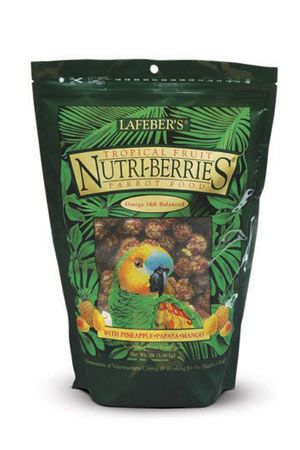
BlueFrontedAmazonW_NutriBerryIt has been 25 years since Nutri-Berries became part of the spectrum of foods for companion parrots. When they were first rolled out the door, they were considered a bridge diet for all of the seed-eating parrots. The idea was to have birds move from eating unbalanced seed-only diets to a balanced pellet, with all of the nutrients that a parrot needed. And it was felt that we should feed birds pellets. However, the companion parrots of that generation did not know or understand that a pellet was something to eat. All they had was people food with a seed blend and sometimes monkey biscuits. So Dr. Lafeber had the idea to provide a balanced diet that looked like seed to the parrot — giving them all the nutrients they needed! It was in essence a trick — it looked like seed in a round shape but really was balanced like a pellet. However, there are those who do not understand or know how Nutri-Berries came about.

NutriBerry25thLogo_nA Clinical Analysis of Nutri-Berries

I have often heard people say, “Nutri-Berries are treats and are just seed balls!” Well, that is just not true. While companion bird owners and/or some veterinarians believe that pellets are the only approach to providing balanced nutrition, Nutri-berries can provide that balance as well. A research study done in 2009 by Drs. Klasing (avian nutritionist at UC Davis School of Veterinary Medicine) and Hawkins (board-certified avian veterinarian at UC Davis) using cockatiels as their model showed that Nutri-Berries provide a nutritionally balanced food. That particular species of bird was selected because they had a colony of cockatiels available.

So let’s set the stage: Nutri-Berries are made up of seeds and grains along with minerals and vitamins so that they are balanced nutritionally as a pellet. What happens is that various grains and seeds along with other components like peppers and dried veggies are mixed with specific amounts of vitamins and minerals based on their nutritional content so that the final content is balanced just like a pellet. Once this mix of non-GMO seeds, grains and a fine pellet of vitamins and minerals is of uniform composition, it is then shaped into a ball. The size of the ball varies based on the size of the bird’s species and its foot.

Study Results

So now to the study at UC Davis with their cockatiels! The experimental design was to include three groups: the first group received pellets that were nutritionally balanced and composed of a mixture of seeds, vitamins and minerals that were identical to those found in Nutri-Berries. The second group of cockatiels received a pelleted diet that they had been using for the birds for more than a year with great success. The third group were cockatiels that received Nutri-Berries exclusively. Each group was maintained on their respective diet for six months. Parameters were compared from the beginning to the end of the study. These included body weight, hematology, clinical chemistry values, immunological status, physical examination including body condition score, water intake, and feeding behavior.

The results of the study showed that all of the cockatiels gained weight during the study period, and there was no difference in the final body weight due to the diet. Cockatiels that ate Nutri-Berries did not have changes in body weight that differed from the body weights of the birds that ate either of the pelleted diets. The CBC or hematology values did not differ between groups along with the chemistry profile values. There were no differences in the antibody responses or cell-mediated responses between the diet groups. On the physical examination, there were no differences in the parameters of heart rate, respiratory rate, choanal score or body condition score. There were some changes from normal in some of the birds but that was attributed to the health problems before the start of the study and were not associated with a specific diet fed. The cockatiels that received the pelleted diets drank significantly more water than those consuming Nutri-Berries.

The most interesting part of the study involved changes in behavior. Cockatiels that ate Nutri-Berries spent considerably more time consuming Nutri-Berries than those birds that consumed pellets. The use of the whole seeds and grains offered more foraging enrichment for these birds, which are considered granivores. The addition of whole foods enhanced foraging for this species, and it is presumed that this will occur in other species as well. When we want to stimulate the brains of our birds, one way is through foraging enrichment, and using Nutri-Berrries is one technique for that. The other interesting factor was that there was a reduction in the amount of water consumed with feeding Nutri-Berries. It was suggested that birds that have less to do during the day may drink more water. Additionally, those that consume pellets due to the grinding of the product may need more water in their GI tracts to process the pellets.

While we used to consider Nutri-Berries 25 years ago as a bridging food from plain seeds to pellets, we now know that Nutri-Berries are nutritionally balanced and can be fed as the sole diet over time. While we want to give our parrots veggies, other good foods and some fruit, we can rest assured from this study that we can use Nutri-Berries for our feathered friend’s main course.

5 Ways Parrots Rule Our Roosts

head and shoulders shot of Senegal parrot indoors
Photo by Daniel Hansen/Unsplash

To generalize, dogs are obedient, cats are independent and parrots … well, they can be downright manipulative. With a parrot you have a pet companion with the intelligence — and the mischievousness — of a young child, as well as one given the gift of gab, which, when put all together, can make for an interesting family dynamic.

Here’s a lighthearted look at the ways our feathered friends can rule our own roosts.

1. Parrots Control The Conversation

Face it — your parrot decides how long you can talk on the phone and let’s you know when it’s time to hang up. It’s near impossible to compete with a parrot when talking on the phone, and the louder you talk to the person on the other line, the louder your parrot might become to one-up you. Some parrots will even copy their peoples’ words/phrases with spot-on intonations, or laugh/chuckle along with the phone conversation … it’s like playing the “copy cat” game you did to annoy your sibling growing up. Of course, as soon as you hang up your bird is back to quietly preening his/her feathers.

2. Parrots Play Mind Tricks

Ever walk over to the microwave to take the food out because you heard the beep, but then remembered that you put nothing in it to begin with? Or just after putting new batteries in your fire alarm, it beeps a low-battery warning again? Check your parrot. Some parrots not only have a great gift of gab but a gift of imitating sounds that are sure to get their peoples’ attention. (And, while we’re at it, remind Fido that parrots can imitate a dog’s favorite squeaky toy … there’s no actual toy being tossed to fetch.) Many parrots are also quite adept at playing the Jedi Mind Trick. For non Star Wars fans, that means influencing the thoughts of sentient creatures to coerce them into agreement … for example, you feel that one-eyed stare as you twirl up a fork full of pasta, look over at your bird and obediently walk over to his treat bowl to share a noodle.

3. Parrots See A Clean Cage As A Clean Slate … To Mess It Up Again

If you want your parrot to take a bath in the water dish, play with the destroy toy he/she has ignored for days, or drop the biggest dropping of the day clean the cage. Many people like to cage clean in the morning … and many birds seem to take this as a challenge to see how much they can transform the cage by the end of the day. My birds, for one, seem to enjoy splashing water on freshly laid cage liner paper. On the flip side, the moment just before you open the cage to clean it is the moment your bird will suddenly exercise his/her wings with some vigorous “hold onto the perch” wing flapping to kick up a birdie-debris tornado.

4. Parrots Are The “Master Pet”

military macaw head and shoulders pose on black background
Photo by Rob Potter/Unsplash

Parrots not only control us, they control our other pets too. Video evidence abounds on YouTube of parrots — African greys, Amazons, cockatoos, Indian ringnecks … even budgies — tormenting other household pets, namely dogs but some cats. Some parrots perfect their owner’s voice so they can blurt out, “Who wants to go for a walk!?” to get Fido all riled up. The dog runs for the leash by the door and obediently sits, patiently waiting for his/her person to take them outside, but … “Drat! Fooled again!” This same trickster parrot might also be inclined to chuck food at the dog … or wave food around in his/her foot as a way to toy with Fido’s appetite. Or, in the case of the budgie, drop his penguin toy directly on the unsuspecting pooch resting near his cage.

5. Parrots Sometimes Speak On Their People’s Behalf

Placing a parrot’s cage near an open window can cause passerby to pause and ask themselves, “Do I know that person who just yelled ‘Hello’?” or they might think of your house as the one with crazy person who likes to wolf whistle at people. Likewise, if you have a chatty, friendly parrot, you might want to keep your front door locked — I heard a story about a parrot that welcomed a lost pizza delivery guy into the home by saying, “Come in!” when the doorbell rang … I’m guessing it was an Amazon parrot.

Meet The Princess Of Wales Parakeet

closeup on head and shoulders of a Princess of Wales Parakeet (aka Princess Parrot) outdoors with building behind
Photo by Timothychacko, CC BY-SA 4.0, via Wikimedia Commons

Not too many parrots have royal titles, which is just one way the Princess of Wales Parakeet (Polyteles alexandrae), also referred to as the Princess Parrot, stands out. This medium-sized pastel-colored parrot with a long tail is native to Australia’s woodland and scrub habitats and is named after a real princess — Princess Alexandra of Denmark (1844-1925), who later married the Prince of Wales, Edward VII, eventually becoming the Queen of England.

While many parrot species have rich, brightly colored feathers, the Princess of Wales parakeet is more a soft pastel, with plumage that is mostly green with a pink throat, bluish crown and rump, and brighter green shoulders. Don’t let the common name that leads with the word “Princess” fool you into thinking that the species is made up entirely of females! There are male “princesses.” (Although, Prince of Wales parakeets might be something for ornithologists to consider — “The Prince and Princess of Wales Parakeet” sounds like a charming name for a bird pair!) The sexes are dimorphic when they reach sexual maturity, which means you can visually tell adult males apart from females. The male’s plumage has a little more richness, and males also have a slight elongation of the third primary flight feathers, referred to as a spatula tip, which has an upward curl. The male’s iris is orange, while the female’s is more brown in color. There are also several Princess of Wales color mutations, including blue, lutino and albino.

Their “soft” appearance might give you the impression that they have soft vocalizations. While they do have a reputation for being quieter than other parrot species, Princess of Wales parakeets can be chirpy whistlers and some even learn to mimic a few words or phrases (Hearing is believing: check out this Princess of Wales getting chatty with himself).

They are natural ground foragers, and, given their long tail feathers, need a housing that is both wide and tall, such as a flight cage, preferably set up with ground-level foraging area.

The Princess of Wales has a reputation for its gentleness, and hand-reared Princesses are reported to be more apt to be outgoing and friendly companions. Sadly, the Princess of Wales parakeet, while available in aviculture, is becoming a rare sight in the wild.

Bird Brains Are Not That Simple!

African grey parrot leaning forward on perch on playstand
Photo by nicoleGOR/Pixabay

Until recently, if someone called you a bird brain, you knew they were calling you stupid! Everybody knew that birds operated off of instincts and were not capable of thought. Certainly, no one would think them capable of forethought, the ability to think into the future. This idea was fueled by the “unified theory of brain evolution” based on the work of Edinger more than 100 years ago. This concept was that the brains of animals evolved in a progressive and unilinear fashion, with humans at the pinnacle of this hierarchy. The brain and its complexity evolved from fish to amphibians to reptiles, then to birds and on to mammals, with primates and humans evolving to the highest level of ability for cognition.

Tracing Brain Development

In this simple model, there was an ordered chronology from lower to higher intelligence. The brains of these higher thinkers contained the more primitive structures found in “lower animals,” and the organization of these parts of the brain was similar. For example, the spinal cord of a fish is very close in its anatomical comparison to that of birds, mammals and even humans. The basic parts of the brain are also similar. This concept was fueled by embryology, as the development of the brains of embryos was similar. The brain of the bird, like that of mammals and reptiles, forms from a hollow tube of ectodermal tissue (the outer surface of the embryo) at the cephalic or head end of the embryo. This tube folds to form three divisions: the prosencephalon, which becomes the forebrain; the mesencephalon, which is the midbrain; and the rhombencephalon or hindbrain. The hindbrain and midbrain retain homologous structures among the motor and sensory nuclei and the reticular formation between mammals and birds.

Brain Organization

However, it is the forebrain, which consists of the telencephalon and the diencephalon, that has followed a divergent line of evolution. This telencephalon develops on its outer surface — the cortex. This eight-layered outer surface of gray matter becomes the thinking cap of the brain, from directing actions, to knowing that we have been touched and where, to thinking about what we want to do tomorrow or 10 years from now. And the scientists “knew” that birds could not think because, well quite frankly, they did not have this outer cortex gray matter with its complex neural cells and circuitry. In fact, bird brains had an outer smooth surface, while human brains had this highly convoluted surface of gyri and sulci. So, it was reasoned that us humans, with our increased brain surface area, would be even bigger and better thinkers.

Edinger proposed that telencephalic evolution occurred in progressive stages of increasing complexity and size, culminating with the human cerebrum. He proposed that, first, there was the old brain, the paleoencephalon (also called the basal ganglia or subpallium at the telencephalic base), which controlled instinctive behavior. This was followed by the addition of a new brain, the neoencephalon (also called the pallium or mantle at the top of the telecephalon — that eight-layered cortex of gray matter), which controlled learned and intelligent behavior. So birds, he reasoned, really were not that smart as they had none of those outer cortex cells of gray matter to think with – which gave them the rightful title of bird brains!

Delving Deeper Into Bird Brains

Scientists continued to study tracts and brain function in birds and other animals in the 1970s up to the present using new techniques. Based on tract tracing and receptor studies, scientists learned that the hookups were similar but at a deeper level in the brain between mammals and birds. And even more exciting, the functions were similar! For example, functional studies revealed that both the mammalian neostriatum and the avian paleostriatum augmentatum (deeper inside the brain) participate not only in instinctive behavior and movement, but also in motor learning. So more and more evidence was accumulating that birds do, in fact, think.

As this information was accumulating in many aspects of brain function, a group of scientists decided that all of the names had to change to reflect new concepts of brain connectivity and brain function for birds. This Avian Brain Nomenclature Consortium met and since then has been continually revising the names for the parts of the brains of birds. Their premise was that to move forward, the names of the components of brains of birds had to reflect the functions and homologies with those of mammals.

The Crow Knows …

This modern view, with its understanding that the pallium comprises about 75% of the telencephalic volume in the bird and that it processes sensory and motor cortices of the bird similar to mammals, opens up new avenues of understanding of the cognitive abilities of birds. Data from pigeons show that they are able to discriminate up to 725 visual patterns, understand the concept of human made vs natural made, communicate with visual symbols, and the list continues. Crows are able to do some extraordinary tasks – making tools and retrieving objects, figuring out complex tasks, and teaching other crows. There have been studies that show that crows that have been caught by people wearing masks will somehow transmit that information to other crows outside of that flock population. The people with masks will then be harassed by these new crows. Our parrot friends – we know just by living with them – discriminate between people, display tool making and manipulation and have vocal learning. Some parrots, like African greys, have the uncanny ability to tell us concepts in sentences at appropriate times. And we marvel at them – and we should! Because to be called a birdbrain now in the 21st century … well, that is very special!

Fun Days To Celebrate With Your Pet Bird

profile head and shoulder shot of a western corella cockatoo
Photo by Michelle Brittain/Unsplash

You might know the traditional/popular holidays like Independence Day, Thanksgiving, Christmas, New Year’s, Memorial Day, Labor Day, Valentine’s Day, St. Patrick’s Day, and Easter … but did you know that there are also a lot of off-the-beaten-path holidays? In fact, just about every week of every month has a special day of recognition for a specific group, cause or theme — the topics of which range from serious to silly. The month of March alone has some interesting, lesser-known National Designation Days that seem especially apropos for pet bird enthusiasts. Here are some other holidays you can celebrate with your pet bird!

March 3: “I Want You To Be Happy Day”

While there is no definitive source as to how this joyous day came to fruition, its sentiment is worth incorporating nonetheless. This day encourages us to do something nice for others, and that can include our feathered friends. So why not make time for a “session of silliness” like sing to/with your bird (might I suggest, “Don’t Worry Be Happy!” by Bobby McFerrin), or read a silly book to your bird (March is also Dr. Seuss’s birthday month!). Surprise your bird with a new toy or a bird-safe handcrafted item for him/her to chew up — or how about creating some foraging fun with a  Nutri-Berries or piece of Avi-Cake?

March 6 and 7: “National Day of Unplugging”

It certainly serves as a reality check to have a designated “National Day of Unplugging,” but how many of us spend our at-home time logged onto a computer, tablet or fiddling with an iPhone? Imagine how happy your bird will be if you powered-down the electronic devices and spent one-on-one time with him/her (see examples from the aforementioned “I Want You To Be Happy Day”). You can also use this unplugged time to tackle those bird chores you’ve been putting off, like spring-cleaning the cage, laundering cage covers, safety-checking toys, etc. …) Need inspiration? Check out the official website for National Day of Unplugging to see a gallery of what people did when they unplugged.

March 7: “National Be Heard Day”

Of course “National Be Heard Day” seems like a natural fit for households with birds (what bird doesn’t like to be heard?!). But the cause behind this day is not to inspire parrot vocalization but to encourage small businesses to be heard/make themselves visible. You can show your support by shopping at your local (or worth-the-drive) avian retailer or independent pet store or by recommending your pet bird sitter, vet, groomer, etc. to others to show your support for them staying the course in what can be a challenging business enterprise.

March 9: “National Get Over It Day” and “National Napping Day”

This not-so-official National Designation Day can sure come in handy for those of us who live with feathered companions. Are you still holding a grudge against your bird for destroying your table leg or chair … or chewing up your [insert item name here]? Well, birds are natural chewers so “the bad is on you” for not bird-proofing your home. That said, it’s no fun to discover something you love or need (TV remote/phone, etc.) all chewed up … but you really do need to get over it, move on and keep these no-no items out of beak’s reach.

Ever find that your bird’s contact calling or other natural vocalizations seem, well … a little more grating when you are overly tired? This year, 2015, Daylight Savings time begins March 8 at 2:00 a.m., which means waking up an hour earlier come Sunday morning. National Napping Day is celebrated annually the day following the return of daylight savings time to give us a chance/excuse to nap and catch up on the “hour loss” of our precious sleep. Since most parrots love a mid-day nap, chances are your feathered friend will feel extra-special if you partake in naptime along with him/her. Do not, however, nap with your bird on you or next to you as you lie in bed, because you can accidently rollover and crush your bird. Instead, simply snuggle up on the couch/chair nearest your bird’s cage or wheel your bird’s cage into your bedroom to share in a communal snooze.

March 15: “Everything You Think You Know Is Wrong Day”

Here’s another National Day your family and friends probably don’t know about. But what does it mean? It is said that this funky holiday stands to remind us that we’re not always right; that it’s OK for us not to know everything. So what take-away does this day offer pet bird enthusiasts? Well, here’s my own personal experience example: Years ago, I thought I knew how to care for a pet bird when I got my little budgie Fred. But I was wrong on so many levels; from the all-seed diet to assuming he’d naturally take to me petting him, because, after all, my dog liked me to pet him from Day 1, so pet birds must love petting, too, right? Can anyone relate?

March 18: “National Awkward Moments Day”

This day was created to pay homage to all those times you made a fool of yourself in front of others. Sharing your home with a pet bird certainly comes with its own set of awkward moments … like trying to explain that strange, nonsensical talking or honking background noise callers hear when they phone you; or returning home from work or an errand only to discover an errant dropping on your shirt courtesy of your bird. National Awkward Moments Day is the one day of the year we can collectively say that awkward moments are a part of life … or as pet bird enthusiasts say, “Poop happens!”

March 22: “National Goof Off Day”

Yes, the sentiment behind this not-so-official holiday is exactly as it sounds. Take a moment to put aside your daily stressors to do something fun. For example, if you are feeling the heat of getting your tax paperwork in order take a moment to do a silly dance for your bird (and see if he/she joins in), or speak like Goofy (as in Mickey Mouse’s friend) — your feathered friend will enjoy seeing a goofier you!

March 29: “National Mom & Pop Business Owners Day”

This day honors all small business owners. Time to hit up your favorite avian retailer/independent pet store again (or send a good “Yelp out” for your trusted vet, pet sitter, groomer or other pet-bird service provider!). The toys and other avian accouterments you bought back on March 7 are waning by now, and you can again show your support of small businesses with a little more shopping for your bird.

Fill in the comment field below to share how you and your bird celebrated any of the above days — what did you do when you unplugged on “National Day of Unplugging”; what did you need to get over on “Get Over It Day,” and we’d love to hear what awkward bird-related moment you weathered in honor of “National Awkward Moments Day.”

New Technology Allows For A “Printable” Beak

This is not Grecia, but this is how he would have looked before the incident. The beak is one of a toucan’s most outstanding features and serves many functions. Photo by Naturefreak/Pixabay

We live in quite a technological age. We have improved our way of living with advancements made in multiple fields, including computing, electronics, healthcare, and many other intriguing areas and products. One of our greatest, more prolific inventions, the computer, has been around for a lot longer than it seems. It has gone through an amazing evolution of innovations, and continues to do so at an accelerating rate.

One of the extending innovations of computing is 3D printing. 3D printing is a progressive technology that involves the use of base materials that, when controlled by a computer, can form and create many things by use of a specialized ink-jet head. The head is part of a magnificent machine that takes a 3D-software-generated design and “prints” out the intended part.

To date, there have been many realizations of life-changing — and lifesaving — 3D printed things that will inevitably change the world that we live in. As it changes and becomes a better technology, companies will be able to use these printers to make longer lasting engine blocks, new blood veins and arteries, usable limbs, fully functional internal organs — even perfect houses that we will live in. For the future, there is even confidence that we may one day be able to 3D print our own food.

How 3D Printing Saved A Toucan

One of the many ways that 3D printing is helping out in the bird world is seen by a recent attack on a friendly Costa Rican Toucan by the name of Grecia. In January, a group of teen-aged children captured and tortured Grecia, eventually breaking off the top of his long beak and leaving him for dead. The toucan was found and taken to a nearby pet hospital where he was treated by a local veterinarian. However, the beak, as it would appear, was irreplaceable. In times past, such an injury would be untreatable. But with today’s impressive technology, the incredible advancement of 3D printing will be used to create and restore the beak for Grecia.

After news of the injured bird spread, an Indiegogo campaign (a crowd-funding source that allows people like you and me to contribute funds to any kind of project) was started to help fund the creation of a newly printed beak for Grecia. To date, more than $9,500 has been raised, of which only $5,000 was needed. (Thank you, beautiful people!) The remaining money will help fund the building of a hospital in Costa Rica to assist in the care and treatment of exotic animals.

Without the beak, Grecia would have been unable to return to his wild habitat. The loss of the beak would have made him vulnerable to predators. In addition, the colorful beak is required for a toucan to find a mate.

The beak is being made by OrthoPets, a prosthetic company from Denver, Colorado. With the funds raised by generous animal lovers, a new beak for Grecia will now be made a reality thanks to the magic of our amazing technology, the marvel of 3D printing, and the love of people.

We truly do live in a beautiful world.

How Feathers Color Our World

Amazon and African grey parrots perched on metal food bowls
Photo by Gamaliel Troubleson/Unsplash

There is a psychology that surrounds colors. With an inevitable study of how colors impact our lives, much as many other factors do, we have learned that all the colors of the spectrum have their powers. It’s in the color selections that we choose to paint our interior walls, matching our moods, pieces of art, and sectional décor. It’s in the furniture colors, rug designs, and so many other things that we choose to complement our lives with. They make us happy. That’s the power of color.

What can be more colorful than your bird? You and I are lovers of birds. If we weren’t, we wouldn’t be here, right? If you watch birds in the wild — and I’m betting you do — then a flock of birds in singular shades of brown and white doesn’t capture your view as much as a brightly colored male Northern Cardinal in all its red glory. If you’re lucky, you will see the male’s mate, the green-colored female. A Blue Jay coming to your feeder will earn your rapt attention for more than a few minutes. As will an Oriole, a flock of finches, or even the brightly colored, fast-moving hummingbirds.

The colors of an exotic bird are an extraordinary feature. The parrot, with all of the primary colors that make up its feathered body, is a beautiful creature. The same can be said of a parakeet, the stunningly beautiful Rainbow Lorikeet, a Macaw, and the resplendent feathers of a peacock. Many birds in the world have gorgeous displays of colors that are enticing to the discriminate human eye. Just as well, those colors are soothing to our being.

How Colors Affect People

In a study of psychology where colors and their effects on human nature are concerned, it is often determined that blues evoke calm behaviors. Brighter yellows help to effect cheerfulness and warmth, a feature that the shining sun contributes to. Reds are a deep color that encourages love as it seems related to the cartoon color of the heart and the pervading color of Valentine’s Day cards and gifts. Whites are a color that demonstrates purity. After all, the white of freshly fallen snow often evoke a sense of freshness, a new beginning. Orange colors and shades signify a sense of excitement, while purples give off an impression of ascendancy, a feeling of royalty likely linked to the rich purples of gowns and cloaks seen on kings and queens of old. Of course, there are more colors. But imagine a marriage of many of these colors and the collective sense of peace and comfort they bring. That’s what an exotic bird often brings to our lives. How perfect is that?

Birds’ Use Of Colors And How Color Is Created

rainbow lorikeet preening another rainbow lorikeet
Photo by David Clode/Unsplash

There are, no doubt, effects that colors of a bird’s plumage have on each other. In mating, some studies suggest that birds not only discern colors (or pay little to no attention to them at all), but also see UV light reflecting off, or being absorbed by, the colors of the feathers. This ability to detect UV rays and its effects often plays multiple roles in various bird activities.

There is a science, of course, as to how colors of a bird’s feathers come to be. A brief flight around the internet cage will be more than adequate to inform you of the role melanin plays, as well as feather structure, mutations, and psittacin levels, in the creation of the colorful display of a bird’s feathers. It’s a rewarding exploration that will help you to gain an even deeper fascination and appreciation of your beautifully colored bird. After all, their colors contribute wonderfully to your own psychological health and your complete enjoyment of them.

Small Birds Do Talk!

Tiny Talkers

green and yellow parakeet perched on bar in cage
Photo by Bianca Ackermann/Unsplash

When it comes to parrots and talking, the bigger parrots tend to be the most talked about, and for good reason. African greys and Amazon parrots, for example, can certainly hold their own when it comes to conversing with the people in their lives. But bigger birds aren’t the only ones talking. In fact, some of the smaller parrots are capable of mimicking human speech and can even amass impressive vocabularies. But before we go there, keep in mind that although a bird has the ability to talk, it doesn’t mean the bird will choose to do so. And individual birds within a species might more inclined than others to be talkative (just like people!).

A parrot — especially a small parrot — is much more likely to talk if consistently talked to. Here’s a look at some of the tiny talkers of the pet bird world.

Budgies

These small parrots (yes, budgies, aka parakeets, are parrots) have the ability to mimic speech — again, the key word being “ability.” Just because a budgie (or any parrot for that matter) has the ability to talk doesn’t mean that the bird will be a talker. The tricky part is that your budgie might be talking up a storm but his words have fallen on deaf ears. Budgies, you see, can have a garbled, almost mechanical voice, and sometimes the voice sounds like a recording put on fast-forward. Years ago, I had the pleasure of hearing an audio tape of a budgie named Peanut who was saying, “Peanut want a cookie. Give Peanut a kiss. Kiss, kiss, kiss.” He sounded, well … like a demonic prank caller, but he was definitely talking! Not a believer in the budgie’s gift of gab? … check out this budgie’s video! 

Parrotlets

blue Pacific parrotlet and green Pacific parrotlet side by side on a perch
Photo by Susan C. Griffin, CC BY-SA 4.0, via Wikimedia Commons

It’s hard to imagine going down in size from a budgie, but with a parrotlet, you get just that. Parrotlets, while not as verbally blessed as budgies, can and, some do, talk. Again, we’re talking small parrot, which means a small voice. Some describe the parrotlet voice as chirpy, and others say it is robotic-sounding. How cute is that … your little feathered bot! Listen closely and you’ll here a parrotlet chatting it up.

Quakers

monk parrot (aka Quaker parakeet) sitting on tree stump
Photo by kirahoffmann/Pixabay

One of the biggest guys in the tiny talker group is the quaker parrot; and this bird is said to be a born talker, with some breeders reporting that their quakers started to talk by the time they’re weaned. Quakers can rival the talking ability of larger parrots in terms of extensive vocabularies, albeit with a voice that sounds like a squeaky toy — check out this happy quaker.

Indian Ring-necked Parakeets

blue Indian ringnecked parakeet standing on blue cloth
Photo by Jenn/Unsplash

OK, our tiny talkers are getting a little longer, a little bigger when we add ring-necked parakeets to the mix. But these long-tailed beauties are far too often left out of the conversation when talk turns to top talkers. Their voice tends to sound a bit cartoonish and squeaky (yet, cheerful!) than say a spot-on voice imitator like an African grey parrot. Here’s a fun video of a talking African ring-necked parakeet.

Some people share their home with a small bird that talks and don’t even know it! That’s because the bird might be inclined to talk when all is clear; as in no one is in earshot to hear. Maybe it’s time to breakout the recording before you leave home.

Parrot Breeding Biology In The Wild And In The Home

green-winged macaws in wild
Photo courtesy of Dr. Susan Orosz

As I gaze out the window into a sea of white snow, my mind drifts to the macaws of Brazil. On my recent trip to see the parrots of the Pantanal, the hot humid weather is far removed from the frozen Midwest and Eastern part of the U.S. right now. I drift in thought to when we landed in a light rain in Campo Grande Brazil, how it was so warm and humid. It was spring in the southern hemisphere, and the trees and plants were blooming. With these signs of spring, it was a great time to watch the macaws and other parrots breeding and raising their young. We had a great day with Neva Gueddes and her staff as we watched macaws breeding and raising young in the city. Neva is credited for saving the hyacinth macaws in the wild and now is looking at getting macaws to breed and raise their young successfully in the city. Her ideas and research can be used for many species of birds around the globe.

Puzzling Nest Cavity Selection

But there we were, enjoying the day with Nivea, as we learned about wild macaws in the city. One thing that struck our group was what the birds chose for nesting cavities — mostly palm trees that were broken off fairly high. This made for a great nesting cavity, except it was open to the elements and rain could flood it. There must be drainage, as we did not see water in any of the tree nesting cavities.

Additionally, blue-and-gold macaws were also able to make the transition from palm trees with broken tops to pine nest boxes. The interesting thing was where they chose their nesting cavities regardless of type. One nest box was near the entrance of a park, while another was outside the entrance of an office building, and the last one that we visited was in the middle of a traffic circle … certainly not what we would expect! Quiet and lack of activity was NOT the ticket for any of these successful blue-and-gold macaw parents. So why did they choose spots with high human traffic?

The most likely answer is that this was a great strategy to keep intruders away from their chicks. The human activity would scare off predators that wanted to snatch them off. One of those culprits is our bird friend linked to Fruit Loops cereal — the toco toucan, which will eat young parrot and macaw chicks. I did enjoy watching toucans in flight with that long bill giving them an odd shape. The bill is very light but, with their short wings, they would flap rapidly in the wind, which gave them a comical appearance.

Nest Box Differences

We also had the unique opportunity to view inside of several of the next boxes of our city blue-and-gold macaws. The nest boxes were very neat and well kept, except for one hen. Neva said that this hen was a first-time mom. There were some feces in that nest box but not in the others. But in those with chicks, there were no feces. This is because the parents chew the inside of the palm tree nesting cavity or the box to create wood shavings. These chewed wood pieces are constantly being added so that the chicks are constantly being elevated from the feces. What a great idea for keeping the nest clean!

We viewed a few nests with chicks, and the size difference was striking between chicks in the nest and between nests. However, the new mother hen only had eggs with no chicks. All of the chicks that we viewed had full crops and were very healthy. Part of the team’s data collection was to record weights and take measurements in order to track successes and failures to better understand how to make these wonderful birds successful in today’s world.

Are You Mimicking Breeding Season & Don’t Even Know It?

And what can we gain from the information that Neva’s team is generating? We, as parrot owners, can understand more about breeding behavior and what we need to do to avoid giving our birds signals that indicate breeding and wanting to be the mate. Those signals tend to get us in our relationship with our birds in trouble!

For example, in the wild, male parrots often come with warm food to regurgitate into the crop of the hen sitting on the eggs or chicks. And what do we humans do? We come with warm food, to the ultimate nest box to give a large amount of food in a bowl. That ultimate nest box is the cage that we covered at night. Not a good idea. And then there are the environmental conditions — warm with humidity in the air and with an increasing light cycle. We do that by keeping the lights on at night and turning them on in the morning. The pineal gland of the parrot registers light of any type — from the refrigerator light on when we open the door to the light of TV late into the night. All that is light to the pineal gland. So, we need to think about that when we choose where to put our bird’s cages.

And we also need to think about food choices. If you’re a parrot, lots of choices makes one think of spring and getting ready to raise your chicks. So we need to watch out for those factors that signal breeding. While we want to give our birds a variety of foods, we need to be mindful of the signals we might be sending our birds. Those are all important factors in our relationships with our parrots. We need to be wiser and more thoughtful in our approach with them.

When we look up into the skies in the Pantanal, we are privileged to see a number of magnificent macaw species breeding and nesting successfully. That is, in part, due to humans learning about their natural biology and to then altering various factors to allow them to be successful in the wild as well as in the city. Many times, it relates to providing them the proper environment to raise their young — from nest cavities to wholesome food. Protecting their environment also protects us — clean water and air are part of those precious resources that we all need.

And so with spring supposedly in the air and Valentine’s Day around the corner, we might want to think about our true Valentine’s gift. This might be a gift for the birds — the wild ones in the Pantanal or for keeping our natural resources safe at home for our companion birds. As we know — we are all in this together!

Celebrating 25 Years Of Nutri-Berries!

NutriBerry25thLogo_nArguably, it’s the most talked about food in the pet bird community — the ball of wholesome nutrition that pet birds love to eat … we’re talking Nutri-Berries, of course! When Nutri-Berries first rolled onto the bird food scene 25 years ago in 1990, pet bird stewards were captivated; birds that wouldn’t touch nutritionally balanced food like pellets — even the hardcore “seed addicts” — took to Nutri-Berries with delight.

It all began in 1989, when Dr. T.J. Lafeber, with the help of world-renowned avian nutritionists, set out to develop a pet bird food that was not only nutritionally complete but one that offered companion birds the foraging enrichment vital to their emotional health. The result was Nutri-Berries, a game changer for the pet bird food market. That iconic ball shape, with a non-GMO, whole seed-and-grain formulation, chelated minerals, balanced Omega 3 & 6 fatty acids, natural preservatives and flavors, wasn’t done by chance. Nutri-Berries were designed with Nutri-Berries Bag Parrot, Nutri-Berries for parrotsforaging in mind — a revolutionary concept 25 years ago.

The Nutri-Berries food line has grown over the past 25 years from Classic Nutri-Berries to now include El Paso, Garden Veggie, Sunny Orchard and Tropical Fruit Nutri-Berries, with varieties formulated for parrots of all sizes. And if your bird has been enjoying Nutri-Berries all these years, good news! Senior Bird Nutri-Berries, the latest in the Nutri-Berries line, will help your feathered friend maintain good health and continued enrichment in the years ahead.

Birds love Nutri-BerriesHow Does Your Bird Take His/Her Nutri-Berries?

Ever notice that birds have different eating styles? Some are messier than others; some are perpetual dunkers; some prefer to nosh a little bit throughout the day, while others finish everything in the bowl in one perching. Similarly, when it comes to Nutri-Berries, eating styles can differ. Here are a few ways parrots of all sizes enjoy their Nutri-Berries:

  1. An out-of-the-bowl experience: When first introduced to Nutri-Berries, it’s amazing how quickly a bird will pick up one with his foot and bite into it; an instinctual way of eating for many parrots. This isn’t mere coincidence — Nutri-Berries were designed to be held by the bird as he/she eats. Better yet, this one-foot stand works the bird’s leg and foot muscles.
  2. Get your head in the bowl: Ever notice that you’re a little more careful when you chow down on your favorite foods? You hold the plate or bowl close so as to catch any and all crumbs (think crunchy taco!). Likewise, if you have a dedicated feathered foodie, you might not see much more than your bird’s body leaning deep into the bowl — a “Don’t bother me, I’m eating” parrot pose. Your bird doesn’t want to waste a single Nutri-Berrie crumb!
  3. The wave around: If you have a flock of parrots, chances are there’s one that likes to hold his/her Nutri-Berrie by the foot and wave it around before biting into it. Some describe it as the parrot version of the “keep away” game, although the bird knows fully well that he/she controls the game and, more importantly, the Nutri-Berrie. Or perhaps it’s a simple dare … “Just try to take my Nutri-Berrie away; I dare you!”
  4. The rock ‘n’ roll: Children might be discouraged from playing with their food but, with parrots, it’s highly encouraged! And what parrot can resist? Nutri-Berries are fun to eat! Parrots have been known to balance their Nutri-Berries on their backs (cockatoo, anyone?), scoot them around or do drop-and-retrieval maneuvers with them … all in the name of adventures in eating.
  5. “Tongue tied.” One thing you might notice when a parrot enjoys a Nutri-Berrie is that he/she explores it with his/her tongue. This type of tactile exploration makes sense given that Nutri-Berries are full of taste and texture — they are meant to be picked apart, chewed up, and thoroughly relished!

Lafeber is proud to have made pet birds happier and healthier one Nutri-Berrie at time for 25 years now, and here’s to serving up more good nutrition in the years ahead!

Love Of Linnies: Lineolated Parakeets

green lineolated parakeet perched on branch
Photo by “Bloedel Birds” by Viv Lynch, CC BY-NC-ND 2.0

Looking for a small bird companion? Budgies (parakeets), cockatiels and lovebirds probably come to mind, and for good reason as they can make for endearing feathered friends. But perhaps it’s time to make room on the perch for another small parrot that can also be a great companion — the lineolated parakeet, or simply, the linnie. Never heard of a linnie? Read on!

You might very well have seen a lineolated parakeet (Bolborhynchus lineola), also referred to as the barred parakeet, in the bird store, but mistook it for a budgie (parakeet). But take a closer look, and you’ll see a bird with a stockier yet contoured body type with barring on the feathers. While both birds are on the small end of the parrot scale, there are unique traits that set lineolated parakeets apart from budgies and other small parrots.

Lineolated Parakeet Traits

five lineolated parakeets perched side by side on a branch
Photo by Kathinetzwerk, CC BY-SA 4.0, via Wikimedia Commons

The look. The lineolated parakeet has mostly green feathering with black and green bars/stripes. However, there are several color mutations found in those offered as pets, such as cobalt, blue, lutino, violet, turquoise, mauve, creamino, cinnamon, golden, pied and silver. In some mutations, the stripes are lighter. Interestingly, budgies and linnies are opposites in regard to their barred feathering. Typically, the younger the budgie, the more barring it will have. With linnies, the barring becomes more pronounced with age.

Water lover. A linnie’s grooming motto would go something like this, “Have water, will bathe!” Lineolated parakeets have a reputation for being enthusiastic bathers, whether that is bath time offered via a shallow bowl of water or in the shower with you.

Sound levels. Budgies certainly seem to love to chatter, which can be quite intense at times (especially a pair of bickering budgies!). Lineolated parakeets chatter as well, but their decibel level is said to be dialed down a bit. Linnies, like budgies, are capable of mimicking human speech and can be good talkers.

They’d rather walk. Anyone who shares time with a budgie soon notices that budgies like to flitter around their habitat. When not napping or otherwise at rest, two activities you’ll likely see with a budgie are chatter and flittering about the cage (which is why a flight cage is great for them!). A linnie, on the other hand, is more inclined to walk over to change perch spots. This “walk to get where they want to go” instinct comes in handy when teaching a lineolated parakeet to step up onto your offered hand, which they are said to learn rather effortlessly. That’s not to say that linnies don’t like movement. They like to navigate their environment and will appreciate natural branches to move about on. And since they do like to walk round take care to make ensure your linnie’s safety if he/she climbs down from a playstand — watch where you walk.

Follow This Stay-Healthy Plan For Your Pet Bird

cherry-headed conure (aka red-masked conure) walking on green grass
Photo by Dick Daniels (http://theworldbirds.org/), CC BY-SA 3.0, via Wikimedia Commons

If you’re a to-do list person or one who needs a little reminding every now and then, you’re in luck! We’ve put together a month-by-month list of suggestions — and gentle nudges — to help you help your pet bird in the year ahead.

We could all use a kick in the you know what from time to time to tackle the important, yet often postponed, things that can help our pets thrive.

January and February

A new year, new start! If you’ve been putting off bringing your pet bird in for a well-bird checkup, call to make that appointment. And just like when you select a primary care physician for yourself, you should have a designated veterinarian for your bird. You don’t want to meet your bird’s vet for the first time during an emergency situation, wasting precious time online searching to find a vet who has experience treating birds, an important designation. A well-bird checkup allows you and your vet to come up with a game plan to keep your feathered friend healthy and happy in the year(s) ahead. Don’t be shy about asking questions, no matter how silly or basic they seem to you — your vet has likely heard it all.

February is a month full of love, and one way to show your love for your pet bird is to invest in his/her health. Pet owners today are fortunate in that there are numerous companies that offer health plans for pets. Not all companies cover birds, and, for those that do, coverage and deductibles can vary, depending on your bird’s species, age and health history. Schedule some time to shop around to find the health plan that will best meet your bird’s needs. Parrots are long-lived companions, so investing in a health plan for your feathered friend cans be a sound investment and even if lifesaver.

March and April

Don’t let spring hormones get the best of your bird or you! Your motto this time of the year might very well be, “An ounce of prevention is worth of pound of cure” as in be aware of hormonal triggers and do what you can to humanely and respectfully discourage them. Some parrots become moody and/or broody as the days grow longer and the weather gets warmer. You might notice your bird becoming more protective around his/her cage or sneaking off to a covered area when nesting instincts kick into high gear. Check out this insightful article for advice and need-to-know info.

May and June

Plan for the great outdoors. Warmer weather is perfect for some outside chill-lax time for your bird. But before you bring your feathered friend outside to soak up the sun (and the UV light benefits of natural sunlight in the process), assess how you will keep your bird safe outside. Birds that are allowed supervised flight in the home need to follow a different game plan when brought outdoors. If he/she is fully flighted, will he/she be placed in a cage or carrier to prevent an accidental fly off? One option is to start accustoming your bird to wearing a flight harness/leash. Some birds take to a harness/leash effortlessly; others may need to take some gentle baby steps over the course of a week or more. If your bird has a wing-feather trim, is it current enough to prevent him/her from flying away if startled? Plan out your bird’s outdoor schedule/logistics now so to take full advantage of the summer months ahead.

July and August

This is a good time to get involved in the bird community, especially given that the bird events calendar kicks into high gear during summer months. Just being around other pet bird enthusiasts can enrich both your and your bird’s lives. There are local and national bird clubs  — some that are geared for any and all pet bird enthusiasts, and others that are focused on a specific species. Many clubs host guest speakers that include top avian veterinarians and behaviorists. Another get-involved action is to donate to wild parrot conservation efforts; you can even help save your bird’s wild counterpart. Pet bird adoption organizations and sanctuaries are also always in need of helping hands or donations to help keep them up and running.

September and October

Time to check the home environment. Schedule a day for deep cleaning your bird’s cage (before you start using the holiday season’s cooler weather and hectic schedule as an excuse for skipping this cage maintenance step). Take your bird’s entire cage outdoors (sans bird), perches, grates and other accessories out, and power-wash out all the gunk from the cage’s nooks and crannies. Allow it to thoroughly dry in the sunlight and put it back together. While you’re at it, go through your monthly calendar and designate a few other months in the year to make your bird’s cage sparkly clean again. While you are taking the cage apart to clean it, check out each and every cage accessory and toy for wear and tear and replace as needed. And remember perches, boings, tents, toys and the like are meant to be replaced eventually, and the “eventually” is defined by if they can pose a hazard to your bird (e.g., frayed strings, broken parts, exposed sharp edges).

November and December

These are the months we humans often fall off the healthy diet/exercise bandwagon — and who can blame us with all the holiday foods and feasts? Let this time be a good reminder that our feathered friends are also inclined to gain weight. While you’re out shopping, scooping up holiday best buys, pick up a scale so you can keep track of your bird’s weight. Buy one that weighs in grams (not ounces) and weigh your bird at the same time each day (or close to every day) so you can spot fluctuations in your bird’s weight. Going back to that well-bird health checkup you made way back in January/February, you should have an ideal weight-range for your bird, as well as what fluctuations raise a red flag in regard to weight gain or loss. This information is especially important if you are switching your bird’s diet, such as from a mostly seed diet to a healthier pellet-based diet.

Every Day of the Year

Of course, there are things you should do for your bird everyday of the year, such as offer nutritionally balanced food and supplement his/her main diet with fresh vegetables and healthy treats. And if your bird likes to share in some of your meals, make a habit of setting aside bird-friendly samples. That means leaving out the oil, butter, salt and sauces — if it’s not healthy for you, it’s not healthy for your bird.

Is Your Pet Bird A Healthy Weight?

blue Indian Ringneck Parakeet eating fresh food
Photo by Tanuj_handa/Pixabay

You might be inclined to watch what you eat and/or workout more regularly if you notice your clothes feeling a little tighter than usual or the scale going up a couple of numbers. What about your pet bird? Pets, like people, can gain or lose weight depending on what they’re eating, how much they’re eating, and the amount of physical activity they’re doing.  For starters, do you know what kind of shape your bird is in?

Is your bird normal weight or overweight? Has he/she been to the vet for a health checkup in the past 12 months? What foods should your bird be eating, and what type of exercise routine are you doing with your bird? I will explore some of those topics to help you develop an appropriate resolution for your bird(s).

Birds Can’t Eat Right Themselves

Birds in the wild do not necessarily select adequate diets nutritionally. They appear to be able to balance their energy needs, amino acids, and calcium, but not their needs for other requirements. Birds in captivity do not appear to select appropriately either. In a study done by Dr. Dwayne Ullrey, a self-selected diet in African grey parrots resulted in a diet that was deficient in a total of 12 dietary components consisting of vitamins, minerals, and amino acids, the building blocks of protein. That means that sometimes the bird gets fat when trying to meet its amino acid needs. This occurs when the diet does not have these amino acids in the correct proportion. The bird continues to eat to try to meet its amino acid needs but can’t because they are either missing or much reduced in the diet. In the attempt to balance those needs, the bird gets fat in the process. This is a particular problem with budgies (parakeets) on seed-only diets, particularly those with a predominance of millet.

Judging Bird Weight Status

So how do you tell if your bird is normal weight or overweight or underweight? We commonly palpate the keel bone with the pectoral muscle mass on either side along with palpation of the intestinal space to determine a body condition score. It is important for you to palpate the muscle mass in relation to the keel bone so that you know if your bird is OK.

Normally, birds that fly have a prominent pectoral mass that is used for the down stroke of the wing. This mass feels relatively tight, like muscle that is actively used,and will be about even with the height of the keel. However, that muscle mass is used as an emergency energy ration when the bird’s metabolism outstrips the amount of energy consumed. That commonly happens when birds get sick — their metabolism goes up and then the amount of muscle mass goes down and the keel becomes more prominent. The flip side is that birds that are overweight have fat sitting on top of the muscle and you should be able to feel it. Birds that have fat over their keel bone usually store fat in their liver as well, and that can be very bad for your bird. This shows a bird with no muscle mass left as it has been used by the bird to maintain its increased metabolism with disease.

So if your bird has even a slight reduction of the muscle mass over the area of the keel bone, it is important to get an appointment with a veterinarian for your bird right away. That would also be true with birds that are overweight, as that is an important medical problem as well. Cholesterol can build up to create plaque in the great vessels of the heart  and in other important blood vessels that provide supply to the organs of the body.

The Right Bird Diet

So let’s say that your bird needs to go on a diet with the start of the new year. As suggested above, it is important to provide a balanced diet designed for companion birds. Those amino acids need to be balanced along with the fat-soluble vitamins and minerals. The best way to do that is to provide a base of a balanced product like a pellet or Pellet-Berries or another balanced product like Nutri-Berries and/or Avi-Cakes. These non-GMO foods serve as the dietary base, and you supplement with veggies and greens that are not high in simple sugars.

Foods to keep to a minimum are peas, corn, and many fresh fruits, as they have high levels of simple sugars. Foods to consider feeding include sweet potatoes or yams, Swiss chard, beet greens, kale, curled parsley, pumpkin, pea pods, green beans, walnuts, and mango. While there are others, this is just a simple list to get you started. It is also important to provide small servings to help in weight reduction — so read the package label on the volume or weight to feed as a guide.

Tracking Bird Weight Progress

Also, when you go on a diet you know that you need to weigh yourself on a regular basis. The same applies to your bird. Buy a kitchen scale that weighs in grams, not ounces, and weigh your bird daily before breakfast. Write down the weight so you can chart your bird’s daily weight. That is the best way to know if what you are doing to improve the health of your bird is working.

Exercise Is For Birds, Too

Another part of weight reduction is exercise. And boy are we learning that our perch-potato birds are really in trouble, even when their muscle mass is normal! Work at the University of Utah with Dr. Scott Echols suggest that our birds have significant reduction in bone mass. This is causing the bones to soften and to start to collapse in some cases. So we need our birds to at least do daily wing-flapping exercises, if not supervised flying sessions, to retain more bone mass. A cardio workout is also important so that we help them to be heart-healthy as well. But always have your bird checked out first by your avian veterinarian before embarking on an exercise program.

I hope that this helps you work on developing your New Year’s resolutions for your birds to enhance their quality of life. Wishing you great success on this important task!

5 Reasons To Adopt A Pet Bird

two lovebirds side by side on perch in cage
Photo by John Carlo Tubelleza/Unsplash

January is generally noted as Adopt-A-Rescued-Bird month, however, it is important to note that not all birds in adoption organizations were in need of “rescuing,” — i.e., in an abusive situation. Many birds in pet bird adoption groups were lovingly cared for by devoted caretakers who subsequently developed health conditions that made it a challenge to maintain the standard of care their birds were accustomed to or the bird’s caretaker passed away.

Unforeseeable life situations like job loss or a change in living situation can also cause a bird to lose his or her home. And there are also individuals who find themselves “in over their heads” in trying to care for birds they might have inherited, found, been gifted or purchased — they realize that the bird deserves much more than they are capable of providing.

Pet Bird Adoption

Is the adoption option right for you? Here are five reasons to consider adopting a pet bird:

1) First and foremost, you’ll have a chance to offer a forever home to a bird in need.

2) You’ll have a better idea of what the bird is like once he or she reaches sexual maturity. Those who are used to dog and cat companions might not be prepared for the fact that some parrots can be quite different once they reach sexual maturity, which often hits medium to large parrot species around 10 years of age. The “always cuddly” bird a person is used to might be aggressive around the cage during spring.

Many pet birds that are available for adoption have already reached sexual maturity and, as such, there is less of a chance of being caught off guard with a “Dr. Jekyll and Mr. Hyde” switch in personality. Or if the bird is just reaching the age of sexual maturity, the adoption group can help you navigate hormonal stages, and this important “Intel” can greatly help you build a relationship of understanding and respect with your new feathered companion.

3) Many people buy a specific species of parrot based on the bird’s reputation as a top talker, such as an African grey or Amazon parrot. While many parrots are capable of mimicking human speech, the only way to guarantee that a bird will choose to do so is to adopt a bird that already talks.

Wanting a parrot that talks, however, should not be the only reason to welcome a pet bird into your life. Think of talking as an added bonus and as an opportunity to interact, whether to teach new words or phrases or to converse based on the vocabulary your bird has already learned.

4) They’ll help match you up. Reputable parrot adoption organizations will often try to talk you out of getting a bird. That’s not to say that they do not want to adopt out their birds — they want to make absolutely certain that the match will be mutually beneficial to both person and bird. You might have had your sights on getting an Amazon parrot or cockatoo but, after assessing your pet bird experience, living situation, expectations and many other factors, a reputable pet bird adoption organization might very well guide you toward another species of bird that would be better fit.

And by the time a pet bird has been taken in under a rescue group’s wing, so to speak, they are likely to have good knowledge of the bird’s history, such as how many homes the bird has lived in, under what circumstances, the bird’s behavioral quirks, likes and dislikes, etc. Not only will they be able to recommend a species of bird that is the best fit for you, they can help narrow it down to a specific bird based on that bird’s personality, which is likely to be well-known by the time the bird is available for adoption.

5) Reputable adoption organizations work very hard to turn a neglected bird’s health around (which typically eats up the largest portion of the organization’s budget!), and that includes switching the bird from a nutritionally deficient diet to a nutrient-rich diet a parrot needs to thrive. All too often, even the most well-meaning but uninformed parrot owners feed the wrong diet. For smaller birds especially, like budgies, lovebirds, cockatiels and conures, their previous diet might have consisted primarily of seed. It can be a challenge to convert a “seed-only” bird to a diet that provides essential nutrients.

What’s more, since parrots can enjoy many of the healthy foods we prepare for ourselves, such as fresh vegetables, cooked sweat potato, whole-wheat pasta, quinoa, yams, etc … it is rewarding and fun to see your bird enjoy what you share with him or her. Many companion parrots take their time to enjoy each and every savory bite of a food they like. Some will squeal with anticipation or delight, others will literally ask their people for some — the love of wholesome food truly makes life with a pet bird an adventure in dining.

Adopting a pet bird might not be feasible for you but you can still make a huge difference in the lives of parrots in need by volunteering your time, donating supplies (many pet bird adoption organizations have wish lists of items they need); or monetarily through donations. You can even sponsor a specific bird in an organization.

Christmas Traditions For The Birds

yellow wild bird eating seed from snow-covered ground
Photo by Boomie/Pixabay

Want to start the year ahead off on the right foot? Do what the Scandinavians do on Christmas … spread some birdseed around the outside of your home. According to folklore, offering wild birds a Christmas feast will bring you good luck in the new year. Some people place the seed on the doorstep, a fence line, or on the roof. (So go ahead and top your family and friends’ gifts with a little bag of seed as a gesture of well wishes for the new year!)

The Swedish tradition is to set aside the last sheaf of harvest grain and bundle it together into a Christmas sheaf (kind of like an edible Christmas wreath!) and lift it up high on a pole or place it on a rooftop on Christmas Eve for the wild birds to dine on Christmas morning. Here’s a snippet of a poem: 

The Christmas Sheaf
“The fields of kindness bear golden grain,”
Is a proverb true and tried;
Then scatter thine alms, with lavish hand,
To the waiting poor outside;
And remember the birds, and the song they sang,
When the year rolls round again:
“The Christ-child came on earth to bless
The birds as well as men.”

—Mrs. A. M. Tomlinson

There’s also an interesting Norwegian Christmas legend that animals can talk human at midnight on Christmas. (Well, many of our birds can and will talk on Christmas, but hopefully not at midnight!) The story goes that the animals at the stable where Christ was born were stirred awake by the light from the star that guided visitors to Bethlehem. The animals then discover that they could talk. They bicker at first and won’t even let the humans into the stable (including the pregnant Mary and Joseph). They ultimately see the error of their ways, let the humans in and then head to spread news of Christ’s birth … but by then it’s too late; they lose their ability to talk.

Cardinals at Christmas

cardinal perched in tree with a few snowflakes falling
Photo by rfotostock/Pixabay

Many bird lovers receive (and send) holiday cards and gifts with a cardinal on it. Why, exactly, is the cardinal the bird we often see on holiday motifs? First off, a little about cardinals. These passerine birds belong to the family Cardinalidae and are found in North and South America. (Unlike parrots, passerines have three toes pointing forward and one pointing back.)

The cardinal is named after the high-ranking member of the Catholic Church that goes by the same name. The colonists were said to bestow the name because the male’s red coloring and crest reminded them of the vestments worn by Catholic cardinals. (As with most parrots, the male of the species is the more colorful; females are pale brown with tinges of warm red). The cardinal has a year-round presence (no migrating for the winter!) so the sight of this vibrant red bird against a snowy backdrop makes it a vision to behold during winter.

Christmas Bird Count Is Underway

European robin perched sideways on a branch
Photo by Florian_Hölzl/Pixabay

The National Audubon Society hosts a Christmas Bird Count that runs from December 14 through January 5 every year. Bird enthusiasts have an opportunity to be part of this 100-plus year holiday tradition to collect data that helps ornithologists and conservation biologists ascertain how the birds of the Americas are faring over time. But before you go and start counting birds, know that there is well-defined methodology to the bird count. There’s an established 15-mile wide diameter circle of count areas, which is organized by a count compiler. You need to contact the circle compiler in your area to make arrangements. After touching base with a count organizer, you might soon be counting birds from your front porch or backyard, and, in doing so, giving the gift of volunteerism. For more info, visit the Christmas Bird Count section of its website.

Conure Fast Facts

sun conure perched on branch leaning to the side
Photo by rutpratheep0/Pixabay

Not to take away from cockatiels and budgies (a.k.a. parakeets) — which, despite misnomers, are also parrots (and great companions, too!) — but conures are often thought of as a “real parrot,” especially for those who had one of the aforementioned feathered companions growing up.

Conures certainly look and act more like we would expect from larger parrots. Here are some fun conure facts.

They Are New World

Conures are New World parrots. They originate from the Western Hemisphere, namely Central and South America.

They Call Each Other Names

In 2012, Danish researchers did a study on wild orange-fronted conures in Central and South America to learn why parrots are such good mimics. The researchers discovered that conures have a highly developed system of communication that allows them to quickly imitate flock members’ individual calls. They surmise that each parrot in a flock encounters new members each day as birds join and leave the flock. Communication might be a way of negotiating inclusion into the flock

Conure or Parakeet?

Most pet bird enthusiasts/aviculturists refer to these parrots as conures; however, most ornithologists refer to them in more generic term “parakeet.” There are also some differences in common names amongst the two groups. For example, most pet bird enthusiasts/aviculturists refer to the parrot with the scientific name Nandayus nenday as a nanday conure, while ornithologists often refer to this same bird as the black-hooded parakeet. Similarly, Aratinga erythrogenys is often called the cherry-headed conure by aviculturists and a red-masked parakeet by ornithologists.

Aratinga or Pyrrhura?

green-cheek conure walking on ground
Photo by Tony Wu/Pexels

Most of the conure species that are commonly kept as pets are scientifically classified as belonging to either the Aratinga or Pyrrhura genus. The word Aratinga comes from an extinct Brazilian language that translates to bright macaw — ara for “macaw” and tinga for “bright.” Aratinga conures are slightly larger than Pyrrhura conures and include the sun conure, jenday conure, peach-fronted conure, brown-headed conure, half-moon conure and dusky conure. Pyrrhura conures are mostly green and include the green-cheeked conure, black-capped conure, maroon-bellied conure, pearly conure, black-, painted conure and crimson-bellied conure.

Nanday conure sitting on perch
Photo by J. Patrick Fischer, CC BY 3.0, via Wikimedia Commons

When it comes to scientifically naming conures, some species have been reclassified and/or debated as to what genus they belong to. Nanday conures used to be grouped with the Aratinga genus, but were given their own genus Nandayus nenday. Another conure previously classified Aratinga conure is the golden conure, which is also in a genus class of its own, Guaruba guarouba.

The biggest conure of all — the Patagonian conure — also has its own genus/species designation: Cyanoliseus patagonus. As the name suggests, these conures are found in Argentina’s and Chile’s Patagonia region.

The Conure We Lost

The Carolina parakeet (Conuropsis carolinensis) was a conure species native to the United States. Sadly, this conure was hunted to extinction in the early 1900s. Bird hunters at the time are reported to have said that Carolina parakeets were easy to hunt because they would return to mourn the loss of their flock members.

They Are Survivalists

Numerous wild colonies of conures exist, including cherry-headed conures, mitred conures, nanday conures and half-moon conures. These colonies appear to be thriving in urban areas across California, including the city of Long Beach, San Francisco, Los Angeles, Santa Clara County and San Diego County. The book The Wild Parrots of Telegraph Hill by Mark Bittner and documentary film of the same name feature a flock of cherry-headed conures that frequent this area of San Francisco.

Not-So-Common Conures

Patagonian conure sitting on perch, possibly at a zoo
Photo by пончик, CC BY-SA 3.0, via Wikimedia Commons

Conures include many species. Sun, jenday, green-cheek, and maroon-bellied conures are the most commonly kept as pets, but those are only a small sampling of conure species in existence. There are also the Austral conure, fiery-shouldered conure, Finsch’s conure, El Oro conure, Chapman’s conure, Blaze-winged conure, cactus conure, Petz conure, Deville’s conure, Jamaican conure, slender-billed conure and many, many others. Most of these others are too rare to be kept as a companion pet.

Basic Features

Conures are capable of loud, sometimes ear-piercing, vocalizations. Conures in the Pyrrhura genus are said to be less noisy than those of the Aratinga genus. Common conure colors are orange, yellow, or mostly green with accent colors that vary in color and intensity. There are no mostly white-colored or mostly red-colored conure species. A conure’s beak is usually gray (horn-colored) or black, and all conure species have a featherless ring around their eyes (a.k.a. a “naked eye ring”).

Winter Prep For Your Bird

Head and back of pearl cockatiel with head in profile
Photo by Kelly2357, CC BY-SA 3.0, via Wikimedia Commons

We get warm and fuzzy feelings when we think of being home for the holidays. Those of us with pet birds want to provide them the same feelings of comfort and coziness. This can be the time to work on making their cage “home” a more comfortable place for the winter, as well as a time to get new gifts to outfit their “home.”

So first of all, how do you make it cozier for the winter? Our psittacines are tropical by nature but that does not mean that you need to keep your living area at 90 degrees Fahrenheit! Most birds, including our pet birds, are able to adapt to cooler environments but they cannot handle quick changes in temperature. So while you dial down your temperature to the upper 60s to low 70s, it is important to try to keep cold drafts near the cage to a minimum.

That does not mean that you should swaddle your bird’s cage with blankets — quite the contrary, for you should not use dark covers at all. Covering the cage with dark cloth suddenly makes your bird think that it has just entered the most incredible nest box of nest boxes. Combine this with the time of year (it might be December here but it’s Spring in the southern latitudes where they come from) — and voila! — it signals to them that it is time to breed. If you do need to reduce a draft, cover the cage with clear plastic sheeting, but take precautions that your bird cannot chew it. Also don’t use a plastic that gives off a chemical smell, as birds are very sensitive to a variety of airborne toxins.

Candle Lights

That leads to something that we humans love — scented candles! And there are a variety of wonderful scented products that you can purchase at this time of year. But your bird’s respiratory tract is not designed to handle those scents. Remember that a miner’s best friend was the canary. They would take them down into the mines as a sentinel for toxins that were airborne. The unique respiratory tract of birds is exquisitely sensitive to toxins and while we like the scents these products give off, for your bird’s sake, just stick to plain, old unscented candles.

And a candlelit night can be a perfect time for you while letting your bird get their sleep! We want our birds to get about 12 hours of daylight and 12 hours of sleep time. That means late nights in front of the TV are not good for them as well as lights on for periods longer than 12 hours. If your household is one with lights on long at night, you should consider a smaller sleep cage in a quiet and dark room like a spare bathroom.

Food For Thought

When we think of home for the holidays, we also think about our favorite foods. While we want to treat our feathered friends to wonderful foods, we need to keep in mind that healthful is important, particularly this time of year with cold weather. We need to keep their immune systems healthy and there are plenty of foods that hit the grocery shelves this time of year to do that. Take nuts for example! If you have a smaller parrot species, you can crack the nut so that they can forage in the process. Brazil nuts and walnuts are high in Omega 3 fatty acids — important for immune health along with cardiovascular and musculoskeletal health as well. Notice that I did not mention peanuts. If stored improperly, this member of the legume family can be infected with a fungus, releasing aflatoxins that can cause liver failure. (Lafeber peanuts are tested for aflatoxins and are negative for aflatoxins.)

Pomegranates are full of antioxidants and bioflavonoids. And then there are pie pumpkins and yams and sweet potatoes — all with lots of beta-carotenes. Another heavy-hitter for the birds from South America is a mango. This is a common food source that I observed the parrots eating while in Brazil. And much to my amazement they seemed to eat them when they were unripe along with when they were ripe. I do not know why, but we did observe that with the wild parrots. Grapes, bananas, peas and corn are all foods that are high in simple sugars and should be avoided.

Parrot-Perfect Gifts

Part of the holidays is about gifts and we want to shower our pets with gifts as well. From toys to new play stands to perches and every new thing — we are in the mood to buy. But it is important for the buyer to beware. We want our birds to play with safe toys. That would include the right size toy for your bird and some that they would interact with. Sometimes toys can be pretty scary at first introduction, so you might hang a new toy outside of the cage at first and then fiddle with it a bit as if you are interested in playing with it. That might help overcome concern and spark interest.

Beware of metal from bells to wire parts on toys. Most are made with lead or zinc base unless marked that they are made of stainless steel. You can never be too careful. The solder where two pieces of metal come together can be deadly if your bird cracks off that very interesting and shiny object and ingests it. So make sure your toys do not contain metal unless it is stainless steel. It is a great time of year to check the cage for wear and exposed solder joints where the metal comes together. While many folks say to me — “Well, my bird has been in that cage for years, Doc”, that is just the time to make sure that the cage has not fatigued and that solder is not exposed. Take a look inside the cage from your bird’s perspective.  Put your head in there and give it the fine-toothed comb look! And related to that is toothbrushes — don’t use them as toys as the metal that holds the bristles together can be toxic as well!

So now, armed with some wonderful safe toys we can add a few at a time to our recently inspected cage, pull out those healthful foods and put them in our new foraging toys that we purchased or made, and when the sun sets, light our unscented candles. We can be home for the holidays and have a safe, healthful and most wonderful time with our birds.

Cockatiel Behavior: Brilliantly Baffling

cockatiel on perch among other branches and toys
Photo by F. Hektor/Pexels

I’ve shared my home and life with two cockatiel companions — Elvis, a normal gray that I got when I was 9 years old after saving up my penny collection; and my current ’tiel friend, Gracie. Elvis was my first bird, and the only thing I had to compare him to were my two dogs. My dogs were pretty standard canines; they ate just about anything, loved to jump on me to be petted, chased tennis balls, and hated taking baths. Elvis, on the other hand, was nothing like them. When I brought him home via the standard cardboard “critter carrier” box, he was very shy and timid. He did not run to jump up on me; instead he hissed and nipped when I took him out of the box. It took a bit of trial and error — and massive amounts of my 9-year-old patience — for me to begin to figure Elvis out.

Cockatiel Lessons From Elvis

I discovered that he liked to chew up paper after he got ahold of my letter from a Pen Pal (remember those?!). One day I set Elvis down on the bathroom counter to brush my teeth and learned that he loved seeing his reflection. Soon thereafter, I discovered that he not only loved looking at himself, but he also loved to whistle to his reflection. After he spent an increasing amount of time hanging out in front of the bathroom mirror, I discovered that he also liked the steam generated when I showered. Soon I began to notice that he did things I thought made him certifiably crazy. He’d bang his beak hard against the mirror, the countertop and any other reflective surface, such as my mom’s lacquered vase. I thought for sure he was going to break his beak and was convinced that the bits of flake on his beak were a result of his head banging and not because of natural beak growth. He’d whistle, hop, bang his beak, and whistle some more.

I had to show my two best friends — who only had cat and dog companions — my strange little pet. I hosted a sleepover for my birthday and after we settled into our pajamas, giggling — no doubt fueled by Sweet Tarts and licorice from an earlier movie theater outing — I went to take Elvis out of his cage. I was promptly greeted with a nip and hiss. I managed to get him out of his cage despite his protests, but Elvis was having none of it — he did not want to be the life of this little sleepover party. My friends were, not surprisingly, unimpressed, while I was a little disheartened; I wanted them to see how wonderful Elvis was, and instead they saw a very cranky cockatiel. Another lesson learned; my little ’tiel enjoyed his downtime, especially at bedtime. Fortunately, I had a full 21 years to thoroughly learn Elvis’s likes and dislikes, and he was a very good teacher.

Cockatiel Lessons From Gracie

By the time I welcomed Gracie into my home — during Elvis’s golden years — I had many years of Livin’ La Vida Loca cockatiel-style but nonetheless was amazed all over again by all his little cockatiel quirks. Gracie is a “he” and he is all male cockatiel — like Elvis, a head-banger, a whistler, a hopper and, yes, an occasional hissy-fitter if I dared interrupt his “me time.” Gracie added a few cockatiel tricks of his own, like hanging upside-down in the cage and flapping his wings just as I’m heading over to change out the cage liner — sending his birdie debris all about. My friend has a female cockatiel that I’ve pet sat enough to notice that she is more of a chirper than a whistle-serenader, and she is more apt to be content snuggling up on a shoulder than hopping in front of a mirror. One thing both sexes seem to have in common is their fluffed-up, relaxed cheek feathers and soft but audible beak grinding when content and, of course, that high-pitched chirp when something catches their attention — ’tiel talk for “Did you hear that?!”

Common Cockatiel Behavior

“Normal” can be a relative term when talking about cockatiels but here are some of their more common behaviors:

Beak bonking: A male cockatiel might bang his beak hard against his perch, food cup, toy, or the ground beneath him to get the attention of the object of his affection, which can be another bird, you, a toy, or his own reflection. And if he’s really laying on the affection he will lean in close and whistle enthusiastically.

Hopping: Hopping is often paired with a cockatiel’s beak bonking … he’s really upping his game.

Hanging upside-down: Some avian enthusiasts report their cockatiels hang upside-down and stretch out their wings as a territorial stance or to be protective of their area. They might also hang upside-down and flap their wings as a way to “stretch them out.”

Hissing: Most cockatiels will warn you to back off via a “hiss” and maybe a beak lunge as well. They’d much prefer you get their point than having to resort to nipping you.

Bird-Inspired Prose From Kevin Brockmeier

green and yellow budgie standing on perch by wood toy
Photo by UweMini/Pixabay

There are many avenues where inspiration travels. When fiction, music, film, and expressed thought have need of new ideas, the many wonders of the world are there to provide them. And while there are many negative approaches inside much of what we see and read today, there are fair shares of beauty to help even it out. One of those muses is the exotic bird.

Several years ago, a beautiful short story emerged in the pages of an author’s collection. The author, Kevin Brockmeier, has an avid following because of his unique approach to life. His stories often use the stretch of the imagination, concentrating on elements that are usually taken for granted in our everyday world. Love, thought, and beauty are his usual stock in trade; all expressed though his poetic prose.

In his 2009 collection, The View From The Seventh Layer, Brockmeier includes a story called “A Fable Ending In The Sound Of A Thousand Parakeets,” set within a fantastical city where everyone has the gift of song within them. In that city, everything was expressed by singing. Gardeners sang as they worked, parents sang to their children, friends sang songs of memory together, and children sang the pop songs of the day in groups. As it would happen, the city also had a mute who could not sing as the others did.

When the now aged mute first saw a pair of parakeets at a pet store during his own youth, he was enthralled by the birds’ brilliant colors. He bought them, took them home, and cared for them. Eventually, as the process goes, he had many parakeets filling his house. During the extent of his life, he derived great pleasure in caring for the birds. Soon, he knew each one as a unique creature in his life. He believed that the parakeets, if treated like humans, would eventually learn to mimic humans. But, being a mute, the old man was unable to get his parakeets to talk like the birds he gifted others with would soon get their own parakeets to do. But the birds were paying close attention nevertheless.

There is more to this wonderful tale of one man’s life, and the remarkable companionship of birds. But I don’t want to completely spoil the reading of this short story of a man and his birds. Needless to say, the story is a moving one, as are many of Brockmeier’s other works, including his great novels.

Birds are remarkable and beloved creatures. Stories such as this fable help to underscore the love we have for our birds. Their place in our vast collection of the arts is nothing short of beautiful, revealing our fascination and deep appreciation of them.

Do you have a favorite read that includes a bird character or bird-inspired plot or theme? Do share! 


A Special Place For Green-Winged Macaws in Brazil

GreenWingMacawsInBrazilByOroszThere was excitement in the air as we pulled into the parking lot for our last full day of observing parrots in the wild. We had gotten up early to make it to the “sinkhole” as the dawn was breaking. Those that had been there in the past described it as magical. After a brief introduction, we broke up into groups and headed down a narrow trail to one of two observation platforms with our local guide. The terrain was relatively flat and partially wooded. There were a number of birds that we observed along the trail, including toco toucans.

GreenWingsBrazilAmazons, Macaws, And More!

When we arrived, the scene took our breath away — it was like a mini grand canyon! The shear red rock faces lined a large bowl of a canyon with a bottom of dark water and some trees so that we could not tell exactly how far down — other than the fact that it was way down there! And within a few seconds after we had just caught our breaths suddenly there were these eerie sounds. And yes, we knew — those were the sounds of green-winged macaws but they had a very unnatural quality due to the sound bouncing off of these shear rock faces. There they were circling below us as we watched with baited breaths as they effortlessly maneuvered and called to others. We watched for hours — first from our platform and then along the trail that rimmed the canyon to the other platform. We watched and watched — we watched them flying and landing on those shear rock walls, landing near us to preen and show us just how magnificent they were, drinking from a pool of water and feeding on the palms that have been replanted so that more macaws and other parrots could call this place home. They flew above us and then below us and what a view we had.

GreenWingsFlyBrazilBut there were more than just green-winged macaws! We watched and listened to blue-fronted Amazons in the areas around the sinkhole, but they did not fly into it. On the edges were peach-fronted conures as well. And some of us spent time walking the trail in hopes of spotting the elusive and very rare yellow-faced Amazon. As the day was drawing to a close, we finally spotted one, and it was amazing — there was so much yellow with some orange and some yellow on the sides of the body particularly just above the legs, and there was a blush of orange red on the cheek patches in this individual. It was like a mirage, as it was there to behold for a brief moment in time and then the parrot flew off.

History Of The Macaw’s Hole

It was a magnificent day of viewing parrots in the wild. And we were graced with this opportunity because of the insight of a man that we also had the privilege to meet that day as well, Mr. Modesto Sampaio.

Many years ago he purchased part of the cattle ranch named Fazenda Costa Rica only to discover that in the center of his new ranch smaller parcel was a sinkhole. A sinkhole is a large hole in the earth formed after surface layers of the earth collapse as the result of water undermining and dissolving the strata below. Think of an underground cavern forming that finally loses its top. At this ranch, the sinkhole is more than 300 feet deep. That was not what a cattle rancher wants, particularly in the middle of the area for cattle. So he fenced it off so his cattle would not fall into the sinkhole. But he also slowly began to admire the few remaining macaws that graced the area. He noticed that others would sometimes try to come to see the macaws. That gave him the idea that he should concentrate on bringing them back and caring for the sinkhole. After all, its original name was Buraco das Araras or “Macaws’ Hole.”

First he would have to get it back into something resembling its natural state. Over the years, illegal dumping had taken place at the sinkhole. Working with the support of the army, the State University of Mato Grosso do Sul, and the Jardim fire brigade, three truckloads of garbage were removed! Mr. Sampaio and his sons planted native trees to help restore the habitat, and even encouraged the slow return of macaws with the release of a pair of green-winged macaws. Trails and visitor facilities were established and guides trained.

Ecotourism At The Ranch

Through years of careful stewardship, cleaning debris from the site, restoring flora and fauna, changing local perceptions, and protecting the site, Mr. Sampaio and his sons once again made Buraco das Araras a haven for macaws and many other species. With their gradual and sustained success, the cattle ranching activity was replaced by ecotourism, as small groups led by qualified guides shared the wonder of the site. In 2007, permanent conservation protection was ensured at the national level for the 72-acre area around the sinkhole.

This effort needs others to help provide components to make their efforts successful. We were proud that Phoenix Landing used some of its monies collected for the trip for the restoration of the palms that are the source of food for the macaws. Ann Brooks, Phoenix Landing’s president, and Kevin Blaylock presented Modesto with a check for this endeavor. This was a very emotional moment, as helping parrots transcended countries.

These achievements are considerable, and we were fortunate to be able to see their success demonstrated through the aerial maneuvers of macaws both above and below us. What a thrill! And yes, it was quite magical!

5 Ways You’re Ruining Your Bird’s Day

close up on white and blue parakeet (aka) budgie in a cage
Photo by Chiara Guercio/Unsplash

While we all want the best for our feathered friends, sometimes we get so wrapped up in our day-to-day routines that we overlook the things that can make our birds’ day. Think about all the seemingly small gestures and things that go into making your day a little brighter, like getting a funny YouTube video forwarded from a friend, a co-worker unexpectedly bringing in fresh-baked muffins for the office to share, or getting a Skype invite from family members who live out of state.

Now imagine your day without a single “Hello,” having nothing fun to do or opening your cupboard and not seeing anything that whets your appetite. Your bird needs good things, too! Here are five ways you might be throwing a wrench in your bird’s day and how to make things right.

Offering A Bland Breakfast

You might skip breakfast or barely have time to grab a cereal bar on your way to the car but, to your bird, breakfast is a special time of the day. What’s for breakfast is probably on his or her mind as soon as the sun begins to shine. Parrots can be such “foodies” that if they had their way breakfast would be called “breakfeast, emphasis on “feast.” Don’t ruin your bird’s day with a handful of seed thrown in the bowl. Many pet bird enthusiasts recommend offering new, healthy food in the morning, when your bird is likely most hungry.

Leaving Him Or Her In The Cage When He Could Be With You

Don’t leave your bird hanging … let him hang with you instead while you update your Facebook page, surf the internet or catch up on your favorite TV series. Grab a portable perch, and sprinkle some safe items for your bird to chew and destroy on your desk or coffee table. Your bird will think he or she is getting away with being naughty by chewing up these “found” items.

Keeping The Same Toy In The Cage That Was There Yesterday, And The Day Before That And The Day Before That One

Your bird might have a favorite toy, but the one that’s just sitting there untouched? Make your bird’s day by switching the toy out with another. Try a new toy type to see if that catches your bird’s interest.

Not Offering Your Bird The Opportunity To Bathe

Many species of companion parrots kept as pets originate in rainforest and/or humid habitats, and find bathing quite enjoyable. Getting wet is also good for feather health. Let your bird enjoy a gentle spray bath, shower with you or splash time in a shallow bowl of water today.

Not Letting Him Have His Parrot Time

Simple as it sounds, we sometimes forget that parrots need to be parrots. So make your bird’s day by letting him have his parrot time, which can include encouraging your bird to vocalize — go ahead sing or talk enthusiastically to your feathered friend, even if that means closing the windows so your neighbors don’t think you’ve gone off the deep end! It can also be getting your bird to flap his wings and/or fly to and from his cage or perch. And don’t forget those items to shred and chew … it’s something all parrots are born to do!

What Scares Your Pet Bird

cockatiel perched on cage
Photo by giovannistrapazzon/Pixabay

A few of their scariest things …

Halloween is just around the corner. We are scared of zombies and ghosts, and perhaps even the thought of a whole community of children eating sugar. But what’s scary to your small companion bird? If something is scary to your bird, what can you do about it?

First, understand that our companion birds are wired with instincts that would keep them alive in the wild. Some things that are scary to a small, prey species are not obvious to us as a large predator species. Think like a bird in order to minimize scary moments.

Body Language

You will know if your small bird is scared by its body language. Frightened birds hold their feathers in close to their body. Cockatiels put their crests up. They might huddle in a corner or rock from side to side. Extremely frightened birds will threaten by snaking their neck out and hissing. None of these are good signs, and if you intervene by attempting to handle a frightened bird, you are likely to get bitten. Calm your bird down with kind words, turn only one eye to your bird (predators have eyes on the front of their heads, facing forward), and back off a little. Give your bird space and time to calm down. In the realm of “fight or flight” response to a threat, birds will want to choose “flight.” If a bird appears to want to fly from something, then that is something scary to the bird.

Predators

Something that scares a prey species is a predator, like the dogs or cats we also keep as pets. Be aware of your small bird’s safety, and don’t leave him alone, out of the cage with a resident dog or cat. If another pet is staring at your bird, find a way to separate the two pets. Imagine the stress your bird might feel if he believes he might become lunch.

Changes

Changes in your bird’s interior cage décor as well as outside the cage could give him the creeps. If, for example, you hang a colorful picture near the cage, that could be threatening. The addition of a ceiling fan or almost anything overhead can make a small bird feel like there is a raptor — a bird’s natural predator — hovering over him. If your bird exhibits new behavior when you redecorate, try to figure out what the issue is.

Hands Or Handling

Some birds just don’t like hands, especially if those hands are in their personal safe zone —  their cage. Teach your bird to come out of the cage on a perch or ladder, or to come out on his own when offered a special treat outside the cage. Work on handling your bird away from the cage, in a small space. Offer your bird good things by hand, for example, by dropping a treat in a food cup as you’re getting to know your bird. Work up to holding the treat, and then using it to enticing your bird out of the cage. If you have a child in the house, it might be wise to create a rule about staying a certain distance from the birdcage to prevent bird fright or a bite to an inquisitive child’s finger.

Super Vision – UV spectrum

Simply wearing a new shirt around your bird could frighten him. Our companion birds not only see the colors we do, but they also see colors in the UV spectrum. To a bird, some colors fluoresce! If everything else is the same, but you get a frightened reaction when you approach your bird, it may be something new in your wardrobe.

Earthquakes

Though not common throughout the country, birds are especially sensitive to earthquakes and might react with fright. Make sure you’re safe, and then calm your birds down by talking to them, and also checking for any injury. An earthquake or tremor might cause your bird to fly or fall off the perch, so try to gently help him back up his perch.

Night Frights

Cockatiels are especially prone to night frights. Keep a night-light shining near your cockatiel’s cage to prevent night frights. If a cockatiel does start flailing around the cage, turn on the light and speak to him soothingly until he calms down and goes back to his roosting perch.

New Toys

If a new toy invokes obvious terror in your small bird, re-introduce the item slowly. First, place it across the room, and play with the toy yourself. Move it closer after a week or two. Place it on the outside of your bird’s cage. Finally, put the new, now familiar toy inside your bird’s cage.

Vet Visits

Going to see an avian veterinarian can be a scary experience. Help your bird out by occasionally taking him on trips — around the house in his carrier  or around the block — in his carrier in your car. If you can, accustom your bird to being handled; such as touching his feet, restraining him, examining a wing. In general, make handling a normal and comfortable experience for your bird.

Halloween

Speaking of Halloween, this is one day when your companion bird does not need to be at the center of things. Costumes, noises, parties and strangers can all frightening. Let your bird rest comfortably in a quiet, darkened room.

As many ways as there are to scare a small bird, fright should not be commonplace or routine. Be aware of signs that your bird is frightened and do what you can to prevent the occurrence of scary things in his life.

Click here for some Halloween Safety Tips so your feathered companion can have a safe night.

A Microchip Can Bring Your Lost Bird Home

an African grey on a perch spreading their wings
Photo by marysemaitrejean/Pixabay

We’ve all seen stories about a family’s dog or cat running off and being found months or even years later — sometimes hundreds of miles from home. But what about wayward companion birds? Most of those lost canines and cats were reunited because they still had their identification tag on, or they were microchipped. Of course pet parrots don’t wear dog- or cat-type collars, and the average person wouldn’t know how to read a bird’s leg band. Still, far fewer pet parrots are microchipped and, as a result, there are far less happy reunions. Which makes the story of Nigel the African grey parrot a great example of what a microchip can do.

Nigel’s lost-pet story certainly has news reporting agencies from around the globe talking lately. Nigel lived in Southern California with his British-born owner, Darren Chick and so, being an African grey, he naturally mimicked Chick’s British accent. That was until Nigel flew away in 2010. Fast forward to October 2014 when the owners of dog spa had a parrot that matched a lost-bird ad placed by Teresa Micco, a veterinarian. The bird wasn’t the grey Micco was looking for; however, the veterinarian was able to track Nigel back to the pet store was he was purchased at, and not long after, Micco was knocking on Chick’s door with Nigel in hand.

The story’s twist isn’t that Nigel was gone for four years — it was picked up by news outlets because Nigel came back to Chick speaking Spanish, apparently having ditched his British brogue. To non-parrot people, this must seem like quite a transformation … like a lost dog returning home after a few years on the lam meowing like a cat. But most bird enthusiasts can imagine a scenario in which Nigel was in the company of people who spoke Spanish, either directly to him or in the environment around him. African grey parrots seem especially adept at absorbing the words, phrases and sounds they are exposed to. The twist I am waiting to see is if Nigel goes back to speaking like a Brit, if he sticks to Spanish or if he creates his own version of “Spanglish.”

Yet another twist in Nigel’s story. Not long after his reunion with his wayward grey, Darren Chick — Nigel’s original owner made the decision to give Nigel back to the family that had kept the grey parrot for the four years he was missing. According to a story run in the Torrance Daily Breeze, a couple bought the bird, which they named Morgan, at a garage sale for $400. Liza Smith, said Morgan learned Spanish from her Guatemalan-born grandfather, Ruben Hernandez, 86. “We’re just over the moon,” Smith told the newspaper, who added that the bird had become a special friend to her grandfather, especially in the two years since he lost his wife, who used to whistle tunes to the bird. What would you do if your bird went missing and ended up living with another family he or she bonded with … did Chick make the right call?

About That Chip

Back to microchipping … without that chip, Nigel might never had made it back home. While leg bands can and do facilitate reunions, not all are accurately read, and they can fall off or be removed by someone looking to make a buck off of a pilfered parrot. Microchips, which are about the size of a grain of rice and placed in the bird’s breast muscle, offer permanent and positive identification. They are typically placed in parrots weighing more than 100 grams, e.g. conure-size and on up. (Check with your avian vet to see if microchipping is a good option for your pet bird.) In order for a microchip to be affective, a found pet must be brought to a veterinarian’s office or animal shelter to be scanned. If your bird has a microchip, make sure your contact information is up to date. According to the APPA 2010 National Pet Owner Survey, more than half of microchipped pets have outdated owner information.

Unfortunately, microchips do not offer GPS tracking — at least not yet. A company called Escape Alert recently filed international patents for an “implantable GPS microchip for pets,” which the company says will enable owners to track their pet’s exact location.

Top 5 Pet Peeves From Your Avian Retailer

macaw perched atop large cage in store
Photo by Ksenia Berzoj/Unsplash

Owning your own business is a dream of many. Being able to combine your passion for parrots and the reality of having to work for a living together is a blessing. I love my job, I love my clients but, with that said, it is not always laughs and smiles. As an avian retailer and small business owner, I have my share of pet peeves — pun intended — and here are my top five.

1. Pet Store Vs. Avian Vet

Not bringing your bird to the vet and looking for an over-the-counter remedy to help is my No.1 pet peeve. As a professional member of the Association of Avian Veterinarians, I am listed in their directory of members. I receive calls from those wanting to know what to do with their fluffed-up bird that has been sitting on the bottom of the cage for days. I have even had people call me out to their cars to show me injured or sick birds. I cannot stress enough the importance of having a working relationship with an avian veterinarian. While I do have access to what I refer to as medicinal over-the-counter products, I feel it is irresponsible for me to even attempt to diagnose a bird in lieu of seeking appropriate help they need for their companion animal.

2. Not Supplying Necessary Toys And Housing

Toy companies go through great lengths to bring us new and clever toys to keep our parrots mentally and physically stimulated. In the wild, parrots are constantly chewing on woods, seeds, fruits and nuts that help to keep their beaks in shape. We need to keep this in mind when they are in our homes and offer items that are similar.

Different sized birds need differently sized toys, and not all toys fit all species. Not only can a small toy be dangerous to a larger bird, but the toy could be destroyed in seconds. A toy appropriate for the bird’s size and species will help better maintain a healthy beak length. Many people think that a groomer or a vet is the correct way to keep a companion parrot’s beak in shape when, in reality, the bird should be given the opportunity to maintain his beak himself, and a vet should be used as the other option for trimming should the bird’s beak need it.

Not too long ago we did not have the vast varieties of cages and manufactures that we do now. The standard parrot cage in the ’90s was a simple 18-by-18-b-27-inch cage with a plastic base. The more fortunate birds lived with people who had the money to spend on the harder-to-find large cages. Today, we have choices in size, shape and so many colors it is hard to choose! Yet, there are some people who seek out a small cage to fit in a confined space they have. I don’t care how much money is being flashed in front of me — a cockatoo does not belong in a cockatiel-sized cage. I have refused sales of inappropriate cages for larger birds, as well as not selling larger-sized parrot cages with large gauge and space bars for smaller birds because the larger bar spacing and gauge can pose an injury risk if the bird’s head becomes stuck. A cage is designed to be a bird’s safe haven. Pet birds should be able to flap their wings, swing from toys and climb around freely without the fear of becoming entangled or having a wing caught in the cage bars. It is for their safety and health that they are provided with an appropriate cage.

3. Window Shopping

Many people will come to a store to check out products. Perhaps they want to see the size, color, or how the product performs. If you are investing in a cage, carrier, or recreational center, it is nice to see them in person. I applaud people for doing their homework before making a big purchase. The frustrating part of being an avian retailer is when people gather all the information they need and walk out empty handed only to then purchase the product online from an anonymous online store with the click of a mouse. The problem with this is twofold.

One being that when people do this, the small mom-and-pop store that took the time to purchase the product, perhaps drive to pick the product up, put it together, explain to the customer about the upgrades and perks of the product, show the different options it has and how to arrange it, now made a sale for another store. This is not how the small stores stay in business. Secondly, when your product arrives from the secondary online retailer, if parts are missing, broken or wrong, and they might be able to get a hold of a live person to correct the problem. Where do they come? Back to the store where the clerk was so helpful to see if they can correct the other retailer’s issues. If you are not supporting the helpful clerk and the store, why would you expect them to take more time to correct someone else’s problem? Sadly this happens more often than people like to admit. Window shopping can affect your local retailer’s success.

4. Dismissing Advice

Many of the clients I see are new bird owners who either just purchased their bird or have had them for a few short months. Many of them have never read a magazine, book or article to help guide them with their avian companion. Most do not have a vet either. They tell me their bird loves their dog, shares coffee in the morning with them or is allowed to roam the house while they are at work. When I try to gently interject or explain to them why their choices are not the best for the safety or health of their bird, I am sometimes me with an eye roll. They believe their knowledge of dogs or cats can cross over to into avian care. Some people are appreciative that I take the time to make safe food lists, write down vet information or just spend time discussing various issues. Others just ignore what I am trying to say, and I never see them again until they need help.

5. Incorrect Food

Avian nutrition has come a long way since I started keeping birds back in the 1970s. Everything has come a long way, actually. You can have the nicest cage, the best avian veterinarian, the newest toys and all the love in the world; however that means nothing without proper nutrition. The body needs a healthy diet that includes vitamins and minerals to boost the immune system, support normal growth and development, and help cells and organs do their jobs. Research has shown that a poor diet can cut a parrot’s life short and can cause disease, illness and, ultimately, death. A parrot on a sunflower-only base diet will not be as healthy as one given a pelleted diet supplemented with fresh vegetables and some fruit. It is important to keep trying new foods and incorporate healthy foods. Just because a parrot likes sunflower seeds, that is not an excuse to just feed just that. To put this into perspective, I like chocolate — imagine if that was my only food group!

The Grey Parrot Anatomy Project

Support The Grey Parrot Anatomy Project

close up profile on head of an African grey parrot
Photo by Bro Takes Photos/Unsplash

Donate Now to the Grey Parrot Anatomy Project and Lafeber Company will make a matching donation to this worthy cause.

To make a donation: Follow the links to the Tracy Aviary donation page and write ‘Lafeber match’ into the Tribute information section.

What Is The Grey Parrot Anatomy Project?

The Grey Parrot Anatomy Project aims to create an accurate physical and digital anatomy reference, including a standardized basis for avian anatomy nomenclature, of the African grey parrot (Psittacus erithacus erithacus). A detailed description of anatomy can provide clinicians and researchers vital information for the diagnosis and treatment of diseases for all parrot species. Although long used for humans and selected animals, such anatomic references for commonly kept parrot species currently do not exist.

Did You Miss The Free Grey Parrot Anatomy Project Web-Based Seminar?

View a recording of the 1-hour webinar presented on October 5, 2014 by Dr. M. Scott Echols and hosted by Lafeber Company:

Macaws And Other Parrots Of The Pantanal, Brazil

Hyacinth macaw walking on brown grass holding something in beak
Hyacinth Macaw” by Alastair Rae, CC BY-SA 2.0

I recently returned from Brazil, where I visited the Pantanal region, the world’s largest tropical wetland and home to myriad species of parrots living in the wild. As an avian veterinarian, I had always wanted to see their natural behaviors. I had the good fortune to travel with a Phoenix Landing Eco tour of the Parrots of the Pantanal and see hyacinth macaws and other psittacines, and to meet incredible people helping to conserve and improve their populations. In this story, we learn about a powerhouse of a conservationist, Neiva Maria Robaldo Guedes, or Neiva as we called her.

The Start Of It All

Dr. Orosz (left) with Neiva Maria Robaldo Guedes.

As a graduate student in wildlife many years ago, Neiva saw some hyacinth macaws in the area that she was working in the Pantanal region of Brazil. She asked her advisor about them; he told her they were very rare and most likely would become extinct in their native Brazil. She was captivated by the bird, the largest in the psittacine family, and decided to dedicate her life to bring them back. This one small but mighty person with singleness of purpose has done just that, struggling against all odds.

She initiated the project in 1990 in the south Pantanal to obtain information on the biology and ecology of the species. This information was then used to create management strategies. She was a one-man band, so to speak, for a while but was able to get her basic funding needs met through Toyota of Brazil and the World Wildlife Fund—Brazil.

A blue-and-gold macaw pair tends to their nest outside an office building in Campo Grande, which is about 555 miles west of São Paulo, Brazil.

Neiva monitored nesting sites, installed nest boxes when and where needed, watched and learned their reproductive behaviors, chick behavior, and chick survival rates. She also most importantly worked on ideas of ecotourism — without that, the group that I was associated with would not be standing in the midst of this one-woman giant saving the incredible hyacinth. Neiva has also helped other macaws and psittacine species. From those early days near the abyss, Neiva told us that there now approximately 6,500 hyacinths in the wild. What a remarkable feat.

Ongoing Efforts

A biologist carefully brings a blue-and-gold macaw chick out of the nest close to a public statue to record its body size and weight.

Our group caught up with Neiva in Campo Grande about 555 miles west of São Paulo as the crow flies. She now has a small education center and several graduate students who are monitoring blue-and-gold macaw nest sites in the city. We followed the students with Neiva for part of the day. Several nests had eggs. There were several nest boxes, located in the heart of the city that had a healthy chick in them. One was next to an office building where, during the week, there were many people coming and going. It seemed that the macaws chose nesting sites near people and used dead palm trees where the tops were removed. Neiva believes that the blue-and-gold macaws have learned that the presence of people keep the predators away. Those predators include owls and the toco toucan, which likes to steal eggs and chicks with that long, colorful bill of theirs. The other problem is that the chicks can be susceptible to chilling and flooding of the nesting cavity with the rainy season. But these macaws have overcome these adversities and are thriving and producing chicks in the city.

It was so exciting to see these young blue-and-gold macaw chicks as the biologists pulled them for a brief period from their nests. At the nest site near an office building, there were two chicks that were only 1 and the second was about 3 days old. Near the central city, there was a single chick that was much larger. One of the biologists carefully brought the chick out of the nest to record measurements of its body size and weight. How remarkable that this chick was close to the public statue of hyacinth macaws erected to honor these magnificent birds!

Neiva’s influence has helped macaws not only to survive city life but to thrive in this city of 900,000. Additionally, she works with local leaders to help shape ecological zones in the city to keep wildlife a continued part of city life and to help ecotourism to flourish. This is a great testament to her influence and knowledge. It is also amazing that city planners are putting wildlife into the equation to make if better for them as well as humans!

It was an amazing time to learn about the hyacinth macaws and the spin off project of the blue-and gold macaws in Campo Grande. Nieva has learned first-hand about the biology of these macaws, from what they eat to their family relationships. She spent part of an evening giving us an overview of this information. All of it was fascinating and I will spend some time discussing some of her findings in a subsequent article. I will continue to write over the next few months about this amazing trip where I was able to watch and learn about the wild parrots of the Pantanal.

For more information, visit the Hyacinth Macaw Project website. Use your browser’s translation feature (often accessible via a right-click on pcs) to read it in English.

For more information about Phoenix Landing’s outreach programs for helping parrots at home and in the wild, see its website.

Five Types Of Bird Friends

three Pacific parrotlets of different colors perched side by side on playgym
Photo by Ruth Rogers, CC BY 2.0, via Wikimedia Commons

We all need friends. And life is even better if a few of your friends have some of the same interests as you. Better yet is knowing others who share in your love and appreciation of birds. In a dog-and-cat kind of pet world, it’s refreshing to have someone who gets how much your bird means to you and who you can swap “You won’t believe what my bird just did” stories with. And why shouldn’t you have a go-to pal to text a photo of that “cute parrot garden statue” you came across while shopping at Home Depot. Check out these five types of friends you might buddy up with as you navigate life with a feathered companion.

1. Inspired Friend

You opened your friend’s mind and heart to sharing her life with a feathered companion. You deserve a pat on the back, and another pat if you were the spark that led your friend to adopt a bird in need of a loving forever home. You are, a great bird-steward role model. Your friend looks to you for advice and knows that no question is too big, too small, or too silly (“If my single bird lays an egg, will it hatch?”). She sees how well you interact and respect your bird, the wholesome foods you feed, the variety of toys and one-on-one interaction your bird receives and comes home motivated to do the same.

2. Birdie-Bling Friend

This friend can’t help but scoop up any and all bird-themed merchandise. She is proud of her flock and her love of birds — and she likes to shop! You know that you will be unwrapping a some sort of goodie with your bird’s likeness on it on your birthday or as a holiday gift.

3. Flock-To-It Friend

Being a pet bird steward can be much more than simply enjoying the company of a bird in your home. On just about any given weekend there is a bird-related event at bird-store or a conference hosted by local or national-based avian organization. Your flock-to-it friend is the one who will be at your front door on moment’s notice, engine running, to check out a bird seminar or bird show. She won’t take no for an answer, and might even have a pet bird sitter ready at the go for you. She always seems to know when there a great bird event in town.

4. “I’m Not A Doctor But …” Friend

She is the one who emails you links to the latest avian research, can recite the care sheet handed out by her avian veterinarian and can tell you what ingredients are lacking in your bird’s diet based on feather condition. She’s the one you call when your bird has blood feather and you kind of remember how to deal with it, but it’s been a couple years since you last dealt with one.

5. A Friend-of-Your-Bird’s Friend

She doesn’t have birds of her own, but adores yours. She lavishes attention on your bird whenever she visits, and your bird loves seeing her. She may not be able to have a bird of her own because of where she lives or due to a busy schedule — or she might just not want one of her own. The fact that she shows love and respect for your flock is the sign of a good friend indeed!

And … many of us have a  …

“I don’t get birds” Friend. You might be best friends since first grade and shared all of your hopes, dreams and secret crushes throughout the years, and you hold the same interests, except for one — birds. You like birds and she doesn’t. You don’t expect her to fawn all over your bird when she comes over to visit, and that’s fine. As long as she isn’t disrespectful to you or your bird, you can agree to disagree. However, don’t expect her to bird sit for you.

Is Your Bird Ready To Fly?

African grey in flight indoors
Photo by Papooga, CC0 1.0 via Wikimedia Commons

Birds are the ultimate flying machines, with truly remarkable aerial feats. Part of what draws us to birds is the fact that they can fly; it is part of a bird’s unique makeup. While parrots can fly, there are certainly differences in the way they fly, and not all parrots are equally adept at flying.

Structures For Bird Flight

Form has been often described as following function. Flight imposes strict limitations on the size, shape, and the structure of the flying “machine.” Aerodynamic efficiency and power have to be combined with structural and muscular strength while keeping weight to a minimum. For birds, that has resulted in a basic uniformity of design. A bird’s smooth, sweeping body shape reduces turbulence and reduces air resistance. Within that framework you can understand that parrots with long wings and tails like macaws, conures, and cockatiels are more aerodynamic than parrots with a more blunted wing-shape, like Amazons and African greys. Amazons and greys are short-flap fliers and, in the wild, they most likely fly from a tree to tree in their territory compared to the macaws, which fly to various longer locations.

The most striking features of birds is their ability to perform very rigorous functions in harsh environments such as diving deeply in cold water, flying at high altitudes, and running in hot deserts. This requires that their cardiovascular system (CVS) must be able to meet the demands of providing adequate delivery of oxygen to vascular beds that are taxed by extreme metabolic demands. The CVS must also efficiently remove metabolic byproducts to maintain function and hence performance.

Because of the unique physiologic demands associated with flight, the structure and function of the respiratory system in birds is significantly different from that of mammals. For example, birds have an extremely efficient mechanism for oxygen extraction, which enables them to maintain their high metabolic rates (necessary to cope with the physical stresses associated with flight) and to fly at high altitudes, where oxygen is reduced).

To Fly or Not To Fly

You’ve probably heard the phrase, “To be, or not to be which is the opening phrase of the soliloquy in the “Nunnery Scene” of William Shakespeare’s play Hamlet. In the speech, a despondent or feigning Prince Hamlet contemplates death. He bemoans the pains and unfairness of life but acknowledges the alternative might be still worse. In a similar way, pet bird enthusiasts are faced with the dilemma, “To trim or not to trim” when it comes their birds’ feathers.

Birds were made to fly and when they don’t, they develop problems similar to humans who do not exercise; they are more prone to obesity as well as liver, kidney, and heart disease. More over, studies of the bones of the wings and legs of our companion birds are currently being investigated under the lead of Dr. Scott Echols at University of Utah Medical Center in Salt Lake City. The bone density comparisons of birds that are “perch potatoes” are very poor in comparison to wild birds. This metabolic bone disease may contribute to other medical conditions, but the extent is not known yet.

Yet flight maneuver inside a home can present some serious hazards. Many pet birds have been severely injured as a result of flying straight into a window, wall or ceiling fan or crash landing in an open toilet or pot of hot water. And fully flighted companion birds have accidentally flown away due to an open window/door or when taken outdoors.

Some pet bird owners choose to limit their birds’ flight via a wing-feather trim, which is oftentimes the case with a new bird to make handling easier or before taking a bird on a trip or outdoors to prevent accidental escape. But you can’t just go cutting random feathers. To do so can cause a bird to go into a tailspin, and the result can be a devastating injury due to the bird landing like a brick straight down onto the floor.

The wing and tail configuration influences how many feathers need to be trimmed should a companion bird’s flight ability need to be restricted. This matters based on the aerodynamics of that species and then of that individual. So the numbers of feathers trimmed is based on the aerodynamics of the bird. The other important component is what feathers to clip. That is also based on the anatomy of birds and flight characteristics. The primary flight feathers are those that extend from the carpus or wrist to the end of the wing. The barbs that come from the feather shaft are asymmetrical with the leading edge shorter than the trailing edge. This anatomic arrangement reduces turbulence. And the primary flight feathers are involved with producing lift, which is why these feathers should be clipped appropriately to temporarily reduce flight.

The secondary remiges, or the secondary feathers, produce thrust. When extended, birds’ wings have the airfoil like that of an airplane and has been described as the perfect airfoil. The bones of the leading edge along with the long, thick tendon called the propatagial ligament, makes the cranial edge of the wing rigid and rounded, while the flight feathers make the trailing edge taper to a point. The wing is hollow on the underside so that the wind rushing across the surface of the wing due to that anatomy produces the lift.

In-Flight Training

The health benefits of allowing a bird to do what he or she is built to do — fly! —  is well worth integrating safety protocols inside the home. As bird owners, if we want to get our birds flying we think. “Well, let’s just let them fly!” But we soon realize that is a problem because, much to our amazement, they can’t – well, at first they can’t. The problem is some pet birds do not know how to fly or at least fly well. That has to be learned. And the other component to flight is just the opposite and that gets them into real trouble — they have to learn how to land! Those are things that their bird parents teach them and so those are things that you will have to teach. Maneuvering requires a significant learning curve as well as learning to land. You have to start slow so that the bird almost hops from a stable perch to another perch, and gradually increase the distance so that the bird learns to land. Maneuvering comes next, as the bird learns to first fly straight and then through hoops to tuck wings for an instant and then learn to go around corners. Flapping sessions — where you perch your bird on your hand or arm and move it downward so that the bird has to flap his wings to stay on — improves cardiovascular performance, which will help with short flights. These should be gradually lengthened so that the bird can build up fitness, which translates to improved cardiovascular performance.

While it takes time and patience to teach flying, maneuvering and landing, it is well worth the reward for most birds. Each bird and situation is different, so some home setups will better accommodate flight than others. Birds with medical or other problems, for example, may not be able to fly. Contact your avian veterinarian to discuss options for your feathered friend. And if you are able to safely allow flight, take a moment to marvel at all those components to make it happen!

10 Ways To Celebrate Your Bird

looking down on a peach-faced lovebird in a cage
Photo by DEHNCKA/Unsplash

You are crazy about your pet bird. How can you show your bird how much you love it? Try these fun ways to make your bird feel special.

1. Make a Bird Craft

Channeling the love you have for your pet bird into a craft will make you appreciate your bird more. It will also make it easy to share your bird with others. Learn a new craft or change the theme used in a craft you do well. Are you a photographer, quilter or cake decorator? Look up some bird-themed designs. Do you draw or paint? Do you write poetry? You can bake bird cookies, embroider birds on shirts, knit birds onto caps, make a Lego® bird, or … the options are limitless and will expand your creativity.

2. Scratch A Pinfeather

Since the last suggestion didn’t directly involve your bird, this one does. When your bird has new feathers coming in on his head, he cannot reach them. In a flock, a bird will have another bird to preen his pinfeathers. Be a good flock buddy to your bird; he’ll appreciate a gentle preening from you.

Pinfeathers are budding feathers. When they appear on your bird, they are encased in keratin, which makes them look like they are rolled up in plastic or wax. The base of these new feathers has a blood supply and is very sensitive. New feathers unfurl from the top, and that’s where you can gently rub the pinfeather between two finger tips to help release the new feather. Don’t work on it too far down the shaft of the feather — it will be uncomfortable and your bird will let you know that it hurts.

3. Get A New Toy

Companion birds love getting new toys! Treat your bird to a new toy, swing or ladder. Maybe you can even spring for a new playground? If your bird’s cage is already full of toys (hopefully with plenty of room left for him to flap his wings and easily move about), get a new toy and rotate out an older one. Later, you can replace that toy and it will be just like a new toy to your bird. If you’re really feeling loving or thrifty, you can make your bird a toy. Just make sure whatever you create is the appropriate size for your bird and that it is made of safe materials. Dyes should be nontoxic, hardware should be stainless steel, and don’t include any loops in the design. Birds love color, movable parts and musical or noisy parts.

4. Feed A New Veggie

Check out the local farmer’s market for a vegetable you don’t know well. Kale is a popular vegetable right now. See if your bird (and you!) develops a taste for it.

5. Hang Out

Quality time with a companion bird doesn’t have to mean touching and petting. Make a place where your bird can perch near you and just hang out. You can watch TV or read while he sits on a towel on back of the couch. Your bird can be on a playground while you play ping pong, play the guitar or sew quilts.

6. Get To Know Your Bird’s Natural Environment

It’s really fun to find out more about the environment your bird is built to live in. Do some in-depth research into your bird’s natural environment. Look at photos of wild birds of the same species. You’ll have a new appreciation for your bird and you’ll also have a better sense of how natural instincts can influence his behavior.

7. Take A Trip Together

Does your bird spend most of his time in one room in your house? Take him on short trips into other parts of the house. You might even make short trips in the car, if the weather is not too hot or too cold. Expand your horizons and prepare your bird for more interesting trips. If your bird has wanderlust, you can take him to classrooms, on camping trips or on visits to family.

8. Learn A New Trick

Birds love to interact with their people. Work on an easy trick with your bird, like “shake hands,” if your bird knows how to step up, then it almost has this one down. How about using a treat to guide your bird to “turn around.” It’ll pick that one up fast.

9. Make Eating A Foraging Experience

At the least, move your food dishes to different places. Offer some veggies that take some work to tear up, such as corn on the cob, broccoli and whole carrots. Thread parsley or greens through cage bars. Place a snack on top of the cage so that your bird has to get it down. Get creative hiding food or treats in tissue paper or among marbles in a bowl. In the wild, your bird would spend a lot of time searching for food. Let him do so in the cage every once in a while.

10. Join A Bird Club

It doesn’t seem like this is for your bird. But the more you know about birds, the happier your bird will be. The people in bird clubs will listen to your stories. This is a place where it’s OK to love your bird. Of course there are online options. There are online chats, Facebook pages dedicated to birds, websites and blogs to scour. There are also national societies dedicated to our companion bird species. There are bird conservation organizations as well. Bird people and their birds get a lot out of flocking together.

You’re one of my favorite kinds of people — those who love their birds! I hope this gives you even more ideas of how to shower love on your bird and to nurture that love over time.

Tips To Manage Your Pet Bird’s Mess

Amazon perched on wire atop cage
Photo by davidvives90/Pixabay

If you share your life — and home — with a pet bird, containing mess and keeping the cage clean can be a daily battle. After all, there is no such thing as a tidy bird. Molted feathers, droppings, chewed-up toys, empty seed hulls and flung food birds can be quite messy. Fortunately, companion bird enthusiasts do get a little help by the fact that many of today’s cages are designed with mess management in mind. (If your bird’s cage is stuck in the ’80s or ’90s, this is even more reason to update!) Take a close look at the cage, and you’ll notice some features you might have taken for granted.

For example, the slanted bottom panels help waste roll down into the bottom tray of the cage and not out on the floor. And don’t take for granted the fact that the bottom tray is fully removable — which is as good of a reason as any to give it a thorough scrubbing periodically.

Cages today are designed to mitigate mess, but they can’t completely eradicate it. But not to worry — with the right accessories, you can keep the cage and your surroundings relatively clean. (Isn’t everything with pet birds “relative!)

1. Be On Guard!

Seed guards, the little mesh netting placed on the outer perimeter of the cage, have been around years and they can be pretty handy at stopping those annoying little seed hulls from floating out of the cage whenever your bird flaps his or her wings. Small birds are more likely to eat a more seed-based diet, with smaller seeds that can be stirred up and into the air with the slightest movement — so a seed guard might make your life a little easier if you share your home with a budgie or cockatiel (notorious seed eaters). A diet makeover can also do wonders to help with cage fallout, which is small stuff compared to the way it can help improve your bird’s health. You won’t have to battle seed hulls with a pelleted diet, Nutri-Berries, or Avi-Cakes.

2. Put a Hood On It

Some pet bird product manufacturers offer products geared toward stopping food-generated mess at the source, in and around the food cups. Some have a hooded top, either as one complete cup design or as a detachable piece. Essentially, the bird leans into the feeding station to eat, so a good deal of the food debris is contained within the cup.

If your bird is like my conure Ollie, he or she chooses to eat in some interesting, yet not mess-abatement-friendly locations. Ollie will oftentimes grab a beak full of food from his bowl and then climb over to perch on the top of his open cage door and eat it there, which leaves little defense in terms of protecting the food directly below. If you don’t like the look of a sheet of newspaper draped across the ground below, one company, DoorSkirts Plus, offers a debris catcher that can be attached to the open cage door to catch debris on either side, so you have all “bases covered” no matter which way your bird is facing.

3. Find the Right Bolt-On Perch

You might know what a bolt-on perch is (if not, it’s one that bolts onto to the cage with a washer or similar attachment) but did you know that some bolt-on perches are designed to direct your bird to the center of the cage; for example, with a food cup, toy or an appealing diameter at very end of it? When your bird is in the center of the cage, there is less likely to be cage fallout.

4. Line It Up

Most bird people know the trick of stacking up a few layers or more of newspaper or cage liner, so all they have to do is remove the top soiled one and a clean layer will be ready to go. The “roll and go” works even more efficiently if you keep a trash bin near by; the farther you have to walk to reach a trash can, the more likely you are to leave a little debris trail from the rolled up liner.

5. Watch What He Eats

Of course, the types of food your bird eats and how you serve it can directly affect cleanup.  If your bird eats mostly seed, chances are, there are seeds and discarded hulls outside the bowl and outside the cage. And if you’re in the habit of dumping seed on top of yesterday’s seed, the mess is likely bigger. Pelleted diets, Nutri-Berries and Avi-Cakes, in addition to offering your bird balanced nutrition, tend to generate less mess. It’s easier to contend with crumbled-up pellet or Nutri-Berries leftovers than the comparably ultra-lightweight seed hulls. And, in terms of mess abatement, some treats should be served and monitored as if serving banana splits to toddlers. A pet bird is likely to wipe Smooshy food like a slice of banana, a blueberry or cooked peas off of his beak and onto the perch, cage bars, toy or anything else that will do. Armed with this knowledge, have your sponge or cage wipe ready so you can do “damage control” shortly after snack time is over.

A Veterinary Conference For The Birds

The Association of Avian Veterinarians (AAV) met at the Sheraton Hotel on the edge of the French Quarter in New Orleans August 2-6, 2014. It is the same hotel that the Association had used two other times during its short 35 years by other veterinary association standards.

Saturday’s Agenda

cockatiel standing indoors beside a window
Photo by bluepaints/Pixabay

The Saturday agenda was a preconference of information from the Association of Exotic Mammal Veterinarians (AEMV) and the American Association of Reptile Veterinarians (ARAV). It was also a time when the Avian Bornavirus working group held its first meeting from researchers from Germany, Italy, the Netherlands, Canada, and the United States. Dr. Dale Smith from Canada put together a consensus paper at the end of the daylong session to explain to conference veterinarians at an open forum on Sunday the points that were agreed upon.

Those invited to the session on Saturday gave short papers of information from their research perspective with time to discuss their findings. As expected, there were differences of viewpoint regarding various aspects of bornavirus and its role in signs of disease. It appears that avian bornavirus can cause infection with or without signs of disease in a variety of birds from our parrots to Canadian geese! There was discussion on differences of results between labs for bornavirus testing and how to approach caring for positive birds that do not show signs as well as treatment for those that are ill.

Sunday’s Agenda

Sunday started with a realistic over view of the “The State of Conservation in Louisiana” by wildlife biologist Dr. Keith Ouchley. He described the loss of swamps and bayous over time as those had been drained for farming and how those losses have contributed to the crisis of Hurricane Katrina. He then went on to describe what is being done now for restoration of those wetlands. These areas can act as a sponge to reduce the onslaught of flooding with hurricanes. He also described how these changes have impacted particularly our wild birds. He described how these new swamp lands and rerouting of rivers to allow for flooding of these lands have changed things back for the better!

After his presentation there were short scientific talks on a variety of research topics — from pharmacokinetics of ceftiotur in red tailed hawks to fentanyl for infusion for pain in Hispaniolan parrots to intravenous lidocaine in broilers as a model for parrots. Dr. Michael Lierz from Germany gave his presentation on the “Different Routes of Infection of Avian Bornavirus in Psittacine Birds.” When they tried to infect cockatiels with this virus orally or by dropping virus particles on the eye, the birds did not develop an infection. This argues that there must be a different route of infection.

Presentations During The Conference

Many of the days were divided into different tracks including: clinical track, research session, technician session wildlife conservation and even backyard poultry. There was a day of master classes where veterinarians gave two-hour in depth discussions of a topic. One that will become a podcast for veterinary members was given by Dr. Michelle Hawkins from UC Davis on “Avian Analgesia: Considerations for Companion and Wild Birds.” That day was closed with a very interesting research and pathology forum. Dr. Scott Echols presented the work that he is doing with a diverse group from engineering researchers who are exploring high-resolution MRI and CT scanning to anatomists to develop an atlas on parrot anatomy. His findings demonstrate that in general the bone density of captive companion birds are significantly reduced bone density that may have implications to overall health.

Labs & Other Activities

Tuesday was lab day where a number of practical labs were given for conference attendees. These labs included a variety of hands on practical two- to four-hour sessions from orthopedic management of the avian wing to egg diagnosis. There were also other exotics represented including one on “How to Work Up Fish cases to “How to Intubate the Trachea for Anesthesia of a Variety of Exotic Mammals.” For those not wanting to take a lab there were round table discussions that included wound care by Dr. Tom Tully from LSU to parrot gumbo presented by New Orleans veterinarian and host, Dr. Greg Rich.

In addition to the classes there were other activities. There were a number of companies exhibiting during the course of the convention so that attendees could learn about new products, tests offered and books and publications available. There were receptions for students, first timers and a President’s reception with a band composed of avian veterinarians. All in all, it was a time to meet and catch up with old colleagues that have become friends over the years of attending the conference and to make new ones.

I think that collegiality is an important part of the conference — to listen and discuss cases and learn from each other. We can agree to disagree and remain friends. We learn what each other’s strengths are so that we know whom to call when we need some additional insights into a particular situation or patient. It is a great time of learning and sharing. And it was all about the birds — our patients that continue to ask us to provide better quality care on their behalf and to improve their lives.

Pet Birds Vs. Dogs

Dogs are said to be man’s best friend, and deservedly so. “Loyal companion,” more often than not, brings to mind a canine companion who wants nothing more than to please his person — you say “Sit,” “Stay,” or “Come here,” and most dogs will do just that (of course there are exceptions; some dogs are prone to bouts of “selective hearing”). While pet birds are less common as pets, a healthy, well-socialized, well-respected bird can also be a happy, attentive companion — some parrots will even follow verbal cues. Consider some of the advantages bird companions have to canine companions and vice versa in this fun look.

Advantage: Bird

budgie perched on showerhead in shower
Photo from Pixabay

1. With a companion bird you can … share in mealtimes. Your dog might love the food you eat, but would you ever think of eating your dog’s food? Parrots, on the other hand, make great dining companions. (And they won’t gulp down their food in seconds like a lot of dogs tend to do; you bird will savor each and every bite!) An added bonus? Eating like a bird can be healthy for you. Foods on the “Yes” list for companion parrots include fresh fruits and vegetables, nuts, whole-wheat pasta, quinoa, and more. Eat like your bird (one full of the aforementioned foods), and your diet will be infused with lots of fiber and an assortment of vitamins and minerals.

2. With a companion bird you can … share in shower time. The love of bathing comes naturally to most parrots; many parrot species are native to rainforest habitats and other high-precipitation environments, so they are more likely to appreciate the opportunity to bathe. (Your dog, on the other mind, might run away, tail between the legs at the sight of a hose or turn of the bathtub faucet.) Bathing helps birds maintain good feather health. Many parrots love to bathe and share shower time with their people. Dogs generally don’t enjoy hopping in the shower; if and when they do, they leave a trail of water behind them when they’re done.

3. With a companion bird you can … have a pet that talks back. One area in which dogs and pet parrots differ is communication. Parrots are capable of mimicking our speech, even our intonations, and some can even mimic household sounds (is that the phone/microwave/doorbell, or the parrot!). Some bird people report that their pets even use words in context. What can top being greeted with a hearty “Hello!” when you arrive home! And if your bird doesn’t talk, he might be an expert whistler, which affords you the opportunity to partake in your bird’s whistle serenade. (Of course, there is a potential disadvantage of parrot communication — parrots are capable of emitting very loud vocalizations, which needs to be taken into consideration, especially if you have noise-sensitive neighbors!)

Advantage: Dog

English Cocker Spaniel peeking out from blanket
Photo by Alkhaine/Pixabay

1. With a dog companion you can … have your pet sleep in bed with you. Many pet dogs (and cats) insist on sharing the bed with their people and their people love to snuggle up with their four-legged friend at nighttime. While this generally poses no health risk to the dog or cat, having your pet bird sleep in your bed can put your bird’s health in jeopardy. Companion parrots have been crushed/suffocated when their people have rolled over on top of them or they’ve become wedged in between the bedframe or between the mattress. Play it safe and keep your pet bird out of the bed — even if you have a large parrot. Parrots are more fragile than our four-legged friends.

2. With a dog companion you can … have your pet walk around your home unsupervised. With dogs, the main concern is that they will chew up something they shouldn’t or go potty in the house if not completely housetrained. Once those concerns are addressed, dogs are often allowed free range with little to no supervision on their people’s part. A pet bird, even one that is potty-trained (which can be done!), is another story. Not only is a pet parrot inclined to chew up household items, the biggest concern for a free-roaming, unsupervised bird is the risk of serious injury if he is accidentally stepped on or inadvertently let outside via an open door or window. As a responsible pet bird custodian, you should know where your bird is at all times and routinely check on him/her whenever he/she is outside the cage. That’s not to say that your bird should not be given plenty of out-of-cage opportunities throughout his day.

3. With a dog companion you can … have your pet go off-leash. There are more opportunities for when a dog can safely go off-leash, like at the dog park or in an enclosed yard. With a companion parrot, there in increased risk of injury, predation or accidental fly-off (i.e., your bird hears or sees something that spooks him and he flies off in a panic) if allowed outdoors without being in a pet carrier, in a cage/aviary or on a flight harness. Today, more and more pet birds are fully flighted, which is great for both their mental and physical health. However, with flight comes an extra layer of needed supervision, especially whenever your bird goes outside with you.

A Different Way of Eating

If you give your dog food he likes, chances are there will be no trace of the food once he is finished … the bowl is licked clean. The foods wild parrots eat, on the other hand, tend to be those the bird has to crack open or chew through in order to reach the nutrition, which leaves discarded shells and other bits of food to fall onto the ground below. This serves nature well, as birds’ natural eating habits — dropping their discards and foraging around for food— helps replant their habitat. In the home, your parrot will also have a tendency to be a “messy eater,” and he should be offered foods that cater to his foraging instincts (that’s why Lafeber created Nutri-Berries, Avi-Cakes!).

Pet parrots hardly ever leave the bowl completely empty; even when offered their favorite treats. A parrot’s hooked bill is meant to crack nuts/seeds and shred their food, which leaves empty shells/seed hulls in the bowl or the shredded remnants of what the bird had. Parrots tend to chew things from the inside out; if you give a parrot a fig, for example, you’ll likely find an emptied-out center, with the outer layer discarded in the bowl. And you might also notice that your parrot leaves a finely crumbled-up pile of “pellet dust” once he’s finished a serving of pellets, instead of an empty bowl.

The difference between the way a dog (or cat) eats and the way a pet bird eats is important to note if you have a pet sitter care for your bird. Some people make the mistake of believing that the bird has food in the bowl when, in reality, the bowl is filled with empty seed hulls, nut shells or food the bird is otherwise done with. They need to know that birds often leave food debris in the bowl and that this needs to be dumped and replenished.

How To Find A Pet Bird Sitter

conure sitting on perch in cage
Photo by Irfan Syahmi/Unsplash

As much as you love your companion bird, he or she can’t go everywhere with you. Sometimes, when a trip will be hectic or stressful or birds are not welcome at a destination, you’ll leave your bird behind. You can either find a pet sitter to come take care of your bird in your home, or you can board your bird at someone else’s home or facility.

Pet Sitter

You can find established bird sitters in several ways:

  1. Ask an avian veterinarian for recommendations
  2. Contact a bird club about members or associated businesses who pet-sit or board birds
  3. Search online at pet sitter organizations like Pet Sitters International (PSI) or the National Association of Professional Pet Sitters (NAPPS)
  4. Consider hiring a relative or neighbor who likes your bird

Be sure to interview potential pet sitters at your home and note how they respond to your bird. Look for someone with experience caring for birds, or at the least who is very interested in learning how to care for your bird. Pet sitters range from pet professionals to the teen next door. Reliability is important. Urge your bird’s caretaker to leave you daily notes or to send you an email about how it’s going while you’re gone.

Someone who is coming to your home can also help make your house more lived in. They can pick up mail and the newspaper, change shades or blinds and turn on different lights at night while you’re gone. Your bird benefits by being in a familiar environment.

Make Bird Care Easy

Set up your supplies in one place on your counter, so that your pet sitter doesn’t have to look through cabinets to find things. Have extra bowls available and explain how you wash them and how you fill them. A major mistake inexperienced small bird caretakers make is to think a bird has seed in the food cup, when actually the cup only holds hulls. You’re safest asking a pet sitter to empty the food cup each day, wash and dry it, then fill it with a day (or two’s) worth of food. Have plenty of paper, food and treats on hand.

Set up your bird’s cage so that all maintenance and feeding can be done from outside the cage. Not everyone is comfortable handling birds or even putting their hand/arm in a cage. Demonstrate care and cleaning to your pet sitter.

It’s up to you how many visits you require from a pet sitter. At a minimum, they should be coming once a day to give your bird fresh water. Can you drape a cover over part of the cage or set up lights to go on and off, rather than requiring visits to put a cage cover on and off?

Make Bird Care Fun

Your pet sitter will understand why you love your bird so much if you let him/her know what words your bird can say, what tunes he can whistle, or what games you play together. What kind of music does your bird like to hear? Point out bird toys and let the sitter know what treats they can feed your bird, or what foraging opportunities they can offer your bird while you’re gone. Only if your bird and sitter know each other should you talk about letting your bird out of his cage while you’re gone, and what commands he knows, such as “up.”

Boarding Your Bird

There are a few bird boarding facilities in the country. In most other areas, you will be choosing from a pet store that boards birds, an avian veterinary clinic that boards birds, or a private person who would take your bird into their home.

Check out potential locations. Costs will vary, but so will care. Look for a clean facility. It’s best if boarded birds are in a separate area from birds for sale or bird clients. It’s the best when boarded birds have their own room — but that is not the case in most instances. Most boarders will ask for proof of a recent veterinary exam, which should make you feel better about leaving your bird with them.

Take your bird to the facility at least a few hours ahead of time, so that he can settle in and your boarder has time to ask questions. Provide food and instructions as well as your contact information, and the name of your avian veterinarian. Be sure to specify how long you will be gone and when you expect to pick up your bird.

To find a reliable bird boarder, ask other bird owners, ask at bird clubs, and ask pet sitters who they recommend.

Even when it’s difficult to leave your bird behind, you can make sure your feathered friend is comfortable and cared for by competent people. Getting to know a pet sitter or boarder might even introduce your bird to a new friend and some entertaining experiences.

3 Tricks Your Cockatiel Can Do

cockatiel standing facing to the side but with head turned to camera
Photo by Chrisad/Pixabay

All of our small companion birds, even the low-key, relatively quiet cockatiel, can do the tricks that you see macaws, Amazons, and cockatoos do at theme parks. One main reason that the larger birds star in these shows is because the audience can see them better. It’s easiest to teach pet birds tricks that build on natural behaviors, which makes training cockatiels to turn around on cue, shake hands, and walk across a tightrope a possibility. With some practice and patience, you might be surprised by what your ‘tiel can do! Here are three fun tricks to try with your pet cockatiel.

Train With An Edible Reward

You’ll probably get the best results in training if you offer your cockatiel a food reward. It needs to be a small offering that your bird is able to consume it quickly, so that you can continue your training session. Offer whatever you choose, such as a piece of hulled sunflower or a bit of spray millet, only as a reward. Do not include it in your bird’s regular diet.

Tricks To Train Your Cockatiel

1. Turn Around

Place your bird on a perch and put your finger below the bird’s beak, holding a treat. As your bird reaches for the treat, say, “Turn” or whatever word you’ll be using to ask your cockatiel to turn around in a complete circle, which is the eventual goal. You’ll need to work up to that behavior in small steps.

Once your bird is reaching for the treat, move it a little so your bird has to turn slightly to receive the treat. When your ’tiel does that, praise him and give him a treat. When your cockatiel has that down, move your finger some more, still below the bird, and heading toward his tail. Eventually your bird will have to turn around to get the treat you are holding behind him. At first you, will likely need to start with a treat below your bird’s beak and then move it to below his tail to guide your bird’s action. Your bird will follow that motion, naturally turning in the process.

Once your bird is turning around backward, start moving the treat back up to the starting point. Cockatiels usually catch onto this pretty quickly, and if you’ve used your command consistently, you can soon ask your cockatiel to turn or spin on command.

P.S.: Your bird will probably prefer to go around one direction or the other.

2. Shake Hands

Have a treat ready, and move your finger toward your cockatiel’s feet. Say, “Shake hands” or “how do you do?” or whatever you want to use as a voice command for this trick as you are near your cockatiel’s foot. Then move on to touching your cockatiel’s foot. Next, put your finger under a toe. Then several toes, and lift up. Your cockatiel might catch on anywhere along this progression. Be consistent in using your command. Perhaps curl your finger when asking your cockatiel to shake hands, as a visual signal that this is not “Step up,” for which the signal is a straight finger. Remember, cockatiels are very observant; eyesight is one of their strong senses.

Note: Most parrots are left-footed. Is your cockatiel offering you his left foot? It’s something to notice.

3. Walk a Tightrope

Walking along a rope is, of course, second nature to a cockatiel. They are meant to be climbing around in trees and swaying branches. But with the right pattern from you, it will look like a death-defying act to anyone watching your cockatiel do it.

Fashion a sturdy tightrope from two supports and some clothesline. You might try incorporating going up to one end of the tightrope via a ladder part of your trick. Lead your cockatiel with a treat at first, praising him for any progress from one support toward the other. Eventually, put your cockatiel on one side, and hold the treat at the other side, saying your command and giving your cockatiel a hand signal to ask him to walk the tightrope.

Praise your bird profusely for doing this trick when you ask.

Training Skills & Tips

Hold short training sessions and make them fun. If you or your bird becomes tired, find a way to end on a positive note, and stop working. There are no rules on how often you train or for how long, just what’s comfortable for you and your bird! 

Props

Be creative and check out the hardware store and used toys. It could become a project to build your own prop, or it could help involve a family member with your bird.

Feather Trims And Other Summer Safety Info

Summer is a fun time to share with your bird and so I wanted to pass along some summer tips to make the time more enjoyable.

Need-To-Know Feather Info

head and shoulders photo of a yellow-naped Amazon parrot
Photo by Josh Hallett, CC BY 2.0, via Wikimedia Commons

While we all want to get out of the house this time of year, how should we do that successfully with our companion birds? Parrots have a continuous molt cycle, unlike chickens, for example. That means that the feathers of the wings tend to molt one at a time throughout the year. This molting pattern works great in the wild so that when they lose one of these large flight feathers, they can still fly. The flip side is — when you have trimmed your bird’s wings so that you can go outside and they molt and regrow one of the primary flight feathers — then they can fly off.

What do I mean by primary flight feathers? The primary flight feathers are the large feathers that originate on the bones of the carpometacarpus, or at the wrist outward. Depending on the species, there are 10 to 13 of them. The secondary flight feathers are the large feathers that take origin off the ulna, which is in the mid portion of the wing. It is important that only the outermost primary flight feathers are trimmed to control flight and that these feathers are cut just under the coverts that cover over the shaft of these feathers. When these primary flight feathers are clipped too long, the secondary flight feathers are clipped instead or the outer two primary feathers are not clipped, which means that your bird can fly off.

So grooming your bird properly is important to figuring out when your bird can or cannot fly. If you want to take your pet bird outside without having to put him or her in a cage, then you need to trim some of the primary flight feathers. The numbers trimmed and the length of the feathers trimmed are different, depending on the bird species. Make sure that you inspect both wings to make sure all of the trimmed flight feathers are still trimmed and that there are no new blood feathers growing in to allow flight across the backyard with lift to the trees. [If you have never trimmed your bird’s wing feathers, have a professional bird groomer or your avian veterinarian show you how to do a proper wing-feather trim, including safe handling techniques, until you are capable of comfortably and efficiently doing so on your own.]

Make Your Bird Feel Safe

So now that you are outside with your bird, enjoying the sunny day, what else should you know? If you plan on having your bird on your arm or hand, keep them close to your body. If they haven’t been outside before, it might be better to start the process inside a cage and let your bird get used to the sights and sounds first. While you might think that all birds would naturally love to be outside, your pet bird might be very scared. Remember that, in the wild, hawks by day and owls by night prey upon birds, so the great outdoors can be a scary place. If you take your bird outdoors you might notice that he or she often looks up into the sky scanning the sky for predators. This is a natural instinct, as birds need to be alert for predators — both in the sky and on the land — that might be lurking in their environment. While you might think that is bad, it shows that their brains are active as that is their natural behavior. So, while it is good to get your pet bird outside,  will want to start with 20 minutes to an hour and gradually build up.

There are some points to consider if you want to keep your bird in an outside enclosure  If you are going to be outside, then you can use a smaller cage, but make sure that the cage bars are small and the bird can retreat to another part of the cage if he becomes frightened. To reduce stress, put a darker colored cloth on at least part of the cage, that way, if your bird sees a hawk flying overhead he can retreat to the covered part. You need to be vigilant — I have seen hawks “come out of the sky” with talons blazing and they can slip them through the bars of the cage. That is why it is important to be in the area with your bird and to have cage bars that are close together.

If you want to construct an outside enclosure, for most birds, I recommend using ½-inch by 1-inch wire spacing, as that dramatically reduces the possibility of predator invasion from hawks to rats.  With outside enclosures, make sure the bottom of the cage is also secure so that no animal can dig under and then into the enclosure as well.

Put safety as your top priority for your bird while outside. Think about cats or dogs coming into the area and bothering your bird while he’s in the cage. That is why you need to stay outside with your bird. You don’t want the neighbor’s child letting your bird out while you go inside to answer the phone! You may need to think about putting a lock on the cage door but one that you can quickly open in case of an emergency.

An Outdoor Bath For Your Bird

An outdoor shower can be great fun for a pet bird, but remember to direct the water up and use a misting spray to wet the feathers. At first you will notice that your bird looks like a drowned rat — that occurs when the feathers are not waterproofed but as you keep those omega 3 fats up in the diet, that will improve the sheen of the feathers and improve the waterproofing as well. South American parrot species often enjoy an afternoon shower in the warm sunshine, as that mimics life in the rain forest. And that leads to the point about temperature. It should be in the upper 70s to low 90s when you have your bird outside to give him or her a spray bath. We don’t want them to get too cold and we don’t want them to have heat stroke. If the temperature escalates into the 90s it is important that your bird is in at least dappled shade. A breeze is also helpful to keep your bird cool. Showering them several times during the day may help as well. Birds that are overheating, stay still, visibly pant and some may fluff their feathers to get rid of heat.

So, while we all want to get outside and have fun with our birds, we must always remember to stay safe. I hope these tips help you enjoy a great time with your birds outside this summer. I am sure that they will enjoy the wind in their feathers and the sun on their backs!

Airplane Travel And Your Pet Bird

Flying With A Bird

So you want to take a vacation?! Of course you do, and you want your best friend, your companion bird, to go along with you.

To Travel With Bird Or To Travel Without?

close up on blue and gold macaw face
Photo by realworkhard/Pixabay

The first decision to make is whether to take your bird with your, or not. Be honest with yourself and be upfront with the relatives, friends or the hotel where you are staying at your destination.

1)    Do you have time to care for your bird and provide him care and social time while on vacation?

2)    Most hotels don’t allow animals to stay in rooms unattended. Can you spend every minute of your trip with your pet bird? If not, is there a local kennel or boarding facility where you can safely house your bird? Many major attractions have kennels, but call ahead to make sure they have pet-bird experience and that their facility can safely house a pet bird.

3)    If you’re visiting friends or relatives, consider whether they might be allergic or afraid of birds. Will they welcome your pet along with you?

Those are major decisions. If you decide not to take your bird with you, look for in-home care or boarding for him during your trip.

Air Travel

One or two small birds can usually travel with you in the cabin of an aircraft, with the proper planning.

1)    Look up guidelines for the airline you will be flying. Restrictions include size of a carrier, number of birds per carrier (one or two), and requirements for a health certificate. Airlines may not accept animals for transport in certain weather conditions. Consider the time of year you are traveling and know the guidelines of the airline you will be travelling. Expect to pay $125 or more for each bird travelling with you. Check this comprehensive list of airline regulations.

2)    Look up guidelines for importing birds into the state to which you will be traveling. Most likely they will require a health certificate in order to bring your bird into the state. Washington state conveniently lists all state websites. Your avian veterinarian can provide you with one.

3)    Are you transporting a species that is illegal to own in the state to which you are flying? Be aware that if you are transporting a quaker parakeet and passing through a state where the bird is prohibited you should make prior arrangements to ensure that you follow the state law. For example, quaker parakeets are illegal to own in California, Georgia, Kansas, Kentucky, Hawaii, New Jersey, Pennsylvania, Tennessee and Wyoming. In Connecticut, quakers are legal to own, but you can’t sell or breed them. New York and Virginia residents are allowed to own quakers, but they must register with the state.  Look up the rules for various states at the USDA website.

4)    If you have done your homework and have checked to make sure your pet bird is OK for airline travel, now you can move on to prepping your bird for the trip. Outfit your airline-approved carrier with a perch, your bird will appreciate it. Secure bowls to the side or door of the carrier with some food and some greens or an orange in lieu of water. Stack up several layers of newspaper on the bottom of the carrier, so you can keep discarding the top layer and provide your bird with a clean travel environment. Do not include toys in a carrier, which may harm your bird as the carrier is jostled.

5)    Label your carrier clearly with your pet bird’s name and species, as well as with care instructions and your contact information in case the two of you become separated.

6)    Make your reservation ahead of time, alerting the airline to the fact that you want to travel with your pet. If your airline accepts pets, it will only accept a certain number in the passenger cabin.

7)    Either take a folding travel cage with you or make arrangements to borrow a cage at your destination. Do not expect your bird to stay in his travel carrier for the duration of your trip; he needs to be able to stretch his wings!

Bird-Friendly Hotels

If you will be staying with your bird in a hotel, check with the hotel to see what their rules are. Motel 6 has long had a policy of accommodating pets. Read their pet guidelines.

To find other hotels that will accept your pet, use a search engine to look for “pet friendly hotels” or “traveling with a parrot.” You may also go to the main page of a chain of hotels you patronize and look up their rules.

There are more and more hotels which accept pets. This trend will continue if we are responsible pet owners and don’t abuse this privilege. Be sure your pet will not harm any hotel property. Have plenty of towels, sheets, paper towels and bird perches with you so that your bird does not chew on any furniture or soil any bedding or flooring.

Hotels usually don’t allow animals to be alone in rooms, or if they do accept it, the animal cannot be noisy or disruptive and must be contained in a cage or carrier. Respect the rules. Make arrangements with a local pet sitter, boarding kennel or avian veterinarian office to board your bird if you must spend large amounts of time away from a hotel room. Many major attractions do have boarding kennels, look that up and contact them before you leave home.

Providing For Your Bird

Be sure to carry a good supply your bird’s brand of food and some water from home (or bottled water) when you travel with your bird. Do your best to keep its accommodations clean, its food and water refreshed, and to allow it some social time with you so that your bird has as much fun on your trip as you do.

Sources of Info:

To Find State Veterinarian for Destination:

http://agr.wa.gov/FoodAnimal/AnimalHealth/statevets.aspx

From: http://blog.birdsupplies.com/legalities-of-interstate-travel-with-pet-birds

Be aware that if you are transporting a quaker parakeet and passing through a state where the bird is prohibited you should make prior arrangements to ensure that you follow the state law.

http://www.peteducation.com/article.cfm?c=15+1794&aid=3190

http://www.officialpethotels.com


Give Your Bird A Clean Cage This Summer

Summer is officially here! That means warmer weather, more time outdoors and, for some, a more flexible schedule. Make sure to let your pet bird in on the summer fun! To get you started, here are three things you can do for your feathered companion to improve his health and well being, as well as add some summer-inspired fun to his day.

1. Deep Clean The Cage

budgie on perch in cage beside cuttlebone
Photo by Anita Bozic/Pixabay

Roll your bird’s cage outside and give the cage a thorough wash. If you don’t already have one, consider buying a power-washer attachment for your hose (I got mine for $14). Not only is a power washer great for blasting dirt and debris off of your patio, it has that extra “whomp” needed to dislodge wedged-in-the-weld seed hulls and food bits that find their way in virtually every corner of the cage. Even if you are diligent about changing the cage liner and wiping your bird’s cage down, you’ll be surprised by how much gunk can accumulate in the corners and spaces in between the cage grate, food-door hinges and the playtop area.

Take the removable parts of the cage out like the cage grate, food cups, perches, toys, swings, and then open anything that has hinges, such as the food doors and playtop area, and blast away at the cage. Wipe the cage bars down with a sponge and then spray it down again. The cage grate can also be water blasted, as well as the wood perches (then wiped clean). Allow the cage to thoroughly dry in the sun before putting it back together.

Tips to pass the time while you wait for your bird’s cage to dry in the sun:

  • Watch an episode or two of your favorite TV show while cuddling with your bird or with your bird perched near by.
  • Place your bird in a travel cage or on a bird-safe harness, and enjoy time together outdoors.
  • If your bird enjoys mirror time (cockatiel, anyone?), take him into the bathroom for some serenade time. Pull up a chair (or sit on the closed toilet) and be your bird’s captivated audience, or sing along. A closed bathroom can be a safe place to keep your bird while you clean the cage; however, you need to be smart about it. Make sure the toilet lid is down to prevent accidental drowning should your bird become startled and falls into it, and remove any items that could pose a hazard if ingested. Also, if there are others in your house, tape a sign to the bathroom door letting them know that the bird is inside to prevent your bird from being accidently stepped on or let loose if the door is opened. (When opening the door to any room that your bird has free roam in, always look down and walk carefully — birds don’t always stay where you perch them, so — until you see your bird — assume that he or she flew or hopped down to the floor.)

2. An Outdoor Bath

male Eclectus parrot bathing in a bird bath
Photo by David Clode/Unsplash

Most birds love an outdoor spray bath on a sunny day. If you have a smaller “backup cage,” a designated sleep cage or a travel cage with bars (as opposed to a mostly enclosed pet carrier), place your bird inside it, then take the carrier or cage outside and give your feathered friend a gentle spritzing with water. If your bird is accustomed to wearing a flight harness, place your bird on a surface he or she can get a good grip, like the back of a chair, and do the spray bath there. You can also give your bird an outside spray bath if he or she has a recent wing-feather trim, but be absolutely certain that your bird cannot gain enough lift off to clear a fence or otherwise fly away.

Years ago, I thought my Amazon parrot’s wing-feather trim was enough to keep him grounded but, when a sprinkler unexpectedly went off, he was startled and flew over the backyard fence. It took me over an hour to discover that he made his way to a patio six doors down. Amazons are heavy-bodied fliers when compared to a swift flier like a cockatiel, so your cockatiel, for example, might very well be able to fly off even if he or she had a wing-feather a few weeks prior.

3. A Summer Picnic

Summertime is filled with picnics and concerts in the park and movies on the lawn. Why not create a bird-friendly version for your feathered friend? You can improvise an indoor park by rolling out a blanket, and sitting on the ground with your bird for some playtime. Offer some fun foods and a few of your bird’s favorite toys. Food and toys that you can offer by hand are especially good for this bonding time — offer a Nutri-Berrie for your bird to hold and chew up or a foot toy for him to hold and destroy (or throw!). You might also discover that your bird enjoys chasing a ball toy around. Play some music and get your bird to sing along in your very own “music in the park.”

Tips To Get Your Bird Back In The Cage

Our small birds love their time out of the cage. How do we know this? We know because sometimes it’s soooo difficult to get them back in the cage. Plan for this by training your pet bird. Here are some tips to try for when you need to get your small bird back in the cage, now.

Lower Your Energy

green-cheek conure perched on finger
Photo by bluepaints/Pixabay

Of course, whenever you are in a hurry to get to work or an appointment always seems to be the time when your bird decides to play keep-away with you as you try, in vain, to return her to the cage. Try these tips:

As you get more and more frantic, so will your bird. Remember, our small birds are flock animals, very observant of body language, and low on the food chain. To your bird, a flock member that is acting distressed and moving erratically could signal mortal danger.

Slow down, speak softly to your bird, and act as though you have all the time in the world to pick up your bird and take her back to the cage. This ranks up there with whispering to a screaming parrot to change behavior, as far as difficulty goes. But it works. Change your behavior in order to change your bird’s behavior.

Time To Trim Wing Feathers?

Trimmed wing feathers grow out once or twice a year. As they grow in, you can decide once again whether to leave your bird fully flighted or to trim the feathers again. Work on the habits/behaviors listed below, and perhaps you can leave your bird flighted. Consider having just a couple of the flight feathers trimmed, which will slow your bird down but still allow her to fly. [Note: Don’t let a wing-feather trim give you a false sense of security that your bird cannot fly away if startled when you go outside. Some bird species, like cockatiels, are efficient flyers and can gain flight lift-off even after a fairly recent wing-feather trim.]

Good Habits To Form

Start working on changing parts of your routine that make it easier to get your bird back in the cage. Make the cage a wonderful place to go back to for a special treat. Train your bird to go into the cage by responding to a cue or performing a trick to get there. And finally, keep practicing the “Up” cue, and learn how to hold your bird so you only have to retrieve her once, not repeatedly.

Holding Your Bird

Once you have asked your bird to calmly step up and she complied, gently hold her on your finger by pressing your thumb against the index finger on which your bird is perched. Make this a habit whenever you’re holding your bird, starting with short amounts of time. This way, if you ever accidentally go out a door while holding your bird, you’ll be holding her in a way in which she cannot fly off. This is how you get your bird across the room and into the cage without making repeated trips, every time she flies or jumps off.

Hands Over Back

Another way to get your bird into the cage once you have her in your hands, is to hold a hand lightly over the back and wings, which will prevent the bird from raising the wings to get away. This also takes some training before it is an action your bird accepts. Start by holding your hand over your bird, and as this becomes more comfortable, lower your hand and do so for longer periods of time until you work up to holding your hand over your bird’s back for the half a minute it will take to get her back to the cage.

Huge Reward

One of the best ways to make going into the cage a great experience for your small bird is to have a favored food waiting for her in the cage. For our small birds, that might be a piece of spray millet or a Nutri-Berrie or piece of Avi-Cake.

Place the food in the cage, and then use both a hand signal and verbal signal to let your bird know it’s there. For example, I tap the side or top of the cage and say “In the cage.” Do this as you’re putting your bird in. Do training step by step. Once your bird realizes that a tasty morsel waits inside when you say “In the cage,” try saying that as your bird is perched on the door, then when she is on top of the cage or a short distance away. If your bird is away from the cage but reacts by leaning toward it when you say “In the cage,” help your bird out by asking her to step up, and then take her to the cage.

“Elevator Up”

Keep your bird in top recall form by practicing the “Up” cue both onto a finger and a stick. This is especially easy to do if your bird jumps to the ground. Birds usually want to get up higher, so make that easy by repeatedly asking your bird to step up and lifting her higher each time. I suggest also stick training your bird. If your bird ever has to be handled by someone who is not comfortable with birds, stepping onto a stick offers is a way for them to hold your bird or put it back in its cage. If your bird tends to go through seasonal hormonal flare-ups, this saves your fingers too.

Up The Ladder

Acquire a long ladder, one that goes from the ground to the cage. A small bird will naturally head up a ladder if you place her at the bottom of one. Use a command like “Up the ladder,” and give your bird a treat for accomplishing it. Once your bird does this regularly, then put her a few inches from the ladder and use your command. Then lengthen the distance. Eventually when your bird is away from the cage or flutters to the ground, you can say “Up the ladder” to get her back home.

The “Where Is My Bird” Hunt Is On …

Can’t find your bird? There are certain places birds tend to flock to within the home. Look for your errant bird in these common birdie hangout locations:

Up high:

  • Curtain rods
  • Valences
  • Lamps
  • Mantels
  • Tall furniture
  • Ceiling Fans
  • Picture Frames

Inside things:

  • Under furniture
  • Cupboards
  • Drawers
  • Open bag or box
  • Laundry basket
  • Plant

Danger!

  • Dish tub
  • Water glass
  • Bathroom
  • Through door
  • Through window
  • Pot on stove
  • Seat of sofa or chair

How Egg Laying Affects Your Pet Bird

The Rites Of Spring: From Egg To Chick

6-week-old African grey chick standing on towel
Photo by Papooga, CC BY 2.0, via Wikimedia Commons

It is that time of year for the hatching of chicks — those from the wild and those in our homes! While they can be cute and fun, chicks are a lot of work and require proper care to survive and thrive. Many of the birds that we raise in captivity are altricial, which means that they born without feathers and unable to care for themselves. That means that the parents typically care for them for a period of time, depending on their species. For example, cockatiel chicks wean at about 8 weeks, while those of blue-and-gold macaws wean at about 16 to 20 weeks. The amount of time the parents spend in the nestbox is also dependent on the species. For example, cockatoos, in general, spend a large amount of time in the nestbox with their chicks with lots of touching and nurturing. Macaws do not spend as much time with their chicks while they are in the nest, but spend more time with them when they fledge from the nestbox compared to cockatoos.

We are at an early phase of understanding the rearing on parrot chicks. That is what aviculture is all about. Aviculture is the practice of keeping and breeding birds and the culture that forms around it. Aviculture is generally focused on not only the raising and breeding of birds, but also on preserving avian habitat and running public awareness campaigns. The truest meaning of aviculture, was described by Dr. Jean Delacour, the most dedicated, influential, and highly respected individual in the modern history of aviculture. “Aviculture — The worldwide hobby of keeping and breeding numerous species of wild birds in captivity to maintain their numerical status in nature with a view of forestalling their extinction by supplying aviary raised stock.”

There are times when we humans need to hand-rear wild birds. This might be done with birds that were injured or when there is a problem with the nest. These tend to be important species that need to be conserved. Fostering is a better option than hand-rearing if the chicks can be replaced into a nest of the same species. I was once hand-reared some bluebird chicks when the mom was attacked and killed by a cat. A young boy saw the cat kill the bluebird and then realized that no one was sitting on the nest of four bluebird eggs. He alerted his dad who brought him with the eggs to the vet hospital. We candled the eggs to determine that all four eggs were fertile. At that point, we put them in the incubator and when they hatched, we kept the young chicks going for several days by feeding them about a half an hour apart. Fortunately, we located two nests with nestlings of comparable age, so we placed two chicks each into each nest. The best news was when all of the chicks fledged from their nests and flew off in the fall with their adopted parents and their adopted siblings!

Fostering can occur with chicks or, in some cases, with eggs. Inexperienced pairs of your parrot species may lose valuable eggs while learning how to incubate their eggs. In cases like that, the eggs are put in nests of experienced parents while those that are inexperienced are given dummy eggs to learn how to sit on them properly. Many of the parrot species have an internal counter, as they will lay a certain number of eggs before they start to sit on the eggs and incubate them. That is why you should not pull eggs from a hen that is laying eggs, as she may continue to lay and in the process deplete her internal stores of calcium and protein. Let her lay her normal clutch and then let her sit on those eggs even if they are not fertile, which will give her body a rest before she starts to lay additional eggs.

Which brings me to an important point — hens will lay eggs without the presence of a male. That means, for example, that you might have your conure for 15 years and then one day she is down in the bottom of the cage with half-closed eyes. That should concern you greatly and you need to get your bird to the vet. But it might be that she is about to lay an egg, or it might be an egg that has become stuck in her oviduct. I once treated a female Amazon that had an egg stuck for about four months before she was brought to the vet hospital. It was very difficult to keep her alive, but she did make it. That is why it is important to know the sex of your companion parrot — just in case “she” might be trying to lay an egg.

Any bird that is laying eggs need to have additional nutrition. This mostly means increased levels of calcium, protein and the fat-soluble vitamins-vitamin A, E, D3 and K from a maintenance diet. With poultry, there are laying diets for the species and grower diets for the chicks. The proper diet can be very difficult to determine with our some of our parrot species. We know for example that macaws need increased levels of fat in the diet and the ingredients need to be highly digestible. It is even harder to determine the appropriate nutrient content for our wild bird species.

Feeding chicks the wrong foods may cause severe metabolic effects that include stunting. This is why it is important to get baby wild birds to a licensed rehabilitator. Often the wild bird chick has parents nearby. If they have feathers they may have just fledged and are trying to test their wings. If they are naked, they need to be put in a plastic container lined with paper towels and put up so that our four-footed friends (dogs and cats, in particular) can’t get to them. Stand back and watch for the parents to feed.  If they don’t come back in about a half hour, it is time to warm then up and get them to a rehabilitator ASAP. These dedicated individuals take care of these wild creatures because they want to and took courses, obtained training and passed tests to allow them to care for these chicks. They are not paid by the wildlife agencies to do this so help them out as best you can. They shoulder most of the costs out of their pockets.

This is a wonderful time of the year. We can marvel at the wild birds raising their brood.  We can also be reminded that our feathered friends in our home may also go through some rites of spring so we need to be vigilant owners.  And remember to feed them right during this time of rebirth.

3 Tricks Your Budgie Can Do!

blue and white budgie standing beside round plastic toy with bell inside
Photo by papaya45/Pixabay

Our small companion birds do some things naturally that are quite entertaining. Anytime you spend with your bird, interacting together, is good socialization. Birds learn quickly and retain their mastery of “tricks.” There are many behaviors that a budgie will do naturally. With some practice, you can give a cue for the natural behavior, and then have a nice behavior your budgie can perform upon request.

Train your bird in short, positive sessions a couple times a day. End before either of you gets tired. At the end of a session, and often when your bird does as you ask, give your bird a great treat that he does not get in his food dish. Examples are a piece of millet spray or a hulled sunflower seed. Make this treat something he can eat quickly.

Up The Ladder

Place your budgie at the end of a ladder, and say your cue word for this trick. Budgies naturally want to climb up, so you probably don’t have to even prompt your bird to go up the ladder, just work on giving him a hand signal or a verbal cue to do so. When your budgie seems to be getting the idea, start giving him the “up the ladder” cue from a few inches away from the ladder. Your budgie should head toward the ladder and go up it. Try from even farther away. You’ve got it. Both you and your budgie will look really smart to your friends and family now!

Where does this ladder lead?

Down The Slide

Prop a budgie-sized slide on the other side of a ladder, and you can entice your budgie, which probably has some inner daredevil in him, to slide down the other side and get a treat for that. At first praise your bird for touching the slide, and remember to use a verbal or hand signal each time he is at the top of the slide. Hold a treat at the end of the slide, and your parakeet will get the idea he should slide down. It is best to break tricks into steps. Start going down a small slide, then work up to a longer slide. There aren’t ready-made bird slides, you’ll need to design one from a length of plastic or find a toy that is parakeet-sized.

Through The Hoop And Then The Tunnel

You’ve seen dogs go through tunnels on agility courses — train your budgie to do the same. A good budgie-size tunnel is a toilet paper roll or toothpaste box. If you want something more durable, then find a length of PVC pipe at a hardware store. Train this trick in steps, so that you know your parakeet is comfortable going through things. The first step is going through a hoop. Start leading your parakeet through a sliver of a toilet paper tube cut into a ring. Or find a ring such as a bangle bracelet or plastic bird toy part. Assign a hand signal and or a verbal signal to this behavior, and be consistent in using it whenever your budgie is walking through the ring.

Once your budgie is getting the idea and responding to your cue, cut longer and longer pieces of toilet paper tube, until it readily runs through a whole tube. If you want to make this trick even more interesting, create a bend in the tunnel. Maybe start using hamster tubing or create your own tubes with PVC pipes or some kind of hosing.

Training Skills And Tips

Hold short training sessions and make them fun. If you or your bird becomes tired, find a way to end on a positive note and stop working. There are no rules on how often you train, just what’s comfortable for you and your bird!

Props

Be creative and check out the hardware store and used toys. Toys make especially good bird props, since they are safe for human babies. A piece of bangle bracelet (as a hoop) could be made of something toxic to a bird, so don’t let your budgie chew on it, or find an alternative. There are ready-made ladders for companion birds, but you’ll need to create many of your own props if you choose to use them.

A Retreat All About The Bird Brain

It was a wonderful weekend at The 2014 Wellness Retreat: The Wisdom of Parrots sponsored by Phoenix Landing. The emphasis was on the brains of birds. This included topics ranging from avian brain anatomy and physiology, and diseases that affect the brain, to bird wisdom, bird behavior and how to help our companion birds live better lives, as well as the wisdom of wild parrots and even the brain of our wonderful Alex the African grey parrot and his grey team! The retreat was a tribute Liz Wilson — ­one of the pioneers in understanding behaviors of our companion parrots. I know that she would he proud! Liz was very devoted to understanding parrots and their compassionate care.

Liz with black Palm CockatooLiz, as many of you know through reading her many articles in Bird Talk magazine, was direct, no nonsense, very insightful with a dash of humor. She could cut through all of the “stuff” quickly to the real problem and explain things in her direct style so that “us humans” could get it. Dr. Scott Stahl related the fact that Liz was one of the first non-veterinary speakers to come to the Association of Avian Veterinarians (AAV) conference and give a talk on problem behaviors in companion parrots and ideas on how to work through them. I remembered the time that she scolded us avian veterinarians at an AAV meeting on how we would towel birds in the exam room… the harpy eagle grab as she called it! And she, quite effectively, in one fell swoop, showed us our stupidity. Instead, she suggested to all in the audience and then she showed us, that you should simply and slowly towel a bird. Using the blue-and-gold macaw she had in her hand to demonstrate, we all got it in an instant!

Liz would have been intensely interested in the lectures throughout the weekend at out Wellness Retreat. Dr Susan Orosz gave a talk on the wisdom of birds, where she discussed the sociality hypothesis for brain development and complex cognition as a result of it. She related that birds have smooth-surfaced brains. Mammals have gyri and sulci and a multi-layered cortex that is found on its surface. The smooth surfaced brain of birds was thought to not have functions associated with the cortex of mammals. Therefore, it was thought, that birds operated by reflex only. However, the new hypothesis is that complex cognition results from social evolution. Intelligence evolved not to solve physical problems but to process and use social information, particularly the social knowledge of conspecifics or flockmates. Crows, jackdaws and parrots have larger brain power than that of some other species of birds. So even though they don’t have a cortex like a mammal they are able to do have “cortical thought” — they just use another part of their brain!

African grey parrot sitting in cage
Photo by Graphicbirdie/Pixabay

Dr. Irene Pepperberg gave us insightful information on the studies that she has done with Alex and his other grey friends on their thinking ability and how they process information. She showed that parrots are capable of complex cognition. Their abilities are better than the apes and small children on the many tasks that they were presented. It was exciting to listen and understand how Dr Pepperberg worked through the process on how to develop the tasks to ask the correct questions. This was necessary so that the data generated in her lab using the African greys could be compared with other animals and their cognitive abilities. As you would expect the African greys are right up there in the complex cognition scale!

There were additional lectures that rounded out the two days of great learning. There were multiple sessions that ranged in interest and level of understanding. Dr. Lauren Powers gave several lectures, which ranged from “The Scoop on Poop” to an advanced session on the Avian Respiratory System. Dr. Scott Stahl discussed what owners need to know about Avian Emergencies and Reproductive Diseases. Drs. Rhoda Stevenson and Liza Clark discussed how they cared for Liz Wilson’s blue-and-gold macaw, Sam over the 40 years of her life! Dr. Frank Rutowski reviewed first aid and what you need in your avian first-aid kits and gave a packed lecture on the Wisdom of Wild Parrots. Dr. Lee Bolt discussed foot and leg care, while Dr. Beth Rhyne explained how to prepare and what to expect during an avian exam.

There were a number of behavior talks as well- just as you would expect since this event honored Liz. Kevin Blaylock did a Behavior Training Workshop, while Laura Ford did a Parrot Workshop. Leigh Ann Hartsfield discussed how to communicate with your parrot. Michelle Czaikowski Underhill discussed Boredom Busters for your parrot. There were plenty of great topics and great opportunities to learn from each other. It was an exciting time of learning! I also think that the large number of hallway discussions in a relaxed atmosphere benefitted parrots, their owners and their vets!

There was a silent auction with a large number of donated items! David, Liz’s husband donated a large part of her jewelry and books to the auction for the sake of the birds. In addition, there was the wonderful Phoenix Landing Parrot Store (Helpingparrots.com) with lots of items to choose and buy from! This store is also available online and the money goes to support the objectives of Phoenix Landing — to improve the quality of life for all parrots. To that end, the first line item is to provide educational opportunities for the care and needs of parrots. Liz was a board member of this non-profit for the betterment of all of our parrots. She was honored on Sunday morning with a tribute provided by a number of people whose lives she had touched. We talked about her wonderful sense of humor, her desire to learn the truth and use that information for the benefit of parrots. Liz was one of the pioneers in parrot behavior and spent a large part of her life teaching what she knew to owners, her fellow vet techs and avian veterinarians. This was a weekend of learning, communing about parrots and helping them have a better life. She would not want it any other way!

Spotlight On Female Parrots

Girl Power!

green male eclectus and red female eclectus outside
Photo by Hans/Pixabay

Female birds tend to fly under the radar, so to speak, when compared to their flashier male counterparts. In many bird species, including parrots, the males have the more eye-catching colors — how many times have you read a bird species profile that describes the female’s feather coloring as a duller or muted version of the male’s? In parrots, the male is also the likelier of the two sexes to mimic speech. When you see a list of the top talkers among companion parrots, it is more often than not a reference to the males of the species. (The opposite of us humans, you might say!) It’s time to give our feathered girls time in the spotlight.

Let’s Hang Out

The females of many parrot species have a reputation for being the cuddlier of the two sexes, compared to their louder, more boisterous male counterparts. Cockatiels are a good example. You likely won’t see your female cockatiel banging her beak loudly against her toy or strutting and whistling in front of a mirror like a male cockatiel is particularly prone to do. No; she is more inclined to chirp for your attention — not in the loud male cockatiel shriek, but with a softer contact call. And she’s probably more content spending time on you rather than doing the male cockatiel’s hops and whistle serenades.

Amazon parrots, which are among the top talkers, also have a noticeable gender divide. Some male Amazon species — especially double yellowheads, blue fronts and yellow napes, can become territorial and aggressive during breeding season. Females of these species, on the other hand, might be more broody than aggressive during spring. “Broody,” in fact, is a bird-inspired term: it describes the behavioral tendency of a female bird to sit on a clutch of eggs in order to incubate them. A broody bird might pluck the feathers on her chest and abdomen and use them to cover her eggs. As part of this nesting behavior, she might also seek out dark, covered areas around the home in search of the perfect spot to nest. (Can’t find your cockatiel hen? Check in the cupboard or under the sofa! She’s scoping out potential nest sites, even if there is no male cockatiel in the house.)

Interestingly, women are also known to display a type of “nesting behavior.” As their pregnancy due date approaches, many pregnant women have a sudden and seemingly inexplicable need to de-clutter the home, spring-cleaning style … which is endearingly referred to in pregnancy books as “nesting.”

That’s not to say that, depending on the time of the year, female parrots are either pushovers or moody and broody. “Hen pecked” is another bird-inspired term. (Well, it’s a attributed to chickens, which can even peck each other to death!) For some parrot species, the hen does rule the roost when housed with males, and she can be quite consistent in her hen-pecking ways. Some female parrots fit the “hen pecker” moniker better than others. Female parakeets (budgies), for one, can be downright bossy.Female budgies can get into intense bickering matches, while males usually are better at getting along. Similarly, female Eclectus have a reputation for being assertive and bossy toward their mates, while males of the species are more often described as being more timid and reserved.

Duller Color, Doesn’t Mean Duller Personality

The majority of parrots are not sexually dimorphic, meaning that it is difficult to tell the sexes apart simply by looking at them. Some parrots, however, are sexually dimorphic and it’s usually the male that has the more vibrant colors. The Eclectus parrot is the exception to this color-coded rule. Female Eclectus are mostly vibrant red, while male Eclectus have a rich green coloring. With such a contrast in colors, you can’t really say that one is more colorful than the other.

But if you were to look at a normal gray cockatiel male and female pair, you’d soon notice that one has brighter orange cheek patches and a richer gray coloring than the other. The first would be the male and the latter would be the female. Same with Indian ringnecks; males have the colored ring around the neck, while females lack this extra “feather color accessory.” (The playing field is even, however, when it comes to color mutations, that is, birds that are bred to bring out certain color characteristics. Once you start getting away from the bird’s natural coloring, the obvious differences in feather color becomes less distinguishable.)

Because of their less vibrant color, female parrots might literally be passed by — and passed up — when it comes to choosing a pet bird. This is unfortunate because the females of many parrot species tend to have endearing and gentle personalities. Of course, there are exceptions to every rule — you might very well meet a boisterous female or a quiet and docile male.

Do you share your life with a female parrot? Have you noticed a difference between male and female companion parrots? Do tell!

New World Parrots Vs. Old World Parrots

sun conure perched on branch outside
Photo by rutpratheep0/Pixabay

You might know what part of the world your parrot is native to, but do you know what world category your pet bird belongs to? Parrots can be categorized as Old World psittacines or New World psittacines. “Team New World” includes a familiar list of parrots that are also popular pet companions. If you share your life with a conure, Amazon parrot, or macaw, welcome to the New World! If you come home to an African grey, cockatoo, or cockatiel, you’re part of “Team Old World.”

Why Divide The World?

blue-fronted Amazon parrot on black background, body facing right but head turned to camera
Photo by David Clode/Unsplash

New World is a reference to the Western Hemisphere, namely the Americas, as well as some islands in the Atlantic and Pacific Oceans. The term “New World” is credited to Amerigo Vespucci, the 16th-century Florentine explorer, who just so happens to be the inspiration behind the name “America.” Vespucci explored the east coast of South America and discovered that South America was not part of Asia but extended much further than previously believed.

Back in those days, the world was thought of as being made up of three continents — Africa, Asia, and Europe. So this South American discovery was like discovering a new world —at least for Europeans!

blue and gold macaw sitting on a perch
Photo by Maheera Kulsoom/Unsplash

New World parrot species are native to the Western Hemisphere, specifically found across the continents of North, South, and Central America. New World parrots include Amazons, conures, caiques, parrotlets, Pionus, quaker parakeets, and macaws.

Old World parrots are native to the Eastern Hemisphere, specifically found across the continents of Africa, Asia, and Australasia. African grey parrots, lovebirds, and cockatiels are examples of Old World species. These regions encompass a diverse range of habitats, from tropical forests to savannas and grasslands, supporting a variety of parrot species. [Note, although Europe is considered part of the Old World designation, there are no parrots native to Europe, so this continent is left out of the parrot equation.]

In the simplest of terms:

New World Parrots = North + Central + South America
Old World Parrots = Africa + Asia + Australasia

A World Of Difference

cockatiel standing facing to the side but with head turned to camera
Photo by Chrisad/Pixabay

New World parrots typically originate from rainforest-type habitats, which means damp and temperate weather is the norm for them. (My very unscientific take-away? If your Amazon, macaw, or conure has a hearty appetite, perhaps it’s because their wild cousins have a smorgasbord of lush rainforest foods to enjoy, and enjoy food they do!) Old World parrots, on the other hand, come from more arid habitats that are more susceptible to drought-like conditions. (My very unscientific take away: Perhaps this is why African greys and cockatoos are especially good at puzzles; their wild counterparts have to “unlock” available food sources. Of course, all parrots are natural foragers.)

A “Dustier Old World”

A notable difference between New World and Old World parrot species is that three of the more popular Old World parrots are also the dustiest. If you’ve ever shared space with an African grey, cockatoo, or cockatiel, you may be familiar with a layer of white dust left behind (which seems to be especially noticeable around any electronic device within feather shakeout fallout distance!). These three Old World species produce a ton of powder down!

Differences in Disease

sulphur-crested cockatoo standing on perch
Photo by Germapet/Pixabay

Interestingly, disease might affect New World and Old World parrots differently. For example, in her article on proventricular dilatation disease (PDD), Susan Orosz, Ph.D., DVM, Dipl. ABVP (Avian), Dipl. ECZM (avian)  notes that PDD affects New World and Old World parrot species in different ways. According to Orosz, the classical symptoms of PDD — depression, anorexia, loss of body condition, regurgitation, and passing undigested food in the feces are symptoms most commonly found in New World species, such as Amazons, macaws, conures, Pionus, and parrotlets.

However, with Old World species, such as African greys, cockatiels, cockatoos, and Ecelctus, a PDD-infected bird often has symptoms of ataxia, which appears as if the bird is having a seizure. Orosz suggests that a different part of the brain is affected in Old World birds with PDD as opposed to New World parrots affected with the disease.

African grey parrot perched atop cage
Photo by TheOtherKev/Pixabay

On a similar note, Psittacine Beak & Feather Disease (PBFD) appears to be especially a concern in Old World species. The International Veterinary Information Service (IVIS) overview on circovirus, which causes PBFD, states, “The most frequently affected species are cockatoos, macaws, African grey parrots, ringneck parakeets, lories and lorikeets, eclectus parrots, pionus parrots, and lovebirds.” IVIS also notes,  “The disease does not occur naturally in the wild in South America since New World species appear to have an inherent resistance to the circovirus [14]. The disease is more prevalent in Old World species; however, due to poor disease control in the shipments coming from South America and Australasia during the early pet-bird trade, the circovirus has spread rapidly across multiple species [14].”

Knowing where in the world your feathered friend is from —whether they’re New World or Old World — can offer another layer of insight to help you better understand their natural behaviors, preferences, and care needs.

Why Cockatiels Make Great Pets

Wondering about a cockatiel as a pet? Here are the top reasons to own a ‘tiel.

Small Size Parrot

Head and back of pearl cockatiel with head in profile
Photo by Kelly2357, CC BY-SA 3.0, via Wikimedia Commons

Most of the qualities you’d really like in a parrot are found in the gentle, amenable cockatiel. This is truly a bird that can perch on your shoulder safely and meet friends without biting. A cockatiel stays nice into maturity and is a really good size for your abode, even if that’s a studio apartment. Your bird can get plenty of exercise in your home and his cage will fit, too.

Gentle Disposition

Of course there are exceptions, but most young cockatiels are tamable. Even parent-reared birds only need some gentle handling to become your loving pet. Cockatiels generally remain tame once they are. To maintain that sunny disposition, limit adult birds’ exposure to daylight to 10 to 12 hours. Longer days can stimulate hormonal activity, nipping and territoriality.

Quiet Calls

Cockatiels can usually be kept in apartments without disturbing the neighbors. You may even meet a few more of the neighbors if they’re curious about your bird. A single cockatiel may be noisier than two cockatiels, which will chatter with each other. Females are quieter than males, making only cockatiel calls, whereas males whistle, chortle, drum on their perches and just generally show off. Only male cockatiels have the potential to learn to talk, and that is often not many words or phrases.

Active Social Networks

Cockatiels often charm their owners, who want to share about their birds. There are large circles of cockatiel lovers on the internet and in bird clubs. There are specialty clubs which raise and show cockatiels such as the National and the American Cockatiel Societies, there are Facebook pages for cockatiel lovers, and even one for cockatiel and guinea pig lovers.

Loving Birds

Cockatiels often genuinely like to be touched. They will beg you to rub the feathers behind their crest, against the grain of the feathers. They might like their cheeks rubbed, especially on their bright red cheek patch. They like you to scratch and help them unfurl pin feathers on their heads when those come in.

While loving and affectionate, cockatiels appreciate ambient attention, too. They are happy when they’re out of their cage while you pursue a quiet activity like reading, watching TV or studying.

Out & About

Cockatiels make good parrot ambassadors. They are often gentle and personable enough to share with young people in classrooms, story hour at the library or in senior homes. The birds can learn to perch quietly on strangers, and youngsters delight in learning how soft their feathers are — when they know to pet a bird gently. You can easily show others how to care for a bird well by pointing out that your bird eats a good diet, including leafy greens, gets misted occasionally and spends social time with you.

Varied Diet

Cockatiels learn to love a varied diet if it is introduced to them when they are weaning and are very young. Offer them seasonal treats like yam, squash and sweet potato, in addition to a nutritionally balanced base diet. Offer them greens daily, and seasonal vegetables. Cockatiels don’t generally like much fruit in their diet. You and your cockatiels can explore the range of veggies at a farmer’s market together, though.

Spoil Your Cockatiel With Toys

Cockatiels appreciate and play with their toys. They have unusual uses for bells, having a penchant for sleeping while wearing them. Cockatiels like to play with movable parts on toys, and appreciate having wood to chew. Like other parrots, cockatiels see color and enjoy multi colored toys. They love to climb ladders and most also appreciate a swing. Be sure to get cockatiel-sized toys for your bird. Toys for budgies are too small and fragile, and toys for larger parrots are either dangerous or frightening.

Cockatiels are gentle, affectionate pets. They fit in small homes and are usually welcome in apartments. You and your cockatiel can have lots of fun interacting with each other; they like to be touched but will also just hang out with you happily. There are many people who appreciate cockatiels, giving you lots of ways to make new friends.

7 Ways You Can Help Birds And The Environment

view of Earth from space showing North and Central America
Photo by WikiImages/Pixabay

As far as holidays go, Easter rules supreme during spring. But there’s another annual event that bird lovers can help celebrate — Earth Day, which takes place on April 22 each year. Earth Day is celebrated in more than 192 countries, and events are held worldwide to demonstrate support for environmental protection.

While most bird enthusiasts are inclined to recycle (e.g. newspaper for cage liner, cardboard boxes and shredded paper for bird toys), there is more we can do to help the environment. In honor of Earth Day, here are seven ways bird lovers can make a difference in our own neighborhoods and abroad.

1. Grow a bird-friendly backyard.

With urban crawl comes shrinking food sources for wild birds. Help a birdie out by turning your yard into a wild bird foraging ground. Research online or check with your local wild bird supply store to match the right plants and shrubs with the birds in your area.  An added benefit? Insect control; birds feeding in your backyard will also dine on insects they come across!

2. Plant a tree.

close up on woman's hands planting a tree in field
Photo by voluntouring/Pixabay

Trees help reduce greenhouse gas emissions, which helps fight pollution. They also help prevent soil erosion, and better yet, they provide roosting spots and nesting sites for wild birds. Name your tree in honor of your feathered friend.

3. Update your lighting to energy-efficient bulbs.

Better yet, update the lighting around your bird’s cage to full-spectrum lighting. Full-spectrum light helps your bird’s body to properly utilize calcium, which outdoor birds get via natural sunlight. According to some sources, full-spectrum bulbs last 10,000 hours longer that conventional light bulbs; fewer light bulbs, healthier lighting for your bird!

Unfortunately, natural sunlight filtered through glass is too diluted to reap its health benefits, so placing your bird’s cage near a window won’t do the trick. So let your pet bird enjoy time outdoors (take the appropriate safety measures such as having him in a carrier, travel cage or on a harness).

4. Leave your car at home.

Walk or bike to the store for your bird’s produce; you’ll fit in your daily exercise and reduce your carbon footprint.

5. BYOB, as in Bring Your Own Bag when shopping.

Do you really need that store-supplied plastic bag to bring home a single item, like a box of dry spaghetti? As your purchase makes its way down the checkout conveyor belt, tell the cashier you’ve got your own bag or you don’t need a bag at all.

6. One-up the “shop locally” mantra by planting your own garden.

close up on lettuce growing in garden
Photo by filmbetrachter/Pixabay

You can’t get any more local than that, combine that with the fact that bird’s love fresh produce, and you’ve got a win-win situation.

7. Book an eco-tour.

flock of sulphur-crested cockatoos walking on ground
Photo by Kelli McClintock/Unsplash

If you have a tax refund coming your way, consider using your windfall to book an eco-tour. You might even find one in or around your bird’s native habitat. Even if far-off travel is not in your plans, there are many worthy parrot conservation projects to donate to.

After a day of planting and walking instead of driving, it’s time to celebrate! Make some eco-friendly snacks to share with your bird, like a trail mix of almonds, dried cranberry, sunflower, and coconut shavings. Or, as you wait for your garden to grow, hit the local farmer’s market for some locally grown produce and make a veggie tray with your bird.


Conures: Sun Vs. Green Cheek

sun conure walking on ground
Photo by rutpratheep0/Pixabay

Both sun conures (Aratinga solstitialis) and green-cheeked conures (Pyrrhura molinae)  have quite a bit in common. Steve Garvin, who has bred  Pyrrhura conures for 30 years, pointed out that one of the obvious differences between the species is color. But thanks to Mr. Garvin and other conure breeders, there are green-cheeked conures sporting bright yellow and orange, the colors of a sun conure that pet owners find so attractive.

Difference: Volume

The big difference between sun and green-cheeked  conures is the volume of their vocalizations and calls. How big is that difference? According to Garvin, “A green cheek makes about half the decimals of sound and makes noise less frequently, not using their voice as a location call as much as a sun. Green cheeks are way more suited for apartment life because of volume.” There you have it. This is a big difference. With both species, early behavioral training to curtail screaming for attention is important.

Reward your bird for being quiet by giving him attention, verbal praise and treats. Provide him with plenty of toys and activities in the cage so that he learns to play quietly and happily alone at times. When your conure calls to you, answer in a whisper to reinforce that a soft voice is the level you are looking for. Learn to use a contact call to reassure your bird that you are within hearing, even though you are not in the same room. This can be any word, from the conure’s name to “Here I am,” to a certain whistle.

Difference: Genus

green-cheek conure walking on ground
Photo by Tony Wu/Pexels

Sun conures belong to the Aratinga genus, and green-cheeked conures are in the genus Pyrrhura.  Aratinga means “little macaw” in Latin. If you’re looking for a macaw without the size and expense, this is the place to look. Sun conures, jenday conures and gold-capped conures are in the Aratinga genus, and all are loud as well as attractive. The family of Pyrrhura conures are smaller, predominantly green, and soft-voiced compared to their larger conure cousins. Green-cheeked and maroon-bellied conures are the Pyrrhura conures most often available as pets.

Similarity: Playful

Both families of conures share personality and a love of play. They are inquisitive, clever and intelligent. Both Aratinga and Pyrrhura conures like snuggling into things, such as under your hair, under a shirt, or into a fabric bird buddy hung in the cage. Conures probably like being turned over on their backs and you may even find one of these conures sleeping that way. Needless to say, there are occasionally some owner panic attacks over that. Conures are interactive with each other, playing and wrestling together, and with their people.

Both sun and green-cheeked conures want and will demand your attention. Neither is a good bird for a person who is gone much of the time. They will play with toys, play on your body and love being out of their cage when you are home. If they don’t get this needed attention, they can develop screaming behavior, so you should work with your bird early on to curb this behavior.  Here’s a one-word description of conure personality: dependent.

Provide both your green-cheeked and sun conures with some wooden toys and chewable foraging toys. They like to chew. This can include chewing on their owners; both species are known as “nippy,” and you should be aware of this when considering these species as a pet. This could be a seasonally hormonal behavior, as well as being the species’ reaction to the rough play it likes.

These conures are more likely to be family birds, not as likely to be bonded to just one person, so there are many situations where that is a positive trait. Conures have “big bird” traits and personalities in small bodies.

Difference: Size

It’s not a big difference, but a  green-cheeked  conure is about 10 inches long, similar to a cockatiel in size. The sun conure is roughly 2 inches longer at 12 inches. The sun conure is stouter, with a bigger beak.

Similarity: Poor Talking Ability

Neither of these birds are known as good talkers. The occasional bird may learn a few words, but that is not typical. You want to get a conure as a pet if you have time to spend with them, and value their sociability and playfulness, rather their talking ability. When a sun or green-cheeked conure does talk, it is often not in a clear voice.

Similiarity: Non Dimorphic

Another similarity, shared by all the conures, is that males and females are similar in appearance. Young sun conures sport more green than older ones, but both male and female mature sun conures are similar in appearance, as are both male and female green-cheeked conures.

Similarity: Eye ring

All the conure species have a ring of flesh around their eyes, which in many species is white.

Subscribe to our newsletter

Click here to subscribe to our newsletter

×

Join our Lafeber Flock

Enjoy our Pet Birds' weekly newsletter, featuring captivating stories, care tips, and more.
Opt for Small Mammals' monthly edition for delightful facts about rabbits, guinea pigs, and more.
Choose our monthly Backyard Chickens newsletter for insightful information to keep your flock happy.
*