Can you imagine a parrot perched in the White House? It’s probably happened at some point during our country’s history; after all, some of our past presidents had parrot companions during their presidencies.
There have been no presidential parrots in recent years, but there certainly were some in our recent past. Here is a list of presidents who really did have parrots during their White House days.
The First Presidential Parrot
Our nation’s first president, George Washington (1789-1797) was more of a dog lover, but First Lady Martha Washington appears to have been the parrot person in the family. According to GeorgeWashingtonWired.org, Martha had a green parrot named Snipe. (Some historical accounts reference a parrot named Polly.) Also mentioned in historical accounts is that up until the days before Martha Washington’s death, there was a cockatoo residing in the back piazza of Mount Vernon, which her tending physician later described as being quite fond of her. (Interesting fact: President Washington is the only president never to have resided in the White House.)
Parrots From The 1800s
Another president whose wife had a fondness for the feathered kind is our fourth president, James Madison (1809-1817). According to www.firstladies.org, Dolley Madison was known to enter a reception room with her parrot on her shoulder as a way to interact with shy guests who were invited to the White House. The green parrot apparently outlived both James And Dolley Madison.
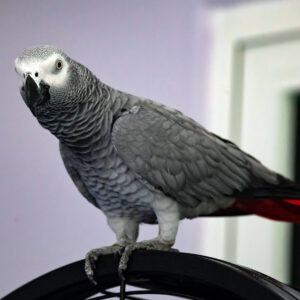
The next time you pull out a twenty dollar bill, perhaps a potty-mouthed parrot might come to mind. That’s because our seventh president, Andrew Jackson (1829-1837), apparently had a habit of swearing, and, thus, so did his parrot, Poll (also referenced as Pol). Poll was said to be an African grey parrot (surprise, surprise!) and was originally bought as a gift for his wife, Rachel, but President Jackson became the parrot’s caretaker after her death.
Out of all the presidents, Jackson’s parrot stands out for his reported behavior at the ex-president’s funeral in 1845. Poll was brought to the funeral because he was a close companion of Jackson. Unfortunately, the bird had to removed from the funeral service because he started swearing and yelling profanities … which he likely learned from the Jackson himself. Here’s a quote from Rev. William Menefee Norment, who attended the funeral: “Before the sermon and while the crowd was gathering, a wicked parrot that was a household pet, got excited and commenced swearing so loud and long as to disturb the people and had to be carried from the house.”
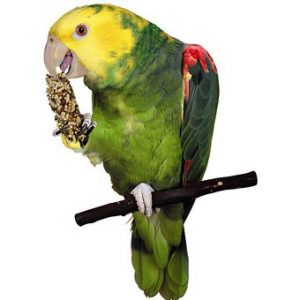
Other presidents who owned parrots include our 18th president, Ulysses S. Grant (1869-1877), described in historical references simply as owning a parrot among other pets, and our 25th president William Mckinley (1897-1901). McKinley’s parrot is said to have been a yellow-headed Mexican parrot (Amazon parrot) named Washington Post that could whistle “Yankee Doodle.”
Parrots From The 1900s
Theodore Roosevelt (1901-1909),our 26th president, had a menagerie of pets, including a hyacinth macaw named Eli Yale. Fortunately, there’s a photo of his son Theodore Roosevelt Jr. with Eli in the White House conservatory, 18 December 1902.It’s said that Roosevelt was somewhat intimidated by the parrot’s beak. There is also a photo of his oldest daughter photographed with an Amazon parrot, although, interestingly, the bird is simply referred to as a parrot.
John F. Kennedy (1961-1963), our 35th president, also had an assortment of pets, including a canary named Robin and a pair of parakeets named Bluebell and Marybelle, which would have been a good fit for the Kennedy’s young children. His successor, Lyndon B. Johnson (1963-1969), our 36th president, was the last president on record as sharing his White House days with parrots. He apparently had lovebirds.
Canary Connections
A number of our past presidents were keen on canaries. Zachory Taylor, our 12th president (1849-1850), had a short-lived canary that they called Johnny Ty, who is said to have died shortly after they tried to pair him with a mate only to discover it, too, was a male. (Male canaries can become quite hostile to one another, especially during breeding season, which is why they shouldn’t be housed together.) Rutherford Hayes, our 19th president (1877-1881), had four canaries. Grover Cleveland, our 22nd president (1885-1889) and also our 24th president (1893-1897), was also a canary owner. Warren Harding, our 29th president (1921-1923), had a relatively short term in office, but at least he had his canary named Bob to keep him company. Calvin Coolidge, our 30th president, showed his sense of humor when he named his canary pair Nip and Tuck, and he aptly named his white canary Snowflake.
Dog’s seem to rule the White House as of lately (President Barak Obama shares the White House with Bo, the Portuguese water dog), which begs the question … would you be more inclined to vote for a presidential candidate if you knew he (or she) had a pet parrot?
Editor’s note: The bird community lost Liz Wilson when she passed away on April 13, 2013. Please visit our dedication page for her full biography, photos and comments from her colleagues.
During one of my lectures, an audience participant complained that her parrot no longer stepped up consistently. She said that she had “tried everything” but nothing helped. My colleagues and I hear this claim frequently, but the odds are excellent that this is not the case.
This column is the first of another mini-series addressing the problem of accidental rewards that we humans provide our companion birds. A fundamental rule of behavior is that no animal, human or otherwise, continues a behavior if it isn’t reinforced. These rewards are crucial to identify and understand because they are the reason that our birds continue to present behaviors that we do not like. Since our actions are often the reason that a problem is happening, we need to recognize these inadvertent reinforcers and stop them. Otherwise, nothing will change for the better.
So the trick to resolving behavior problems is to analyze the situation to identify the reward, and then change things to produce a better outcome. In this column, I will address this issue generally. The next couple of columns will deal with the specific (and common) problems of excessive screaming and biting.
Many parrot owners make a fundamental mistake with their parrots. They pay attention to their birds when they are misbehaving and ignore them when they are being good. So they are rewarding unwanted behavior with attention, and then they wonder why the bad behavior doesn’t go away. Instead, the object is to ignore the behaviors you don’t want, and reward the ones you like.
Applied Behavior Analysis (ABA) is a useful approach to behavior modification when you are trying to identify the accidental rewards that are causing an unwanted behavior to continue. Using what they call the “ABCs of Behavior,” interactions can be broken down into understandable units.
A = Antecedent – or what happens immediately before the target behavior
B = Behavior – the “problem” behavior, the target of the analysis
C = Consequence – the reinforcer that causes the behavior to continue
Going back to the audience member’s complaint, further questioning revealed useful information. It turned out that the parrot was least likely to step onto her hand when she wanted to put it in its cage. So if we fit this scenario into the ABC pattern, we see this:
A = Parrot is asked to step up
B = Parrot steps up
C = Parrot is locked in its cage
Now it is much more obvious as to why the parrot’s previously acquiescent behavior had changed. After all, when it stepped up politely, it was locked away. So the consequence of its good behavior was isolation.
Changing this pattern is easy enough. All we need to do is change the consequence to something the parrot enjoys, and it will likely choose to step up again. Of course, it will depend on the parrot as to what it enjoys. Some cuddly types relish a quick snuggle or scritch. Food-motivated birds value a tiny bit of luscious treat. Some birds really enjoy a simple, but enthusiastic, “Good bird!”
So now our ABC is:
A = Parrot is asked to step up
B = Parrot steps up
C = Parrot gets a reward it values
The odds are now increased that the parrot will choose to step up for the owner.
So what do we do about the getting-it-in-the-cage issue? That is also quite simple. Again, using reinforcers that the parrot values (e.g., praise, scritches or a food treat), step the bird into its cage and reward, but leave the cage door open. When the bird steps into the cage and is rewarded, immediately bring the bird out again for some play time. After a few minutes, repeat the training. Continue to do this until the bird is quite happy to enter the cage.
The next step is to close the door momentarily and reward, then open the door and bring the bird out again. Continue this pattern until the bird is quite comfortable going into its cage and having the door shut behind it. (My blue-and-gold macaw, Sam, for instance, is quite pleased to go into her cage, as she has learned that a tasty nut awaits her.)
Timing
The biggest error made with this type of training is faulty timing. If your timing is off, you reward the wrong behavior, so proper timing is crucial. Best rule of thumb is that the reward must come within a couple of seconds. So, if you have to go into the kitchen, open the refrigerator, get a tiny treat and return to give it to the parrot, you may as well wait until next year. There will be no connection made between the behavior and the reward if there isn’t good timing. So have the food treats ready prior to starting the lesson.
The greatest mistake people make with food treat rewards is offering pieces that are too big. First, it takes too long for the bird to eat it. Second, large food rewards cause the bird to run out of appetite quickly, thereby losing its effectiveness. For example, instead of offering an entire sunflower seed as a reward for a medium-sized bird like an Amazon, cut the (shelled) seed into at least four pieces first.
It pleases us to please our birds, so we often make the blunder of giving them treats that have not been earned. Please remember that such unearned tidbits rapidly lose their value. Save the special treats for training, and offer them at no other time.
My next column addresses avoiding accidental rewards when dealing with excessive noise.
Why put off to tomorrow what you should do today … especially if it can be a lifesaver for your pet bird? Here are five choices to make now to better your bird’s health.
1. Choose an avian veterinarian and schedule an appointment.
Establish contact with an avian veterinarian before you find yourself in dire need of one. Unfortunately, some pet owners are forced to frantically search the Internet or phone book for a veterinarian because their pet became sick or injured. The danger with this is multi-fold; in the case of an emergency, precious time can be wasted not only in trying to find the phone number for a veterinarian, but searching for the physical address of a clinic you’ve never been to. In this harried approach, you also run the risk of bringing your bird to a veterinarian who little to no experience treating birds.
Many of us take the time to find a doctor we trust and like; it should be no different when it comes to our pet birds. Save yourself a headache — and possible heartbreak — by researching a few veterinarians in your area and choosing the one who best meets your needs (ex. location, hours, avian experience, bedside manners, etc.). The next step is to take your bird to your chosen vet for a well-bird exam.
2. Choose to keep your bird up-to-date on diagnostic tests.
If you are traveling at all in the year ahead and plan on having your bird stay at a pet boarding facility while you are away, you don’t want your reservation to be denied because you neglected to keep your bird up-to-date on its annual diagnostic tests. Most pet boarding facilities that accept avian clients require a health certificate from a veterinarian stating that your bird has been tested for, and is free of avian diseases such as Proventricular Dilitation Disease (PDD), psittacosis and Beak and Feather Disease (PBFD).
If you plan on taking your bird along with you on your travels, especially if you are going out of state or taking your bird on a airplane flying, you might need a certificate of health from your veterinarian within 30 days or less prior to your departure date.
3. Choose to pay attention to your bird’s poop — no joke!
Kudos to you if you make an effort to change your bird’s cage liner every day, but before you “roll and throw,” pause to see what your bird’s gastrointestinal tract has been up to. You don’t need a crime-scene-style investigative kit to do this, you just need a general idea of what constitutes a normal dropping for your bird.
The next time you bring your bird to the vet, take along the dirty liner from your bird’s cage. (Don’t tightly roll up the liner, which can smear the droppings. Instead, slide it loosely into a grocery store bag for easy transport) and ask your vet to show you what makes up the droppings. Interestingly, some foods can influence the dropping’s color. Birds that eat mostly seeds usually have green-colored droppings, while those on a mostly pelleted diet have brown-colored droppings. Certain fruits can also influence the color of your bird’s feces … a few fresh blueberries, for example, can color the feces purple!
4. Choose to stash some cash for your bird.
Create a healthcare savings account for your pet bird, and contribute to it each month for your bird’s healthcare needs. Adding $10 or $20 a month can help you budget for your bird’s routine exams and potentially ease the sting of an unexpected medical treatment. Also, consider buying pet health insurance for your pet bird. Shop around for the coverage that best meets your needs; ask what procedures are covered on the plan and what the deductible will be for your pet bird, as the price can vary depending on your bird’s age and species.
5. Choose to weigh your bird regularly.
Instead of guessing your bird’s weight by how much heavier or lighter your bird seems when perched in your hand, it’s time to taking guessing out of the equation. Purchase a scale that weighs in grams (not ounces) and do a weekly weigh-in of your pet bird. Weight ranges vary depending on the bird species, so ask your avian veterinarian for your bird’s ideal weight range. Report any fluctuations outside of your bird’s established weight range to your avian veterinarian, as this can be a sign of ill health.
A gram scale can also be helpful if you are converting your bird to a healthier diet. Some birds can take a while before trying a new food, which is why many aviculturists recommend continuing to offer the old diet along with the new offering until the bird consistently eats the new diet; essentially you are weaning your bird off its former diet and onto a new one. Regular weigh-ins can help you monitor your bird’s weight to make sure it is not losing weight during this transition.
In my last column, I discussed some of the unique features that help birds to fly — from hearts that pump five times their volume per second, to their respiratory system, which allows them to aerate more quickly with a larger blood volume compared to that of mammals. Their shape reduces turbulence, and their organs are lighter in weight. Yet one organ that is relatively heavy is their intestines — their guts. So let’s look at the structure and function of this complex organ, and at adaptations birds use to make the most of it.
From Beak to Crop & Into The Esophagus
The gut, or GI tract, starts anatomically at the bird’s beak and ends at its vent. The proximal portion of the GI tract consists of the beak, oropharynx, cervical esophagus, crop and thoracic esophagus. The esophagus of birds is distensible and sits on the right side of the neck — just the opposite of what occurs in mammals. Some birds, but not all, have a distensible portion of the esophagus, which is the crop or ingluvies.
The crop is an esophageal diverticulum and varies in size depending on the species and the age. Young chicks have a much larger crop than adult birds of the same species. In addition, the size of the crop decreases in size with sick birds that are not eating normal volumes of food. This is important when determining the volume to be fed when gavage-feeding critically ill birds. In psittacine birds (parrots), the crop normally extends from the right side of the neck at the base of the thoracic inlet to the left before narrowing into the thoracic esophagus. From the thoracic esophagus, which lies on the left, the GI tract continues into the stomach.
The Stomach — A Rotatory Grinder
The stomach of birds consists of the proventriculus, isthmus and ventriculus or the gizzard. It lies on the cranial left side of the abdominal cavity. Since birds do not have a diaphragm, it is termed the abdominal coelom. The proventriculus is the proximal portion and is the glandular portion that secretes the digestive enzymes. There is a narrow isthmus or intermediate portion followed by a saclike to highly muscular gizzard.
The gizzard acts to grind food, making it more readily available for the enzymes to digest. In psittacine species, there is a rotatory motion of the food in the stomach with food moving from the proventriculus to the ventriculus for grinding and then back into the proventriculus. This normal pattern can be disturbed by a variety of disease processes, with the most noted being proventricular dilitation disease or PDD.
The Small Intestine — Reduced Length & A Clever Strategy
The anatomy of the small intestine includes the duodenum, jejunum and ilium. The majority of the pancreas lies between the 2 limbs of the duodenum. The splenic portion is located near the back of the bird and is not as closely associated with the GI tract. This portion contains more of the endocrine portion of the pancreas. The bile duct and pancreatic ducts open near the terminal portion of the ascending duodenum.
In most species of birds, the jejunum and ileum are composed of a number of U-shaped loops along the edge of the dorsal mesentery, which is the membrane that takes origin from the back and hangs into and supports the intestines. From our perspective for understanding flight, birds have a limited length to their small intestines and have a unique peristalsis-retroperistalsis pattern to digest and absorb nutrients.
What that means is that they reduce the length and hence the weight of the intestines — a brilliant move! Then they run the digesting foods back (retroperistalsis) and forth (peristalsis) in this shorter segment until digestion and absorption has been completed—so they don’t need to move a bunch of guts around like mammals!
From Ceca to Vent
The next physiologic principle involves the last part of the GI tract. This final segment of the GI tract includes the large intestine or rectum and the cloaca. The large intestine begins at the level of the paired ceca. The large intestine consists of a short and straight segment and is probably homologous to the mammalian rectum.
The ceca — if the species of bird has them — arise at the junction of the end of the small intestine and the beginning of the large intestine or rectum. Parrots, however, don’t have ceca or they are rudimentary, and the ceca of passerines are small. Poultry and ostrich have very large ceca. The large intestine of birds functions similarly to mammals; its major task is to reabsorb water. That is an important factor for flight as well. To see how that works we need to explore the cloaca.
The cloaca of birds is divided into the coprodeum, urodeum and proctodeum. Its basic organization is similar between species, except for the possible phallus in waterfowl and ratites. The coprodeum is the cranial-most compartment and it stores fecal material. The coprodeum is continuous with the large intestine, but is separated from the urodeum by the coprourodeal fold.
The urine and urates are stored in the urodeum prior to evacuating the cloaca, as the ureters open into this receptacle. The oviducts or ductus deferens open into the urodeum. The more caudal fold is the uroproctodeal fold that separates the urodeum from the central and distal-most cavity; the proctodeum. The cloacal bursa opens into the proctodeum. The vent is the opening of the proctodeum to the outside.
The Role Of Retroperistalsis In Water Reabsorption
Interestingly, urine from the ureters flow into the urodeum. The urine of birds is not as concentrated as that of mammals so that means that there may be a larger volume and hence weight of the water. But birds have solved that problem because they can move that urine by retroperistalsis from the urodeum into the coprodeum to the large intestine.
Remember, the large intestine is designed for the reabsorption of water. So birds have again solved a problem using a physiologic function — retroperistalsis! This ability to run fluids and gut contents backwards help solve the weight problem for flight. The shorter GI tract works more efficiently while reducing weight. Retroperistalsis of the urine from the kidneys help to reduce carrying water around and allows water to be used more efficiently. Birds are their own miracle! How brilliant from a physiologic perspective!
Birds And The Miracle Of Flight
Humans have often marveled at the ability of birds to fly and sometimes suffered terribly in our initial efforts to join them through technology. Birds have solved the problem through aerodynamic design of their own, streamlined bodies, reduced weight, a powerful heart and an efficient respiratory system, among other adaptations.
Also important are their adaptations to their guts that allow rotatory digestion in the stomach, peristalsis and retroperistalsis in shortened small intestines, and water absorption that allows effective water management. While their GI tract is relatively short, it works efficiently to fuel the flight that thrills us. From starling to eagle, they’re all pretty impressive from a flight perspective.
Editor’s note: The bird community lost Liz Wilson when she passed away on April 13, 2013. Please visit our dedication page for her full biography, photos and comments from her colleagues.
If you are just tuning in, this is the second of two parts. In the first, I discussed the “Don’ts” – things to avoid when cohabiting with birds. This column discusses the “Do’s.” As previously explained, this is a simplified list, and things are cataloged haphazardly, not in order of importance. I should also add a disclaimer. This is a perfect list for a perfect world. I, for one, have not managed to avoid all the negatives — far from it! Nor have I achieved all the positives.
But I’m still working on it.
As previously mentioned, thank you for the excellent input from members of the parrot division of the International Association of Animal Behavior Consultants: Lisa Bono of Barnegat, N.J., Chris Davis of St. Charles, Ill., Jon Peterson of South River, N.J., Karen Webster of Anchorage, Alaska, and Jamie Whitaker of Houston, Texas, as well as Linna Reusmannof Cataula, Ga.
DO’s:
1. Read and learn, and make an educated decision about which pet parrot species is right for you and your household BEFORE you buy. It is often useful to ask the opinion of multiple educated parrot people, but not those who have something to gain from their answer. In other words, avoid personal agendas (such as store sales people who have just the right bird for you) and seek the help from those whose only motivation is helping you find the right pet bird.
2. Make sure you and your human family can tolerate the voice of a particular parrot species prior to bringing one home. Noise sensitivities vary and different parrot voices can grate in different ways.I’ve lived for 45 years with large macaws – birds whose vocalizations can practically shatter windows. Yet one of the most aggravating vocalizations I’ve ever encountered was a cockatiel whose shrill “Weep? Weep? Weep?” drove me crazy. It has to do with auditory frequency, and I reacted as if it were fingernails on a blackboard.
3. Find an experienced avian veterinarian NOW, PRIOR to emergency. The last thing you need to do in the face of an emergency is start looking for an experienced bird veterinarian. And if you are lucky enough to find someone, you will be dealing with a stranger, not someone you already know and trust. Additionally, many veterinarians do not take new clients as emergencies. Now is when you need to find an experienced avian veterinarian – not a dog and cat vet whodoes birds on the side. I am not exaggerating that your feathered friend’s life could depend on it.
4. Teach your bird to eat a varied, nutritional diet. Since malnutrition is the underlying cause of most medical problems in companion birds, the best way to prevent such problems is to make certain a pet bird eats an excellent diet. You are the one in total control of that diet, unless your bird has access to the refrigerator when you are not home. It is total garbage that a pet bird won’t learn to eat a nutritious diet. The only obstacle is the human giving up too soon. Work with your avian veterinarian on this, as it is crucial to your pet bird’s health.
5. Research the dietary needs of your chosen pet bird species prior to purchase. This will allow you to budget how much your grocery bills will increase with the addition of fresh vegetables, nuts and fruits.
6. Take your bird to your avian vet for annual well-bird check-ups. Birds are masters of disguise when it comes to illness. Waiting until symptoms are obvious usually means the bird is now so sick it cannot hide it anymore, and the odds of saving it decrease exponentially. Annual check-ups allow avian veterinarians to catch problems early. Additionally, they provide your veterinarian with a healthy baseline against which to compare in the future should problems arise.
7. Plan for the future in case your pet bird outlives you. Parents know they need to make arrangements for their kids should anything happen to them. Since parrots can have a lifespan that rivals that of humans, parrot owners must do the same. Besides, our “feathered kids” won’t grow up and leave home like human children do (or should).
8. Whenever possible, teach your bird (or dog, cat, child, husband or wife) with positive reinforcement by instantly rewarding behaviors that you like and totally ignoring behaviors that you do not wish to continue. This is much easier and effective than using aversives (like distasteful punishments) to try to erase unacceptable behaviors.
9. Work to PREVENT problem behaviors from starting. As with health, behavior problem prevention is always easier and cheaper than trying to fix something later.
10. Work to FIX problem behaviors that have already started. Don’t wait until you can’tstandan obnoxious behavior to seek help. People routinely get rid of birds because of a problem that could have been fixed easily if stopped earlier. The longer you wait, the less likely you are to have the necessary patience to successfully change a behavior.
11. Invest in a large, good-quality cage. One would think this is a no-brainer but sadly, no. People often spend all their money purchasing a bird, so they try to save on the price of the cage. Very bad mistake.
12. Seek help with management problems. For instance, if you have a hard time keeping a cage clean, you may need a different cage or different substrate. Ask experienced parrot people for guidance.
13. Never stop reading and learning. No matter how much you think you know, you do not yet know enough. None of us knows enough. I have lived with parrots for 45 years and worked professionally with parrots for 40, and I will never stop needing to learn more.
14. Understand that a bird’s motivations might be alien to you, so do not try to interpret a behavior to mean what it might signify if it were a human. The misunderstanding of motivations creates endless problems between people, and we’re all the same species and speak the same language. Since birds are totally different from humans, one can only guess at the expanse of potential misinterpretations between them. A classic example of this is the human assumption that parrots are “angry” when they yell, when the opposite is more likely.
15. Open your mind to the experience of sharing life with a bird, an extraordinarily vivid life form. You are cohabiting with a flighted being, a fragment of a vanishing rain forest. Keep your mind open and the results can be extraordinary and the wonder endless.
Give your pet bird a boost of health and happiness in the year ahead by taking a close look at its gear and replacing the pet bird essentials that might be past their prime. Here are some tips to get you started:
Have you had to “modify” your pet bird’s cage to keep things in working order? Perhaps you’ve incorporated binder clips, paper clips or zip-ties to keep things in place, such as a loose or broken bar from falling off, or the cage door shut. Quick fixes such as these might help you penny pinch, but you run a risk of your bird being seriously injured if its toe, beak, wing or head gets caught up in non-cage-issued part, which might also have traces of lead in it. The end result might be a veterinary bill that dwarfs the cost of what you would have paid for a new cage. Also, use the “New Year, New You” motto as inspiration to finally upgrade your bird’s “starter cage” to a one that is more spacious and has features that make daily maintenance easier on you.
Toys
It’s sometimes hard for pet bird owners to say goodbye to their pet bird’s toy after it is no longer of service to the bird, or it becomes a downright hazard. Look at the toys in your bird’s cage. Are any toys destroyed to the point that all that is left is a piece of rope or a string hanging from a hook? Your bird chewed off the wood and cardboard pieces months ago, and has no interest in what’s left behind, yet the toy still hangs in the cage. Most pet bird toys are designed to be destroyed, so keep this in mind when you buy toys; you will have gotten your money’s worth when there’s almost nothing left. Go through your bird’s toy box and make sure that it’s not full of the “skeletal remains” of toys your bird has chewed up and is done with; make new toys part of your pet bird’s new year.
Additionally, consider replacing, or relocating to a different area of the cage, any toy that your bird ignores. If your bird’s toy is made of destructible parts like cardboard, wood pieces and other easily chewed-up parts yet looks just like it did when you bought it, your bird might not be interested in that particular type of toy. Sometimes moving the toy to a different area of the cage, such as near a favored perch spot, will pique your bird’s interest in it, but be prepared to try out new toy types until you find ones your bird takes a liking to. (You can always use an ignored toy as a keychain … you’ll never lose your keys again!)
Perches
Perches are easy to overlook. As long as they are hanging in the cage and/or perched on by your pet bird, you might not think twice about them. However, just as we occasionally need to re-carpet a room or replace a loose floorboard, perches need to be inspected and replaced if worn down. (Perches should also be taken out of the cage and cleaned from time to time.) Parrots love to chew wood and, since most perches are made of wood, a bird owner shouldn’t be too surprised to discover that his or her bird chewed up its perch to the point where it looks like a beaver snuck into the cage and gnawed a section down to the core. Similarly, rope perches add a cushy and comfortable place to perch; however, even if this is your bird’s favorite place to perch that doesn’t mean your bird will not chew on it. Some parrots can turn a rope perch into something that looks like a shaggy mop head, which warrants buying a new one.
This is the time of year when many of us vow to make healthier choices, including eating better. Why not extend this commitment to your pet bird? Parrots love treats, even the ones that aren’t so good for them. One way to start the New Year off right is to replace not-so-healthy foods with ones you can feel good about offering to your bird. Check out Lafeber Company’s healthy yet fun-to-eat foods, and help your bird get the balanced nutrition it needs.
Bird Owner New Year’s Resolutions
This year, I vow to do a thorough cleaning of my cockatiel Buddy’s cage at the beginning of each season. Also, I want to change his toys more often.
— Kimerle
This is Frances’, the pearly conure’s first Xmas and New Year with us, his new adoptive family — we are hoping his New Year’s Resolution is to stop smearing his face in his poop. (Wishful thinking). Our New Year’s Resolution for him — to take him on more outdoor adventures come summer (and hopefully get him used to his Aviator Harness). We have already improved his diet by switching him to Nutri-Berries, which have made his feathers brighter and more beautiful! Thanks! Frances loves his Nutri-Berries!
— Lindsay
My New Year’s Resolutions are: To gain my rescue bird’s trust! I rescued a peach-fronted conure about 8 months ago and, while he is now healthy (avian vet says so… cost a fortune, but so worth it!), he still is un-trusting of our hands. He will gladly sit on my shoulder and chirp or beak grind, but if anyone tries to pick him up with our hands he will bite out of fear (except if he gets on the floor and wants to be up, then he will step up to hands). He will take treats out of our hands now, so the next step will be to try to get him to step up on our hands willingly. Calypso’s resolution will be to be more trusting of us (even though it will be hard to undo years of abuse) and try not to bite out of fear!
— Mouse Simpson
Do share! What’s your New Year’s Resolution as it relates to your pet bird? Share your resolution by adding a comment below. You can also comment on behalf of your pet bird … what do you imagine your pet bird’s New Year’s resolution might be?
’Tis the season for food and fun. We all lead busy lives, but, with the holidays upon us, we somehow find time to decorate, go shopping, visit friends and family, and eat much more than normal. However, the hustle and bustle of the holiday season is not an excuse to forget about the needs and safety of our pet birds. The holidays can bring added dangers to a bird’s typically safe life. Being aware of these dangers can prevent accidents and tragedies, and a trip to your emergency avian veterinarian.
Decorations
Decorations can be particularly dangerous. They are usually manufactured with the mindset that no one is going to ingest them, and are typically made of cheap metals and other ingredients that are likely to be toxic to birds. Never give a bird anything to play with that is not made to be given to birds, and keep your bird away from all of the holiday decorations.
Christmas Trees
Christmas trees are a common decoration found in homes during the holidays. Live trees are tempting for a bird to explore, and it may be tempting to some owners to allow and even encourage this behavior. Avoid this temptation and do not allow your pet bird to play in the Christmas tree. Playing in the tree can allow exposure to many dangers. The tree might have sap, which can stick tightly to feathers and is very difficult to remove. Another danger is the potential toxicity of the tree. It is not known whether any or all species of Christmas trees are toxic to pet birds. The sap could be toxic, as could the bark, leaves, cones, seeds, or any other part of the plant.
Additionally, these trees once lived outside, exposed to wild birds and other animals carrying viruses, bacteria, internal parasites and other infectious organisms, such as Sarcocystis, and external parasites, including lice and mites, that could infect your bird. Not only are Christmas trees potentially toxic, but other holiday plants, such as poinsettias and mistletoe can be lethally toxic.
Candles
Another common decoration seen during the holidays is candles, such as the Menorah and scented candles. Certainly the open flame is a hazard, especially for flighted birds, but candles should also be out of reach of walking and climbing birds. Candles also produce fumes that may be irritating to a bird’s sensitive respiratory system or even toxic to the bird. There are safe candles, but, even with the so-called safe candles, I recommend that candles not be left burning in the same room with a pet bird.
Baking
People tend to spend more time in the kitchen during the holidays socializing and, of course, cooking more. Pet birds want to socialize, too, but the kitchen should be off limits during food preparation. Many hazards lurk in an active kitchen: open pots of boiling water, hot stoves and dishpans of standing water. I have examined birds that have had accidents involving all of these scenarios, most with disastrous and sad outcomes. We should also keep in mind that nonstick cookware releases a gas when heated that is lethally toxic to birds and should not be used with birds in the home.
Also, make sure all family members and guests are aware of the foods that your bird should not eat. Chocolate, a common holiday treat, should never be fed to birds. Avocado, although not typically served this time of year, is lethally toxic to birds. Although foods high in sugar, salt and fat are not considered toxic, birds can ingest too much of any of these and develop associated health problems, for example, excess salt can cause kidney problems, as well as brain lesions.
Another food category that birds seem to enjoy but should not be given is dairy products. Birds are naturally lactose intolerant and can develop GI upset if fed cheese, milk or other dairy products. Many of us enjoy a little spirits during the holidays, but wine, beer and other types of alcohols should never be given to birds. Caffeine should also be avoided, so no dinner wine, and no coffee and dessert for the birds; just healthy treats and water.
Holiday Guests
This time of year brings more people into our homes; maybe it’s all of that extra food, or the presents, or maybe the wine. Visitors coming and going, change in routine and increased activity level within the home is a huge disruption a bird’s life. Bird’s that are not accustomed to this level of activity may be easily startled or uncomfortable. Be aware and considerate of how your birds react in these situations, and protect them by temporarily moving the cage to quieter area if they seem stressed by the activities going on around them.
People coming in and going also means that the door will be opened more frequently. This is most important in homes that have flighted birds. Birds with the ability to fly seem to always know when a door is open and fly straight to it. Escaped birds are difficult to find and recover.
Strangers in the home also mean that there may be visitors who do not know how to handle or interact with pet birds. As a responsible pet bird owner, teach those interested how to interact with a bird, as it helps to socialize your bird and may foster curiosity of bird ownership in your guest.
Holidays can be fun, but can also be dangerous to a bird. Be aware of the potential risks that this time of year brings, and you will be better able to prevent any harm that may come to your bird.
Real-Life Holiday Mishaps
Real-Life Cases from Dr. Greg Burkett, Board-Certified Avian Veterinarian;www.thebirdvet.com
“A lutino cockatiel was flying around in the kitchen during the holiday feast preparation. She accidentally fell into a boiling pot of soup on the stove. On presentation she had redness or hyperemia of her cere, beak, adnexal (tissue around the eyes), skin on the bald spot of her head, and feet. Initially after the incident, lesions were not apparent, but within 30 to 45 minutes she exhibited third-degree burns on all unfeathered portions of her body.
Sometimes birds can survive third-degree burns if they are not over a large portion of the body. But, in this case, the scalding water was ingested and inhaled into the mouth and sinuses. These internal burns were severe and the bird was unable to recover.
Another case involved a blue-and-gold macaw. The owner called the hospital and reported that his macaw was wobbly and unable to perch. When then bird arrived and was examined, I determined that the crop was distended with food. The owner then reported that he had given the bird a few Doritos chips – an entire bag. The bird showed signs of salt toxicity. He was treated and released with no longterm problems. Without treatment his bird could have developed permanent brain damage or even died.
Last Christmas, I saw a budgie that was allowed to play in the Christmas tree. He was brought in because his feet had become stuck to his abdominal feathers. He has begun to chew his feet to free them to no avail. The owners thought that they could clean it and free the bird’s feet. After 20 minutes of bathing they decided that they need the help of a specialist. That as good, but the decision was made too late. Bathing the bird and trying to remove the sap was more that the bird could handle and caused hyperthermia. The stress and the hyperthermia lead to the bird’s death.”
Real-Life Cases from Laura Wade, DVM, Dipl. ABVP (Avian); Specialized Care for Avian & Exotic Pets; www.buffalobirdnerd.com
“I had a cockatiel [patient] that got its tail feathers singed after flying through a lit candle during the holidays. Close call, but it could have been worse. Candles at the holidays are dangerous, especially with flighted birds. Clients should also be careful if birds can gain access to a decorated Christmas tree — birds might chew the lights or glass ornaments or take glitter off of ornaments (risking exposure to lead etc.).
Although it could be a good foraging activity to have your parrot help you open Christmas presents, be careful of any foil ribbons, bows, etc., which might have toxic metals (zinc, lead) in them. Of course, also be careful of access to cookies that might have chocolate, etc.
“Our client had their grandchildren spend the holidays at their house. After the pitter patter of tiny feet went home, one inquisitive cockatoo found a stash of several snack-size wrapped dark chocolate bars that had been hidden in a couch by one of the children. The cockatoo carefully unwrapped all four bars, and ate every one of them! Luckily she was found soon after playing with the evidence — the wrappers!
The owners rushed her to our hospital. When the sweet umbrella cockatoo gave me a kiss, her breath smelled like chocolate! The dark chocolate could also be seen through her skin in her crop. Since she was such a sweet girl, we were able to treat her easily. We placed a gavage tube and flushed out her crop with warmed saline solution.
We also gave her a dose of activated charcoal to absorb any toxins that may have already made their way into her GI tract. She had no clinical signs of chocolate toxicity and did very well. Every day for a few weeks, she did check out the couch looking for more chocolate! So, after all the guests leave your home and you are enjoying the quiet once again, make sure to bird-proof your home!”
During a holiday gathering, another client let her bird hang out on her shoulder and meet her guests. While dinner was cooking, the bird spooked off her shoulder, flew into the kitchen and landed in a frying pan on the stove. Luckily, the pan was just starting to heat up and was not full of hot oil or food. The bird was quickly scooped up and its feet put under running cold water.
This action by the owner saved her bird’s life! The bird’s feet had second-degree burns, but he did make a full recovery after spending a few days in the hospital for wound treatments, bandage changes, fluid therapy and pain medications.
During parties and holiday gatherings, the safest place for pet birds is in their cages! Even the most quiet and tame of pet birds can be frightened by the commotion that a party brings.”
We talk about miracles, particularly during the holiday season, but one that we as bird owners often marvel at is the miracle of flight! The adaptations necessary for birds to fly are considered among the most intriguing puzzles of all in biology. Bats are the only mammal that have the ability to fly on a dynamic wing, while insects have true flight but usually on a fixed wing.
Humans have yearned to fly, but it took the last 100 years for us to perfect machines for flight — we just can’t do it even with wings strapped to our arms! And, in these 100 years, we have finally gotten closer to the abilities that birds have been endowed with — from “flying” deep into the water to flying far into the outer reaches of the atmosphere. How is it that birds can do this so effortlessly? What allows them to make this miracle happen?
A Warm-Blooded Heart
A number of factors are involved for this to happen. Having evolved from reptiles that had developed a four-chambered heart, birds also developed the ability to maintain their own internal body temperature, to be “homeothermic.” They can be, on average, 9 degrees warmer than mammals, which can account for a number of other issues that we can explore in the future. Warm bloodedness allows animals to maintain a constant body temperate, and that is important for providing the energy necessary for flight.
Flight takes an incredible amount of energy; up to 20 times the energy of just sitting. The ability to maintain an internal body temperature is also accompanied by the development of a four-chambered heart. That type of heart is important for providing the energy for pushing the blood to oxygenate the tissues, and it is critical in generating the power for flight.
A Balancing Act
So for flight, form does indeed follow function to be successful. There are strict limitations for the shape and size of a flying animal or machine. Aerodynamic efficiency needs to have sufficient power combined with structural and muscular strength. Part of this equation also requires that weight be kept to a minimum or even more power and strength is needed—stretch the limits too far and flight just does not occur! This has resulted in a certain uniformity of design in all birds that fly. So a parrot has a similar overall structure to that of an eagle, heron or a duck. The anatomical parts of birds are perfectly suited for life in the air. All are designed to allow for the Miracle — from weight reduction to power and all of the aspects needed to fly!
Efficient Respiratory System
In a previous column, I talked about the unique respiratory systems of birds. That uniqueness allows for one-way movement of air with the blood in a cross current multiplier to efficiently allow for the removal of carbon dioxide with the capture of oxygen in their very effective air capillaries. These air capillaries are smaller but have a thinner lining to whisk the oxygen into the red blood cells on the other side of the mucus membrane while dumping carbon dioxide to be exhaled.
Additionally, the ability to use the air sacs to move blood with a fixed lung allows for packing a huge number of these oxygen-capturing air capillaries into the lung surface, compared with the alveoli of mammalian lungs. So in effect, us humans just couldn’t get enough oxygen for lift off or to maintain flight even if we could get airborne! On the other hand, birds’ respiratory systems allow them to take in oxygen efficiently and to get rid of carbon dioxide, and to maintain flight.
Streamlined Shape For Reduced Drag
The body shape of birds allows for smooth, sweeping lines that reduce turbulence and minimize air resistance. Their shape is perfectly suited for flight – they have pointed front ends with smooth contours and a compact, but light, body. Even their legs disappear during flight to reduce drag – their landing gear comes up with takeoff and flight but, when landing, birds bring their legs down and spread their toes to increase drag needed for slowing the body for landing. You have probably seen ducks with their tails and legs down with toes out during landing!
So birds are like airplanes that put down their wheels for landing. Insects, by contrast, have a very different outward appearance. They are often blunted with a number of appendages that do not retract well so that they are sticking out in all directions. Insects are slow fliers at 10 to 15 miles per hour, while there are some birds that can fly upward of 100 to 200 miles per hour. Interestingly, there is 100 times greater drag when flying at 100 miles per hour than there is when flying at 10 miles per hour. A bird’s significantly greater efficiency of streamlining allows for those high airspeeds with a minimum of energy.
Weight Reduction with Strength and Flexible Rudder
Weight reduction is one of the important adaptations necessary for flight. The skeleton of birds has been fused in many locations to reduce weight while adding strength. In the skull, a large number of the bones have been fused and the infraorbital sinus has been added to fill it full of air to reduce weight and add buoyancy. In contrast, I am sure you have noticed how heavy your head becomes when you try to do a number of sit-ups properly!
Weight reduction with centralized strength is important for flight. The vertebral column in birds has been fused from the distal thoracic region with the lumbar vertebrae to just before the vertebrae of the tail, the coccygeal vertebrae. These fused vertebrae then make a rigid platform to work off of to thrust the body forward during the downstroke of the wing beat. This strong rod is fixed to the bird’s “landing gear” through a structure called the synsacrum.
The synsacrum represents the fused ilium, ischium and pubis, and it is then fused to the vertebrae, including the caudal thoracic, lumbar, sacral and proximal coccygeal vertebrae. The distal coccygeal vertebrae are moveable except at the tip, where the tail feathers insert. That allows the tail to move so that it can act as a rudder! Those of you whose birds have had broken tail feathers know that this can seriously compromise their ability to maneuver.
A Good Skeletal Architecture
As you would expect, the landing gear of the legs need to act to absorb shock. This is accomplished through the flexion of the joints, while the head of the femur is firmly placed in a confined hip joint that continues to transmit the landing forces through the fused synsacrum to the fused vertebral column. Pretty ingenious I would say!
The thoracic girdle also has fused elements where the wing is connected to the body. The thoracic girdle is composed of the clavicles that fuse to make the wishbone, the coracoids and the scapulae. The coracoid is the stout bone that connects the humerus of the wing to the sternum. The sternum, with its long keel, provides the broad surface for the insertion of the pectoral muscles for the down and upstroke of the wing. The ribs insert onto the sternum, and these ribs, in turn, attach to the vertebral column.
With each downstroke, the force moves from the wing across the sternum through the ribs to the vertebral column, which then, because of its fused parts, acts to propel the bird’s body forward. The clavicles act as a transverse spacer bar to not allow the chest cavity to collapse with the force exerted during the downstroke. The birds’ fused skeletal architecture is an elegant adaptation for flight, providing structure while managing the forces of flight effectively.
And More To Come …
In the next discussion, I will discuss how a bird reduces weight of some of the organs for flight, as well as some ingenious ways that anatomy has been modified to meet the physiologic demands during flight.
Editor’s note: The bird community lost Liz Wilson when she passed away on April 13, 2013. Please visit our dedication page for her full biography, photos and comments from her colleagues.
In this first of a two-part column, I will discuss the things to avoid when cohabiting with parrots and other avian species. My next column will discuss the “Do’s.” This is a simplified list and things are cataloged haphazardly, not in any order of importance. I should also comment that this is a perfect list for a perfect world. I, for one, have not avoided all the negatives, nor have I achieved all the positives. But what is the point of life, if we don’t keep trying?
Thank you for the excellent input from my colleagues in the parrot division of the International Association of Animal Behavior Consultants: Lisa Bono of Barnegat, N.J., Chris Davis of St. Charles, Ill., Jon Peterson of South River, N.J., Karen Webster of Anchorage, Alaska, and Jamie Whitaker of Houston, Texas.
18 DON’Ts:
1. Use any brand of nonstick cookware
Despite all the warnings and publicity, fumes released from overheated nonstick cookware are still killing companion birds of all species. Nonstick coatings like Teflon appear in other things as well, such as hair driers and space heaters. Pet bird owners need to be extremely vigilant about this, and talking directly with the various companies prior to purchase can help.
2. Tolerate behaviors that no one else can stand
I am horrified by the number of parrot owners who acknowledge, often with great pride, that their parrots have behavior problems that no one else would tolerate. It is as if they wear this as a badge of courage or something. However, since many parrot species are extremely long-lived, this means these owners are setting them up for failure in their next home. What kind of legacy is that? Serious problem behaviors need to be resolved, not ignored or tolerated.
3. Respond to behaviors you don’t want by paying attention to the parrot
It is a sad reality that most pet bird owners ignore their parrots when they are being good and yell at them when they are bad. So the parrots’ bad behaviors are being rewarded with attention. And why exactly wouldn’t these bad behaviors continue?
4. Get any species of bird if you are an obsessive neat freak
Birds are messy creatures, period. Even tiny soft-billed birds like canaries and finches toss seed around, and every bird sheds feathers and feather dander. Neat freaks need not apply!
5. Don’t get a parrot if you live in housing that allows NO PETS
People who smuggle parrots into “No Pet” housing end up teaching their parrots to be loud by trying to shut them up every time they make a peep, dooming the parrots to losing their homes. Quiet pets include fish and reptiles so people in such housing should consider them, instead.
6. Get a parrot just because parrots can talk
While a talking parrot can be amusing, human language will not justify how much work parrots are. Babies learn to talk too, but that’s hardly a reason for starting a family! Radios can provide human speech if that is all that is needed, and they are much less demanding.
7. Don’t expect your parrot to talk
Some species of parrots have a reputation for talking ability but that does not mean that every individual bird in that species will talk, as many don’t. If talking ability is that important to you, consider a parrot that already talks. But parrots that talk in one environment may not in another, so there are no guarantees. And again, please reconsider getting a pet parrot if talking ability is really your only reason for wanting one.
8. Get a bird of any species just because it is beautiful
As with talking ability, beauty alone will not counter balance the negative aspects to bird ownership. If beauty is your sole motivation for wanting a bird, please stick to pictures; they are so much less problematic.
9. Get a parrot species that produces a lot of powder, such as a cockatoo, African grey or cockatiel, if you or a family member has respiratory allergies
These so-called powder-down species can produce respiratory problems even without allergies. Do not take the chance. The human’s — and the parrot’s — future depends on it.
10. Get a bird if you or a family member is sensitive to noise
As previously mentioned, birds make noise. If you (or a family member) values silence, perhaps a picture will work for you as well. I’ve been asked countless times how to get a talking/chirping/babbling bird to shut up. Radios come with ‘off’ switches. Birds do not.
11. You are already strapped financially
Even small birds need large and expensive cages and that is just the beginning of the financial outlay. When considering the cost of food, toys and avian veterinary medicine, birds are expensive to maintain properly.
12. Get a parrot if you’re already too busy
Parrots are social creatures, and they need daily interaction, if only for a few minutes at a time, several times a day. If you haven’t the time to provide that, then don’t get one.
13. Don’t cut corners on the price of toys, food and cages
As stated earlier, parrots are expensive. If you can’t afford to do it right, don’t get a parrot.
14. Get a large parrot if you live in a small space
If you cannot give a pet parrot the space it needs, then don’t get one. Large parrots and extremely active smaller species require large cages and if you haven’t the room, don’t get one. Period.
15. Sleep with your parrot
Appalling though it sounds, numerous pet parrots (as well as infants) are suffocated yearly when sleeping alongside humans. There is no excuse to run this risk.
16. All-over petting
As far as an adult parrot is concerned, “all-over petting” is sexual foreplay. This needs to be avoided for obvious reasons, as sexual stimulation can lead to serious problems for owner and bird.
17. Get a long-lived species like a parrot when you won’t commit to a long-standing relationship
Unlike shorter-lived companion animals like dogs and cats, many pet parrots can live a long time. Even a canary can live for 20 years and 50- to 60-year lifespans are common with larger parrot species, such as Amazon parrots, cockatoos and macaws. They need a long-term commitment from us. I recently encountered a young woman who was looking for a home for her 4-year-old Amazon parrot because she was going to college. Hello? The possibility of college didn’t exist four years ago?
18. Get a parrot if there’s even one person in your household who is not supportive of the idea
Parrots can be aggravating companions even for those of us who love them. To bring such an intelligent, sentient creature into a home where others do not welcome it is incredibly selfish and totally unfair. How would you like it if someone did that to you?
My column for next month will address The Do’s for Living With Parrots.
Dr. Irene Pepperberg and Alex, the African grey parrot that broke ground on animal intelligence. Courtesy David Carter
Time heals. Not, however, neither nearly as quickly nor as fully as we are led to believe. Five years after Alex’s passing, he is still sorely missed; by me and, I believe, by Griffin and Arthur, the other African grey parrots in my lab. Days still exist, particularly when I return after a long absence, during which I walk into the laboratory, glance at the cage in the far corner of the room, and expect to be greeted by Alex’s familiar, imperious “Come here!” [Yes, we still have Alex’s cage; Griffin likes to climb on it and play there. We think it helps him accept Alex’s absence and gives him some confidence in his new role as “alpha” bird.] Alex’s voice, of course, has been stilled, and the momentary sadness passes, because Griffin’s more plaintiff “Come here” and Arthur’s “Tickle” make it clear that life and research in the lab continues.
And research most certainly does continue. Both birds have participated in studies on reciprocal behavior and on reasoning by exclusion, and Griffin has just finished work showing that he sees some common optical illusions just as humans do. I’ll describe the first two experiments, as they have either been published or have been accepted for publication.
Give Or Take?
The reciprocity study, begun under the direction of a visiting French colleague, Franck Péron, was designed to see if the birds would work together on a task in order to maximize their rewards. The task was as follows: Each bird could, in turn, choose one of four colored cups on a tray in the presence of the other bird. The choice of each cup had a different consequence, and the human trainers disbursed the rewards: Choose pink, and you get a treat; choose orange and your partner gets a treat; choose purple and no one gets anything; choose green and you both get treats.
Clearly, if the birds figured out the system, they’d realize that if they cooperated and each chose green, they’d be rewarded all the time. We also added a little twist: We let Griffin, the dominant bird, choose first on half the trials, and let Arthur choose first on the other half to see if that made a difference. We ran the experiment for a long time — 500 choices for each bird — to see if their behavior might change over time and if they would learn to work together. The results were quite interesting.
At the beginning of the sessions, Arthur, whether he began trials or not, tended to choose orange, thereby giving the dominant Griffin the reward — or he chose purple, as though he didn’t want to give up the reward but was afraid to take something for himself. Griffin, the dominant grey, chose green on a lot of early trials, both as leader and follower, maybe trying to show what to do to get the most rewards. We weren’t too surprised. But then, over time, things changed!
Arthur realized that humans were disbursing the treats, and Griffin couldn’t “punish” him in any way. So Arthur became more and more selfish. Griffin reacted to Arthur’s behavior by becoming completely selfish, but only when he was in the leading position. When Griffin was in the (very unaccustomed!) situation of having to go second, he continued to choose green — to share — at about the same rate as in the first trials, though he also acted a bit more selfish than at the start. It seemed that Griffin, when forced to be subordinate, was either trying to show Arthur that he could be nice or to continue to demonstrate what “should” be done, maybe in order to regain that dominant position!
Follow The Treat
The reasoning-by-exclusion study was begun to see if parrots could figure out where a treat would be after they were given a clue as to where it was not. The task sounds confusing, but it has been used to show that nonhuman primates can think the same way as humans do, and we wanted to see if parrots would respond similarly.
David Premack, a psychologist studying chimpanzees, designed the following task. He showed his apes that he was hiding an apple under one container and a banana under another. Then, in the absence of the apes, he removed one of the fruits (the “invisible” condition). He let the apes see him eat the apple and then let them search the containers. If they remembered where each fruit had been hidden, and realized that the apple would no longer be present, they would know to search for the banana under the correct container.
Of course, all sorts of controls needed to be in place so that the animals were not inadvertently cued, for example, by the scent of the fruit. Moreover, they had to have liked both fruits equally well, so they wouldn’t go only to the place where they thought a favorite treat might be hidden. The task can, theoretically, be made simpler by showing the nonhuman what is being removed and where the removal is occurring (the “visible” condition), but such a procedure actually confuses some animals: They are distracted and choose the container that the experimenter has touched, possibly assuming that the experimenter is cluing them to go to that container. Arthur and Griffin, as well as two pet African grey parrots of former trainers in our lab, Carl and Leigh Ann Hartsfield, however, were not confused and succeeded under both the visible and invisible removal conditions.
Interestingly, while we were in the middle of our study, our Austrian colleagues published a paper showing that at least one of their African grey parrots could do the invisible task —“scooping us”— but we had some additional twists to our protocol. We wanted to make sure that the birds really understood what was under each cup and that they were not simply avoiding the cup from which something had been taken. We specifically wanted to see if they knew when to reason by exclusion and when not to do so. So, in the next experiment, we hid two pieces of food under each cup, but one cup had special treats and the other had their regular pellets.
We removed either one treat or one pellet, and mixed these trials with the original trials with just one piece of food initially under each cup. If the birds were paying attention, they should be able to distinguish the two sets of intermixed trials. In the “two rewards under each cup trials,” they should always choose their favored treat; after all, even one treat should be preferred to two pellets. Similarly, in the “one reward under each cup” trials, they should continue to reason by exclusion. Griffin, Arthur and one of the Hartsfield’s birds succeeded, showing that African grey parrots were at least as intelligent as apes and young children!
Clearly, lots of work remains to be done before we fully understand the intelligence of these remarkable creatures. Even after more than 30 years of study, and even with the loss of our star pupil Alex, we are continuing to figure out just how smart African grey parrots really are.
Dr. Irene Pepperberg is an adjunct associate professor at the Dept. of Psychology, Brandeis University, Waltham, MA. She is also a lecturer and research associate at Harvard University, in Cambridge, MA.
You can help Dr. Pepperberg continue the groundbreaking parrot research she began more than 30 years ago with Alex, the African grey parrot that won admirers from around the world with his cognitive abilities. If you shop online through sites such as Amazon.com, you can designate the Alex Foundation to receive a percentage of your final sales, or register with the Alex Foundation at iGive.com and a percentage of sales from companies associated with iGive will go to the foundation. The Alex Foundation also has a “Donate” button linked to PayPal. Visit http://alexfoundation.org and click on the “Support Us” link for more information.
Sterner Matching Challenge: From now until January 5th, 2013, Andy Sterner will generously match all donations made to the The Alex Foundation up to a total of $10,000! If you’ve ever thought about giving to The Alex Foundation now is a great time by doubling your donation! All you have to do to qualify is give. No need to specify anything when you make your payment. Click here.
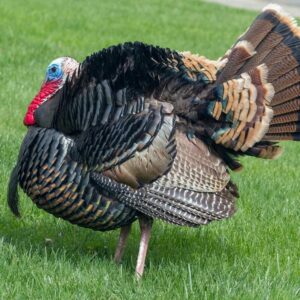
I love Thanksgiving, in part because I am an avian vet and this is a bird holiday involving a very special bird — the wild turkey (Meleagris gallopavo). Wild turkeys are the heaviest of the poultry species, or galliformes. The domestic turkey that we cook for our tables on Thanksgiving was bred from a subspecies of the wild turkeys from southern Mexico. While the wild turkey is a darkly colored brilliant bird, the domestic turkey is bred to grow rapidly and have white feathers — all for an important meal on the third Thursday of November!
Turkey Types
As suggested, there are a number of subspecies of wild turkey. There is the Eastern wild turkey (Meleagris gallopavo silvestris), which is the one encountered by the pilgrims on their first Thanksgiving. In the United States, these magnificent large birds range from Maine to northern Florida and also into the northern reaches of Canada. They are associated with woodlands and edges of woods. They can stand up to 4 feet in height, and males may reach up to 30 pounds! Perhaps Benjamin Franklin was thinking of a particularly magnificent Eastern wild turkey when he suggested that the turkey be our nation’s symbol.
There is also the Osceola Wild Turkey, or Florida Wild Turkey, (M. g. osceola) that derives its name from the Seminole leader, Oseola. These turkeys are smaller and darker, with an iridescent purple- green coloration. Another turkey subspecies, the Rio Grande Wild Turkey (M. g. intermedia), ranges from Texas to New Mexico up to Oregon and is more adapted to a prairie habitat. It has much longer legs, and its feathers have a green coppery sheen.
The Merriam’s Wild Turkey (M. g. merriami) has a limited range along the Rocky Mountains and the area around Mt. Hood, Ore., where it was reintroduced. This bird is noted for the white tips of the feathers along its back. Additionally, there are two subspecies of wild turkey from Mexico; Gould’s Wild Turkey (M. g. mexicana) and the South Mexican Wild Turkey (M. g. gallopavo). It was this second subspecies that the Aztecs domesticated and the Spanish brought back to Europe for food. This domesticated turkey was bred throughout Europe so that the Pilgrims were thought to have brought it back to the Americas!
It is the wild cousin that I am the most familiar with on my farm in Ohio — the Eastern wild turkey. Having watched them closely on the farm these past years, they have made me laugh —as well as cry, such as when a mother hen was run over on the road and her chicks surrounded her dead body. They have a complex social structure, and their calls and vocalizations reflect that. I have learned their call when I put out the morning food at the bird feeder, as well as their alarm call.
The Turkey Walk And Talk
A turkey can be comical in appearance, with a long snood (fleshy appendage on the top of the beak in males), a wattle beneath its lower beak, red and blue skin (depending on emotional state and ranking) and its head covered with caruncles, a type of fleshy growth. Males have a tuft of modified feathers called a beard, which is longer in mature males.
A turkey’s gobble can be heard for close to a mile. The males will gobble particularly in the spring for mate selection, and they also make a drumming sound that resembles a car backfiring. They will drag their wings and strut about with their tails upright, and the light hitting them makes them absolutely brilliant! Watching them, I’m reminded that many a young human male has strutted his stuff to get the attention of females and position himself in his peer group. Male turkeys sometimes fight in the spring, jumping and kicking each other in the chest. A male may push his beak down the throat of another, and the two will wrestle each other’s head and neck for position. Other turkeys crowd around and watch to see the victor.
I could stand there for hours watching them in the sunlight hitting their feathers. The colors shift from bronze and copper to green, gold and blue, depending on the position of the feather relative to the sun.
Typically, over the late spring to summer, the hens will be solitary and then, one day, eight to 10 chicks are following after them. As ground nesters, they live a precarious life here on the edges of the woodlands; other areas they do much better. But, here on my farm, predators are out to get the hens on the ground or their chicks. Foxes, raccoons, coyotes, owls, and even eagles, all make their mark and it takes a savvy turkey to avoid their predation.
At about 10 days of age, the chicks are able to start to roost, making them less vulnerable. In the fall and through the winter, the hens and toms flock together by day and then roost together at night. Right before dusk, I often hear the heavy beating of their wings as they fly up into the trees and then clamber from branch to branch for just the right spot.
Young turkeys have to learn how much weight a branch can tolerate, but eventually they learn to spread their collective weight about the trees. I can only image them bouncing around at night on their branches as the wind howls in the winter.
Turkeys have been clever enough to survive through the millennia. Their camouflage as they enter the woods has confounded many a hunter. They are resourceful, eating nuts, insects, grasses and berries.
If you’re fortunate enough to live near turkeys, count your blessings. If your familiarity with turkeys comes once a year in November, give thanks for these magnificent creatures. Have a happy Thanksgiving!
Nothing charms us as much as birds. They possess the power to profoundly alter our lives and, if we set our egos aside and see and honor them for who they are, they can forever change the very essence of who we are and of how we perceive other species around us.
Recently, I had the good fortune to visit the beautiful Bavarian city of Munich. My husband was in a business meeting where I was not needed, allowing me to walk the old town area that surrounds the Marienplatz, the city’s famous central gathering place. It is dominated by the large Glockenspiel where, several times a day, a number of life-sized figures spring to lifelike animation and put on a show for the hundreds of spectators gathered below.
Less than a block away, sits St. Peter’s Church, a beautiful and very peaceful oasis in an otherwise extremely crowded and bustling area. As a lover of churches and cathedrals, I took longer than I initially planned, taking photographs and then sitting awhile in a state of peaceful contemplation.
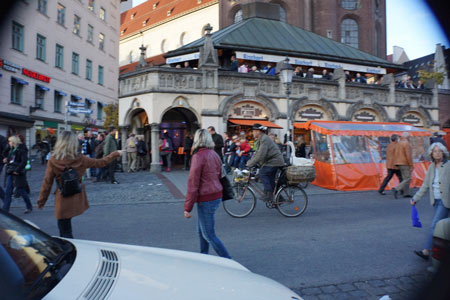
Suddenly, I felt that I needed to leave … now! For whatever reason, I exited a different door from where I entered, which deposited me onto one of the busy streets that flow into Marienplatz. Opening the door I heard the distinctive honking of a goose and peals of delighted laughter from the crowds outside. At that moment, from my heightened vantage point at the top of the stairs exiting the church, I saw a bicyclist wearing a traditional Bavarian hat pedaling swiftly around the corner.
A large open wooden box with a little bed inside was secured on the back of his bicycle. Perched on the bed was a huge goose, happily honking at all the charmed and delighted spectators. Unfettered, the goose rode along behind her “dad,” secure in the knowledge that she was obviously a beloved and very important being in his life.
For myself, and I am reasonably sure for many others, that moment was one that will live in our memories forever. So that’s it, my moment of magic; too surprising and ephemeral to even catch on camera even though I tried to follow them and track them down. I have only my memory to remind me of the experience.
But Wait …
After I wrote the foregoing, I was saddened that I was not able to get a photo of the goose. Then I thought back on how serendipitous that moment had been. I realized that the goose only honked twice and stopped the moment I saw it. I remembered that I had intended to exit another door, to continue my trek through areas of Old Town Munich that I had not yet seen, but I was literally compelled to exit that particular door just in time for a four or five-second glimpse of the goose before she was out of sight. After thinking about the entire episode, I realized just how lucky I had been and decided to be happy and grateful for the experience I had.
On the last day of my visit, two days after my goose experience, I was thirsty and decided to visit the large open market plaza behind Saint Peter’s. Walking outside, toward the back of the church, preparing to cross the narrow street to the market, I was alarmed by the deep guttural screaming of a child having a full-blown tantrum. I saw a man, his wife and three young children. The middle child, who appeared to be in his “terrible twos,” was the source of the screaming. He was irritated about something and was on a real roll. He didn’t even slow down for air, but just kept howling. His parents, looking embarrassed and weary, decided to wait out the episode and stood by the church’s rear outside wall, away from the major crowds. Reassured that the child appeared to be physically fine, I moved on to the market. I purchased a bottle of water and took a sip. Then, for some reason, I did not know where I wanted to go. I stood in the same spot, along the main road behind the church, annoyed that I did not seem to be able to make a decision.
As I stood next to the narrow market street, mentally berating myself for not being able to simply decide which direction I wanted to walk, I again heard the familiar honking and nearly dropped my water bottle in my haste to grab the camera that I had slung around my neck. The goose only honked twice — just enough to draw my attention — and I squeezed off a few shots as they sped by. Like some crazed paparazzo on the heels of Angelina Jolie, I raised my camera above the crowd, shooting at whatever it happened to capture. The crowd was dense and the moment brief — only a few second — and I soon lost sight of the man and goose. Amazingly, another series of events had placed me in the same location as the man and his goose, allowing me to catch some much-desired photos of the duo.
I’m not stupid. I know a magical moment, a true gift, when I see it.
I also know that the thing that made the experience so memorable was the presence of the goose. A guy dressed Bavarian style peddling along with a dog riding behind him, although charming and cute, would not be magical. It takes a bird to create that, even one as “common” as a goose. The particular species simply does not matter because the magic is still there. All birds have the capacity to bring magic to every occasion. All we need to do is to pay attention and take a moment to recognize it.
Birds surprise us, enchant us and, if we are very, very lucky, they can, and will, steal our hearts away forever.
As storm-ravaged areas pick up the pieces after Hurricane Sandy, pet bird owners in hard-hit regions might find themselves facing additional challenges and wondering about the health and wellbeing of their beloved companions.
Gregory Rich, DVM, owner of the West Esplanade Veterinary Clinic in Metairie, La., an exotics practice, knows first-hand how devastating a hurricane can be — Dr. Rich’s clinic was destroyed by Hurricane Katrina in August of 2005. Fortunately, before the storm hit, he evacuated the animals in his care by driving them via cargo van to his brother’s home in Florida. It took Dr. Rich 18 months to re-build, and he spent nearly four months locating all the owners of the pets he evacuated from his clinic.
Dr. Rich shares his Hurricane Katrina experience, as well as what pet bird owners need to do next.
After Hurricane Katrina, what were your concerns in regard to your practice and your patients?
The biggest concern was for the livelihood of my practice. Would there be a neighborhood? Would anyone be able to return, and when? Would there be a population that would support my veterinary clinic and staff?
Five days after Hurricane Katrina, I ventured from Florida back to my clinic in Louisiana. There were gas stations re-opening, and there were cars, albeit very few, on the streets. I left my cell phone number on my door when I left and, the next day, I began receiving calls from clients needing food or medical help for their avian/exotic pets — life was present in my clinic’s neighborhood!
Was there anything in particular that gave you inspiration to get you through those initial days and weeks?
Inspiration came from friends in the avian world who somehow tracked me down by my cell phone, and called me at my brother’s house in Florida to ask if I was OK. Several offered to come help rebuild. It was especially heartwarming to receive packages of bird food from companies like Lafeber to feed the 28 birds I had evacuated with.
What hazards do bird owners need to be aware of in the aftermath of a hurricane?
The biggest hazards we noted were lack of availability to clean water. Birds, rabbits, guinea pigs and ferrets that were left behind and rescued all suffered various forms of GI distress or kidney malfunction from lack of water consumption or consuming contaminated water. Dogs and cats suffered the same fate.
Strangely enough, we did not see an increase in contagious or infectious disease post Hurricane Katrina. Even at the rescue centers or avian holding facilities with hundreds of birds housed in close quarters, we did not experience outbreaks of Chlamydophila, Aspergillus or Mycobacteria.
Getting food shipments for the first week and, in some areas, the first month was not possible. Roads were impassable, distribution centers or businesses were closed. Bird clubs and individuals not affected by the hurricane provided a conduit for food and supply distribution that saved hundreds of people’s pets and breeder stock from starvation.
What advice do you have for bird owners who been displaced from their homes?
Health checks are extremely important anytime pets are exposed to other pets that have unknown health status. Since it is widely thought that only 10 to 20 percent of any city’s bird population has had veterinary health examination, one can surmise that numerous birds in any room or building housing rescued or evacuated birds have the potential to harbor contagious organisms.
However, in my personal experience, we did not see outbreaks of any contagious disease, and I worked with two privately run facilities that housed 76 birds at one house and over 150 birds at the second location. The stress of being left without food and/or water for days did cause some underlying disease conditions to come to the forefront in individual cases.
Did you notice any trends in your practice after Katrina, such as an increase in aspergillosis cases?
We strangely did not see the Aspergillus cases even though birds were left behind in houses filled with mold after the hurricane. And now, seven years later, we still have not seen that status of fungal disease increase in our population of local birds. We did see a large increase in intestinal parasites where birds were left behind in houses that got flooded with Lake Pontchartrain water and allowed to sit for days.
We had a huge increase in our “New Client” base post Hurricane Katrina. Everyone wanted to make sure his or her pet was OK. It seemed to be a solace to owners to let them know something was still OK in their world. No one in our country is prepared the first-time around. Everyone lives in the “It can’t happen here” attitude until it happens, then you are on guard for life.
The American Federation of Aviculture (AFA) Disaster Relief Team is ready to assist anyone in need due to a recent weather-related disaster. Contact the AFA Business Office at 512-585-9800 or your Regional Director immediately so that AFA can assist you with your bird-related needs.
Editor’s note: The bird community lost Liz Wilson when she passed away on April 13, 2013. Please visit our dedication page for her full biography, photos and comments from her colleagues.
As we all know, parrots can be extremely vocal critters — and this can be both good and bad. Good when they make sounds that we like and not so good much of the rest of the time, as companion parrots have a fine ability to drive us humans bonkers when they so choose.
But what are “good” sounds and what are “bad” sounds?
Happy Sounds
Happy sounds might include talking, as few parrots talk when they are anxious or feel poorly. I did a Bird Talk Magazine column years ago about parrots talking and received a perplexing e-mail in response. A lady had gotten an adult pet parrot that was initially quite a talker, but he subsequently stopped talking after being in her home a few months. Her (probably not avian) veterinarian suggested the bird was “too happy to talk” — and the owner wanted my opinion. After 40 years of living and working with companion parrots, I have yet to encounter this situation. As far as my non-veterinary opinion is concerned, there is something physically wrong with this bird.
Another happy sound is a pet parrot singing. Like with children, parrots often seem to sing to themselves when they are happy. I should add that this isn’t always pleasant for the humans in the vicinity, at least with parrot species that appear to be tone-deaf, like macaws. I have been privy to many species of pet macaws singing, but I have yet to meet one that could actually stay on key. Indeed, they all seemed to sing like my husband, which is not a good thing! (I will confess, however, that a parrot singing off-key tickles me greatly and thus brightens my day.)
Whistling is another happy sound, especially for African grey parrots. Indeed, in the years when I boarded parrots in my home, any whistling on the radio was immediately joined by the whistling responses from the several African grey parrots that shared my home at the time. Cockatiels are also inclined to whistle when happy and relaxed, and male cockatiels especially can develop elaborate whistle serenades.
I’ve also delighted in pet parrots that babbled along making happy human-talk noises, though no actual words are included. While parrots may not always understand human words, from my experience, they always understand the sentiment. So I believe that a pet parrot making happy gibberish and nonsensical conversational noises is a happy parrot.
Neutral Sounds
Laughter needs to be filed in the “neutral” category, as a pet parrot’s laughter does not automatically mean the bird thinks something is actually funny. Laughter is a human sound, not a parrot sound. Pet parrots learn to pair the sound of human laughter with certain actions if people teach it to. My own blue-and-gold macaw, Sam, for instance, is quite adept at laughing a millisecond before the canned laughter starts on a TV sitcom. In her 60-plus years in captivity, she has learned the inflections of speech that indicate that laughter will follow, and her timing is spot-on.
Living with David and me, Sam has also learned to laugh whenever she hears the intonation of sarcasm, a talent noted by the staff of the Exotic Bird Hospital when she has stayed there. Apparently, her laughter cheers up the entire hospital when she visits. This was evidenced by a vet tech’s comment after she came home, “We miss her sarcasm!” She is highly rewarded for this by lots more human laughter joining hers!
It is important to understand that a pet parrot learns to pair laughter with an action only by following the pattern set by a person. So a parrot that laughs after biting you does not think it is funny that it hurt you. It was taught to connect biting with the sound of human laughter because some misguided (twisted?) person taught the bird to — by laughing when it bit someone.
Silence is another thing that belongs in the “neutral” category. It can mean a normal early afternoon period of napping, for example, or the quietude of a dark and rainy day. Or it can mean illness, as the parrot feels too poorly to waste energy vocalizing. Or the bird is quietly and happily intent on destroying something she isn’t supposed to have, such as your wife’s designer watch or your Great-aunt Millie’s priceless antique roll-top desk.
Unhappy Sounds
The most obvious unhappy sound is the piercing alarm call a pet parrot might make when it fears for its life. Such life-threatening things might include a hawk outside a window, a large box being carried through the room, or the dreaded vacuum being dragged out of the closet.
In addition to shrill alarm calls, the grey parrots (both African grey and Timneh) have an unusual sound they make when frightened; they growl, loudly! This sound is unusual in the world of birds, often leading non-avian veterinarians to conclude that a grey has a serious respiratory issue.
Some pet parrots that live in sterile, uninteresting environments appear to use vocalizing to stave off boredom. Such sounds are usually extremely loud and repetitive, what human psychologists might characterize as stereotypies. Such parrot vocalizations can be fabulous for defeating tedium, since the racket often results in great excitement as human patience snaps, and people resort to yelling and stomping around.
One last comment about alarm calls and how people react to them: while it is important that frightened parrots be reassured if something terrifies them, be aware of how intelligent these birds are. I watched helplessly as a friend repeatedly rushed over to reassure her parrot whenever the bird made an alarm call. While the behavior started as a valid response to scary things seen through large windows, the bird then learned to scream whenever she wanted attention.
A better resolution might have entailed removing the need for alarm calls by covering the window or moving the parrot’s cage away from it. That would only leave the attention-seeking calls, which the person would then ignore.
The subject of alarm calls reminds me of a favorite African grey story. A family had a very calm adult grey parrot, in addition to several more skittish and hyper-reactive birds. Once in a while, things would apparently get boring for the pet grey, as he would suddenly start shrieking out the “grey alarm call,” guaranteed to pierce the brain like an ice pick in the ear. The other parrots responded by screaming and leaping off their perches or crashing into walls. The grey would then shake out all his feathers, vigorously wag his tail with pleasure, and croon, “It’s okaaayyy …” in his sweetest voice!
Editor’s note: The bird community lost Liz Wilson when she passed away on April 13, 2013. Please visit our dedication page for her full biography, photos and comments from her colleagues.
As an offshoot of my last column (“Parronting” Styles with Parrots), I’ve been thinking about the importance of companion parrots and politeness. I am not, of course, expecting pet parrots to be polite. As far as I can tell, what humans might conceive as politeness is not a concept that parrots understand. Not something they need, so they don’t have it. (This reminds me of a biologist’s charming response to a child’s questioning if his pet frog would learn its name. “Your frog doesn’t really need that information, so he has no place to put it.”)
But we humans do need politeness, and we also need to practice it with our pet birds.
Politeness means accepting that our parrots should not be expected to wait around in the hopes that we will choose to interact with them. They have their own lives, after all, and they have a right to choose not to interact with us whenever we might wish it. It means not expecting them to be at our beck and call.
After all, parrots evolved in the wild without humans. Unlike the modern dog (essentially a man-made creature that is the result of genetic manipulation), parrots evolved away from people, living their lives without human interaction other than us being an occasional predator. First- or second-generation, domestic-bred parrots are likely to perceive things similarly to their wild counterparts.
Do You Want To Step Up?
As I mentioned in my previous column, I was originally an authoritarian parrot person. When I gave a “command,” I expected it to be followed. When I opened a parrot’s cage door, offered my hand as a perch and said, “Step up,” I expected the parrot to do exactly that. I was, after all, the human!
But, as I matured in my dealings with parrots, I came to understand that my style of interacting with parrots was unnecessarily strict and most assuredly rude. My friend and colleague Chris Davis taught me a much better approach, and this is the technique I use to this day.
When I go to get my old macaw Sam out of her cage, I stop at the closed door and ask Sam, “Would you like to come out?” Sam generally answers that question immediately. Perhaps she looks askance and turns her back. Perhaps she looks at me as if I have two heads and gives me one of those “Why would I want to do that?” kinda looks. If so, she obviously does not wish an interaction, so I go away and come back later.
If Sam’s response is positive, my response is different. Perhaps she looks interested and raises a foot. Perhaps she perks up and heads in my direction. So I then open her cage door and offer my hand, saying “Step up, Sam.” Then I bring her out with much well-deserved praise and adulation. I have not asked her (no, not commanded her) to step up until I feel certain that is what she would like to do.
However, if a tidal wave is imminent or the house is on fire, or whatever, I would likely use the command of Step up. Under such circumstances, I expect Sam to obey. In this instance, I am not asking a polite question. But we haven’t had any house fires or tidal waves in recent memory, so I haven’t used that command in a looooong time.
This approach works well with people as well. If my husband tells me to do something, I am likely to resist, just on general principles. My colleague Dianalee Deter commented years ago that her daughter was a headstrong young woman from an early age, so Dianalee found if she said, “Put on your shoes” she had a fight on her hands. If instead she said, “Would you like to put on your right shoe or your left shoe first?” no battle ensued. This is a perfect approach, as only acceptable options are suggested. The no-shoes option is not offered. As founder and CEO of the Phoenix Landing Foundation (www.phoenixlanding.org), Ann Brooks puts it, “Choice is my favorite word!”
The Problems With Petting A Pet Bird
Problems often arise when authoritarian people expect their pet parrots to accept being petted whenever the human wishes. If the parrot resists, this is construed as the bird’s problem when in reality, it is the person’s’ problem. Whose body is it, after all? While people might see themselves as the owner, it is quite obvious that companion parrots do not see us that way, as they do not appear to see themselves as being owned. So it is their body and, under normal circumstances, they get to decide what happens to it.
Years ago, I had a bird grooming client who had one of the mildest African grey parrot hens I’d ever met. Our relationship only entailed me gently wrapping the parrot in a towel and trimming her nails, so there was no earthly reason why she should’ve seen me in a positive light. But she had never attempted to bite me, not once. So I was quite startled when the owner complained that the African grey had started biting her. Questioning indicated the grey was biting her when she tried to pet her. Further queries revealed the grey was politely pushing her hand away repeatedly prior to biting.
In other words, the African grey was respectfully requesting — repeatedly — that the owner cease her attentions but the woman was ignoring the bird’s requests. Only when the bird finally resorted to aggression did the woman finally back off. So the owner was teaching the bird that biting was the only effective way with which to communicate — at least with her.
I greatly preferred a friend’s courteous approach to petting his African grey parrot. He would crook his finger and say, “Wanna scritch?” and then wait. If the idea appealed to his African grey, it would come over and offer its neck to be petted. If not, my friend would withdraw.
When interacting with parrots, simple courtesy is much more effective than approaching with the attitude that your opinions and wishes outrank theirs. And oddly enough, this works with other species of animals as well!
This is the time of year when most of us invite little neighborhood “goblins and ghoulies and long-legged beasties and things that go bump in the night” to our front doors for treats. Because this is considered the scariest time of the year, I thought it appropriate to share some of the frightening things that can happen if we are not vigilant while the festivities are going on. Although most of us understand that a costume party held in the area of the house that our birds consider a place of safety may be difficult for them, we do not think of how we may endanger them during those times when we entertain many costumed strangers on our door steps each October 31st.
Our birds are precious family members whom we enjoy including in those activities that are safe for them. As their stewards, we do our best to consider all the potential problems that may arise from any situation in which they are placed. Because of our strong feelings of love and protection, it is not enough to assess only potential problems that may exist for them within our homes, it is also imperative that we also consider whatever outside influences that may influence the home environment.
Unnoticed Halloween Dangers For Birds
We all know that leaving a fully flighted bird outside of his cage is unwise when doors or windows are open; however, the risk is heightened when a bird is startled by people who are yelling “Trick or treat” while dressed in scary or gaudy costumes and standing at a widely opened front door. If you add to that the fact that the bird’s person is usually distracted by handing out treats and chatting with the visiting little ghouls and ghosts, the possibility of a bird escaping the home during is greatly increased.
An extraordinarily friendly bird (small cockatoos are good at this) may even wander out to see what is going on and escape outside and be accidentally stepped on, shut in a door, grabbed by a neighbor’s dog, run over by a car or bike, or fall victim to numerous other awful manners of injury or death. To amplify the level of danger even further, trick or treating usually occurs during the night, while the weather is beginning to be considerably colder — factors that make finding a startled and disoriented bird alive and well less likely.
Some birds are jeopardized by their peoples’ innocence. For example, a bird might be left sitting in front of an uncovered window in the front of the house where passersby can see him. Although a person might think nothing of having his or her bird visible to strangers, a bird is often seen as an instant source of income for thieves and can make your home more vulnerable to robbery. Even smaller birds with lots of personality may appeal to a neighborhood youngster who has always wanted a bird. Although you know your neighbors to be honest, they may innocently mention that you have birds in your home and, over time, the message may eventually get out to someone dishonest. The little love of your life is seen as just dollar signs or a novelty to dishonest people … it’s sad, but true.
Luckily, keeping our birds safe on Halloween and during other times of revelry can be easy with a little advance planning.
If you are entertaining people in your home, even a very sociable bird can become nervous or extremely frightened by the sight of people in costume. Unless your bird is accustomed to groups of costumed people in his environment, it is best to move his cage to a familiar bedroom or family room, preferably one you can lock from the outside. This also eliminates the worry of possibly tipsy celebrants forcing interaction with your bird or feeding him foods that are harmful. Leave a television or radio playing in the room with your bird to help camouflage the sound of noisy celebrants. If your home is too small to do this, consider leaving your bird with a trusted friend or family member; preferably a responsible animal lover whom he has stayed with before.
If you are not entertaining visitors but are participating in handing out treats, make sure your bird is in an area where he cannot fly or walk to the opened door. Also, keep him away from windows where he can be seen by passersby and trick or treaters. A television or radio playing in the room with him can soften doorbell and people noise. These distractions also lessen the chances of his revealing his presence in your home by talking loudly or screaming for attention each time the doorbell rings or when he hears you talk to the people at the door.
After Halloween is over, remember that candy and candy wrappers are almost irresistible to most birds. Keep harmful items out of areas your bird can access. If you hosted a gathering in your home, closely inspect it for any candy or foods or other objects that may have been dropped or left where your bird can reach it.
Our feathered family members enrich and uplift our lives in ways that are inconceivable to non-bird people; we know that life without them would be hollow and sad. By actively anticipating and appropriately addressing events and situations that affect them, we honor their importance in our lives and can greatly increase the chances of our beloved feathered friends living many long and happy years to come.
Almost 30 years ago, macaw owners and their veterinarians saw a new disease in their pet birds, with muscle wasting and regurgitation. The disease also caused dilation of the proventriculus of the stomach, and the disease became known by the name PDD, or proventricular dilatation disease. While the cause of this disease was unknown, it was suspected to be a virus. Until recently, clinicians, researchers and pathologists could only make the diagnosis of PDD based on dilation of the proventriculus and a biopsy of the crop or pathology slides that showed a lymphocytic, plasmacytic ganglioneuritis.
Clinical signs observed are variable and depend upon the competency of the individual bird’s immune system. The most common clinical signs observed are depression, anorexia, loss of body condition, regurgitation, and the passage of undigested food in the feces. These classic symptoms are more commonly associated with New World species of parrots (Amazons, macaws, conures, Pionus, parrotlets, etc).
But with the advent of PCR technology, our view of this disease and its suspected viral culprit is changing. At this point, it appears that avian bornavirus (ABV) is most likely the causative virus that results in the symptoms of PDD.
Arrow indicates dilated crop four hours after feeding, with little or no mobility.
Avian Bornavirus And PDD
In a survey of 39 healthy parrots, Dr. Michael Lierz Dipl ECZM (Wildlife Animal Health), Justus, Liebig University, Gissen, Germany, detected ABV in 27 of the birds (45.8%) based upon blood sample testing. Data from Veterinary Molecular Diagnostics (VMD, Inc, in Milford, Ohio) suggests that the rate is about 30% of birds (both healthy and ill) that they have tested. This compares favorably with the observed infection rates of Borna Disease Virus (BDV) in mammalian species. (Bornaviruses are widespread and affect both birds and mammals.)
This information suggests that we need to form a much different view of PDD — the old view of a disease of low incidence but severe clinical manifestations is outdated. Current research suggests an infection of much greater frequency with a low incidence of clinical disease and a much lower incidence of severe disease. In other words, it appears that many parrots have the virus, but only a small percentage exhibit serious disease.
Such a view of Avian Bornavirus (ABV) compares favorably with that of BDV. The infection rate for Borna Disease virus (BDV) in mammals is reported to be less than 30%. In healthy horses in Germany, a mean infection rate of almost 60% was found compared to the significantly lower clinical disease case rate of approximately 5%. ABV appears to parallel BDV very closely in this regard. The vast majority of ABV-positive birds do not show clinical disease. A much smaller percentage will show clinical disease, but this is quite variable.
We must expand our view of clinical ABV disease to that of a continuum of a wide range of clinical symptoms. Many clinically infected birds show only mild clinical signs of disease. Those with the “classic” severe form of PDD represent the extreme of this continuum and are a small percentage of birds that are clinically diseased. But we all know that we want to avoid this in our beloved birds.
Research Into The Role Of Avian Bornavirus And PDD
There are a number of studies currently looking at Avian Bornavirus, but I think that the most exciting is that from Giacomo Rossi, DVM, Ph.D. Recent studies from Dr. Rossi’s lab at Camerino University, Italy, help us understand the mechanism of the disease. One of the troubling aspects to the data to date is that some birds are positive for the virus on PCR analysis but do not show symptoms. Only a smaller number of birds that have the virus on PCR analysis have symptoms. How could this be? At the 2009 European Association of Avian Veterinarians conference in Belgium, Drs. Rossi and Stefano Pesaro, DVM, PhD, presented a study indicating that cockatiels could show the same symptoms of PDD if injected only with proteins from the birds’ own nerves, not the bornavirus.
In their subsequent studies, Drs. Rossi and Pesaro observed under an electron microscope that macrophages attacked nerves that had become infected with virus and there was leakage of proteins- ganglioside proteins from these damaged nerves. This caused an auto-immune reaction – the macrophages were attacking their body’s own nerves. This reaction and inflammation that resulted from this immune attack produced the symptoms of the disease. The exact symptoms were a consequence of the parts of the central nervous system that was invaded by the virus with its subsequent leakage of the ganglioside proteins.
As a neuroanatomist, I understood that this was a neurologic disease because I observed a large number of bird patients over the years with PDD. From my observations, I knew that New World bird species most commonly have symptoms affected by the disruption of innervation to one of the cranial nerves of the brainstem – the vagus nerve. The vagus nerve supplies the first part of the intestinal tract – from the crop, stomach including the proventriculus to the duodenum, and the heart. When the vagus nerve did not work properly, there was disruption of the normal motility of the GI tract and a thinning of the wall of the GI tract.
Old World species (African greys, cockatoos, cockatiels, Eclectus, etc.) normally have symptoms of ataxia that mimic seizures to the untrained eye. They have a different part of the brain affected! But all of the nerves or the cell bodies in the brain, when affected, have the invasion of lymphocytes. Those collections of lymphocytes are what the pathologist is looking for under the microscope to make the diagnosis of PDD. This “lymphocytic ganglioneuritis” is the hallmark of PDD.
However, according to Dr Rossi’s lab group, these lymphocytes go there because of the leakage of those ganglioside proteins! That sets up an autoimmune reaction and immune complexes. It is not the virus but the leakage of the proteins from these immune complexes that causes the symptoms. The celebrex often used to treat the symptoms of the disease acts to reduce this autoimmune reaction and helps reduce symptoms. But some birds improve while others do not! This may relate to the immune system of the individual patient and the autoimmune reaction—just like in people who get Guillain Barré Syndrome, a disorder affecting the peripheral nervous system. So, by better understanding this autoimmune reaction, new strategies for treatment can emerge and provide hope to manage this syndrome better.
As we all work together to understand this disease, we will develop better protocols to help our avian friends lead healthful lives. Our birds deserve this from all of us.
Editor’s note: The bird community lost Liz Wilson when she passed away on April 13, 2013. Please visit our dedication page for her full biography, photos and comments from her colleagues.
Developmental psychology has defined four major types of parenting styles. (You know, “parents.” As in adults with dependants that are so-called “real” children.) Perhaps there are some parallels to how we parrot-loving types deal with our feathered (but unfortunately non-tax deductible) dependants. These four parenting types defined by Developmental Psychology. These include authoritarian, indulgent, authoritative and negligent parents. Since it behooves us to periodically examine our relationships with our parrots, we should consider these different approaches in terms of our pet birds. (www.devpsy.org/teaching/parent/baumrind_styles.html)
1. Authoritarian Parrot People
These folks feel their parrots should do exactly what they are told to do, no matter what. If a command is given, that command must be followed, or the owner feels their control over the situation is lost. (In the interest of full disclosure, I used to be in this category … until I relaxed, learned more and gained a little wisdom.)
Authoritarian types want to control their parrots more than is wise or necessary. If, for example, a parrot is happily absorbed doing something alone like playing, eating or pondering a concept of astral physics, there is no justification for the human to horn in. I often hear from these types of pet bird owners when their parrots bite them when they shove their hands in their parrots’ faces, demanding that they “Step up!” In situations like this, a parrot’s response of biting is often a direct result of the human’s rudeness, not an indication of a problem behavior on the bird’s part.
Authoritarian parrot people also phone me to complain that their parrot doesn’t always like to be petted, and they feel this indicates that there is a problem with the bird. My response is that parrots should be allowed to make such decisions. It is, after all, their body and they should not be expected to submit whether they like it or not. (My husband David doesn’t like to be petted either, but that doesn’t mean there is something wrong with him.)
2. Indulgent Parrot People
These people think their parrots can do no wrong, and they allow their parrots to do whatever they wish. They often repeat the mantra of never make a parrot do anything it doesn’t want to do, and they want their pet birds to “live free!”
Indulgent parrot people look askance at any controls being put in place, often considering controls to be “abusive.” (They appear to like the word “abusive” and use it frequently.) They often live in homes with woodwork destroyed, furniture chewed and books shredded, and their clothes are often chewed up as well. They rarely have repeat company, as their parrots often scream non-stop until they are rewarded with treats and bite anyone who is allowed onto the premises without the parrots’ express permission. These indulgent folks apparently feel this makes their parrots “happy” but, in reality, their birds often appear distressed and confused.
A subcategory of Indulgent Parrot People is the “Helicopter Parrot People.” This category includes those who claim to live for their pet birds. Every free minute is spent with their parrots, often hovering over them and wringing their hands. They apparently have no life outside of this relationship. Constant hovering creates problems by encouraging over-dependence. Many of these birds never learn how to play or forage independently, which is extremely unhealthy for them.
3. Negligent Parrot People
At the other end of the spectrum, Negligent Parrot People are apparently too busy to pay attention to their pet birds. Diets are frequently composed of only one thing – seeds or so-called “pellets.” Fresh vegetables and fruits are rarely (if ever) supplied. Their parrots are seldom allowed out of their cages, as the people are too busy to supervise them. Toys are few and rarely replaced when damaged. Negligent parrot owners have more things on their minds than what their parrots are, or are not, doing. They appear to believe their parrots know instinctively what is best for them and need no guidance from humans.
4. Authoritative Parrot People
These folks have a more measured approach. They provide rules and guidance without being overbearing about it. This is the category I strive to achieve in my life. Their parrots are allowed the freedom to make choices, but an effort is made to avoid situations where bad choices can be made. They do not, for example, leave their parrots on a windowsill and expect the woodwork not to get chewed.
The reality is that balance is needed. Each of the first three parenting styles has its positive points, but the pendulum swings too far.
The Authoritarian needs to relax. We all know we humans are a great deal bigger than our parrots, so we needn’t constantly enforce that message. We humans need to be less insecure about what we might perceive as challenges to our control. A parrot being allowed to make many of its own decisions takes nothing away from us. And the Authoritarian approach provides the consistency that pet parrots need (though more than is necessary). Clearly stated rules can provide a feeling of safety for a parrot and feelings of safety lower stress.
Indulgent Parrot People are correct that parrots do need a little indulging once in a while, but not all the time. As with most animals, one earns another’s respect by being fair and consistent, not by allowing chaos. Indeed, quite the opposite. And if there is no respect, there can be little love. Establishing and enforcing fair and consistent rules will strengthen the bond between parrot and person. Besides, most of our parrots will outlive us, and who will want a parrot that has been allowed to run amok? Indulgent owners who do not teach their parrots good manners are setting the birds up to fail in their next home. Is that evidence of love? Not to me.
The Helicopter Owner needs to back off and calm down, but curtailing all vigilance is not healthy either. Parrots are indeed accident prone, so they must be supervised when out of the cage or when encountering new things. They also tend to hide the signs of illness, so owner awareness is necessary, within reason.
Negligent Parrot People, though by no means an ideal parent type, have their good points, too. A parrot owned by this type of person tends to be more independent, and this is a good thing. As previously stated, parrots need autonomy in various parts of their lives, and they certainly can get this from the Negligent Parrot Person.
I believe homeostasis, defined as “the tendency of a system to maintain internal stability” is what we should seek to achieve in our relationships with our pet parrots (as well as the rest of our lives). We need to be attentive, but not overly so. We need to allow them the freedom of choice, but not in all things, as there are many dangers. We need to provide clear and reliable limits for our parrots, with much freedom within those constraints.
Every time I talk to bird owners, I emphasize the importance of having one’s pet bird checked out yearly by an avian veterinarian. Indeed, I often refuse to work with a parrot with a so-called “behavior problem” until after the owner has had the animal thoroughly checked out. After all, many alleged psittacine delinquencies are instead manifestations of physical problems.
I also routinely hear stories about veterinarians seeing birds who apparently do not have a great deal of information about them. A recent example would be the parrot who was diagnosed as having allergies simply because he had a runny nose — but that diagnosis was evidently made by just looking at the outside of the bird. From the owner’s description, no diagnostic testing was done. According to the Association of Avian Veterinarians (the AAV), bacterial infections are the most common cause of runny noses in pet birds, NOT allergies, and testing needs to be done to identify the specific bacteria and the most effective antibiotic with which to treat it (bacterial culture and sensitivity testing). When I questioned the bird’s owner further, she admitted that she didn’t think this vet was a “real” bird vet.
Consequently, I am frequently asked how a lay person is supposed to find a vet who is knowledgeable about birds, as opposed to a vet who will see birds… and how can a lay person tell the difference.
Disheartening Survey
When people get a new dog or cat, most of them know to seek veterinary care for their new pet. According to a survey done in 1989 for PET AGE MAGAZINE, 60% of dog owners and 68% of cat owners have their animals checked regularly by a veterinarian. However, the same survey found that only 7.6% of bird owners take their animals to avian veterinarians, and that 92% of their respondents take their sick birds to pet store employees to be treated.
Pet Stores And Pet Store Medications
These numbers are incredibly depressing, considering the fact that the average pet store employee has neither the training nor the qualifications to treat sick birds safely and effectively, nor does (s)he normally have access to the most effective drug therapies available. From my own experience, over-the-counter pet store medications at best only mask signs of a problem without correcting the underlying cause – and at worst, these “drugs” waste valuable time that a sick bird simply does not have to lose. They can also alter the results of proven avian diagnostic techniques such as bacterial culture and sensitivity testing as well as blood tests for chlamydiophylia (a.k.a. chlamydiosis/psittacosis/”Parrot Fever”).
Suffice it to say, if your foot is broken, you don’t go to a shoe store for treatment. A corollary of this rule is that you don’t take a sick dog to a cow vet, so you shouldn’t take your sick bird to a dog vet.
So What Exactly Is An Avian Veterinarian?
Contrary to what The Public seem to think, most veterinarians are NOT trained in veterinary school to deal with every species of animal they might come across in private practice. They are required to learn about the domesticated animals (dogs, cats, horses, cows, etc.), but not what are termed exotic animals. Most veterinary schools have a course in avian medicine, for example, but in most cases that course is classed as an elective. In other words, veterinary students are not required to take it. They take the course only if they have a specific interest in these other types of animals. Also, not all veterinary schools even work with exotics. For example, for an astonishing period of fourteen years, the Veterinary Hospital of the University of Pennsylvania did not treat any species of exotics in their small animal facility in Philadelphia — they ONLY treated dogs and cats. Consequently, no matter how interested they might be, vet students who attended the U of P during those years got no hands-on experience with exotics unless they spent part of their training in other facilities.
A [Ahem] Rare Bird
Avian vets are extremely dedicated individuals who, in their copious free time (joke, ha ha) have sought additional training in the relatively new field of avian medicine. They are members of the Association of Avian Veterinarians [AAV], so that they have access to all the most current medical information about birds. This is really important, since new information is discovered all the time, and we all want our birds to benefit from state of the art avian veterinary medicine.
So How Do You FIND These Avian Vets For Your Pet Bird?
You can find these specialized veterinarians by asking around, but make certain you are asking reputable sources for information. Do not automatically assume that the veterinarian recommended by a store or breeder is the best vet for your pet. For example, there used to be a bird store in my area that would void the guarantee on a sale if buyers took their new bird to the only board certified avian specialist* in the area. This store preferred to refer their buyers to local vets who apparently rarely did the diagnostic testing recommended by state-of-the-art avian medicine (as outlined by the AAV). From my own experience, this sort of thing happens when a facility is famous with local avian vets for selling sick birds.
*Loosely defined in small animal veterinary medicine as anything that isn’t a cat or dog. Hence, if you have a pet chicken, it is defined in small animal medicine as an exotic animal.
*A “board certified avian specialist” is a veterinarian who succeeded in fulfilling a RIGOROUS series of criteria, including years of experience or specialty training, percentage of birds that make up his/her practice, writing two publishable papers and passing an extremely difficult exam. As of 2006, there are less than one hundred of these specialized avian vets in the entire world.
Reputable sources of information would include educated members of local bird clubs, good bird stores, or your local dog and cat vet. You can also phone the national office of the AAV and ask for names of member vets in your area. The AAV Central Office is in FL, and their phone number is (561) 393-8902m and e-mail address is [email protected].
It should be mentioned that most avian veterinarians also care for the other animals defined by veterinary medicine as exotics — such as reptiles, ferrets, amphibians, etc. Some also see dogs and cats. This does not mean they are not avian vets. Depending on where they are in the United States, it is a rare veterinarian who can survive financially by seeing ONLY birds. This has nothing to do with their competency in avian medicine.
It is perfectly valid to ask what percentage of a vet’s practice is made up of birds. That will tell you how much experience the vet actually has with birds. If he or she only sees one or two birds per month, for example, you may wish to go elsewhere. However, if you find a veterinarian who tells you that he or she knows little about birds but would like to learn, that’s ok. That person generally knows when to ask someone more experienced for help, and most of the top avian vets in the country are accessible by phone. It’s the veterinarians who won’t admit they don’t know that really scare me.
One more very important question to ask is, “What was the last continuing education seminar about birds that this vet attended?” Several years ago, the AAV had their annual conference in Philadelphia [where I live] and I was amazed and appalled how few of the vets from the area that “do birds,” showed up to learn the most current information about avian medicine. I concluded (to my great dismay) that they were quite happy to take someone’s money to see their bird, but they were not going to spend their own time and money to update their knowledge about them.
How To Tell If You Really Have An Avian Vet
Now that pet birds have become so popular, there are lots of vets who will “see birds” who have perhaps less knowledge than one might wish. The following are a few tips (in no particular order) that may help you differentiate between these people and their more knowledgeable colleagues. You do not necessarily have a REAL avian vet if:
When you call for an appointment for a sick bird, the receptionist tells youit’s too cold to bring a bird out. The vet may be experienced with birds, but the hospital staff is not. There are plenty of easy tricks to keeping a bird warm in transit, which is definitely preferable to allowing the bird to die at home without professional help.
When you arrive at the hospital for your appointment and nobody knows what kind of bird you have. If you have a rare species, be fair — but if they think your cockatiel is a cockatoo, there’s a problem.
Everyone at the hospital is afraid of your two month-old baby macaw. Many bird vets have difficulty finding experienced avian technicians, but the vet must know how to handle the animals if his/her staff does not. If everyone on staff is afraid of a baby parrot, no matter how big, then they have little or no experience with psittacines.
The veterinarian does not remove the bird from its cage to do a full physical exam. The days of diagnosing from the outside of the cage are LONG gone. To do competent avian medicine, a vet has to do a proper physical exam, and to do that, a vet has to actually TOUCH the animal.
The veterinarian does not weigh your bird. Properly equipped avian vets will have an accurate gram scale with which to get weights on their patients every time the bird comes in. A current, accurate weight is not only necessary to properly calibrate a medication dose, but also to help the vet evaluate the overall condition of the animal. From my experience, “Feeling the keel” does NOT provide sufficient information.
The veterinarian or support staff does not spend considerable time discussing proper diet with you. The most common cause of medical problems seen in avian medicine in this country is STILL malnutrition; therefore proper diet is crucial and should be discussed in depth.
They schedule bird appointments every 10-15 minutes. There is a tremendous amount of time involved when seeing birds. The avian vets I know schedule bird appointments for a minimum of 30 minutes, with most lasting considerably longer than that.
They don’t think routine check-ups are necessary. The AAV recommends annual visits, especially with very young or old birds. A vet in my area recently told the first-time parrot owner of an unweaned macaw chick that he didn’t need to bring the baby back in “unless he thought there was a problem.” As far as I am concerned, that is very bad advice. Weaning is an extremely stressful period in a parrot’s life, and a brand new parrot owner often doesn’t know there is a problem until it has reached emergency status. This is NOT the best thing for the bird!
They consider a beak trim to be just as routine as a nail trim or wing clip. Generally speaking, a normal parrot beak does not ever need trimming, whether the bird chews on a “beak conditioner” or not. A change in the growth pattern of a parrot’s beak could be indicative of a medical problem.
With a new bird check-up, the vet does a physical exam and pronounces the bird “healthy” without recommending any diagnostic testing. A properly done physical exam can tell an experienced avian vet a great deal, but by itself it simply isn’t enough. Diagnostic testing must be done to rule out the possibility of latent disease.
The Grand Tour
If possible, ask for a tour of the hospital. If your veterinarian is serious about avian medicine, you should see some basic equipment:
A gram scale capable of weighing birds with great accuracy (already mentioned)
Incubator cages for hospitalized birds
Proper diet for hospitalized birds – not just “parrot mix” and pellets, but vegetables and fruits, also.
Ideally, a separate room for hospitalized birds, away from dogs and cats.
Proper Teaching
If your bird is sick and needs you to medicate at home, it is incredibly important that you should be properly taught how to accomplish this. You should NOT, for example, be told to “squirt it in the back of the mouth.” Medicating by mouth incorrectly can lead to aspiration pneumonia and death, so it is critical (understatement of the century) that you be instructed correctly.
Unrelated But Important
While I’m on the subject of avian veterinarians, I do want to mention something that is basically unrelated but extremely important. DO NOT ASSUME that your avian veterinarian will be available off-hours if you and your bird have an emergency. After all, emergencies rarely seem to happen during the working day. So an important question to ask is how does your avian veterinarian deal with emergencies? Are they available 24 hours a day, 7 days a week? If so, you can be sure they won’t be for long – NO ONE can live like that forever. If not, to whom do they refer? Does the hospital to whom they refer have experience with birds? If your vet does not have emergency back-up for avian patients, then you need to find someone who does. The LAST thing you need to do is to wait for an emergency to happen, and THEN start looking around for a bird vet. ASK YOUR AVIAN VET ABOUT EMERGENCY COVERAGE NOW.
In Conclusion
If your veterinarian fulfills all these criteria, chances are excellent that you have a qualified avian practitioner. Stick with them, be patient if they don’t call you back in two minutes if you have a question. Ask them to explain things you don’t understand, especially when it comes to the care of your bird. However, be reasonable, and don’t expect them to spend hours on the phone with you answering every little question you might have. But most importantly, PLEASE, when it comes to the treatment of your animal, follow their instructions to the letter. The best avian veterinarians in the world can accomplish little without the full cooperation of their clients.
This article was first printed in THE PET BIRD REPORT, Issue #29.
Screens can prevent your feathered friend from escaping when you open windows or doors. Photo by Sasel13/Pixabay
Those “Lazy, Hazy, Crazy Days of Summer” are here!
Let’s check out how the activities of the season could affect your bird:
Enjoying the fresh air: Opening doors and windows will let in the fresh air of summer — but it will also give your bird a direct path out! Screens are a good idea.
Keeping cool: It’s time to turn on the ceiling fans for that cool breeze. Of course, this poses an obvious hazard so be sure to turn them off when your bird is out of the cage!
Swimming: Ah, there’s nothing like a refreshing dip in your backyard pool! Remember to keep the chlorine and muratic acid where your bird can’t reach them — they are poisonous if ingested.
Cookouts: Outdoor grilling is a summertime favorite. Be careful not to leave the lighter fluid or matches lying around — neither one would be good for your bird to find.
Fishing: As you get ready to catch the big ones this year, don’t let your bird explore your tackle box. Lead sinkers are toxic! Other items that pose a lead problem if chewed are painted surfaces, batteries, some jewelry, and galvanized wire.
Sun tanning: While you are soaking up the rays for that perfect tan, keep the lid on your lotion or oil. These products are not safe for your bird to eat or to get on his feathers.
Basking in the sun: Putting your bird in a sunny window with no shelter can cause overheating in a very short time. Use Caution!
Canning garden vegetables and cooking sweet corn: Birds are attracted to water — open boiling pots are a real danger. Watch out!
Washing Windows: Ever seen the Windex commercial?
Summertime pests: Bug sprays, pest strips, or flea medicine for your dog or cat can be harmful to your bird. Do not use these products near your feathered friend!
Warm wishes for a wonderful summer from your Friends at Lafeber Company!
The following list is compiled from experiences I had working for twenty years with avian veterinarians. Each is true. Bird owners drive their avian veterinarians crazy when they do the following.
1. Leave a message for the avian veterinarian to call, then expect a callback within 5 minutes, no matter what.
Avian veterinarians are generally incredibly busy caring for sick birds and talking to their owners. It is often late evening before they finally have to a chance to sit down and start returning messages that have accumulated through the day. Bird owners have to wait their turn. As an aside, if owners suspect a problem with their bird, they should schedule an appointment, not leave a message for their veterinarian to call.
2. Call in hysterics when their parrot preens out a feather and they think it is starting to pluck … and then don’t call when the bird is too quiet for a week.
Feather damaging behaviors — while upsetting — are not a medical emergency. Yes, the bird definitely needs to be checked by an avian veterinarian, but this is not a Life Or Death issue. On the other hand, a parrot being too quiet for a week could very well be a medical emergency, and an avian veterinarian should see the bird NOW.
3. When the avian veterinarian finally gets a chance to return a routine call at 10 PM, owners tie her up for 45 minutes with “while I have you on the phone, I have one more quick question about a bird I used to have…”
If the avian veterinarian doesn’t return a call until late, odds are good that she’s had a long and exhausting day. I know how tempting it is to ask multiple questions that are unrelated to a current case. I always have questions for my avian veterinarian who knows so much! But please, give your avian veterinarian a break!
4. Stop medications your avian veterinarian prescribed without consulting with your vet because, “He was better…” or “He didn’t LIKE it…”
Owners should NEVER stop medications for ANY reason, without first consulting first with their avian veterinarian. Stopping an antibiotic too early can enable bacteria to become immune to a drug, and the bird is likely to relapse and become MUCH sicker the second time around. Other medications, such as steroidal anti-inflammatory drugs, can be extremely dangerous if stopped abruptly. It is vital that all prescriptions be given exactly as directed, as often as directed, and for as long as directed.
5. Don’t inform the avian veterinarian about financial constraints when extensive testing is recommended, then complain loudly about the bill to the receptionist and clients in the waiting room.
Owners have to advise their avian veterinarian if there are financial restrictions. If they say nothing, veterinarians will assume there is no problem with expenses. (Besides, it’s a cheap shot to complain to the receptionist, since she has nothing to do with billing.)
6. Don’t follow the avian veterinarian’s instructions because “someone on the internet” or “someone in a pet store” (they don’t remember who) said it wasn’t a good idea.
The internet has been sardonically nicknamed the MISinformation Highway, thanks to the incredible amount of bad information posted there. Anyone can pose as an “expert,” no matter how little they actually know. If you are careful, there is excellent information as well, but it you know little, it is difficult to judge what is accurate and what is not. As you learn in the beginning, stick to websites recommended by your avian vet as having good information about companion birds.
As for assuming that someone working in a pet store must be knowledgeable, that is sadly far from true. Many pet store employees have little or no accurate information about birds. After all, working in a store doesn’t guarantee someone has actual knowledge about the products they sell.
Bird caretakers have to trust their avian veterinarians, rather than a faceless stranger or a clerk in a store. An avian veterinarian has specialized training, has seen the bird, knows its history (IF the owner has told him/her everything) and has test results (IF the owner has allowed him/her to do diagnostics). The stranger does not. If owners don’t trust their avian veterinarians, then they should find another avian veterinarian that they dotrust.
7. Don’t allow the avian veterinarian to do the required diagnostics … then complain when (s)he can’t give the owner a diagnosis, or the bird doesn’t get better.
When an avian veterinarian is not allowed to do the recommended diagnostics, he/she isn’t able to collect all the information needed to properly help a sick bird. Without sufficient data, even the most experienced avian veterinarian in the world can only guess what is wrong. Consequently, if a bird does not get better, it is not the fault of the avian veterinarian – it is the owner’s fault for not allowing the avian veterinarian to do a proper work-up.
8. “It’s not my fault because… nobody TOLD me …” [Fill in the blank]: … an all seed diet was bad, … overheated Teflon kills birds, etc, etc, etc.
It is the parrot owner’s responsibility to read, learn and question. It is impossible for anyone to teach someone all they need to know… That would take years!
9. Go through all the testing to make certain a parrot is healthy, then take it to the local pet shop for grooming because it is cheaper than going to the veterinarian.
By taking a bird into a pet store for grooming, an owner exposes a bird to other birds and therefore possible disease. This is NOT what you would call “saving money,” right?
10. When entering the exam room for an appointment, the owner removes the parrot from its carrier and allows it to climb on his/her shoulder… and then is unable to get it off when the avian veterinarian wants to examine it.
This is a tremendous waste of an avian veterinarian’s valuable time (and makes the owner look very silly).
11. Treat a sick bird with over-the-counter (OTC) medications from a pet store, and then complain when the avian veterinarian cannot do proper diagnostics.
Pet store medications are rarely (if ever) effective in curing a bird’s illness. However, they can affect some diagnostic tests to the point of invalidating the results. This is not the avian veterinarian’s fault.
12. Expect an avian veterinarian to provide state-of-the-art avian medicine — but get furious when he/she is unavailable because he/she is attending an avian veterinary conference (which is how he/she stays up-to-date so he/she is able to provide state-of-the-art avian medicine).
No explanation is needed for this one, but it happens, none-the-less!
13. If a bird dies, an owner doesn’t allow a necropsy (veterinary equivalent of an autopsy).
By not allowing a necropsy, an owner is denying the avian veterinarian knowledge that he/she could use to aid other birds in the future. We bird owners have the responsibility to help avian veterinarians learn as much as possible, so they can better help other sick birds. Also, if the owner has other birds, the avian veterinarian has no way of knowing if the other birds are at risk of contagious disease unless a necropsy is done on the bird that died.
Another example of this are clients who do not allow an avian veterinarian to treat a sick finch because it is an inexpensive creature — then complain that avian veterinarians know too little about finches. Knowledgeable breeders have post mortems done on anything that dies, including eggs.
14. Don’t do annual check-ups with their birds, only bringing in a bird when there is an emergency.
By doing annual check-ups, the avian veterinarian has a normal baseline for a bird, providing a norm against which future test values can be compared. This can enable the avian veterinarian to pinpoint slight changes that might indicate the very early stages of a problem developing, long before it can become serious.
15. Read about a bird’s medical problem on the internet and then ask their avian veterinarian to diagnose the condition.
Veterinarians (avian or otherwise) cannot diagnose a problem in an animal they have never seen. Neither can medical doctors. Don’t ask, ’cause they can’t tell.
16. Buy a bird at full price to “rescue” it from sub-optimal conditions, and then expect the avian veterinarian to discount his/her bill because the “rescuer” is such a good person.
Let’s remove the rose-tinted glasses and translate this into reality. Purchasing a bird under the above circumstances is actually rewarding the facility for shoddy care. By expecting a discount at the veterinary office, they are asking their veterinarian to work for less money — and veterinarians are already the lowest paid medical professionals in this country. So the substandard store stays in business (to screw up another animal’s care) and the avian veterinarian ends up working as a greeter at Wal-Mart. Does this make sense? Also, let’s clarify something else: if someone buys a bird from a pet store at full price, then that is a purchase, not a rescue.
17. Refuses to let the avian veterinarian do the diagnostics he/she recommends because the owner “just doesn’t have the money right now…” and then (s)he buys another bird on the way home.
Avian veterinarians have a bitter expression — especially about certain bird breeders: They can’t afford proper avian medicine, but they can always afford another bird. Sad, but often true. I suppose it’s a matter of priorities, yes?
18. Expect the avian veterinarian to discount his/her services because (s)he loves animals.
This is an amazing example of extraordinarily distorted reasoning. No one expects a lawyer to discount his services because he loves the law, nor does anyone expect pediatricians to cut their prices because they love kids.WHY do people think veterinarians (who are already making less money their fellow professionals) should do this because they love animals? You don’t believe me? Look it up. Veterinarians are the lowest paid professionals in the USA, making a starting salary of only $35 to 50,000 a year — and that is with four years of college and four years of veterinary school!
Your feathered friend will truly be delighted when he finds that fruits like cranberries, dates, mango, papaya, and pineapple have been added to Avi-Cakes!
Just like Classic Avi-Cakes, new Fruit Delight Avi-Cakes have it all:
It was many years ago in early afternoon, during that wonderful little lull that sometimes happens in a normal day of a busy veterinary practice. I had just finished my lunch, and was sitting at the front desk. When the phone rang, I answered.
“My daughter’s parakeet has been acting funny for a few weeks, and she thinks it’s sick. I got some of that bird medicine from the feed store and I’ve been putting it in his water, but now he’s on the bottom of the cage. I asked my husband’s sister-in-law’s neighbor what I should do — she has a bird — and she suggested I call the new store in town, that maybe since they sell only birds, they would have better medicine. So I called them and they said I should call your hospital right away, ’cause you people treat birds and would be able to tell me what I should do. My daughter’s only 8, and she’s going to be very upset if it dies…” As an aside, she added, “I didn’t know that vets treated birds.” (Like, why would they do such a thing?)
Unfortunately, this sad tale was a familiar one. I wondered briefly just what the odds were that this poor little bird would even live long enough to make it to the hospital. So I explained how dangerously sick the budgie sounded, and told her she should bring the little guy in NOW. Because I’d learned from long experience, I also explained how expensive an office visit was for birds.
“WHAT!?!?! That’s ridiculous! This is only a $10 parakeet!” she cried.
What A Horrible Thing To Say…
In the years that I worked as an avian technician, I cannot count how many times I have heard that line, and I cannot express how depressed it has always made me feel. With those words, the person on the phone has told me volumes — that she doesn’t value this tiny life at all, that it is a disposable pet, as it were. She also told me that little bird wasn’t tame (at least to her), and wasn’t an important member of her family (at least to her). I thought about the fabulous budgies I have known over the years, and I felt very, very bad for that little bird. I also ached for that 8 year old, and wondered what she would have said if she’d been asked how much her budgie was worth. And I pondered the fact that I’d never heard a dog owner say their dog was only a mutt from the pound.
I tried to be patient as I explained that the exam fee isn’t based on the value of the animal — it is based on the value of the veterinarian’s time. After all, veterinarians don’t charge more to see a show dog than they do to examine a mutt. And it takes just as much time and expertise to treat a budgie than it does to treat a hyacinth macaw. The explanation was lost on her. Muttering something about how she could buy several ‘keets for that price, she hung up the phone. Angry and disheartened, I went back to my nursing duties, caring for animals that obviously did have value to their owners.
Time = $$$
Yes, avian medicine is much more expensive than dog and cat medicine. Why is that? There are several reasons, which I will explain, but the main one is TIME.
Simple arithmetic explains a great deal. For example, small animal vets generally see four appointments in an hour, and I’ve even seen some that would see as many as six. At 2006 prices here in the greater Philadelphia area, good small animal hospitals charge about $45 per visit for a dog or cat. At that rate, a small animal vet can bring in about $180-270 per hour in office fees alone — and this doesn’t include the additional income from flea spray and heartworm preventatives.
On the other hand, if a vet sees birds instead of dogs and cats, the timing changes dramatically. Good avian veterinary hospitals schedule bird appointments every 30 minutes. So if the bird vets want to bring in the same income as a dog and cat vet generates, they have to charge 2 to 3 times as much. However, the best bird vets around here only charge $65-95 for an avian exam. Consequently, they are only bringing in $130-190 per hour, or as much as $140 less than a dog and cat vet — so they are actually losing money when they chose to work with birds. (And they don’t get to sell flea spray and heartworm prevention.)
It’s A Dog Eat Dog World
This situation was exemplified by the experience of a local bird vet who was between hospitals. To service her clients, she rented exam room space in a dog and cat hospital, paying a percentage of her daily income. However, that business relationship ended abruptly when the hospital owner got the same offer from a dog and cat vet, and the avian vet found herself without a place to work. When asked why he chose to replace a well-known avian veterinarian with a regular small animal vet, the hospital owner stated bluntly, “A dog and cat vet makes more money.” (One would think this strange, considering that an avian veterinarian has specialized training. Specialists are supposed to make more money than people that are NOT specialists, right?)
Teaching And Time
So why does an avian exam take so long? If all the avian vets had to do was a physical exam on the patient and a test or two, then the length of their office visits would be much more reasonable. However, when it comes to knowledge, many new bird-owning clients have little or no information about their recent acquisition. So a New Bird Check-up takes a long time because the process of education cannot be rushed.
Diet And Nutrition
The first thing new bird owners usually need to learn about is diet. This is because malnutrition is still the underlying cause of approximately 85 to 90% of the medical problems that avian vets see in companion birds. STILL. Amazing, isn’t? After all this time, most people still feed seed and grapes and an occasional piece of apple. (But actually, that isn’t surprising when you consider recent statistics about obesity and diabetes in the United States. Many Americans feed a primarily junk diet to themselves and their kids, too.) Then, after the avian vets have explained the importance of a good diet, they have to teach the new bird owner how to get their little seed junkie to eat better foods like vegetables, or better yet, how to convert them to a formulated or so-called pelleted diet.
On To The Next Subject
Once through discussing all that, they can start on the subjects of proper management, safe caging and bar width, proper cage size, good cage locations, full spectrum lighting, varied perches for foot health, the necessity of toys and how to choose safe ones, and the importance of environmental enrichment. And while they’re at it, they need to warn them about non-stick cookware, toxic houseplants, ceiling fans, aerosol sprays, other pets, small children, uncovered fish tanks, open toilets, etc., etc. One of the avian vets in my area has asked me to work with him on the development of a behavioral pamphlet to give new parrot owners. He’s a great believer in setting proper controls with psittacines, but found when he also tried to explain teaching and training, his new bird office visits lengthened to over an hour!
And The Vet Hasn’t Even Touched The Bird, Yet…
Everything I’ve explained so far completely ignores the unfortunate fact that the average bird owner only seeks veterinary assistance when (s)he recognizes there is a problem. And by the time uneducated bird owners finally understand there is a problem, that means the bird is really in trouble — like that poor budgie I mentioned at the beginning of this article. So avian veterinarians also have to explain about birds masking the signs of disease, that “looking fine” doesn’t mean a bird IS fine, etc. etc. After all, a proper physical exam doesn’t provide sufficient information regarding the health of a bird, no matter how good it looks. Diagnostic testing has to be done to rule out the possibility of latent or asymptomatic disease, which is something regular small animal vets rarely have to worry about. After all, when a dog is sick, it LOOKS sick.
“Sick Bird Syndrome” or SBS
Not only does a sick dog look sick, but its symptoms generally give the vet a clue as to what’s making it sick. Birds are different on this count, too. Birds that are ill with totally different diseases can display the exact same generic set of symptoms. Avian vets fondly call that group of symptoms, Sick Bird Syndrome or SBS. A bird with SBS is fluffed when the room isn’t cold, sleeps more than normal, eats less than normal, quieter than normal, etc. So what might be the symptoms of a terminal renal tumor in a bird? SBS. How about Parrot Fever? SBS. What about liver disease? SBS. Get the point? This lovely birdie trick has many times led to the following phone conversation:
Bird Owner to avian veterinarian: “My parrot is fluffed up and quiet. What is wrong with him?”
Avian Vet: “He’s sick.”
Owner: “I know that, but what is wrong with him?”
Avian vet: “I don’t know, other than he is sick. To find out what is making him sick, I would have to see him, maybe run some tests.”
Owner: “That’s crazy, you’re a vet, and you should be able to tell me more than that. You’re just trying to rip me off.”
CLICK.
STILL More $$$…
So bird vets have to do more testing than dog and cat vets do, and these tests done on birds are often more expensive than the equivalent tests for dogs or cats. Why? Again, because birds are different from mammals. Not only is the handling of the patient different, the collection, handling, processing, and running of the samples themselves is often different, too.
Because they are not like dog and cat samples, avian samples are usually sent to special labs. For example, being experienced doing lab work with mammalian blood does NOT mean one is also competent to deal with avian blood. As a consequence, many avian veterinarians use labs that specialize in exotic animals — and special labs are more expensive than regular labs. The avian vets here in the Philadelphia area send many bird samples to labs as far away as Florida, Texas, or California.
This means the transportation of the samples is different, too. Instead of a messenger stopping by daily to pick up samples to be transported a few miles to a local lab — which is the situation for the dog and cat hospitals in this area — the avian veterinary staff has to package samples to be sent as far as across the country. And since disease can move much faster in a sick bird than a sick mammal, those samples usually need to go FAST. Blood samples, for example, are usually sent Overnight Air. Therefore, shipping the samples to these labs costs even MORE money.
Lastly, one avian vet commented to me that even calling the client with lab results takes longer when the patient is a bird. He said he can deliver 10 dog or cat test results in a few minutes, but the same number of calls to bird owners can take several hours. You know how we birdie-types can be, right? We always have “one more quick question…” but it isn’t the question that takes time, it’s the answer!
And If The Bird IS Sick…
If the bird is sick enough to need medicating while the vet awaits lab results, but not sick enough to hospitalize, then the avian vet or staff has to teach the owner how to safely medicate their pet. And needless to say, it takes longer to properly teach owners how to restrain and medicate a bird, than it takes to teach them to pop a pill into a dog. Suffice it to say, this process tacks another 20+ minutes to an already long office visit. Most bird owners report that a visit with a sick bird lasted well over an hour.
So the next time you take your feathered friend to your avian vet — and that should be once a year, and more often if you think it might be sick — try not to shriek at the receptionist about the size of the bill. (That’s a cheap shot, anyway — the bill isn’t the receptionist’s fault!) From my experience, vets will spend as much of your money as you say they can spend. If you tell them your finances are limited, then they will do what they can to keep expenses down. If you say nothing about money but agree to all the tests the vet recommends, (s)he will assume money is not a problem. After all, you didn’t bring it up, right?
According to the numbers, veterinarians are the lowest paid professionals in this country — if you don’t believe me, look it up. I have worked with a lot of vets over the years, and they are NOT rich people. On the contrary! And statistically speaking, the avian vets would be making more money if they canned the bird stuff, and stuck to dogs and cats.
But we don’t want them to do that, do we?
This article was published first in THE PET BIRD REPORT.
The heart of Lafeber Company really is a true love for birds and is still inspired today by the special passion deep in the soft heart of our founder — Dr. Lafeber, Sr.
Dr. Lafeber, Sr., was the grandfather of avian medicine. He pioneered life-saving techniques in the avian field throughout his career, and he became known as one of the world’s foremost authorities of pet bird care. Compassion for the malnutrition of the birds in his veterinary practice pushed him to develop and produce the very first pelleted diet for companion birds and eventually led him to start Lafeber Company.
Dr. Lafeber’s innovative work was rewarded with numerous awards including the Association of Avian Veterinarians Lifetime Achievement Award.
Dr. Lafeber spent most of his life encouraging bird lovers everywhere and is best remembered for his inspirational bird lectures that enriched the lives of so many birds, bird owners, and veterinarians.
After all is said and done — it still comes down to a matter of the heart — a pure and simple love for birds!
Lafeber Company is a strong family company built by a father and son team of veterinarians with a shared love of animals and a special passion for birds. The very first commercial bird food pellet was developed by Dr. Lafeber, Sr., and made in the back room of his veterinary clinic. Dr. Lafeber’s son followed in his footsteps, eventually became his business partner and together they developed many of the favorite Lafeber diets. The business has now passed to the second generation of the Lafeber family, and the legacy of quality continues.
Our recipes are developed by Dr. Lafeber along with top avian veterinarians and nutritionists. Every formula is tested by an independent laboratory to ensure optimum avian health. We also consult leading experts of bird behavior so that our diets provide enrichment and enjoyment for our feathered friends along with the best nutrition possible.
Lafeber Company uses only the finest non-GMO, natural ingredients in every product. Seeds, fruits and vegetables are hand-inspected upon arrival to our plant. Many of the grains are literally grown right outside of our front door.
Our manufacturing facility has always been located on the Lafeber Family farmland, and all of our pet bird food products are mixed, formed, and packaged under one roof with equipment specifically designed for small batches of bird food. Carefully watching our bird food production process from start to finish gives us the best opportunity to maintain our high-quality standards.
Hard work is another key component behind the Lafeber line. Artisans perform in every capacity of our operation and work closely together in our unique setting. Our associates take personal pride in their work, and their dedication has helped Lafeber Company rise to the top of the industry over the years.
At Lafeber Company we personally understand the hearts of our customers and the love they have for their birds. We know our customers expect the best, and we are honored by their trust in our products. Lafeber Company has built a reputation for quality pet bird food, and we strive to hold true to our quest for excellence as we move forward. Our mission to this day revolves around the simple premise Dr. Lafeber established many years ago. Feel free to contact us for further information pet bird care and nutrition.
Lafeber Company — Two Generations of Veterinarians Caring and Working for the Health of Animals
Macaws are a force to be reckoned with. Everything about them is big — from their voices to their attitudes! These beautiful creatures are so colorful that they call attention to themselves even when they are quiet. Macaws may seem formidable to the uninitiated novice, but those who share their lives with these magnificent friends know that they have surprisingly soft, loving hearts and sensitive natures. Macaw people adore their great friends to the very core of their being, and for good reason. It only takes one gentle kiss from their giant beak to open the stoniest of hearts.
Lafeber bird foods are ideal for your lively macaw — a bird that needs good nutrition and appreciates the opportunity to tear food apart!
Lafeber Company is dedicated to making the best bird food possible for your macaw and can offer you the benefit of our years of research. Our non-GMO foods incorporate pellets, seeds, fruits and vegetables, balanced Omega 3 & 6 fatty acids and chelated minerals. We believe that bird food should be nutritious and exciting at the same time, so you will find that our diets are designed to promote healthy foraging and enrichment.
Lafeber has developed several non-GMO bird foods that are perfect for encouraging foraging behavior, including Nutri-Berries and Avi-Cakes.
Are you one of those lucky people who share your life with a parrot?
Throughout the ages many cultures have considered these beautiful creatures to be the “messengers of the gods.” Parrots possess a magical quality that easily captures the imagination. Whether you have a rowdy Amazon, an intellectual Grey, an elegant Eclectus, or any special member of the parrot family — the common denominator is that they all possess many endearing, lovable characteristics. When you open your home and your heart to a parrot you are transformed in many ways — all for the better!
Wild parrots are busy all the time foraging for lots of different kinds of food. Lafeber bird foods are made with shapes and textures intended to appeal to your bird’s natural instincts and sense of curiosity. Your parrot never needs to be bored because of the wide variety of nutritious diets and treats available from Lafeber!
We have done all of the hard work for you and can offer you the benefit of our years of research. Our foods incorporate non-GMO seeds, pellets, fruits, vegetables, balanced Omega 3 & 6 fatty acids, and chelated minerals. We believe that bird food should be nutritious and exciting at the same time, so you will find that our diets are designed to promote healthy foraging and enrichment.
Cockatiels can just steal your heart away with their sweet personalities!
Highly interactive and personable, cockatiels are wonderful feathered companions. Many are relatively quiet and affectionate making them a favorite for children and newcomers to the world of birds.
Cockatiels are enjoyed in many homes today as a precious lovable family member.
Lafeber pet bird foods offer a variety of nutritious, non-GMO foods for your beloved, top-knotted little friend.
We have done all of the hard work for you and can offer you the benefit our years of research. Our foods incorporate seeds, pellets, fruits and vegetables, balanced Omega 3 & 6 fatty acids and chelated minerals. We believe that bird food should be nutritious and exciting at the same time so you will find that our diets are designed to promote healthy foraging and enrichment.
Everybody loves parakeets! A true favorite all over the world, these small colorful creatures have charmed their way to the top of the popularity charts.
Parakeets easily win your heart with their friendly personalities and playful antics. They are as intelligent as they are cute and as colorful as they are funny!
Do you share your life with one of these lively little guys?
Lafeber bird foods are a simple and healthy way for you to feed your parakeet!
We have done all of the hard work for you and can offer you the benefit our years of research. Our non-GMO foods incorporate seeds, pellets, fruits and vegetables, balanced Omega 3 & 6 fatty acids and chelated minerals. We believe that bird food should be nutritious and exciting at the same time, so you will find that our diets are designed to promote healthy foraging and enrichment.
We are thrilled to tell the whole world about our newest product and announce that pelleted diets are no longer boring!
Lafeber’s Pellet-Berries are an exciting result of combining the science of pellets with the natural enrichment of fruits and grains. We have combined our pellets with tasty tidbits of cranberries, dates, apricots, and grains in a round berry shape to create a delicious wholesome meal that promotes healthy foraging.
Pellet-Berries have it all:
* 81% Pellets
* 19% Fruits and Grains
* 100% Enriched Nutrition
* Omega 3 & 6 Balanced
* Excellent Foraging Food
* Non-GMO
* Naturally Preserved
* Naturally Flavored
* Veterinarian Recommended
Pellet-Berries are a step above most pelleted diets because they are nutritious, delicious, and fun for your parakeets, cockatiels, and parrots.
Birds like to get wet! Just watch the wild birds in a mud puddle after a rain!
Water stimulates normal preening behavior.
Central heat and air conditioning can make indoor environments as dry as a desert even in humid, rainy places.
Birds prefer cool water for their bathing pleasure.
Many pet birds enjoy a nice misting with a spray bottle. You can also spray the mist upward so it falls on your bird like rain.
Give your pet bird a shower with the watering can that you use to water your houseplants.
A bathing dish with an inch of water in your bird’s cage or in the kitchen sink is a great way for your bird to get wet.
Try putting a mirror at the bottom of the bathing dish for added fun.
Let your bird think he is walking through grass that is wet with dew by running water over some carrot greens and placing them on the floor of the cage.
Have you thought about taking your bird in the shower with you?
How about wetting a cloth and wringing it out over your bird’s head?
Add a tablespoon of human-grade, drinkable, aloe vera juice to an 8-ounce spray bottle to help an itchy bird.
If your bird doesn’t like getting wet, a humidifier in your home will make some birds more comfortable.
Your bird won’t “catch cold” from being wet but avoid bathing if your bird is not in good health.
Bathe your birds in the morning or afternoon so they will be completely dried before going to bed.
YES! Nutri-Berries fit perfectly in your pet bird’s diet with the balanced nutrition essential to good health. The non-GMO seeds, grains, fruits, and vegetables you find in Nutri-Berries lend to the whole-food goodness and also add lots of tastes and textures for foraging pleasure in every bite.
We don’t cut corners with Nutri-Berries!
Can a square food be a well-rounded diet?
YES! Avi-Cakes are squares that make a straight line to complete nutrition with a combination of non-GMO seeds and pellets bound with the great taste of molasses. Avi-Cakes are called a “work and chew” food because your bird has to exercise lots of muscles to pull them apart.
Avi-Cakes are fun — squared!
Can a cylindrical food have an angle of nutrition?
YES! Lafeber Premium Daily Diet Pellets provide complete, non-GMO nutrition for the good health and long life of your bird. They are made in a wide range of sizes with formulas to fit all of your feathered friends.
You will now find all of the Lafeber Gourmet Nutri-Berries in new stand-up packaging!
Your favorites — Tropical Fruit, Sunny Orchard, El Paso and Garden Veggie — are easy to recognize in their familiar bright packages that are now made wider at the bottom to make them stand upright.
The new bags are already a hit with our customers, because they make Nutri-Berries easier to store in cupboards or on shelves, less likely to spill, and more convenient all the way around.
As always, the Lafeber packaging is air-tight and resealable to keep the non-GMO Nutri-Berries fresh for your feathered friend.
The nutrition inside of each package stands up for itself! You can always count on Lafeber’s Gourmet Nutri-Berries to be the the most nutritious bird food available.
Look for Gourmet Nutri-Berries in their new stand-up bags.
Keeping your resolutions will be easy when you check out all of the info offered on our website! We are your link to learning and the solution to your resolution!
Lafeber Company has an ongoing resolution of excellence and we are looking forward to serving you and your flock in 2011!
Home for the Holidays:As family and friends gather in your home for holiday celebrations, the extra commotion can be exciting yet overwhelming for your bird. It might be a great idea to cover half of the cage so your bird can enjoy the festivities and feel protected at the same time. You also may want to consider moving your bird to another room away from high-traffic areas.
Deck the Halls:But not your bird’s cage! Be careful of ribbons and bows that can be shredded by your feathered friend. The threads can entangle a bird and cause injury.
Holly Jolly Christmas:Remember that beautiful traditional favorites like holly, poinsettia, and mistletoe are poisonous to your bird.
O Christmas Tree: It’s natural to assume that your bird would enjoy a tree in your home. Please keep in mind, though, that white flocking on a Christmas tree is toxic to your bird. Tinsel can be dangerous if swallowed and an encounter with twinkling lights could turn out to be a shocking experience!
Chestnuts Roasting on an Open Fire: Scented candles can add a nice fragrance to your holiday atmosphere but should not be used when your bird is in the room. Also, please use caution as you do your holiday baking because fumes from burnt non-stick cookware can pose a serious hazard to your bird.
Jingle Bells:Jingle all the way home this Christmas with a new toy for your bird. Be sure the bells on any toy are the open-ended type since beaks and toes can get caught in the round jingle bells.
We Wish You a Merry Christmas — from your bird’s point of view! Please take a moment to consider these holiday hints to ensure a healthy, happy holiday season.
If you are looking for great bird food for your parrot, macaw, cockatiel, parakeet, or any feathered friend in between, you have come to the right place!
Lafeber Company knows what your bird needs and takes pride in offering the highest quality, non-GMO nutrition in pet bird food available on the market today. Lafeber Company also knows what your bird likes — that’s why our diets are exciting and fun, as well as nutritious!
We are delighted to introduce this new blog venue to keep you — our valued customers — updated and informed on the intricate world of pet birds and pet bird food. We will be featuring lots of topics to help you keep your bird healthy and happy. You won’t want to miss stories from some of our long-time customers and perspectives from top avian experts. We hope you will enjoy getting to know us and come to understand our dedication to you and your bird.






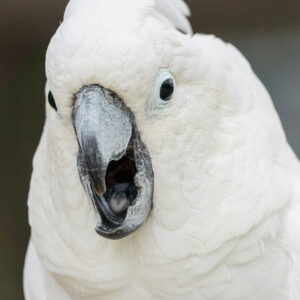
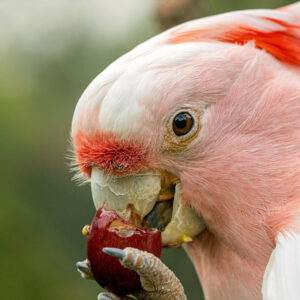
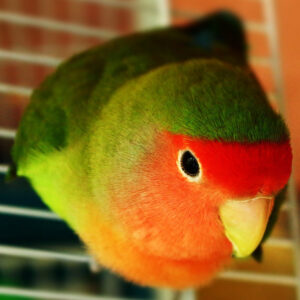
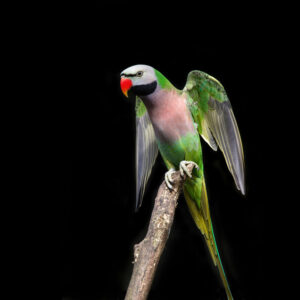
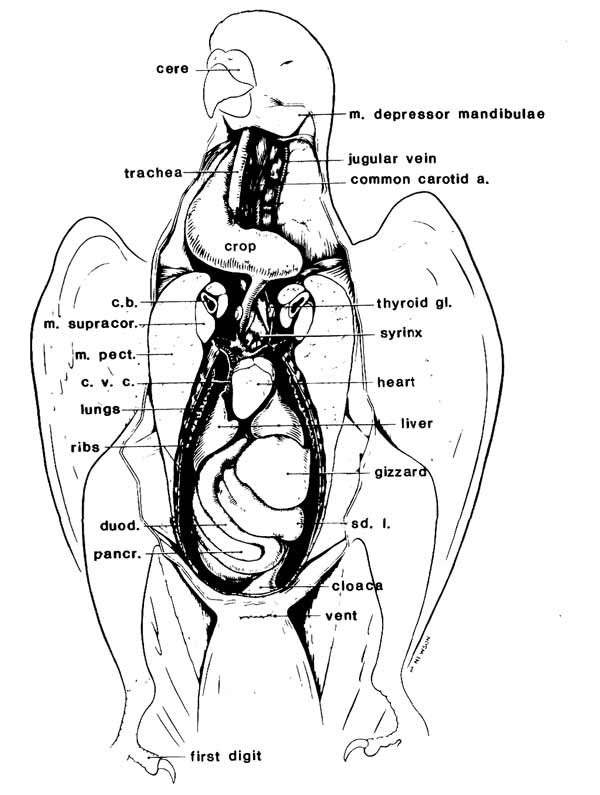
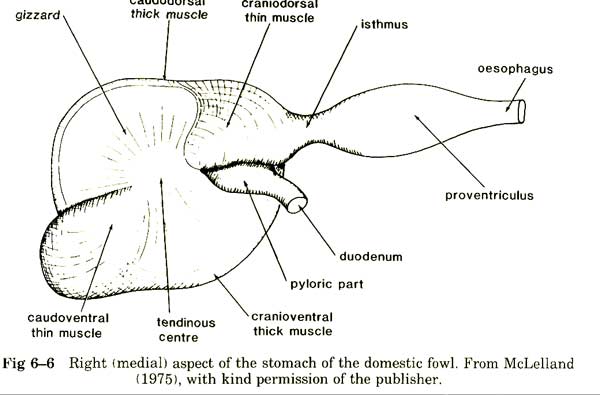
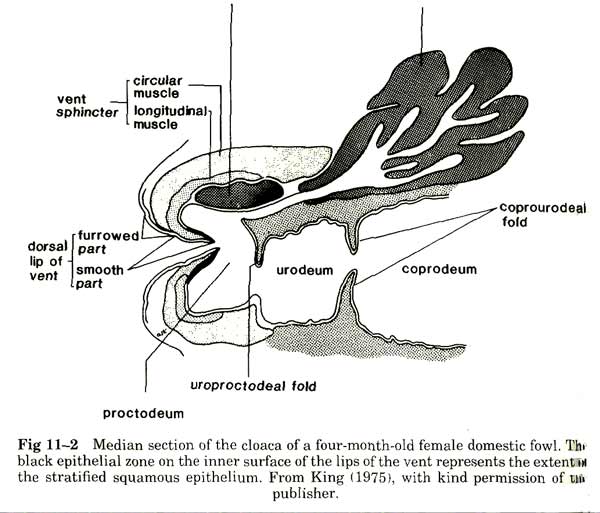
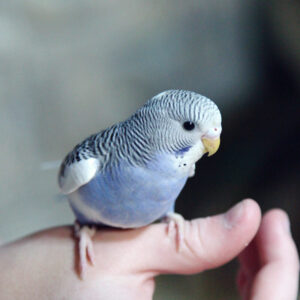
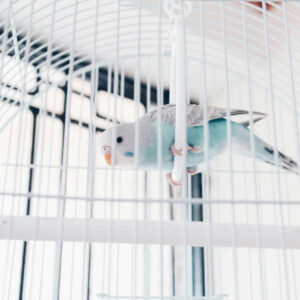
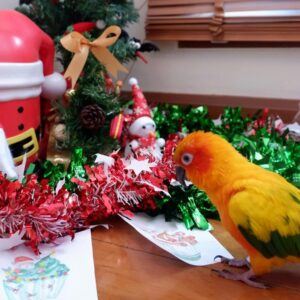
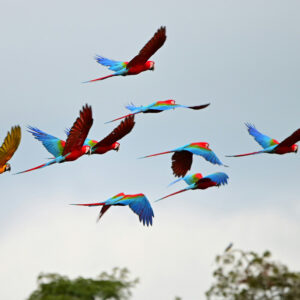
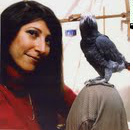
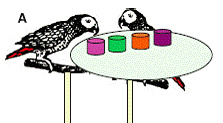 Clearly, if the birds figured out the system, they’d realize that if they cooperated and each chose green, they’d be rewarded all the time. We also added a little twist: We let Griffin, the dominant bird, choose first on half the trials, and let Arthur choose first on the other half to see if that made a difference. We ran the experiment for a long time — 500 choices for each bird — to see if their behavior might change over time and if they would learn to work together. The results were quite interesting.